The Benefits of Photography


A recent study in the Journal of Personality and Social Psychology found that “Taking photos enhances the enjoyment of positive experiences across a range of contexts and methodologies.” Among the 2000 individuals studied, those who took photos generally derived more enjoyment from a positive experience—such as a family outing or travel—than those who did not.

Researchers in the study observed that taking photos “directs greater visual attention to aspects (italics mine) of the experience….” Certainly. With cameras in our hands we’re in hunter-gatherer mode. The brain switches from general observation where we’re looking, to specific considerations of a subject where we’re perceiving—seeing in the sense of trying to understand and better relate to what we’re seeing.

The capacity that a camera provides is not only the ability to capture an image and share it—which alone is pleasurable—it also expands the ability to see, imagine, understand and appreciate. And because photos capture a moment in time, we can study the content more closely—as in these contemplations—and revisit the images as historical documents.

There are those who argue that seeing the world through a camera lens is a step removed from direct experience. Indeed, that would be a problem if the viewfinder provided the sole means of observation. But it doesn’t.

We use cameras selectively. When something attracts our attention, we want to explore it further, hold onto it, share it or engage it creatively. There are many different reasons for taking pictures, but almost always the desire is prompted by an attraction. Whether or not we are aware of it, we create images as a response to love, the energy of attraction.

Obviously, a photo of a peony is not a peony. It is, however, a representation that provides a different kind of experience. The odor and movement of the flower are missing and the colors may be somewhat different, but its image—on paper or on a screen—generates the experience of beauty nonetheless. It touches the aesthetic “nerve.” And there are differences in consequences. Experiencing a flower directly can be exquisite, but it’s also momentary. We take in the colors and odor, marvel at its very being, comment on its beauty and condition and so on.

One step removed, a painting or photograph of that flower evokes the experience of beauty, perhaps not as poignantly, but now it includes insight into and a reflection of the person who made the reproduction. Attention shifts back and forth between the object and the image maker. Is the reproduction a faithful rendering or an attempt at impressionism? It is a unique or interesting interpretation? Does it resemble images made by notable painters or photographers? Why did the artist choose this perspective and these colors? What was he “saying,” given the choices he made? And so on. In this way, the act of photographing expands both the artist’s perception and her awareness of self and subject matter.

I discovered photography in 1955 by joining my high school Camera Club. It was the only extra curricular on the list that appealed to me.

Some months later, just moments after this picture was taken, I was adjusting the focus knob on the enlarger and knew for certain that, whatever else would happen in my life, photography would play a prominent role. At that time and for decades later, the bright lights in photography were those who made and exhibited pristine photographs. When I met Ansel Adams at RIT in 1963 he’d just published a book but was relatively unknown.

Technically and aesthetically his 16×20 prints amazed us. He set the bar impossibly high, given the technologies of the day. Other photographers who gained prominence before and after him were  those who could achieve high levels of technical and pictorial quality. Photo historians regarded them as “masters.” And rightly so. Their preferences in subject matter tended toward land and cityscapes, architecture and nudes.

Cameras with more features and better lenses, paralleled by improved color quality ushered in the Modern Period where the preference was for big, colorful and beautiful images that evoked a Wow! response. Following this movement and into the present, the preferences of Post-Modern photographers were more on the bizarre with a preponderance of social commentary, favoring documentation over aesthetics.

Until recently, photographic excellence required a lengthy and technical learning curve. With the advent of digital technology that is no longer the case. A child with a smart phone can produce equal or better technical quality than an expensive film camera.

I make a distinction between “taking pictures” and “making images.” Clearly, the study cited above focused on the former—recording subjects and events for the delight of sharing.

Taking pictures does, in fact, “heightens the enjoyment of an experience” through focused attention and increased engagement. But in terms of camera use, even by the general public, enjoyment is just the tip of the proverbial iceberg. The act of making images can be and do so much more—as I hope this blog has demonstrated. The making and contemplation of images and photographs—images on a paper substrate—for the purpose of exploration and creative expression can contribute substantially to personal growth, Self and social awareness and spiritual enrichment.

Don’t take my word for it. Take your camera out for a whirl. Go somewhere you’ve never been before with the intention of capturing images that convey the spirit of the place. Print the images that work best for you and sit with them in silence to see if there is one, or a combination of images, that evoke consideration—thoughts or feelings about life, living, yourself or the world. What in particular do the images say about you and your preferences for subject matter and composition?

Keep in mind that finding information in a photograph is not a matter of identifying objects, but rather in finding meaningful patterned relationships between you and the world as you see and experience it. Notice subtle feelings as you contemplate your images. They are a reflection, in truth a representation of your consciousness! Ask if they were successful in expressing the spirit of the place. If so, what were the contributing factors? If not what would you do differently in order to make the images more expressive—to yourself and others? Ultimately, immersion into any creative process is a journey into Self. Like any other tool, a camera can be used in many different ways. Whether we’re talking about hammers, computers or cameras what matters is how we choose to use them.

Once it has selected a photographer, spirit always stands still long enough to be recorded.

Anonymous

Photography brings what is not visible to the surface. I continue on my way seeking my own truth ever affirming today. When I photograph, I make love. Photography is my passion; the search for truth my obsession.

Alfred Stieglitz

I have always felt that is is how one sees rather than what one sees that makes any photograph interesting.

Michael A. Smith

What is it that I feel most deeply about in life? Are these feelings coming through in my images? What is the subject matter I relate to the most intimately and profoundly? What is it that I see that no one else does, that only I can show the world?

Robert Hecht

The mission of photography is to explain man to man and each man to himself.

Edward Steichen

ABOUT THE PHOTOGRAPHS

The posy was growing in Linda’s garden and I photographed it there. The image of myself in the darkroom was taken by another student, Charlie Keyes. We were constant companions most days after school, printing the photographs we’d taken for the yearbook. Many years later I published a Blurb book entitled “Milestones,” to tell the story of my life in photography, illustrated with photographs that marked milestones in my development. The book begins with a picture of my mother and me next to my first birthday cake and my one gift—a Kodak Brownie.

You can connect to my PORTFOLIO SITE here.
Web Site Announcement


I’ve been working on a portfolio web site for quite some time. Now that it’s on-line I am delighted to share it with you. The purpose of the site is primarily to gain more exposure for my work. There are many images, so you might want to bookmark the site and review it a bit at a time.

Because I believe that beautiful images can contribute to healing, I am also interested in having them find a home on the walls of hospitals, nursing homes, hospice centers, certain non-profit organizations, socially responsible corporations and interior design firms who serve these entities.

Toward that end I will be sending 5×7 photographs to those in charge of interior design in these facilities. The front side will have the above image on it, and the back will have the site’s address. If you would like to receive one of these, perhaps to use as a bookmark—or have me send one to someone you know—just make a request via email <smithdl@cinci.rr.com>. I hope you enjoy the photographs.

www.DavidLSmithPhotography.com


Publication Of “Contemplative Photography”

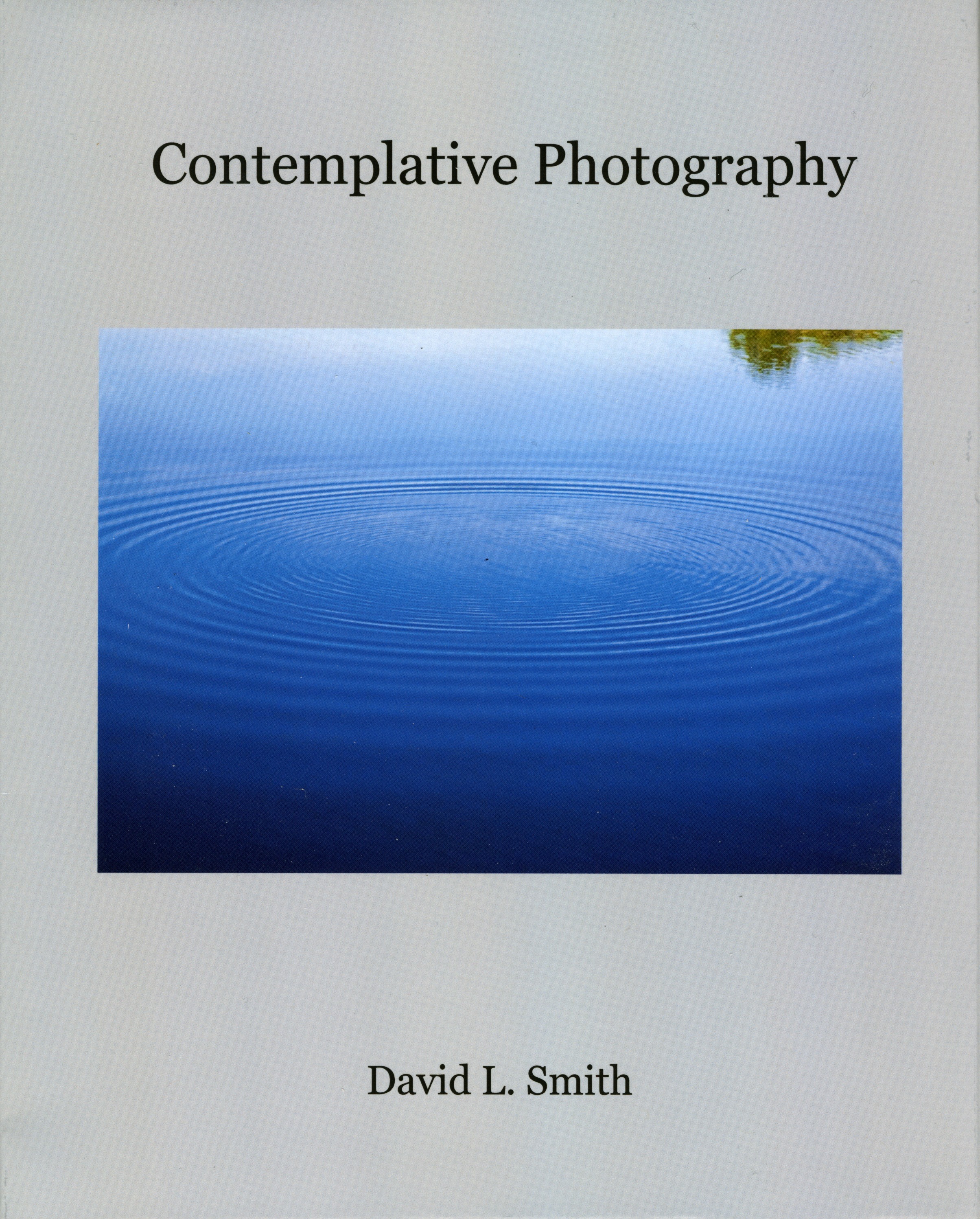
Contemplative Photography: Reflecting On Photographs is a compilation of images and related texts derived from my weekly blog postings. This and my other photography books can be previewed page by page by going to the links below. When I was getting started in photography the quality of printed books was generally very poor. The only way to experience high quality photographs was to attend an exhibition of original gelatin-silver prints. No longer. The quality of inkjet prints has been excellent for several years.

Now the quality of black and white inkjet printing has caught up. Since archival tests have shown these prints to hold up for close to one hundred years—if kept in a light-tight, low humidity box—many, perhaps most, notable photographers have abandoned the film and wet process, particularly since  galleries are increasingly selling digital inkjet prints. At a conference of photo gallery owners in New York I attended a few years back, color inkjet prints were selling alongside gelatin-silver for thousands of dollars. Black and white inkjet prints were just beginning to sell, but at much reduced prices. That too has changed. Some photographers and dealers are saying the quality of an inkjet print can be better than a silver-gelatin print.

One of the consequences of advances in digital imaging and printing technologies has been a substantial reduction in the number of photographic exhibitions—outside of the five largest cities in the United States. Work is still exhibited at outdoor fairs and certain city-wide celebrations of photography, but the traditional exhibition by a single photographer is rare. They are costly to produce, launch and promote. There are time restrictions and sales by non-celebrity photographers barely cover the cost. The publication of photography books by unknown photographers—or those without a gimmick or sensational content—has for years been virtually impossible. This is understandable, considering the publishing industry’s struggle for economic survival in the digital age.

On the upside, photographers of all stripes can reasonably and cheaply self-publish high quality books. While not achieving a large national audience, these books appeal to collectors and people who appreciate fine photography. They make great gifts. The photographer designs every aspect of the formatting and printing. And promotion and sales are handled by a third party. Beyond the prestige factor, the reasons not to self-publish is the small audience and lack of profitability.

In such a climate artists need to  examine their purpose. Why do I photograph? To make money? Communicate? Become known? Make a contribution to the field? Or simply have the work seen? Equally important—For whom am I producing this work? Where does my satisfaction lie? My response to the question of purpose flows from the discovery early on that I was compelled to photograph. I would do it, even if there was a certainty that not one person would ever see what I produced. Simply put, I love the world and photography is the best way I can express that love.

My intention has never been to document or comment. Neither did I intend to make money or gain notoriety as a photographer. I just wanted to express the feelings of love and awe that begin with observing the subject and extend throughout the process, even to the signing of the finished print. I always wanted to my work to be seen—in the hope that some of what I felt could be shared, if even just a little. If my prints could talk, I’d want them to be a statement about the blessedness of Being.

Toward these ends, self-publishing has been a blessing for me. This is my twelfth photography book. I’m very pleased with the quality of the printing. And I invite you to give it look. On the Blurb website, click on the book’s cover. When the page opens, click the “Preview” tab, then select “Dust Jacket” and click on the book again to turn the pages. The book(s) can be enlarged to full screen by clicking on the double, out-pointing arrows above the book. I’ve allowed that every page can be previewed. And the text is readable at the enlarged size.

Here is where you will find all twelve of my photography books.

Here is where you will find “Contemplative Photography” alone.


Aesthetic Preferences

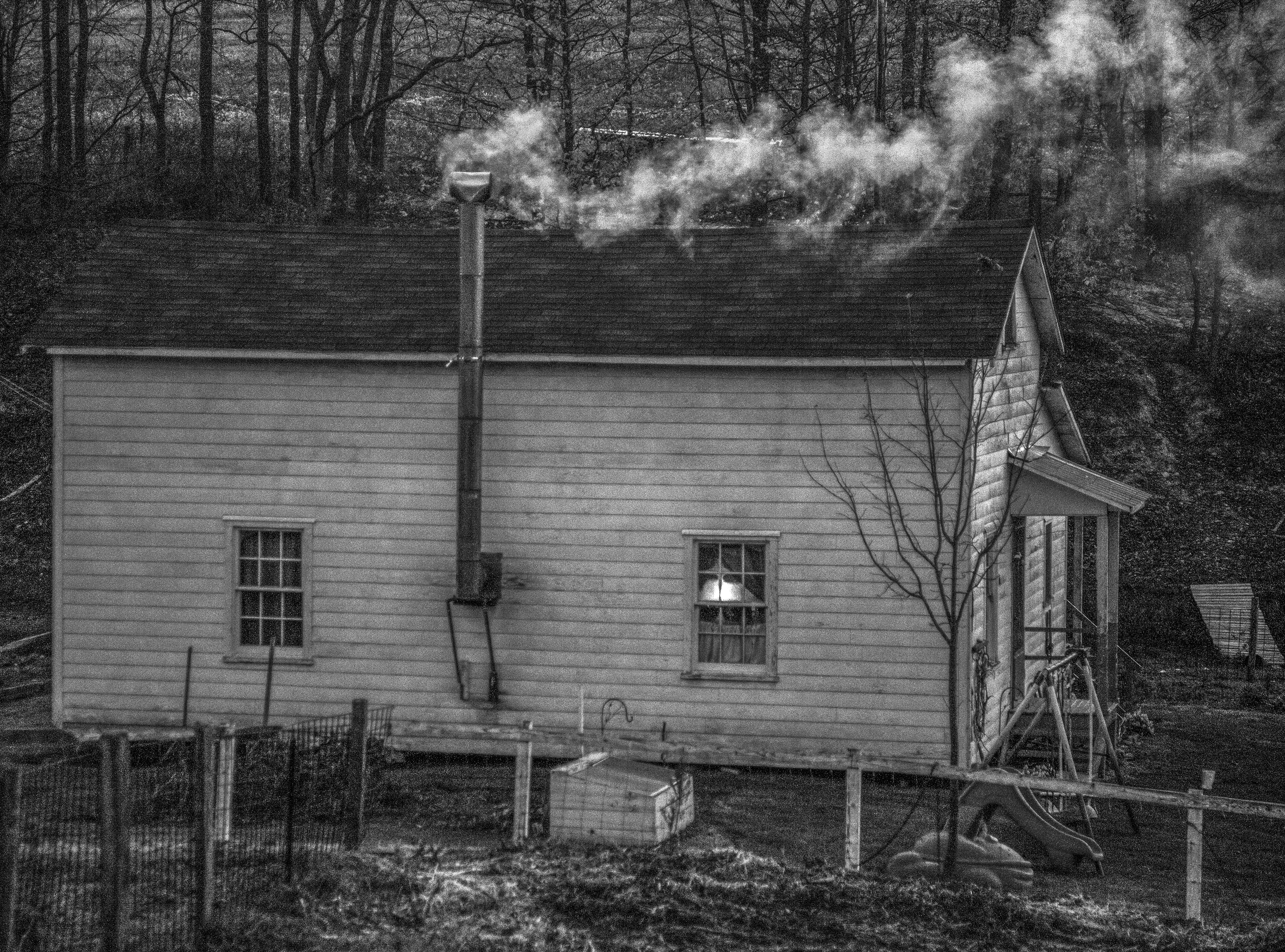
This haunting little image was made before sunrise on a cold October morning. I was cruising the back roads in the hills of Amish country in mid-state Ohio, when I saw an orange light in the window and a whisp of smoke—not much else—as can be seen in the color image below. That original was tack sharp and very underexposed. When I saw the smoke I wondered if there was some gradation there, so I made a duplicate and converted it to black and white in Photoshop.

After teasing out some detail in the elements surrounding the house and boosting the exposure level I noticed that I preferred the black and white image, despite the appeal of the orange light in the window cutting through the overall blue atmosphere. The increased camera sensitivity and exposure boost in the black and white image resulted in a lot of “noise.” The graininess is very apparent when it’s enlarged even a little. Viewed at this size however, the black and white  appealed to my aesthetic, more so than the color image. You may disagree.

It raised a question in me. Considering that the  light in the window is what captured my attention on location, why do I now prefer the black and white image? As I was reviewing my black and white collection for possible images to contemplate this week, I stopped on this one and kept staring at it. I liked it but didn’t know why, and a theme wasn’t coming to mind. The nature of contemplation is precisely to hold the attention on something long enough that an insight can emerge. So I stayed with it, kept looking and asking that question.

I noticed that themes having to do with the occupants of the house, their economic situation or the Amish way of life didn’t appeal. Those weren’t tracks I wanted to explore. Looking at the images side-by-side, I realized that what captured and held my attention—made me stop to engage heart as well as mind—was the aesthetics involved. While the original image benefitted from simple color contrast—orange against deep blue—the black and white image had some “tooth” to it, expressed in the wispy tail of smoke, the woodland textures and fence, the swing set and slide, the light in the window and the hint of daylight on the front of the house.

Combined, these elements evoked in me the sensibility of “early morning” rather than the “middle of the night.” I usually prefer image simplicity, as few elements as possible to create impact. But here’s an instance where complexity—more information—shifted the statement from “Here’s a house where everyone’s asleep and the light was left on,” to “Someone in the family is up early, warming the house, preparing for the day.” In the color image there’s a light in the window. In the black and white image the light is in a person or family. There’s a sense of caring that comes across. Arguably, that’s one of the qualities that makes a “house” a “home.” Of course, the reality could be very different from the one imagined here, but the prerogative of the image maker is to express his or her personal preferences—a unique way of seeing.


In the dark we will always seek the light; that is the real bottom line.

Deepak Chopra
ABOUT THIS IMAGE

Title: Light In A Window / Smoking Chimney

Location: Baltic, OH (Amish Area)

Before I rolled down the window to take the shot I turned the car’s dome light on so I could see to crank the camera’s sensitivity (ISO) setting to increase the chances of actually recording something. I turned off the engine to eliminate vibration, braced myself and the camera for the slow shutter speed, made the exposure, closed the window and drove off hoping I could “fix it in post.”

An Appreciation Of Being

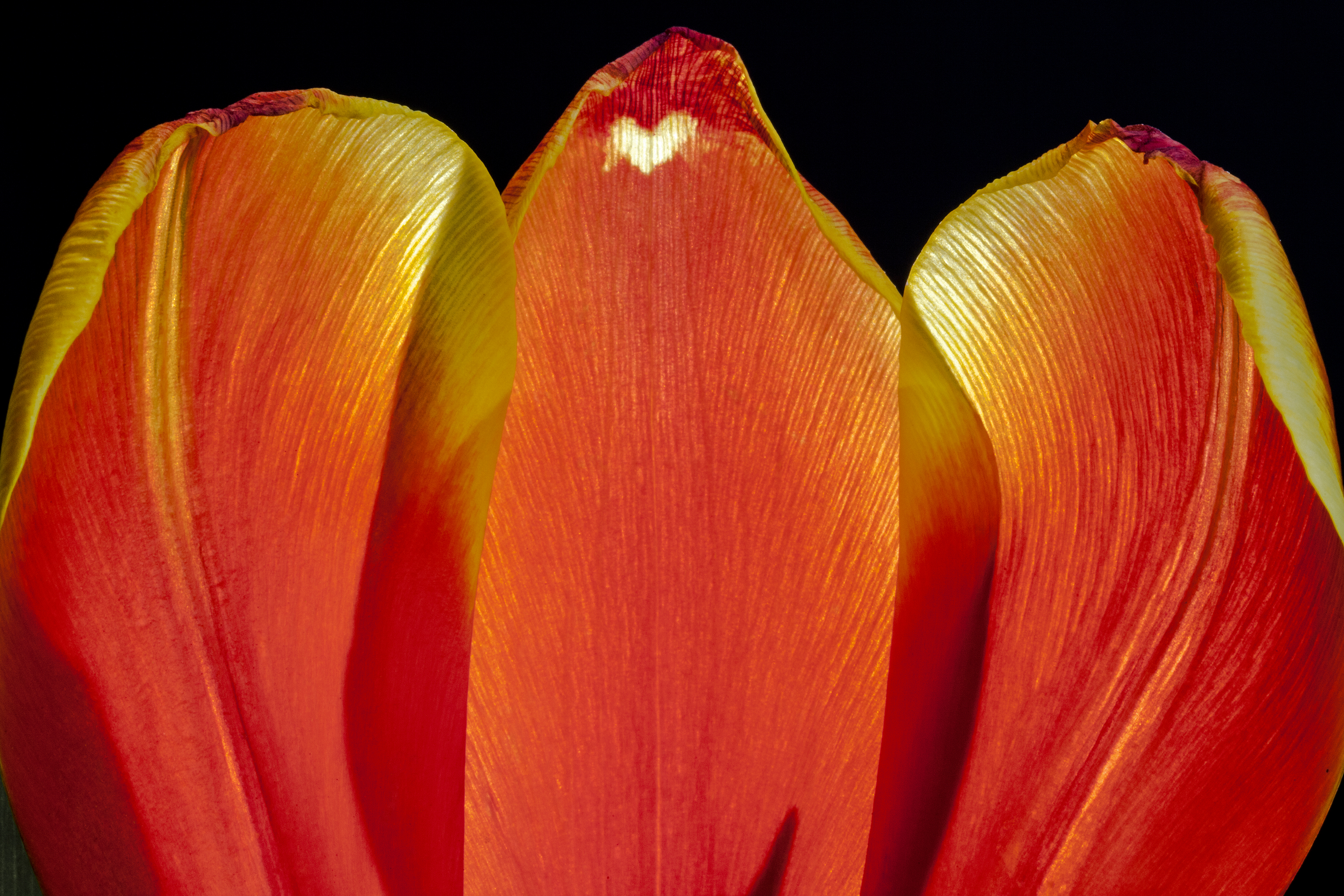
I was surprised to learn that tulips are originally from Persia. They were brought to the Netherlands in the 17th century. The name comes from the word turban or “taliban,” the wraparound headdress worn by many Middle Eastern people. In Latin, it translates to “tulipa.” The flowers pictured here are a hybrid known as “World’s Favorite.” Linda planted the bulbs in the Fall, and when they came up in early April, she and I were stunned by their beauty. The picture in the catalog she purchased them from didn’t do justice to the reality. I couldn’t go past our kitchen window without looking out to admire them. One morning when the sun raked across the crimson and yellow heads with the leaves not yet fully illuminated I planned to photograph them the next day. I sat on a cushion to get the low angle but it was worth it.

When the tulips matured, Linda put one of them in a vase and set it in the living room. Seeing the striations and yellow “feathering” up close, I had to take it into the studio to get some feature shots.


In meditations the mind attempts to focus on a point—a mantra or the breath. Contemplations focus the attention on a theme that’s allowed to unfold or develop. Both are mental exercises. There are some instances however, when words are inadequate, even get in the way. I wanted to use the tulip images for this blog, but when I thought of some themes none felt right. Rather than evoking thoughts, the images evoked feelings—mostly a stream of Wow’s! When that happens—typically in the presence of awesome natural beauty—I purposefully relinquish words and downshift from “head” to “heart” mode. To affect this shift I use the little phrase “I rest now in the silent truth of Being.” Without words that typically identify, describe or analyze, the heart seems to envelop the subject and be fully present with it—like a loving hug of appreciation. So I offer these images, less as a contemplation and more as an invitation to appreciate the Beingness represented here. Gratitude as well for their beauty and the gift of photography as a medium for sharing that this magnificent being up close.

The white heart on the above petal was actually there. I didn’t notice it until I looked closely to see how I wanted to photograph these petals. Those in front had dropped off.

A little research later on turned up the fact that florists consider tulips to generally symbolize fame and perfect love. “Fame?”

  • Red tulips mean “believe me” and are a declaration of true love.
  • Variegated tulips mean “you have beautiful eyes.”
  • Yellow tulips mean “there’s sunshine in your smile” and cheerful thoughts.
  • Cream colored tulips mean “I will love you forever.”
  • White tulips symbolize heaven, newness and purity.
  • Purple tulips symbolize royalty.
  • Pink tulips mean affection and caring. 
  • Orange tulips mean energy, enthusiasm, desire, and passion.

There is nothing to seek and find, for there is nothing lost. Relax and watch the ‘I am.’ Reality is just behind it. Keep quiet, keep silent; it will emerge or, rather, it will take you in.

Sri Nisargadatta Maharaja

“Jaguar Sun”

Announcing the publication of Jaguar Sun — my third novel in the series, The Path Of The Jaguar

In 1967, the year we were married, Linda took me to San Ignacio, Cayo in Belize where she had taught English for over a year. It had been a profound experience for her. And it was for me. We arrived late at night to stay with her dear friend and family. Being a city kid I was freaked by the biggest roach I’d ever seen—in my bed. Then when the fluttering overhead in the “bathroom” turned out to be a bat, I wanted out. Phone service and transportation were minimal and on a schedule, so I was stuck for at least another day.

The next morning I awoke to the sights and sounds of a lush jungle. After photographing the dripping wet greenery, parrots and clapboard houses I was hooked. Days later, while riding an open jeep over a pitted dirt road I asked about a tall bump on the horizon. Linda explained that it was a Maya ruin. I’d never heard that word, so she explained that the area was once home to an ancient civilization. I thought nothing of it. Later, back home in Cincinnati, I was in the library and a title caught my eye—The Ancient Maya by Sylvanus Morley. Reading it ignited a spark that led to a deep immersion into the subject.

For thirty-one years I read every book and scholarly paper I could get my hands on. I fed hundreds of dimes into copy machines, took courses in anthropology, archaeology and primitive religion to name a few. I attended archaeological symposiums, corresponded with scholars and visited Maya museums and sites—all the while wondering why. I knew I didn’t want to make a scholarly contribution to the field. And I wasn’t particularly interested in making a documentary film about the Maya. So why was I devoting so much time, energy and money and building a series of image and information databases? The answer came on the night of August 2nd in 1998. Around midnight I had the idea for a series of stories. It came to me so clearly that I got up and wrote until eight in the morning. Long story short, that same day I told Linda I was going to learn how to write a novel. I didn’t entertain the prospect of publishing, I just wanted write the stories that came to me. Thus was born the idea for a series of novels entitled The Path Of The Jaguar. From the outset I was determined to make each story historically accurate, plausible and an immersive read.

Up until then I hadn’t realized that prolonged and focused study of history can result in an immersion into its times, people and places. As I read, I was easily transported into the mentality, lifestyles, rituals and environments of the ancient Maya. In order for the stories to carry the impact of direct experience, I needed a context that would justify a first person point of view. I found it in the theory of reincarnation. What if my narrator—not myself—had the capability of recalling past life experiences? And what if he or she was able to write them down in a continuous stream of detailed remembrances?

Each story is narrated by the same person recollecting the challenging and growthful experiences of three different lifetimes, male and female personalities, within the context and background of major events in Maya history. By combining historical characters, their perception of the cosmos and it’s representation in ritual, with the everyday lifestyles of commoners and tradesmen in a rich jungle environment dotted with scores of cities and villages, I hoped to immerse readers in the realities of Central America between 35 B.C.E. and 700 C.E. The series title derives from a convergence between a common phrase, “the path of the soul” and the significance of the jaguar in Maya mythology. The word “jaguar” in the title of the series and in the novels is a reference to the soul. The Maya called it ch’ulel. So in essence, the stories depict the journey of a single soul—the narrator—through three incarnations. Although there is a natural progression featuring soul initiations, the stories can stand alone.

Book One: Jaguar Rising: A novel of the Preclassic Maya 

It took me twelve years and fifteen drafts to complete this story. Currently I am revising it in order to reduce the extensive use of Maya vocabulary. (Readers were too often consulting the glossary). The revised edition will become available in the Fall of this year. If interested, I recommend waiting. I will post an announcement.

35 B.C.E. By this time Maya civilization was already flourishing in the jungles of Mexico, Belize and Guatemala. K’akich B’alam, “Fire Eyes Jaguar,” is a young man who, on the threshold of manhood, learns that the long-distance merchant who raised him is not his father. Rather, his blood father is the ruler of large city far to the south. While the youth’s prophecy at birth said he would “rule as a powerful warrior,” his heart is set on apprenticing to his uncles who are builders and painters. It’s a tug of war between the demands of society and his passion to paint murals. K’akich  engages this struggle at a time when charismatic rulers and innovators were building cities and giving form to their ideology in art, architecture and religious spectacle.

Book Two: Jaguar Wind And Waves: A novel of the Early Classic Maya

378 C.E. Lady Jaguar Claw, daughter of the Tikal ruler, fulfills her father’s promise to the lords of Teotihuacan by marrying one of their sons. Her husband of seven years has been chartered to deliver a prophecy and establish a new order throughout the lowland jungles with Tikal as his base of operations. Battered by wave upon wave of emotional turmoil created by her husband and his enforcer, Lady Jaguar descends into an abyss of depression and despair. Suffering from soul-loss, she looses herself. The light has gone out of her. She sits and stares out the doorway watching the rain. A shaman tries to help, but the smoke surrounding her heart, continuously fed by the fires of anger, bitterness and guilt resist treatment. Her birth prophecy foretold that she would battle a mighty demon amidst “powerful winds and waves.” This is the story of that battle and her rise from the abyss.

Book Three: Jaguar Sun: The journey of an Ancient Maya storyteller

695 C.E. It was a time when the nature of warfare changed dramatically in the jungle cities. Where before, rulers raided neighboring kingdoms to capture members of ruling families for blood sacrifice to sustain the sun god, they are now conducting large-scale raids and forced migrations to acquire men, women and children to bolster their armies and increase the labor force for building projects. A climate of fear has gripped the lowland cities. Seeking entertainment and distraction, people gather around storytellers in great numbers, eager for true and made-up stories about raids and valiant warriors. Seeing the faces of misery, fear and hopelessness in the places he visits, Raised Up Heron—an aspiring storyteller—presents stories intended to inspire hope, courage and self-determination. He attracts very few listeners. Surrounded by the clash of cities, the protagonist confronts battles that rage within. How could he draw crowds in the big cities like other storytellers? Is that even desirable? Must he be satisfied telling his kind of stories in the marketplaces of small villages? Could there be a rightful place for him? To answer these questions he must first discover his deeper identity and purpose.

Night

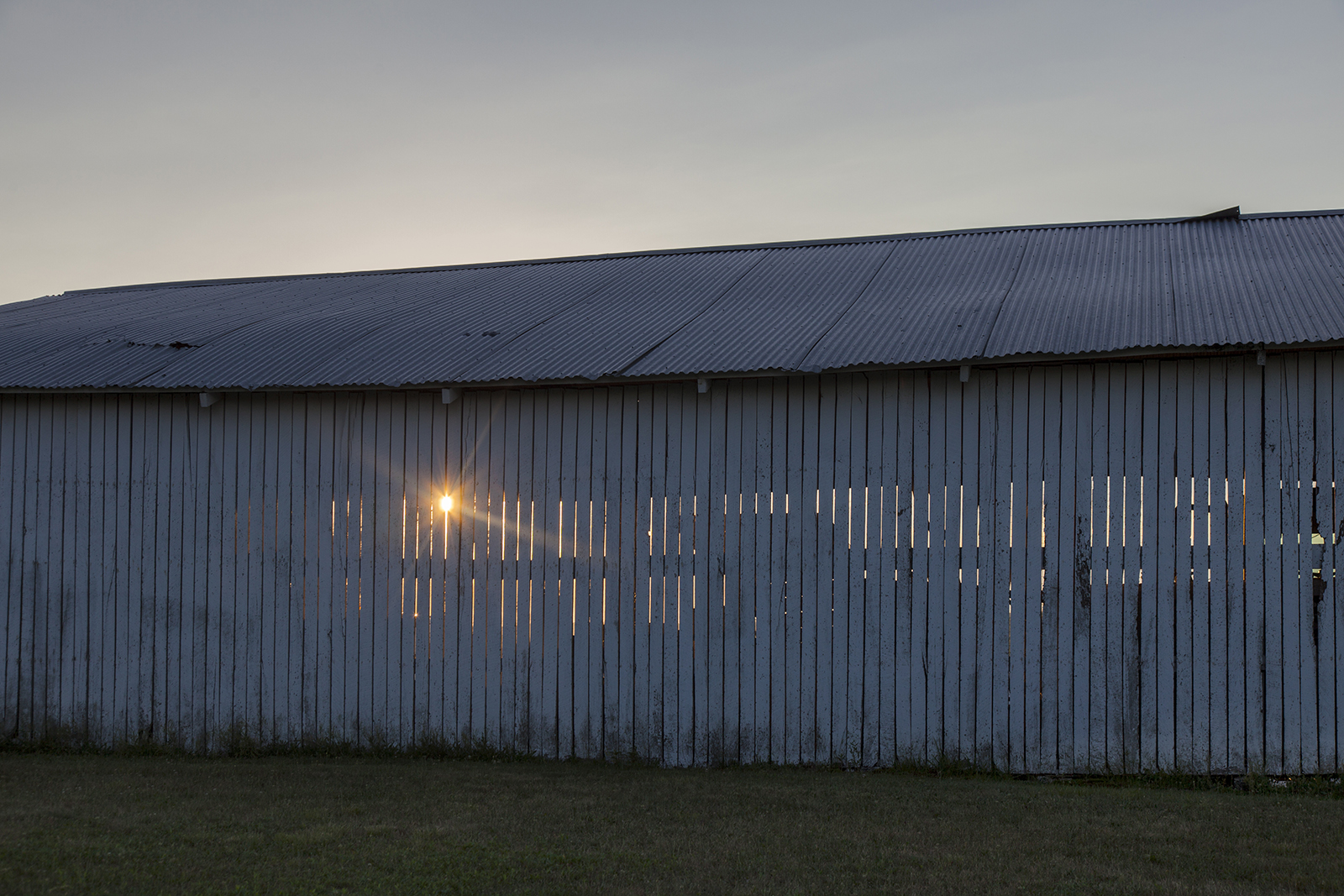
Night is an ideal time to photograph in black and white because darkness hides all but the upper register of whites on the tonal scale. In any given scene, with only the strongest highlights creating lines and shaded areas, geometries become apparent that are barely noticed in the light of day. This image of a metal barn roof shows how the suppression of detail results in simplicity. Attention becomes focused and the sensibilities of atmosphere and mystery are enhanced, inspiring poets, songwriters and others to write about night, moonlight and stars.

A principle of visual aesthetics suggests that there is “mystery” in the shadows. Indeed, the subconscious wants to penetrate the dark areas, to see what’s there. The more information we can glean from an image, the more we can make sense of it. By hiding detail in deep shadows, impression supersedes information. So, in photographs taken at night there’s a subtle pleasure in the searching, if even for a moment, followed by an acceptance that it’s okay to assume or not know the details. In allowing, there’s a release of tension, a kind of satisfaction.

There are still some places in the world where the night sky is so bright it takes your breath away. I had that experience at Tikal in the Guatemalan jungle a few years back. The lodging facility turned off their generators at 10 o’clock to conserve on fuel, and by eleven o’clock the kerosene lamps in the cabins were all out. It had been raining hard all evening. I awoke around 2 AM and it sounded like the rain had stopped. I turned on my penlight and poked my head out the door to see what the conditions were like. Now I’ve worked in darkrooms all my adult life, but I’d never experienced such stark blackness. It actually startled me. It was hard to believe. I walked about ten paces from the doorway, shining the light on pavers, careful not to step on a scorpion.

When I turned the light out I couldn’t see my hand in front of my face. And then I looked up. I’d never seen very much of the Milky Way, but now in spite of high clouds, it stood out brilliantly, a tremendous arc of stars above the dripping canopy. There was no moon, but after about ten minutes my eyes became accustomed to the starlight and I began to see quite a bit of detail in the jungle.

I knew that the night sky played a principle role in the development of the ancient Maya’s cosmology and calendar, but it wasn’t until I saw it for myself that I understood why. They observed and recorded the movement of the stars and planets for over a thousand years. For me, one night was all it took to feel the cosmic immensity and awesomeness. It felt like I was literally riding a planet.

Night, the beloved. Night, when words fade and things come alive. When the destructive analysis of day is done, and all that is truly important becomes whole and sound again. When man reassembles his fragmentary self and grows with the calm of a tree.

Antoine de Saint-Exupéry

There is something haunting in the light of the moon; it has all the dispassionateness of a disembodied soul, and something of its inconceivable mystery.

Joseph Conrad

No sight is more provocative of awe than is the night sky.

Llewelyn Powys
ABOUT THE BARN ROOF IMAGE

Title: Barn By Moonlight

File: 945

Location: Waynesville, OH

I’d spent the day photographing with film cameras and, because the sun had gone down, was driving toward home when I saw this barn lit by  moonlight. There wasn’t enough light to hand-hold the smaller camera, so I got out the 4×5 view camera. In the time it took to fix the camera to the tripod and open the shutter, the highlights on the roof of the barn had diminished because the moon had moved. Even with my head under the dark cloth I could barely see enough of the barn’s roof to focus.

So I repositioned the camera to anticipate the point at which the roof would be fully illuminated, set the focus on infinity and stopped down to get some depth of field. One thing great about photographing by moonlight is that on a clear night the luminance doesn’t change. Also, it’s very diffuse—part of the reason for the lyrics “Moonlight becomes you…” I made a time exposure, probably around two minutes, pleased that the movement of the faint clouds would blur slightly. For me, the image is one of my top five night shots.

A special “Thank you!” here to Paul Kennedy, my  friend and roommate at RIT, for requesting this theme. He and I camped out on the beach at Lake Ontario one night to take the following image of star trails. I believe the time exposure was around two-to-three hours.


What Lifts Us Up?


Spring came early this year. The crocuses and daffodils are already in full bloom. Having made the above image last week I thought about using it here because daffodils represent rebirth. This being the Easter season I thought that “resurrection”  might be an appropriate theme, but then I learned that strictly speaking, the word refers to an individual being raised from the dead. In the case of Jesus—who was one among many who were reported to ascend from the dead in a variety of cultures, worldwide—the language of the scriptures specified that he was “lifted up.” Those two words resonated because I’d researched the subject of what lifts us up—individually and collectively—in great detail as part of my process of designing programs for a Human Development Channel (working title), a cable television offering that didn’t materialize due to a lack of financing. (We needed 70 million dollars). So I raise the question now—What are the things that lift us up? What are the experiences that inspire and encourage us to do better and be better?

In my estimation spiritual development is primary. I believe the still small voice within—“conscience,” “soul,” or by whatever name we call it, carries the weight of truth urging us to live according to our higher and true nature. So anything that encourages or helps me to listen to and deepen the connection to that voice will  lift me up. It’s said, and I have found it to be true, that the answers to all our questions can be found within. In silence. I’ve also found that answers to questions presented at that level provide wisdom and direction rather than advice or problem solving. In this regard I have been uplifted by the very process of observing how wisdom, sourced in this manner, works things out.

Socially

The external experiences that lift us up spiral out from personal to universal. To begin with, I regard moments of joy as validations, indications that the idea or activity that gives rise to it is in alignment with my life’s purpose. Because joy lifts us up it encourages replication, and with each experience of joy we gain more confidence that we’re on the right track—living authentically.

Moving out from center are our closest relationships. In this arena we’re uplifted by expressions of love, demonstrations of genuine interest, partnership, helping, caring and sharing. Perhaps because these relationships are so familiar and easily taken for granted, a sincere casual compliment that takes five seconds can be more uplifting to a parent, child, spouse or significant other than a day-long celebration with cake and party hats. With my father all it took was a wink—to let me know that he approved or understood. Approval lifts us up. So also the goodness we find in other people. I have a theory about it—that seeing goodness in a person is the first spark of falling in love.

Beyond close relationships are members of the extended family, friends, colleagues, teachers, students, professionals and others we interact with fairly regularly because of circumstances, common interests or goals. In this circle we are generally uplifted by their attention, interest and acknowledgement. In my experience the interactions that lifted me up the most were those where, because of a shared resonance, we engaged in subjects that transcended the concerns of everyday living. Even more uplifting to me was simply being with and observing people in this circle who demonstrated small—and at times large—acts of courage, integrity and ethics. I think we are all uplifted by people who “walk the talk.” And of course it works both ways. I have the opportunity to uplift others by being fully present with them, by offering support and acknowledgement, by engaging them in our quest for meaning and possibility, by exploring the depth of their knowledge, experience and wisdom and by living with integrity.

The circle of people we don’t know but come into contact with is large, variable and expanding. Included in this circle could be certain neighbors, service providers, sales people, health professionals, teachers, politicians, police officers, firemen, clerics… These people can inspire and uplift us by being kind, patient and having a positive attitude—as well as being knowledgeable and competent. In privileged societies such as ours, these qualities of temperament and consciousness stand out against the background of people who are not happy at home, at work or in a relationship. Attitudes are contagious. So when a waitress looks me in the eye, wants to listen rather than talk, hangs back rather than interrupt a conversation, gets everything right and displays a pleasant-to-cheerful attitude, she lifts me up by demonstrating that there are competent and happy people in the world. And there is reason to be happy! Actually, I consider these people to be an antidote to weltshmertz (pronounced “velt-schmertz”), a German word referring to the feeling of sadness for the world.

Widening this circle to include people we might see but are not likely to come into contact with, are media and movie celebrities, higher level politicians, certain business owners and executives, administrators, sports figures, scientists, musicians and artists to name a few. These people lift us up by their performances, demonstrations of excellence and accomplishment. By expanding the range of human knowledge or capability, by getting us caught up in the brilliance or excitement of their performance, they encourage higher aspiration and the setting of more challenging goals for ourselves. In the field of entertainment the message of the Oscars and other award programs is—“Hold onto your dream! This could be you some day.” In sports and many other fields the admonition is similar: “What one of us can do, others can do.” At a grander but perhaps less appreciated scale, we are individually and collectively uplifted when any member of the species realizes his or her higher potential.

Experientially

There are performances that, in themselves, lift us up. It’s difficult to generalize because of individual preference, but it’s clear that music can have a profound affect. Certain musical instruments and voices can seem to lift us off the floor. I had this experience late one night while listening to a man literally sending sounds from a treble flute into the hollow—and hallowed—space of the Lincoln Memorial. It was a celebration of resonation and reverberation that I’ll never forget. Each singular tone that emanated from his flute and was allowed to fade out sent tingles up my spine. And it kept happening. More frequently uplifting for me in the arena of music are certain jazz musicians and the voices of Barbra Streisand and Andrea Bocelli.

Works of art can easily lift the spirit. Whatever the medium or technique, the artist’s mastery and vision combine to show us the world—as it was or is—through deeply attentive and subjective eyes. Seeing as others see or have seen, asks us what we see and encourages us to perceive beyond merely looking. Engaging in any creative process is especially uplifting. Whatever the medium, the quest to understand how we perceive and what is within us to express encourages a great deal of introspection and self-knowledge. And the outcome can be another source of upliftment. It’s why I designate my finest prints as “numinous.”

Television and movies can lift us up through excellence in both storytelling and production. The screenwriting of Aaron Sorkin—The West Wing, The Newsroom, The Social Network, A Few Good Men—lifts me up. So also the production excellence of certain television series’—Anne Of Green Gables, Mad About You, Gilmore Girls, Blue Bloods and Downton Abby—to name a few.

I am substantially uplifted by exposure to wisdom. Whether in the form of talks by notables such as Deepak Chopra, Wayne Dyer and Marianne Williamson, the writings of scientists, philosophers, mystics and other lovers of the world, my world is expanded. And speaking of expansion, images of the universe are another source of upliftment for me.

Ultimately, I think what lifts us up are experiences and demonstrations of what’s best and highest in us. They can be as subtle as a wink or as spectacular as the moon landing. In my vision for a cable television channel that would “respond to the authentic and higher needs, wants, interests and aspirations of viewers as well as advertisers,” the programming goals were to educate, enrich, empower, engage, inform and entertain—all experiences that lift us up.

You raise me up, so I can stand on mountains;

You raise me up to walk on stormy seas;

I am strong when I am on your shoulders;

You raise me up to more than I can be.

Lyrics by Brendan Graham, sung and popularized by Josh Groban

ABOUT THIS IMAGE

Title: Daffodil

File: DC8465

Linda often brings flowers into the house from her garden. It gives me the opportunity to work with them in the studio, particularly to accentuate their features through lighting. In one of my Lighting For Television and Film classes I suggested that students take the advice of a lyric written by Johnny Mercer. It says “You gotta accentuate the positive, eliminate the negative…” Generally speaking, that’s one of the challenges of studio lighting. I continued to reference the advice but not the song because none of the students had heard it.

Layering


Layering is how many things grow organically—from the inside out. Metaphorically, when we want to understand an object, system or process we “peel away” the layers so we can see what’s inside or what’s happening. It’s the basis for analysis, taking things apart to look “under the surface” in order to discover the “underlying truth” of whatever is being examined. Due to the onion’s obvious layering, it has become a metaphor in a variety of fields.

In “social penetration theory” interpersonal relationships develop from a relatively shallow, non-intimate level to deeper, more intimate ones. In this area psychologists Irwin Altman and Dalmas Taylor advanced the “onion theory” to illustrate how personality is like a multi-layered onion where the public Self is the outer layer and the private self resides at the core of the person. They observe that as time passes and intimacy grows with the disclosure of more personal information and shared experiences, the layers of one’s personality begin to unfold and reveal the core.

In the field of organizational development, “peeling the onion” refers to searching for  the underlying causes of breakdowns within a company’s many departments or branches. It’s a learning process that seeks more data by penetrating the layers of interaction and engagement, interpretation and meaning. Even feelings. It asks “Why?” and “What else is going on?” in order to discover the authentic needs, wants and interests of employees and clients. Perhaps most important for administrators and managers, the peeling back of their individual layers can help identify or examine their personal purpose and seek increased alignment with the corporate or company mission. The periodic process of defining and updating a company’s mission and vision statements is, in fact, a matter of peeling the onion in order to reconstruct it as a renewed and vitalized whole system.

Peeling the onion in government asks if and how the current layers of bureaucracy relate to the values and ideals of the founders. Likewise it calls religious organizations to examine whether or not  policies and practices reflect the values and example of the founder. Individually, it amounts to an examination of conscience. Am I spending my time on the layers of my life that matter most? Are they an outgrowth of my purpose? And as a person, am I growing from that core?

My Maya guide in Santiago Atitlan, Guatemala (who had a doctorate in Anthropology from Harvard University) told me that “everything and everyone in the village is seen to be at a different layer of development. You’re considered an asset to the community if you speak well in your layer. And you’re not expected to talk like or behave like someone in a higher layer. Child development, building construction, farming, the life of the family and the attainment of wisdom all happen in layers.” According to Anthropologists Jennifer Mathews and James Garber, “Vertical layering is a fundamental part of Maya ideology that arranges everything from the heavens to simple features.”

The modern perception of layers and the processes of layering—learning and growing— derives from the ancient Maya conception of the cosmos as a flat expanse of land, resting on the back of a gigantic turtle floating on an enormous tropical pond full of water lilies. In the middle stands a great tree, symbolized by the giant ceibas that rise above the canopy in the jungles of Central America. The cosmic tree, seen by the ancients as the Milky Way, connected the three worlds—upper, middle and under world—with its starry buttresses rooted in the south. With their penchant for modeling the cosmos in every aspect of daily life, Maya kings associated the layering of trees with everything that grows, particularly human beings. “Great Tree” was one of their titles, signifying the role of world grower and sustainer. In the inscriptions and on works of art, the World Tree was referred to as “First Tree Precious.” We refer to it as “the tree of life.”

Trees and onions, animals and people grow from the inside out. Small to big, whether we’re talking about food, money, businesses, artworks, architecture, communities or nations, the process is one of accretion—adding not just a duplicate layer, but an expanded expression of the previous reality. Entrepreneurs, artists, politicians, venture capitalists and scientists all know that big things come from little beginnings—seeds that are nurtured. Giant leaps may occur occasionally, but it’s usually the small steps that lead to it. The haste to accomplish has to be tempered with the realization that an onion grows one layer at a time. It’s the same with ideas. Every invention and innovation we can name began with a seed.

What’s so special about this pattern of growth? Why has layer building upon layer become one of the most common patterns in organic growth and development? The science is complex, but more generally and for the purpose of contemplation, I think it has to do with life’s determination to expand, particularly to expand from a center or core. The lesson for me is to begin every new endeavor by building the seed.

From the movie “Shrek”—

Shrek: For your information, there’s a lot more to ogres than people think.

Donkey: Example?

Shrek: Uh—ogres are like onions!

[He holds up an onion, which Donkey sniffs]

Donkey: They stink?

Shrek: Yes—No!

Donkey: Oh, they make you cry?

Shrek: No!

Donkey: Oh, you leave ‘em out in the sun, they get all brown, start sproutin’ little white hairs.

Shrek: [peels an onion] NO! Layers. Onions have layers. Ogres have layers. You get it? We both have layers.

Donkey: Oh, you both have LAYERS. Oh. You know, not everybody likes onions. CAKE! Everybody loves cake! Cakes have layers!

Shrek: I don’t care what everyone likes! Ogres are not like cakes.

Donkey: You know what ELSE everybody likes? Parfaits! Have you ever met a person, you say, “Let’s get some parfait,” they say, “Hell no, I don’t like no parfait.” Parfaits are delicious!

Shrek: NO! You dense, irritating, miniature beast of burden! Ogres are like onions! End of story! Bye-bye! See ya later.

Donkey: Parfait’s gotta be the most delicious thing on the whole damn planet!

ABOUT THIS IMAGE

Title: Onion

File: CDF711

Sometimes I take a camera with me when we’re shopping in produce markets. This was taken on one such occasion, in an indoor market. Because the quality (color) of the lighting was florescent and therefore impossible to know, I asked the camera’s electronics to “read” the color balance as “incandescent.” As it happened, the image was very orange. I did what I could to modify the color, but I never got to the subtle beige of an onion. So I converted the image to black and white and darkened the top left corner so the luminance would match the other areas. All I needed to do then was to add some contrast to the dark lines in the predominant onion. The image was shot with a closeup prime lens.

Order


In nature and in the world of man-made objects, geometric order evidences the interrelatedness of all things. Using the above image as a model, humanity may be said to consist of a single string within the spacetime continuum. Rather than forming a straight line—the way we experience time—the process of human evolution has been an ever unfolding and ordering spiral. For the most part we have not yet realized or accepted that order, novelty, expansion and complexity are ultimately unifying forces. But even conflicts over diversity can be seen as drivers, urging us to realize and accommodate to the reality that we are one, interrelated and interdependent species.

In the above image, if one of the segments of string represents a lifetime, we can see how it overlaps and aligns with many others. With a little consideration we can see the process of ordering at work. And  we can see that one’s life is just a small segment of an unfathomably long string, one that is shaped by an enfolded and fundamental order—the core—characterized by infinite potential, patterning and exquisite beauty. Notice how the mind’s eye sees a star in one place and then another. As in certain geometries considered “sacred,” the pattern in this ball of string is dynamic. It seems to move.

Socially we find examples of this dynamic in the messy domains of business and politics, where over time, conflicting perspectives, goals and methods eventually produce more ordered systems and solutions. A crowning example of this is the founding of the United States of America. Because the founders—and we today—differ in perception, values, goals and desires, there was and will always be conflict, argumentation and debate. In the messy process of sorting things out an order emerges that overcomes psychic entropy—negative thoughts, ideas and ideologies that, if held long enough by a system’s members, leads to dis-integration and eventually the system’s demise. Order then, along with information, is negentropic.

As Mihaly Csikszentmihalyi writes “Psychic negentropy refers to an ordered state of energy or knowledge, a state in which work can be carried out with the least waste and effort. A negentropic system, whether physical, informational, or mental, is one in which the parts function together in synergy, with minimal friction or disorder.” In his book, Being Adolescent: Conflict and Growth in the Teenage Years, co-authored with Reed Larson, he identifies the specific traits that carry the highest negentropic potential. These include positive feelings toward self and others, happiness, friendliness, joy, meaning, a sense of energy, competence and intrinsic motivation to be involved with people moving toward constructive goals. Projected to adults, I can easily see how these would be the forces, among others perhaps, that are urging us toward alignment and synergistic engagement. In this way, on each turn of the evolutionary spiral, the invisible hand of Nature winds the string around a core, albeit one that imposes a design that is in process. And one that we are not yet privileged to see.

Writing about traumatic events experienced by adults—such as occur in family life as well as in business and politics—Csikszentmihalyi goes further to say in Flow: The Psychology of Optimal Experience, that the ability to draw order from disorder is what transforms negative experience into meaningful challenges. Paul Cézanne famously said it was the artist’s task to become “concentric” with nature, to align with it. I see that happening in this image. I also see how the center—the core of an object or  idea—determines the pattern that will emerge. For instance, if the string here pictured were wound around a cube or a triangle a very different pattern would result. The same with an idea or ideology. The core of a belief system shapes thinking, which produces patterns of behavior. It’s the reason for the biblical injunction “By their fruit you shall recognize them.” (Matthew 7:16). Others know us by what we do.

In the above photograph, the winding of a string around a round core results in a star pattern with concentric circles. Standing back, it resembles an eye. Computer scientist, Christopher Langton and others in the field of artificial life observe that the essence of living systems is in their organization, not the involved molecules. It couldn’t be otherwise, because at the atomic level it’s the organization of atoms determines and discriminates one element from another.

Speaking personally, before I had a computer I made a habit of photocopying what I considered to be key ideas in books, magazines and journals. When I acquired a computer, I re-read the pages of highlighted notes and created a “Topics” database which I’ve kept up-to-date. Every non-fiction book I’ve read since college, including the key ideas they contain—the ones I wanted to remember—can be called up instantly by inserting a keyword. And I can go to the actual sources if I need to because that information, along with page numbers is contained in each citation. I also maintain an “Inspiration” database of  the sources and ideas that have inspired me over the years, and several others pertaining to Mesoamerican research. Were it not for the time invested in maintaining these databases—which takes fifteen minutes to a half-hour each week—the process of finding targeted and relevant information would take a lot of searching on-line. While the Internet helps, it’s the databases that allow me to more quickly access and relate ideas to one another. More importantly, beyond providing ready access to the information I want to hold onto, the process of inputting and accessing these collections has revealed patterns of thought. And I can better appreciate how ideas integrate and weave together to illuminate the core.

At the heart of the most random or chaotic event lies order, pattern, and causality, if only we can learn to see it in large enough context.

Corinne McLaughlin

It is the natural tendency of life to organize — to seek greater levels of complexity and diversity.

Margaret Wheatley

When driven into far-from-equilibrium conditions, systems do not just break down, they generate new structures that pull higher forms of order out of the surrounding chaos. It is as if nature reaches into herself and draws forth structures that reflect the inherent potential of the system for higher orders of self-organization.

Duane Elgin

About This Image

Title: Ball Of String

I came upon this ball of string at an outdoor antique fair. About the size of a grapefruit, it sat on a table with a number of other items. To avoid the clutter I asked the vendor if I could move the string to take a picture and he agreed. I had the macro lens on the camera, but without a tripod and no direct sunlight I had to increase the ISO setting to 2000 so I could use a fast shutter speed to minimize the blur from camera movement. I was pleasantly surprised that the image was sharp and there was little detectable noise from the increase in sensitivity.