
Particularity

Ribbed Bivalve Shell

A strategy for making the ordinary look special

In the early years, I used to spend a lot of time walking up and down the many rows of vendors at outdoor antique fairs looking for that rare situation where the quality of light illuminating an object peaked my aesthetic sensibility.

Later on, I noticed that there was a pattern to the places where I was more likely to find something to photograph. These were the booths that were less cluttered. The objects on display were separated by some space; the more the better. When the items were all clumped together in one case or on a table, none of them seemed important. Visually, the experience was chaos, and that reflected upon the vendors, how much or little they cared about their offerings.

When one object was singled out for display, isolated, my eye went right to it. If someone doesn’t care enough about their goods, it’s not likely that I will either. Conversely, when I see objects separated out, displayed on a clean surface or cloth where the sunlight enhances its form, color or texture I’m drawn to it.

Our minds are visually impatient. When presented with a rose bush we look from one blossom to another. And when we’ve seen them all we move on. Whether it’s cars, food, furniture, seashells or paintings in a museum we want to see everything. That’s natural and appropriate. But by taking it all in—the wide view—we can miss the deeper experience that comes from focusing on just one thing and staying with it for a time. I’m reminded that the greatest compliment we can pay an artist is to spend time with his or her creation.

Novelists use the word “particularity” to describe a character, setting or situation to make them special. High value. Here’s the description of a scene: “Sam pounded the bar, insulted the bartender and threw his beer bottle on the floor.” We get the idea, but particularity makes it sparkle: “Sam’s eyes lit with rage. He pounded his hairy fist on the bar and grabbed his Budweiser by the throat. Cursing, he hurled it the floor where thick shards of glass, beer and foam scattered the peanut shells.”

In writer-speak, particularity amounts to “showing” rather than “telling” what happened. Since “God is in the details,” whenever there’s a multiple of anything, appreciation is heightened by going in close, examining one detail at a time. We don’t buy a Toyota; we buy a particular Toyota.

Particularity is well known strategy among jewelers. Diamond rings and necklaces surrounded by greater space suggests greater value. It’s why museums and galleries give as much space as possible to their important holdings. Artists use this technique to choose a wide mat within a frame to surround their painting with blank space. Writers know the value of including lots of white space on a page or screen. Likewise, filmmakers hold on a shot, so viewers have time to examine the elements within the frame. The message of space surrounding an item or image is clear: “This is precious, worthy of your undivided and sustained attention.”

Out in nature, our visual strategy is more often deductive, scanning the whole beach before looking for the spot that appeals. The shell in the above image is very common. Ordinary. But when it’s displayed alone with care and lit to enhance its features, it becomes exceptional. With our attention held on a particular shell—the inductive approach—we gracefully ease into appreciation and gratitude for all shells, and nature itself. When photographing, I’ve noticed that a forest can evoke a “Wow” in me, but a single tree can speak more poignantly to me of “treeness,” of essence beyond and including magnitude.

In environments like antique, flower and car shows where there’s a lot to see, the mind wants to move on once we’ve recognized an object for what it is. But the soul is better served by focused attention, beyond recognition. Having learned this, I walk past areas where there’s visual “noise” or chaos and stop where there’s evidence of order and caring in both subject and presentation. That’s where I’m more likely to find something worth photographing. (I mute the sound on television commercials and look away for the same reason).


 Always to see the general in the particular is the very foundation of genius.

Arthur Schopenhauer


Joy

The soul’s feedback mechanism

When I first printed this image, I thought it was a nice expression of childhood exuberance. Looking deeper now, I see  humanity standing between earth and cosmos expressing joy. Given how our bodies evolved from the earth, it’s like the planet’s rising up here, now conscious, reaching out in a celebration of life and a yearning to connect with the great mystery. 

Images coming from the Hubble and James Webb telescopes are revealing the unimaginable scale, beauty and variety of the cosmos. It’s humbling on the one hand, yet there’s also an immensity within. Noted poet-philosopher Ralph Waldo Emerson referenced it when he said, “What lies behind us and what lies before us are tiny matters compared to what lies within us.” Beyond plants and animals, we can   come to know and realize our potentials, and in the process discover what and who we are and why we’re here.

Shakespeare’s despondent Prince Hamlet, contemplating suicide, wonders whether it’s nobler “To be or not to be.” Living may be painful, extremely so at times, physically, mentally and spiritually. At the other end of the spectrum it can also be joyful. It’s been said that every experience is “Grist for the Mill,” an opportunity to realize what we’ve come here to learn. 

Philosophers from Socrates on, regarding happiness as the ultimate good, debated its nature and how to achieve it. Today, formulas and strategies abound in every medium to help us in the pursuit of happiness. I believe they should have been talking about and promoting “joy,” which is not the same as happiness. While joy can deliver happiness, it’s very different, a subtle quality of alignment with one’s reason for being and connection to the greater life—spirit. For me, it comes in moments of gratitude, appreciation and increased focus, brought on by a sense of satisfaction that comes from immersion—being in the right place at the right time, doing the right thing. 

Mihaly Csikszentmihalyi, author of Flow: The Psychology of Optimal Experience, defines “flow” as “A state of heightened focus and immersion in activities such as art, play and work.” In his talks he says flow is the secret to happiness. Indeed, but in my worldview, happiness stands on the shoulders of joy. As I see it, happiness is a positive emotion that ripples like waves on the surface of the ocean. Joy is more fundamental, an emanation from the depths, a confirmation that says the current thinking or activity is aligned with purpose, in harmony with the soul’s agenda for this lifetime. 

Soul emanations like joy are subtle. They tend to emerge in silence and calm emotions. And they usually surface in reflective moments after an immersive experience. May you have lots of joy, and may it bring happiness along with it!

With an eye made quiet by the power of harmony, and the deep power of joy, we see into the life of things.

William Wordsworth


V. Contrast / Social Contrast

Technically speaking, “contrast” in the pictorial realm is the ratio between the darkest dark and the lightest light in an image. “Soft” contrast at one end of the continuum indicates that there’s very little difference between the lights and darks, the extreme being a “muddy” or “flat” image, gray overall—as in the image below.


In between the extremes of contrast is “medium” contrast, what we’re accustomed to regarding as “normal.” Contrast is never one thing, it’s the difference between two things. Below, there are bright whites, deep shadows and a full range of grays in between.


At the other end of the continuum, “hard” contrast is where the darks are as black as the medium can accommodate and the whites are as bright as possible, with no grays in between. Here, a duplicate of the negative was made on Kodalith film, a process emulsion that only “sees” pure black and white. Of course, a different composition was necessary in this case. Had the boat been in the center, the image would have been too static.


When considering a film negative, photographers speak of “Dmax” (maximum density, where no light passes through the film) and “Dmin” (minimum density, or clear film). In the digital world, cameras have a built-in histogram that displays brightness levels that can be adjusted for each of the primary colors. Whatever the medium, Dmax and Dmin are devoid of detail. Being able to control contrast is both technically and aesthetically important because it determines the amount of detail that will be visible in the shadows and highlights. 

Application

Aesthetically speaking, low contrast evokes a calm, flat, or soft sensibility. Such images are not seen very often because they’re not generally appealing. Extremely high contrast images are bold, evoking a sense of starkness and clarity. Commercial and fine art photographers working in black & white used to say the contrast adjustments were “right on” when the photograph exhibited “snap,” the full spectrum of tonalities—pure white and pure blacks with a full range of gray tones in between. Ansel Adams equated the tonal scale of photographic prints with that of a piano octave, and his ability to accomplish the full range of tones on photographic paper earned him a reputation as a master craftsman. For that reason alone, his original prints are far superior to the reproductions in books and posters. Seeing many of them when he spoke to our class at RIT, was a formative experience me.   

Technique

The first determinant of contrast is the light on the subject. The general rule is to not exceed the camera’s extreme brightness capacity—except in a few areas where it may be desirable or can’t be avoided—and then, look to see that there’s enough detail in the shadows where you want it. To get more detail, add more light. Controlling contrast amounts to adjusting the light on the subject or changing the exposure on the camera. Sometimes both. With film and photographic paper, contrast can also be increased by lengthening the development time.

Reflections On “Social” Contrast

There are innumerable social contrasts I could talk about, but the “elephant” in the nation at this time is politics—the contrast between “liberals” and “conservatives,” “Democrats” and “Republicans.” In the first posting of this series on the aesthetic dimensions—abstraction—I observed that one reason for the political polarization in this country and what sustains it, is the lack of agreement on the meaning of abstract words such as “liberty,” “freedom,” “justice,” “welfare,” “prosperity,” “militia.” Even simple words like “great,” and “fake” can have a wide spectrum of meanings. The assumption that everyone understands or agrees on the meaning of such words contributes to social contrast.

From photography, we can observe that low social contrast, where there’s little interest in public affairs and even less political engagement, a nation’s enthusiasm goes flat; the contrast range becomes contracted and dullness sets in. Feeling disenfranchised or helpless, citizens become disengaged and defer to the preferences of their representatives. The first image above represents this situation. The elements are all there, the subject matter can be recognized, but the expression lacks vitality.

On the other hand, when enthusiasm turns to fixated passion to the extent that neither side can abide the perspectives of the other, the contrast becomes so extreme it results in a war between the representatives, relationships become contentious and the system becomes dysfunctional. Extreme political contrast—represented by the last image—identifies citizens as either a black or a white pixel. You can’t be gray. Extreme contrast is militant: “Choose one position or the other and defend it!” There’s no detail, no middle ground, no substantive perspectives or open-mindedness in either of the positions.

Recent episodes of Madam Secretary and Blue Bloods on television provided demonstrations of how extremely high political contrast can be reduced to a functional level. In both instances, the characters representing the extremes fully expressed their perspectives with well-reasoned arguments, making sure their positions were clearly understood. (In formal debate, the first order of business is always for the participants to define their terms). With the point of disagreement clear, the characters came together and negotiated terms—in detail—that would satisfy both. They compromised and reached a workable, win-win arrangement. 

An argument is reasoned when it’s based on sensible thinking and logic that flows from statistical analysis or proven facts rather than an emotional appeal. For instance, an argument that begins, “The American people want… or know…” is the hallmark of an emotional appeal. Nations are constituted of diverse people having too many perspectives and preferences to be lumped into a single philosophical category, despite what surveys or poles might say.   

At the end of the Blue Bloods episode, Frank Reagan, the NYC Police Commissioner played by Tom Selleck, rebuilt a contentious relationship that had developed between him and his daughter, Erin Reagan, the Assistant District Attorney played by Bridget Moynahan, by citing a particularly nasty hockey game where the players on both sides shook hands after the game. Respect was regained in that situation by acknowledging that, although the game was difficult and people got hurt, the higher ideal of sportsmanship was maintained. I represent that situation in the middle image above.

Social contrast, like pictorial contrast, has to be managed. In the first place, that can only happen when both extremes loosen their grip on how to accomplish a common goal. That requires the participants to have open minds. Once the goal is clearly articulated and agreed upon, the means toward achieving it have to be presented in a reasoned argument on both sides, and that requires full concentration, understanding, respectful questioning and listening, again with an open mind. Finally, and critically important, the participants must consider the maintenance of their relationship as more important than winning any single argument. Shaking hands, having a meal together, meeting each other’s families, frequent personal interaction—these ensure that the next game will be played well.

“Thank you” to the writers, producers, and the cast of Madam Secretary and Blue Bloods. They are prime examples of television that’s socially responsible—showing the full range of tones, not just the extremes.

The critical contrast between seeing and looking-at cannot be overestimated. Seeing touches the heart. Looking-at is cold hearted. The difference may be a matter of life and death.

Fredrick Franck (Artist)

I welcome your feedback at <smithdl@fuse.net>

My portfolio site: DavidLSmithPhotography.com

My photo books: <www.blurb.com/search/site_search> Enter “David L. Smith” and “Bookstore” in “Search.”


Potential


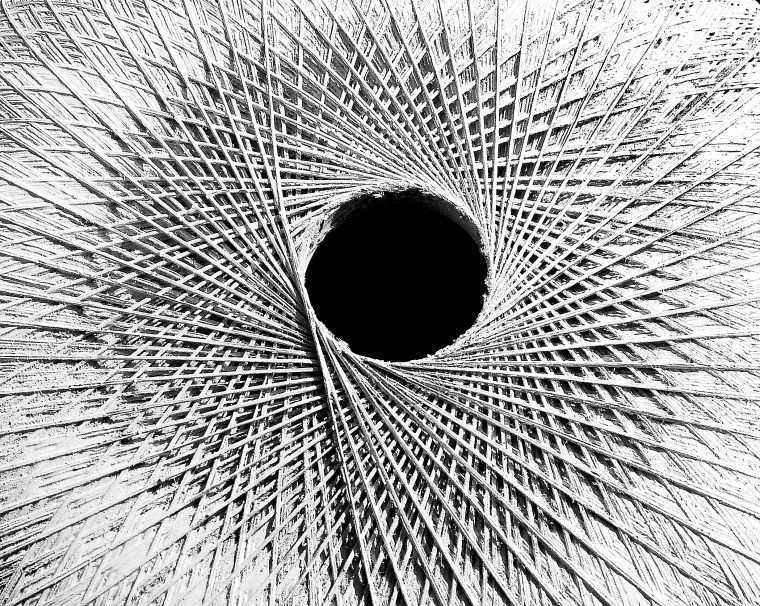
Do you see the beautiful woman bathing at the foot of a waterfall? This isn’t a trick. It’s there. Do you see the elephant? There’s also the Empire State Building, a giant anaconda, the art collection at the Louvrè, my entire photographic collection and that of the Library of Congress. While it’s not a trick, it’s a perceptual challenge because they exist within the frame as potential. In fact, what the interior of this frame carries is potentially a depository of all the visual images ever produced in any form—drawings, paintings, X-rays, photographs, television programs, movies. They’re all there. So also, potentially, are the images that have never been seen, including those not yet imagined or produced. Like outer space which appears to be empty, the content of this frame is not. As with the atom, it’s full of invisible, vibrating fields and forces.

As a blog intended to model how photographs can be used as vehicles for contemplation, this edition is intended as an appreciation of the minds of scholars and researchers who are investigating the “unification” or “nondual” paradigm that’s gaining traction in the sciences. As I consider the areas that peak my sense of wonder and appreciation, I’ll let the professionals speak for themselves.

If you keep zooming in on the image above you’ll eventually see pixels. Each one is a hologram of the whole, pure potential individuated. It can be turned on or off, emit bright light, no light at all or the inconceivable combination of luminance values and colors in between. When a cluster of pixels are black, as above, or a blank television, computer, smart phone or movie screen, they are in the “ground state” of pure potential. Whether real or imagined, an infinite number and variety of images can be projected onto them. Okay, so what’s the big deal?

It’s that this simple insight is changing the way scientists are regarding the universe and the nature of Reality. It’s going to affect everyone and everything dramatically. It already has. The proliferation of electronic technologies in the last half-century was made possible by the conscious application of quantum mechanics, the knowledge of which has, in part, led to this shift in understanding. Up until recently the wildly held assumption among scientists has been that matter is fundamental to the universe and that eons of evolutionary process has resulted in a complex brain that produces consciousness. Without a brain there’s no thought. But that turns out to not be true.

Thousands of well-conducted experiments and case studies insist there is an aspect of consciousness that is not physiologically based, and is not limited by spacetime. More than that they propose consciousness itself is the foundation of all that is. Journals in fields as disparate as physics, biology, and medicine published papers of this research. There are so many that each discipline has its own literature. Everything we talk about, everything we regard as existing, postulates consciousness. We must assume behind this force the existence of a conscious and intelligent mind. This mind is the matrix of all matter.

Stephan Schwartz (Science journalist)

I regard consciousness as fundamental. I regard matter as derivative from consciousness.

Max Planck (Developer of quantum theory)

I am inclined to the idealistic theory that consciousness is fundamental, and that the material universe is derivative from consciousness, not consciousness from the material universe. The universe seems to me to be nearer to a great thought than a great machine. It may well be that each individual consciousness ought to be compared to a brain-cell in a universal mind.

Sir James Jeans (British mathematician and astronomer)

It is not only possible but fairly probable, that psyche and matter are two different aspects of one and the same thing. 

Carl Jung (Psychiatrist and psychoanalyst)

The universe is not conscious; consciousness is the universe.

Rupert Spira (International teacher of the Advaita Vedanta and an English studio potter)

That consciousness is fundamental is an ancient observation, articulated in most if not all of the ancient religions, East, West and indigenous, spoken of variously as “God,” “The Ground Of All Being,” “Ultimate Reality,” “spirit,” “soul,” “ether,” “akasha” and so on. In the 16th century, the Roman Church affected a separation between the emerging discipline of science and faith. Matter became the domain of science, and consciousness (spirit) was the business of the religion. One of the consequences of this was the separation of the individual self—the body perceived as a container for the soul, the brain a container for mind. Today, high school classes and university departments continue to divide science (objective analysis) and religion (subjective experience). Now, the emerging perception that our bodies, minds and spirits are different vibrations of one Reality—consciousness—has resulted in “integral” studies in science, art and business, and significantly, the blossoming field of “consciousness studies,” where rigorous research is underway.

The fundamental reality is not matter but energy, and the laws of nature are not rules of mechanistic interaction but the ‘instructions’ or ‘algorithms’ coding patterns of energy.

Ervin Laszlo (Hungarian philosopher of science, systems theorist, integral theorist and classical pianist)

Contemplating the above image and how it contains pure potential for every image ever produced—or will be produced—consider the screen you’re looking at right now. What you are seeing is the “collapse” or manifestation of my thoughts, represented in image and words, accessed from the Ground Of All Being. According to my readings, each individuated consciousness, as a derivative, participates in and draws from universal consciousness—that Ground. We experience it as imagination and inspiration, or simply “thought.” And we draw from it according to individual perception, needs and desires. An analogy often used to help us understand The Ground, is a computer or television screen turned off. Relative to the images projected onto them, the screen itself is stable, enduring, unlimited pure potential. It can display—actualize—the totality of visual information that exists in the universe. In this way, from unified nothingness, comes the potential for actualizing everything real or imagined.

Its ground state, the cosmos, is a coherent sea of vibration; pure potential. The waves that emerge in its excited state are the actualization of this potential, and they convey the vibration of the ground state. Consequently the clusters that constitute the manifest entities of the universe are in-formed by the vibration of the cosmic ground state. Object-like patterns and clusters of patterns in the high-frequency band are in-formed by the constraints and degrees of freedom that constitutes the laws of nature; and mind-like patterns in the low-frequency band reflect and resonate with the intelligence that permeates the wave field of the excited state cosmos.

Ervin Laszlo

The reason we all seem to share the same world is not that there is one world ‘out there’ known by innumerable separate minds, but rather that each of our minds is precipitated within, informed by, and a modulation of the same infinite consciousness. There is indeed one world that each of the shares, but that world is not made of matter; it is a vibration of mind, and all there is to mind is infinite, indivisible consciousness.

Rupert Spira

To illustrate the process of actualization, read the following descriptions and fix the image in your mind with your eyes closed. Take your time.

  • A blade of grass—make it green, then brown.
  • A bowl—make it wooden, then ceramic.
  • Put an elephant in the bowl—then a flower.

The words triggered your mind to tune into and download aspects of consciousness from The Ground—akasha, spirit, God—whatever name we want to give it. Instantly. And appreciate: images don’t exist anywhere in the brain. Their component energies—size, shape, softness, hardness, color, etc.—are energy stimulations, vibrations “collapsed” from the Ground, creating a composite “mentation,” a mental image  and a representative experience of an object.

Imagine your senses completely turned off. You can’t see, hear, taste, touch or smell. You have no reference for where you are or what is supporting you, because you can’t sense gravity. This is the Ground state, and the only thing that can be said about it is that it is. It exists. Personally, it’s the state of “I am”—a singularity, an individuated Ground actualized from the One, Ground Of All Being. Again, from my readings, evidence comes from the fact that every human being who ever lived and ever will live claims the same name in referring to him or herself—I.

In religious language, the feeling of love is God’s footprint in the heart. It is the experience of our shared being. Likewise, the thought ‘I am’ is God’s signature in my mind. The knowledge ‘I am’ is the shared light of infinite, indivisible consciousness refracted into an apparent multiplicity and diversity of selves or minds.

Rupert Spira

There’s a lot to contemplate here. As individual “grounds” of the Universal Ground—holograms of a sort—might each of us, and humanity as a whole, have unlimited potentials to create? Already we create our personal, professional and collective realities. And what’s the dynamic here? We can only experience the world in duality, in subject-object relationship, so how do we relate to the deep reality of nonduality?

Consciousness has to divide itself—into a subject that knows and an object that is known—in order to manifest creation. It has to sacrifice the unity of its own infinite, and indivisible being and seem to become a separate-self world, which now appears, as a result, to acquire its own independent existence. Thus, the inside self and the outside world are the inevitable duality that constitutes manifestation. They are two sides of the same coin: the apparent veiling of reality.

Rupert Spira

Everything already is. All we have to do is pull it out and make it be.

Linda Smith (My wife and editor)

Okay, given these perspectives, what would be an appropriate response? Science recommends the study and investigation of the material universe. Faith traditions—spirituality—advise prayer and meditation. Seems to me their integration makes sense. Study activates and focuses the mind; prayer and meditation stills it, takes it to Ground.

Below is an image that came into being when I reached out to The  Ground and “asked”—through wondering, imagining and playing—how I could combine something nature-made with something man-made.

Resources

Laszlo, Ervin. The Connectivity Hypotheses: Foundations of an Integral Science of Quantum, Cosmos, Life, and Consciousness. 2003.

Whole systems orientation.

Laszlo, Ervin. What Is Reality? The New Map of Cosmos and Consciousness. 2016

Scientific orientation.

Spira, Rupert. The Nature of Consciousness: Essays on the Unity of Mind and Matter. 2017.

Spiritual orientation.

Wilber, Ken. The Eye Of Spirit: An Integral Vision for a World Gone Slightly Mad. 2001.

Integral, human development orientation.


Invitation


This week I invite you to visit my portfolio website. I replaced 90% of the images there, dropped some categories and added others. The text elements are the same. The purpose of this site is simply to share my images as widely as possible, so if you like what you see please forward a link to those who appreciate photography.

Here’s the link: My Portfolio Web Site

Grandparents


Here are Linda and me at a restaurant with our grandson Ethan. He’s eight in this picture; now he’s nine. We love being grandparents. Among other things, Linda is his confidant and storyteller and I’m a grownup playmate. Recently I read an article by Rachael Caspari entitled The Evolution of Grandparents (Autumn 2016, Scientific American Special Collectors Edition) that provided some new and surprising information about the significance of grandparents in the development of our species.

She says that “living to an older age had profound effects on population sizes, social interactions and genetics of early modern human groups and may explain why they were more successful than archaic humans, such as the Neandertals.” Examining fossils from three million years ago, she and her colleagues found that individuals of this latter group, with few exceptions, didn’t live beyond 30—the age when archaic people lived long enough to become a grandparent.

Dying young was the rule for millions of years, and over that span of time there was a gradual increase in longevity among many of the groups they studied. Still, it wasn’t until around 30,000 years ago, very late in human evolution, that survivorship soared—among the modern humans of the European Upper Paleolithic.

While the researchers haven’t yet discovered the reason why this European group doubled their survivorship ratio compared to other groups—despite their living in much harsher conditions— they found that the increase itself had far-reaching effects. And here’s where the study gets really interesting in terms of our being and having grandparents.

In studying several modern-day hunter-gatherer groups, Kristen Hawkes at the University of Utah, and Hillard Kaplan of the University of New Mexico and others “found that grandparents routinely contribute economic and social resources to their descendants, increasing both the number of offspring their children can have and the survivorship of those children. Grandparents also reinforce complex social connections.”

For example, when grandparents tell their grandchildren stories of deceased relatives, they link them to the family history in a context of what the world was like back then. These and other stories of personal and social challenges successfully met, provide young people a sense of security and continuity. A grandparent can even help a more mature child appreciate that his standing on the shoulders of the past is a privileged position, from which he can reach for his dreams with confidence. Indeed, each new generation stands at the leading edge of human evolution.

Specifically, the author talks about early human elders transmitting information about the environment, teaching grandchildren which plants and snakes were poisonous and where to find water in a drought. While parents were out hunting, gathering or building shelters, the grandparents were educating their children about how to weave a basket or knap a stone blade.

Among her conclusions: “Multigenerational families have more members to hammer home important lessons. Longevity presumably fostered the intergenerational accumulation and transfer of information that encouraged the formation of intricate kinship systems and other social networks… Longevity resulted in increased population size by adding an age group that was not there in the past…Large populations are major drivers of new behaviors…and population density figures importantly in the maintenance of cultural complexity…Larger populations promoted the development of extensive trade networks, complex systems of cooperation, and material expressions of individual and group identity (jewelry, body paint, and so on).” What I take from this is that about 30,000 years ago, the advent of grandparents had a rising and cascading effect, compounding complexity, increasing survival prospects and passing on history, practical information, skills and wisdom in every facet of everyday life, both personal and social.

And significantly, according to Dr. Caspari, “growing population size accelerated the pace of evolution. More people means more mutations and opportunities for advantageous mutations to sweep through populations as their members reproduce. This trend may have had an even more striking effect on recent humans than on Upper Paleolithic ones, compounding the dramatic population growth that accompanied the domestication of plants 10,000 years ago.

The relation between adult survivorship and the emergence of sophisticated new cultural traditions was almost certainly a positive feedback process.. .Longevity became a prerequisite for the complex behaviors that signal modernity.” Indeed, it led to population expansions that had profound cultural and genetic effects ever since.

These findings prompted me to reflect on advances in the many contemporary fields of study and practice that are helping us live longer and healthier lives. On this turn of the evolutionary spiral, where technologies are outpacing our ability to keep pace with them ethically, I wonder if  grandparents might have another role to play.

For instance, might we help the younger generation see that their electronic “toys” and tools can have a higher purpose? And can we help them to see that absorption in tools of any kind can be a distraction from what’s really important in constructing a meaningful, happy and contributing life? Thirty-thousand years after the innovation of grand-parents, both in speech and action, we are still offering the incoming generations the great gifts of stories about their ancestors and the wisdom of our experience.

Although Ethan was just being a kid posing for this picture, in the context of this contemplation I imagine him giving us a double “thumbs up” for having us in his life. Would that I could, I’d return the gesture. What a joy and privilege it is to have him in our lives.

Elders play critical roles in human societies around the globe, conveying wisdom and providing social and economic support for the families of their children and larger kin groups.

Rachael Caspari, anthropologist

May You Have A Joy-Filled Season Of Light!

Light

by Rabindranath Tagore

Light, my light, the world-filling light,

the eye-kissing light,

heart-sweetening light!

Ah, the light dances, my darling, at the center of my life;

the light strikes, my darling, the chords of my love;

the sky opens, the wind runs wild, laughter passes over the earth.

The butterflies spread their sails on the sea of light.

Lilies and jasmines surge up on the crest of the waves of light.

The light is shattered into gold on every cloud, my darling,

and it scatters gems in profusion.

Mirth spreads from leaf to leaf, my darling,

and gladness without measure.

The heaven’s river has drowned its banks

and the flood of joy is abroad.

Walking The Talk

Winners at student-run awards ceremony for best video productions.

             Winners at a Xavier University student-run awards ceremony for best video productions.

Around 4:00 am on Thanksgiving morning I awoke and was thinking about our family tradition of going around the table where everyone said what they were thankful for. My former students came to mind and I realized that they’re all in fine jobs now, most of them with families of their own. Turning back to go to sleep it occurred to me that, for my words of thanksgiving to be authentic they ought to carry through into action. Truly, it’s “by our works that we shall be known.”

So I got up and scribbled a note to that effect. As soon as my head hit the pillow again there came an avalanche of things that I and most of us say we’re grateful for. I offer them here as sort of an after Thanksgiving contemplation. Also it gives me an opportunity to share a few photos of former students so you can see why I give thanks for the privilege of having worked with them.

So for what do we give thanks—and what action would make it genuine?

If plenty — share

If shelter — contribute to those without it

If for a toy or technology — use it harmlessly and to uplift the spirit

If a belief — live it in silence

If health — do what it takes to maintain and improve it

If a relationship — caring, support and empowerment

If love of anyone — expand it to include everyone

If a child — demonstrate love and be a positive role model

If pets or other animals —treat them with respect and provide for their health and well-being

If the work we do — perform it with competence, responsibility, creativity and integrity

If a life of privilege — do something for those less privileged

If for those who serve in the military — let them know they are appreciated

If for a skill or talent — develop it further; use it to uplift and inspire

If position or status — use it wisely and execute it kindly

If simply being together — make the most of it

If a system — care for both the parts and the whole

If freedom — respect the freedom of others

If the use of environmental resources — strive to minimize the footprint and recycle

If power or wealth —make it “power with” rather than “power over”

If peace on earth — make peace where there is conflict and create peace in the home

If silence — be the witness

If simply being alive — do some small thing every day to  experience joy and advance purpose


Reviewing my notes I noticed that gratitude and its attendant actions have been nicely summarized in the perennial advice to “walk your talk.” It’s a lot easier to remember on a daily basis.

To be civilized means to live a life that cherishes others and exudes gratitude and joy.

Bo Lozoff (Humanitarian)

If you are really thankful, what do you do? You share.

W. Clement Stone (Philanthropist and author)


HAPPY HOLIDAYS TO ALL MY STUDENTS!

Evolutionary Transformation


These wind turbines speak to me of innovation and progress in the field of energy. They also stand as testament to the values of adaptation, ingenuity, determination and collaboration. One of the lessons of systems science applied to social evolution is that once established, a system’s curve of development increases with time until the forces of change cause it to peak and then decline. It’s the typical bell curve. And it applies to all systems, even systems of thought. Everything in the universe rises, peaks and then falls. Or transforms.

Leaders in some systems in the modern era, most obviously those in the arena of commerce, become aware of immanent or existing decline and make an attempt to recreate their enterprises in an effort to begin a new growth cycle. They do it by adapting to changing circumstances in ways that are more sustainable. Adaptation is how and why evolution is an advance in complexity and consciousness.

Whether applied to businesses, social systems or political systems, the process of moving from decline to revitalization is called “evolutionary transformation.” It’s a term and concept I learned when documenting a friend’s consulting firm in Washington D.C.. In videotaping their process and conducting interviews, I observed that a prerequisite for positive change was a shift in the thinking of the leader or the leadership team. They had to be to think more expansively about their organization’s identity, purpose and mission, and relate it directly to human needs and wants. Steve Jobs, Jeff Bezos, Elon Musk and Bill Gates are just a few of the contemporary examples of individuals who kept their businesses vital in this way.

The image of the wind turbine evidences transformative thinking that has blossomed world wide. Many leaders in energy industries looked ahead and saw that fossil resources, while plentiful now, are nonetheless finite, expensive to acquire and process and detrimental to the environment. The expansion in their thinking went from short to long term sustainability, and rather than pit themselves in the middle between environmentalists and lobbyists, they elected to move in the direction renewable and clean energies.

At the same time it’s important to note that positive change in social systems can have negative consequences as well. Wars can win territory or consolidate power, but at the cost of many lives. We’re seeing how improved technologies, robotics for example, have resulted in  job losses. And less demand for natural resources, notably coal, has devastated communities. Another principle I learned from my interviews was that “crisis precedes transformation.” When a system is in crisis, it’s already in transformative mode. Whether it results in dissolution or increased vitality depends largely on how leaders respond. Little or no responds favors decline. And many systems fail because the response is insufficient, too difficult or radical.

Crisis or breakdown itself can actually be seen as an “evolutionary driver,” providing the impetus to affect a shift toward survival and growth rather than allow the forces of entropy to have their way. Critical to the consciousness of those who lead in the first place is whether or not there’s a desire to make a fresh start. And if so, are they and their employees, members or citizens willing to do what’s necessary in order to move in the more viable direction? Chapter Eleven bankruptcy filings were created specifically to allow time for entities to restructure, often by replacing leaders with those who are willing to take those steps. At times, we hear of employees taking a reduction in salary to keep a company alive.

Driving through the older sections of cities we see abandoned buildings and shops with windows boarded up, trash on the sidewalks and weeds growing through the pavement. As victims to the forces of entropy, they are gone forever—unless and until a future developer sees the potential for something new. But what about the communities that still have some life left in them, areas on the slippery slope of decline with only hope and a prayer that “the good old days” will return? They won’t. They can’t because the conditions that gave rise to them have changed.

On a much larger scale, the process of “globalization” has been seen by many as a threat to national sovereignty. What is the proper response to increasing complexity, consciousness and interconnectedness? Certainly, it’s not to build a wall around itself. That would exclude it from diverse and even vital goods and services. The more viable option is to view it as motivation to innovate and stimulate increased trade.

The positive news for declining communities is that they can rise again—if within them a leader or a collaborative group emerges to provide the will and the way. I think of the factories abandoned due to cheaper and more willing labor abroad, as well as the one product or single resource communities on the descending curve. Waiting and hoping for the government or someone else to restore them to prosperity is akin to the unemployed men we see standing on the street corner letting life pass them by. Governments are not saviors. Their function is to defend and govern, not to create wealth. They can regulate it, of course, but it is people who create wealth.

I think there’s a misperception of identity. Human beings are more than what they do. Mining, manufacturing and production are roles, and they can change. As souls with unlimited potential, when the door closes on one role, we can open another that is on the cusp rather than the tail end of history. And that is good news. Getting back to lessons learned at ESI, positive transformation requires a change of mind, a shift in perception from viewing one’s world as a diminishing circle to seeing change as an opportunity to widen it in a more viable, inclusive and sustainable direction. As we’ve seen and what was much talked about in the recent election, in a global, interdependent economy workers are in direct competition with their counterparts in other countries. Trade deals, tariffs and regulations may temper the employment drain for a while, but it cannot eliminate it. Executives are smart. For many it’s not just about money. It’s also about differences in cultural attitudes, values, work ethics and philosophies. So what are disadvantaged workers to do? Here again, I refer to the strategies of ESI: What it takes for a system or worker experiencing decline is a shift in thinking from helplessness and dependency to confidence and initiative.

In the old paradigm mentality of the industrial revolution, we exchanged time and labor for money, all of which was managed by, well, management. Top down domination. When a man was out of work he had to find another job in his field of expertise and conform to the company rules and culture or starve. In the new paradigm, largely because of communication technologies, a person may not have a “job” but they can usually find “work.” The difference—and the trend—is significant: a job requires one’s presence and conformity to a set of rules, whereas the performance of work provides freedom to activate one’s own intelligence, creativity and skills doing what’s fulfilling and without imposed rules. What began as “freelancing” is now a normal and preferred way of working for millions of people around the world. The great discovery was that, while jobs provided security, income and freedom was fixed by someone else. Work however, had the advantage of greater income potential and freedom to manage one’s work and family life. Of course, as a lifestyle choice it’s not for everyone.

Applying this growing trend in the workplace, the challenge for those who think—or have been told—that they only have one skill and that it’s no longer needed, is a shift in perception: from “I am only good at one thing; I hope things will get better,” to “I am capable of much more; I’m going to develop new skills and make things better.” It’s the difference between surrendering and taking charge. Next for these individuals comes the question of “How?” The first step is the biggest: reaching inside to discover the potentials, talents and skills that have been lying dormant and are yearning to be expressed. In this people need help, and that’s what community development professionals and social workers are hopefully providing, because potentials, once identified and acted upon, bring results. And as the initial seeds of initiative are watered, the gardener finds himself in charge of a garden—both a leader and a model for the community.

An example of this is the Magnolia Market in Waco, Texas, where Chip and Joanne Gains, the hosts of the popular HGTV program “Fixer Upper,” used their construction and design skills to build, one step at a time, a national business with one of their several initiatives being the restoration (transformation) of an old farm-and-seed facility with huge solos, which now attracts tourists to shop, play and eat.

An example of leveraging potentials on a simpler scale is Susan Branch, who through her blog and books has built a worldwide community of appreciators and customers simply by writing about, illustrating and photographing her lifestyle, home and pets.

So this week my appreciation goes to the evolutionary transformers, people assisting others at every level, especially those in need, to help them discover and realize their potentials so their lives and initiatives can once again ascend the curve of prosperity. According to a popular metaphor, by “teaching them how to fish,” these helpers are also contributing to the success of the nation. The good is recognized and replicated. The following quotes are familiar, but they deserve repeating in this context.

You can’t learn less, you can only learn more.

Buckminster Fuller (Engineer, futurist)

Never doubt that a small group of thoughtful, committed citizens can change the world: indeed, it’s the only thing that ever has.

Margaret Mead (Social anthropologist)
ABOUT THIS IMAGE

Title: Wind Turbines

Location: Milford, IL

File: 988-B3

Just driving around I happened upon scores of wind turbines. Aside from their monstrous appearance and being much bigger than I’d imagined, I was surprised to observe that their blades kept turning despite the lack of wind on the ground. After shooting these great machines in groups with foregrounds of mostly corn and soybean fields, I managed to find one that I could mostly isolate within the frame. My challenge then was to decide the position of the blades. In this image, after several exposures, I managed to click the shutter just when one of them was in the twelve o’clock position. In Adobe Lightroom, I graded the sky from top to bottom. Otherwise, the blades would have stood against the light sky without much contrast.

Energy Flow


This leaf and the ones to follow have “reticulated” veins, meaning they repeatedly branch. I zoomed in on this one to better appreciate the extent of this phenomenon.


“Energy Flow” is an established scientific field that describes and analyzes food chains within ecosystems, involving producers, consumers and decomposers. As one who produces and contemplates photographic images, my interest in leaves included some basic science, but it was their aesthetic qualities moved me to collect and photograph them last week.

As with most of my contemplations, I begin with a consideration of origins. Above, I observe that this red leaf began its life as a tiny bud on a tree limb—a branch among many branches. With the continuous flow of nutrients from the roots, it expanded and produced chlorophyl to become one among the many photosynthesis agents on the tree, all engaged in the process of converting light energy into chemical energy to further fuel the tree and produce oxygen for the atmosphere by consuming carbon dioxide. Continuing the leaf’s lifecycle, it performed this function for a season and as the climate changed it released its chlorophyl and water until it dried and fell to the ground. This, in order to fulfill another essential purpose, the enrichment of the soil so the parent tree could continue to grow. Notice, the roots of the tree also display a branching pattern.


The lifecycle of leaves is a well established metaphor for human life so I skip over that and instead return to the branching feature, observing how chemical energy is distributed along main arteries connected to the tree, then to secondary and tertiary arteries and veins that resemble streets on a city map. The pattern is clear: energy flows from larger to smaller channels. It’s a fanning out phenomenon observable in human and animal systems, highway systems, educational systems, farm irrigation systems, corporate and military hierarchies, food distribution systems, telephone systems, electronic circuit boards, and rivers that flow into deltas. While many rivers invert that order, beginning life as trickles of water from glacier or snow melt, or springs that bubble up from the ground, geological features eventually entrain them to connect with other rivers and streams in a branching pattern. Seen from space, they and erosions in sand and mud all resemble leaf veins.

Cognitively, one such pattern of energy flow is deductive reasoning, where many sub-thoughts derive from a grand thought. President Kennedy challenged us to put a man on the moon and a small group of thinkers attracted a larger group of thinkers—and so on until the thoughts of thousands of thinkers made it happen. The diffusion of thought is how dreams become realized.

I also observe the branching pattern in social systems, particularly as a result of the internet where the thought or action of one “influencer” can fan out to millions of people in the course of hours or a day. We say the image or information has gone “viral,” and that’s exactly the right word. Like a virus, it has spread out quickly through the electronic arteries. For me this raises the issue of content. What are the energies that are flowing through the social body? In Grow Or Die: The Unifying Principle of Transformation, George Lockland wrote that “technology is the self-extension that liberates man to use his energy and information to transform our world.”


As technologies come along to speed and extend the reach and capabilities of communication energy—with less effort and at lower costs—we would do well to take a lesson from the leaves. It’s nutrients that maintain and contribute to growth. Socially, these include images and information that’s true, accurate, useful, helpful, inspirational, educational and empowering. To name a few. The negation of these life-sustaining qualities contributes to desiccation, the drying up of our capacity to better relate, find meaning and become responsible stewards of the planet. One of the primary systems designed to foster nutritional thinking and behaviors at all levels in our society is the educational enterprise. Easily, it can be envisioned as a deeply veined leaf on the great tree of life. Positive or negative, the energies we put into it has consequences.

Energy is neither positive nor negative, we alone have the power to choose which it will become.

Curt Schleier

Love is a sacred reserve of energy, and the very blood stream of spiritual evolution; that is the first discovery we can make from the sense of Earth.

Teilhard de Chardin S.J.

Paying attention is how we use our psychic energy, and how we use our psychic energy determines the kind of self we are cultivating, the kind of person we are learning to be.

Robert Bellah

Note: Wikipedia provides an abundance of botanical information on the science of leaves.

ABOUT THESE IMAGES

Title: Leaf Veins

File: DC10299 / DC 10300 / DC 10325 / DX 10341

I recently collected several leaves from Spring Grove Cemetery, an optimal source since it has the largest variety of trees in the Greater Cincinnati area. So the leaves would flatten I let them soak in a tray of water for about an hour, and then put them between towels to dry. A couple of day later I photographed them on a light table, varying the length of the exposure, but always keeping the aperture at f16 to maximize depth of field with the closeup lens. In Photoshop I eliminated some distracting holes in all the leaves.