Necessary Conditions For A New Humanity

Qualities of Love and Consciousness Are Shaping Our Evolutionary Future

My common practice for this blog is to select a photograph that will prompt a contemplation. In this instance, due to a period of focused readings in theology and philosophy relative to the future of humanity, there came a moment when I had the distinct impression of being in the midst of wise and inquisitive “bees” buzzing around a beautiful flower. Having tasted some rarified nectar, they came away with similar insights but were talking about them in different ways. The impression was acute, so I wanted to synthesize their views to get a more complete picture.

To extend the metaphor, well after untold numbers of “hives” had risen and fallen, there came a time when a mighty one was in turmoil. Within it, a humble worker bee began to speak of a vast meadow with flowers having nectar so abundant and sweet, it could sustain all hives forever. The claim was too grand to believe, but the few who did were told where the meadow could be found and were given directions. Hearing of this and feeling threatened, the queen bee had the humble worker bee silenced. Nonetheless, his story lived on.

It’s this bee’s directives, interpreted and made specific by some wise and learned bees, that kept buzzing in my head. What they had in common was the necessary condition for humans to manifest the “new being,” which they agreed was in process of coming on the next turn of the evolutionary spiral.

The Process

In The Grand Option: Personal Transformation and the New Creation, philosopher Beatrice Bruteau writes, “More complex and more conscious beings are formed by the union of less complex and less conscious elements with one another. Because of their affinity for one another, the elements unite with one another in terms of their characteristic energies. Subatomic particles unite to form atoms, atoms unite to form molecules, molecules unite to form cells, cells unite to form organisms. And so on. This pattern of creating something new, something more complex and more conscious, by the union of the less complex and less conscious, recurs at each of these levels. We can legitimately extrapolate and project the pattern into the future, looking forward to another creative union in which we will be the uniting elements. We will not automatically unite merely because of some natural affinity. Since each of us is free, we can each choose whether we will enter into the proposed union, or not. Thus the union, the new being, the next creative advance of evolution, will come about only if we freely consent to form it.”

The “learned bees” I introduce here, using mostly their own words, are saying we will “freely consent to form this “new human” when we begin to see and regard others in a whole new way. (I addressed this at length in my October 12, 2025 post, How We See Others Matters Greatly).

The Directives

Pierre Teilhard de Chardin S.J. (priest, paleontologist, philosopher)

The necessary condition to form the new being: A convergence in love and the emergence of a collective consciousness, realizing our deep interrelatedness in “Christ-Omega.”

The day will come when, after harnessing the winds, the tides, and gravitation, we shall harness for God the energies of love. And on that day, for the second time in the history of the world, man will have discovered fire. Toward the Future

Teilhard coined the term “radial energy” to characterize the spiritual, center-seeking force that drives human evolution toward ever deeper unity, consciousness and convergence. “Love, conceived broadly as the psychic/spiritual energy of union, is that force… The physical structure of the universe is love.” Human Energy.

Beatrice Bruteau (philosopher, theologian)

Necessary condition: A shift from separative consciousness to “communion consciousness” rooted in mutual self-giving love.

We are being invited to participate consciously in the creation of the New Humanity. It is a matter of realizing that we live from one another and for one another. The Grand Option

Bruteau coined the term “Spondic Energy” (from Greek sponde, meaning “libation”) to characterize a “projection of love energy towards and into other persons, even toward the universe.”  “We will to pour our own life, our own existence, into others that they may be and may be abundantly. It is the proper, or characteristic, act of a person—to share self. Being with another in this central way is precisely what it means to be a person… Our spondic energy is poured toward the future, for the good of the future. It is not a reaction to the past, but a free promise to the world to come, for all things are still possible.”

Ilia Delio (theologian, scientist)

Necessary condition: A new cosmological consciousness that integrates science, technology and spirituality centered on reason and love.

Evolution moves toward greater unity and complexity through love; the new human will be one who knows that to be is to be in relation. The Unbearable Wholeness of Being

Delio urges the development of a “whole-making consciousness” that uses technology not for domination but for communion, what she calls “Christogenesis 2.0.” She believes with Teilhard, that “being is intrinsically relational.” Nothing exists independently or autonomously. “To be is to be with,” she writes. “Reality is being with another in a way open to more union and more being….” “I do not exist in order that I may possess; rather I exist in order that I may give of myself, for it is in giving that I am myself. Cosmic life is intrinsically communal. Being is first a we before it can become an I. There is no being who can stand up and say, ‘I did it alone.’ Rather, the universe is thoroughly relational and in the framework of love.”

Thomas Berry (cultural historian, ecologist)

Necessary condition: A deep ecological and cosmological awakening where we literally fall in love with the Earth and Universe, realizing that we are a mode of them, not separate from them.

The human is that being in whom the universe reflects upon itself in conscious self-awareness. The Great Work

Berry proposed that the great work of our time is reverence and restoration, a transition from a period where we’re devastating the Earth to one of collectively building the Earth. “Only then can the ‘Ecozoic Era’ — the new evolutionary age — emerge.” He said that “All human institutions, professions, programs and activities must now be judged by the extent to which they inhibit, ignore, or foster a human and Earth relationship…” “Spirituality is not about what gods you praise and how piously you do it, but about how your life affects other human beings, and other beings in the universe, including natural habitats and Mother Earth herself…” “We have science to thank for offering us ways of understanding empirical knowledge. We have religion to thank for offering us ways of understanding the ineffable. But it will be our spiritual hunger for a larger story that moves us beyond both science and religion to the place of true cosmic insight.”

Barbara Marx Hubbard (futurist, philosopher, visionary)

Necessary condition: Self-evolution through love. The “Universal Human” arises when individuals consciously choose to align personal creativity with the evolutionary impulse to live as “co-creators” rather than passive bystanders.

The first step in becoming a Universal Human is to shift your identity from your separated ego to your essential Self, your deeper identity as a co-creative expression of the divine. Emergence: The Shift from Ego to Essence

Hubbard encouraged the cultivation of “resonant relationships” based on empathy, cooperation and shared purpose, observing that this is in concert with the cooperative dynamics of evolution itself. She called for “conscious evolution” and the development of synergistic cooperation across all sectors of society, guided by higher consciousness, to move from self-centeredness to God-centeredness. (The Evolutionary Journey). “When a critical mass of people are experiencing themselves as connected, loving their neighbor as themselves, it becomes accessible to everyone…. It is possible that nature will extinct self-centered consciousness. It is not a viable trait at this level of evolution.” (2:44 video talk: (Ch 2: Technology, Co-Creation and Christianity). ” Jesus is the potential self of the human race… (He) manifested the new pattern of creation.. (He) established the template and told us that we would do it too.” (20:00 video: The Book of Co-Creation Introduction).


Sallie McFague (theologian, ecological theorist)

Necessary condition: A radical shift in human self-understanding — from detached dominators over creation to participants in God’s living body, the Earth. For her, the “new human” will be the kenotic human,  one who practices restraint, generosity and relational love as reflections of God’s own self-emptying presence in the world.

The model of kenosis — of pouring oneself out for the well-being of others — may be the most appropriate symbol for our time of ecological crisis. A New Climate for Theology: God, the World, and Global Warming

McFague taught that the ecological, social and spiritual crises of our time arise from an outdated self-image — the autonomous individual who treats the world as an object for use. “What’s required is a deep imaginative and ethical transformation in which we see the cosmos as the body of God and ourselves as embodied, interdependent participants within it.” As a means toward this, she proposed “kenosis” (Greek for “self-emptying,” “pouring out”) as the inner discipline needed to face global warming and unsustainable living. “Kenosis is not a call to passivity or self-denial for its own sake, but to self-emptying for the sake of others — especially the vulnerable Earth community. It is love acting with restraint.” She argued that the root cause of ecological destruction is the inflated self — humanity’s over consuming, self-centered way of being. The antidote, she wrote, is “kenotic consciousness, a deliberate humility and self-limitation that mirrors divine compassion.”

An attempt to synthesize this wisdom

It’s not surprising that these writers viewed the next turn on the evolutionary spiral as a transformation of consciousness through love. Especially interesting and inspirational for me, are the different ways they qualified the “necessary conditions” for creating the new human. Teilhard grounded love as a cosmic, “radial energy” that drives evolution toward ever deeper unity, consciousness and convergence. Like McFague’s kenosis, Bruteau spoke of “spondic energy,” the pouring out of love toward and into others that they may have life in abundance. Delio urges the development of “whole-making consciousness” that uses technology not for domination but for communion, saying “the universe is thoroughly relational and in the framework of love. The new human will be one who knows that to be is to be in relation.” Berry wrote, “spirituality is about how our lives affect other human beings, and other beings in the universe, including natural habitats and Mother Earth herself.” Hubbard foresaw the “Universal Human” arising “when enough of us choose to align our personal creativity with the cooperative dynamics of evolution, moving from self-centeredness to whole-centered, God-centered consciousness.” And McFague saw the cosmos as the body of God and ourselves as interdependent participants within it. She envisioned a kenotic human, “one who practices environmental restraint, personal generosity and relational love as reflections of God’s self-emptying presence in the world.”

Taken together, their “buzzing” is about love of a higher order, the kind that’s universal and  unconditional, capable of uniting minds, hearts and souls to bring about the new human. Beatrice’s  definition of agapé describes it succinctly.

Agapé* is a love that seeks the good of the beloved. It goes out from myself and does not return. It wills the welfare, the being and better being of the beloved, that the beloved should thrive in terms of the beloved’s own good. It is being-communicating. It is ecstatic. It is the characteristic act of the person.

Beatrice Bruteau

Given her writings and those of the other learned “bees,” I’m sure she’d extend the word “beloved” to include every life we touch.

* Agapé is the Greek word for “love.” It’s pronounced “ah-GAH-pay,” with the stress on the second syllable.

__________________________________________________________________________________________

My other sites:

David L. Smith Photography Portfolio.com

Ancient Maya Cultural Traits.com: Weekly blog featuring the traits that made this civilization unique

Spiritual Visionaries.com: Access to 81 free videos on YouTube featuring thought leaders and events of the 1980s. Barbara Marx Hubbard is featured.


Utility Poles

The Intersection of Nature and Technology

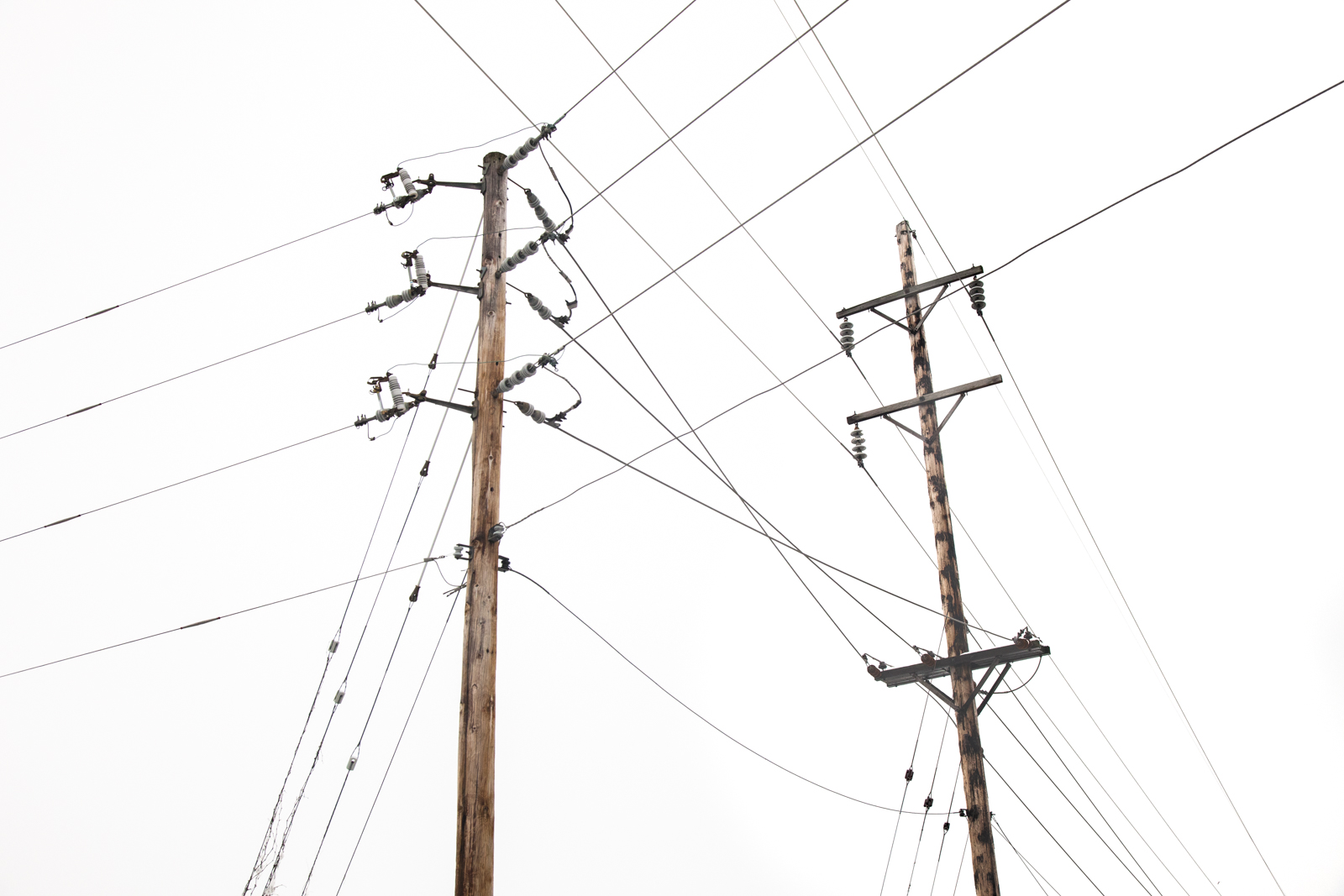
Through the many decades that I’ve been photographing landscapes, utility poles of all kinds, sizes and wires have been a nuisance. Their placement often interfered with rural settings, and in cities the lines tended to be a mess. I don’t like being critical, but when I see these, the reptile part of my brain gets a ping.

Are those who wire and maintain utility poles trained to consider aesthetics? Is all that jumble necessary?

Of course, there are exceptions. In an attempt to balance, hopefully shift my negative gut reaction to utility poles, I thought I’d delve into the subject to see what some facts and a contemplation might awaken. After all, the point of this blog is appreciation.

History

The story begins around 1836  in the UK where telegraph lines were strung on wooden poles by private companies and railways. In 1843 The Electric Telegraph Company deployed them 24 miles along the Great Western Railway between London and Slough. Wikipedia+1. According to a 1933-paper on telegraph poles for the British Post Office, “Scots pine was the ideal timber, obtained from Sweden, Norway and Finland.” britishtelephones.com+1. It was readily available in quantity and reliable with moderate strength and weight.  britishtelephones.com.

In 1844 Samuel Morse received a Congressional grant to build a 40-mile telegraph line from Washington, D.C. to Baltimore. He originally attempted to lay underground cable, but after problems switched to overhead wiring on poles. Atlas Obscura+3Oak Ridge National Laboratory+3California Public Utilities Commission+3. On May 24 his team successfully transmitted the words “What hath God wrought?” through a line carried on hundreds of wooden poles. designyoutrust.com+1. He’d ordered “700 straight and sound chestnut posts with the bark on. Each post must not be less than eight inches in diameter at the butt and tapering to five or six inches at the top.” Wikipedia+1. Chestnut proved to be too hard, so he switched to pine, which was softer, straighter and taller with moderate weight.

Today—North America

Southern yellow pine (including longleaf, slash, loblolly and shortleaf pines) account for roughly 80% of treated poles in the U.S.. Forest Products Laboratory+2Bridgewell Resources+2. Douglas fir is often used for longer poles. Forest Products Laboratory. Western red cedar is used in the west and northwestern regions. stella-jones.com+1. Other species may include red pine, lodgepole pine and ponderosa pine depending on the region. Bridgewell Resources+1.

In Ohio

The dominant forest‐type groups in Ohio are hardwoods. The oak and hickory group covers more than half of Ohio’s forests—about 4.1 million acres. National Resource Inventory+2US Forest Service+2. Softwood (conifers) amount to less than 5 % of Ohio’s commercial forest area. US Forest Service+2Woodland Stewardship Association+2. These poles mostly come from southeastern pine plantations where species and growth conditions favor long, straight poles.

Ohio has about 8 million acres of forest land, representing about 31 % of the state’s land base. Cloudinary+3Ohio Ag Net | Ohio’s Country Journal+3US Forest Service+3. Most of that land is private, about 86 % owned by “family farms.” Ohio Ag Net | Ohio’s Country Journal+2US Forest Service+2. About 94% of commercial forests are located in the southeastern part of the state and are privately owned. US Forest Service+1. Many of the poles in Cincinnati come from privately held woodlots, not state or national forests.

Trees and Harvesting

Pole trees must meet strict form, straightness, minimal defects, and size specifications. woodpoles.org+1. “Those grown for pole use are ready for harvest around 30 years of age or older, sometimes as early as 25 years.” Timber Update. So when I’m looking at a pole in Cincinnati, it likely began life as an oak or hickory tree in a local or regional, privately owned forest. It grew under management to achieve its straight form with minimal defects for about 25-40 years, was harvested, treated with a preservative, tagged, delivered and then installed by the city’s electric company. It’s “service life” afterward could be 50-70 years or more. woodpoles.org+1.

Who owns them

The tree-to-pole process is owned by a forestry/processing company until delivered. After installation, most poles are owned by the utility, the electric distribution company or a telephone/telecom company. According to general standards, poles are “joint-use” in most places, meaning the utility owns the pole and others lease attachment rights. Wikipedia+1.

There’s no charge to staple notices on them, but wherever wires or civic signage are involved there’s a charge.

Many poles are branded with a species code that marks the year of treatment and manufacture, class number etc. These “birth-marks” can be traced. Wikipedia+1.

Recycling

Specialized companies (For example Blackwood Solutions) manage transportation, storage and recycling of retired utility poles. Blackwood Solutions. In Ohio and Cincinnati in particular, FirstEnergy Corporation has a “Wood Pole Diversion Program” whereby poles no longer fit for service are redistributed to interested parties for reuse rather than sent to a landfill. The company offers retired poles at no cost to parties willing to accept full loads and comply with logistics. FirstEnergy Corp. Old poles are used for fencing, trail linings, parking bollards, guide-rail posts, and landscaping features. Because poles are often treated (creosote, CCA, etc.), safe handling and appropriate reuse/disposal matter. Environmental Quality Department+1. According to a technical bulletin compiled by the North American Wood Pole Council (NAWPC), utilities in the U.S. and Canada remove more than 3 million wood poles from service every year. EPRI Rest Service+1.

Contemplation

This was one of those occasions where I saw something on a walk (a telephone pole) and wondered if it might be an appropriate topic for this blog. Immediately I dismissed it, because, although I’ve been photographing utility poles for years, I viewed them as obstacles, intrusions into otherwise beautiful land and cityscapes. A recent story on television about phobias, facing fears in order to eliminate them, prompted me to wonder if I could transform my negative view of these objects into a positive one.

Service

As often happens, well into the research, one sentence prompted my turnaround. “A pole’s service life is 50-70 years.” Instead of seeing utility poles simply as “trees chopped down,” I saw that—as gobblers of carbon dioxide and providers of oxygen for up to 40 years—they continued “life” in service to humanity by extending lines of power and communication, which symbolized the continuity of life. Similarly, when we humans can no longer contribute physically, we can extend our “lines” of power and communication by leading and modeling exemplary lives.

Quality

Only certain species of trees are suitable to become poles, and those have to conform to standards of straightness, constitution, height, sensitivity to treatment and durability under stresses such as insects and climate change. Considering the higher qualities that characterize human beings (love, compassion, kindness, generosity, forgiveness, etc.) how do we stand up?

Afterlife

The tree-turned-pole eventually becomes recycled, part of something else (fence, sculpture, landscaping) rather than simply disappearing. This invites my reflection both on impermanence due to entropy, and retirement from the world of work. I’ve often heard men say they’re just “Puttin’ one foot in front of another,” or “Takin’ it a day at a time.” There’s so much need in the world. Just as a tree continues to serve by being transformed, so we can shift from “have-to-do” to “want-to-do” by applying our gifts (knowledge and skills) to extend our service to humanity. 

Seeing utility poles standing tall and silent reminds me of an equally (arguably more) valuable contribution we can silently make, one that requires no physical exertion. One at a time, we can hold in mind the places where people are suffering—war, famine, abuse, flooding, crime, terminal illness and encompass them in a cocoon or field of divine love and light and pray: “May they…” always concluding, “Thy (God’s) will be done.” For thousands of years, worldwide, this has been and continues to be a normal, everyday contribution of men and women of every sect who live in religious communities. Without the religious context, the same can be done by encompassing  those who suffer in a field of caring goodwill. 

Utility poles are trees transformed. Rooted in the ground, they stand still and hold aloft the lines of power and communication. In a sense, they’re technological sculptures, a fusion of nature and technology that represent the current phase of human evolution. Given the rate of technological change, this composite somehow feels on the cusp of a broader transformation, a time when trees will no longer be harvested for this purpose, when on the next turn of the spiral, power and communication will be distributed without the need for “lines.” I can’t imagine what that might be like, but then the Internet, AI, 5G smartphones, quantum computing, sustainable nanotechnology, gene splicing and synthetic biology weren’t even dreamed about by most of us just 20 years ago.

_________________________________________

My other sites:

David L. Smith Photography Portfolio.com

Ancient Maya Cultural Traits.com: Weekly blog featuring the traits that made this civilization unique

Spiritual Visionaries.com: Access to 81 free videos on YouTube featuring thought leaders and events of the 1980s.

The Sacred Without Hierarchy

Seeing the Divine as Relationship

While researching for my post “What Makes a True Leader” (October 19, 2025), it became apparent that “dominators” historically created and thrived due to a hierarchical social structure. Thinking about it, I began to realize that hierarchies are pervasive; we take them for granted. In Western religious traditions, the spiritual journey has long been imagined, taught and depicted in art as a vertical ascent, a climb from human to divine, from earth “below” to heaven “above,” with models of holiness and spiritual teaching coming “down” to us through intermediaries such as priests, prophets, mystics, saints and kings.

On one of my walks with philosopher Beatrice Bruteau, the conversation turned to the nature of the spirit world. Having read quite a bit on Theosophy, which places “devas,” “logoi,” “masters” and “elementals” on different hierarchical planes of spiritual attainment, I asked about the “ascended masters.” She paused, turned to me and said definitively, “I don’t believe in hierarchy.”

Reality is not a hierarchy to climb, but a communion to join

 Beatrice Bruteau, philosopher, author

Duality

Metaphysically, a hierarchical structure of the spiritual domain is considered “dualistic.” It imagines a great chain of being that reflects degrees of holiness rising from mortals to saints, to “heavenly hosts” and then God. It mirrors how the mind perceives everyday reality as composed of ranks where the higher governs or enlightens the lower. The dualistic cosmologies—common in Theosophy, Neoplatonism and medieval Christianity—can inspire awe and order and provide models (saints) who’ve apparently completed the spiritual journey successfully. In dualism, everything flows downward from Source, and the task of the soul is to ascend upward to unite with it.

Nonduality

In contrast, the “non-dual” perspective sees all levels of existence as expressions of one undivided reality. Rather than a distance to climb, the spirit world is considered a whole, a unity in which every being, from the humblest creature to the highest intelligence, shares the same divine essence. Hierarchies may still appear as useful descriptions of differing functions or forms, but not as absolute separations of value or nearness to God. From this view, “higher” and “lower” transform into sacred presence and wholeness—the divine shining equally in and through all.

The deepest reality is not substance, but communion.
          Beatrice Bruteau, author God’s Ecstasy

When Beatrice spoke about non-dual “communion” as opposed to the dualistic “domination” paradigm, she said there’s no distance between creature and Creator. The example she provides in The Grand Option: Personal Transformation and a New Creation is Jesus washing the feet of his disciples at the Last Supper. Even against their objections, he regarded them as friends in communion (physically and spiritually), equally loved in the eyes of God. None higher or lower. 

A Sampling of Nondual Perspectives

Writing in Everything Is God: The Radical Path of Nondual Judaism, Rabbi Jay Michaelson sees divinity not as a distant monarch but as the very substance of existence itself. He writes, “Everyone and everything manifests God… He is not some old man in the sky but is everything we see and everything we are.” From this perspective, God is not a “being,” but being itself, so the soul’s task is not to climb or rise, but to recognize, become aware of one’s true nature.

British social scientist John Heron applied the nondual perspective to the spheres of social and interpersonal relationships. In Participatory Spirituality: A Fairwell to Authoritarian Religion, he talked about “invisible hierarchies of worth between clergy and laity, master and disciple, divine and human.” In contrast and aligned with Beatrice, he believed that “Genuine spirituality is developed in and through persons in relation”—which echoes Jesus’ phrase, “The kingdom of God is within you.” (Luke 17:21). So Heron sees spirituality as a practice to be developed in our relations with other persons, ideally participating in a wider co-creative community “wherever people meet in authenticity and mutual empowerment.”

Jeff Foster is a British spiritual teacher and humorist who talks about the spiritual realm in the language of nonduality with a focus on healing from trauma. In Life Without a Centre: Awakening from the Dream of Separation, he advises, “Simply noticing what is already present, here and now. One could say this noticing is what you are.” In this view, when we awaken to what he calls “effortless presence,” the quest dissolves. “There is no teacher and no taught, no higher or lower—only this infinite intimacy now.”

Meister Eckhart, a 14th Century German Catholic priest and mystic, spoke about the “ground of the soul.” Regarding the spiritual journey he wrote, “there is no rank nor degree.” He reasoned that there couldn’t be a hierarchy because God is not “up there, but in here”—the soul, the radiant center shared by all.

Dorothee Sölle, a German Lutheran and liberation theologian wrote that, “Transcendence is no longer to be understood as being independent of everything and ruling over everything else, but rather as being bound up in the web of life… That means we move from God-above-us to God-within-us and overcome false transcendence hierarchically conceived.”

And Starhawk (born Miriam Simos), an American feminist, writes in Dreaming the Dark: Magic, Sex, and Politics, “A spiritual organization with a hierarchical structure can convey only the consciousness of estrangement, regardless of what teachings or deep inspirations are at its root. The structure itself reinforces the idea that some people are inherently more worthy than others.”

On Balance

Although it’s apparent that my perspective is non-dual, I’m not trying to promote it. I highly respect the dualistic view, was brought up in it and it served me well. It offers hope and provides moral clarity, a clear sense of right and wrong and good and evil, which is helpful for ethical decision-making, and the contrast between the sacred and the profane can inspire spiritual development and inner transformation. The stories of holy people certainly provide insight into dealing with life’s trials and triumphs. And seeing God distinct from creation allows for petitioning prayer, worship and community-building services. The dualistic perspective was beautifully expressed by the Austrian-Israeli philosopher Martin Buber in his popular book I and Thou.

Does It Matter?

The title of my October 12, 2025 post was “How We See Others Matters Greatly.” Here, I’m suggesting that how we see God—Source, Ground of All Being, Cosmic Intelligence or beliefs in general—matter. I will add my opinion, but first I defer to some established nondual thinkers—

We do not see things as they are; we see them as we are.

Jacob Israel Liberman, Rabbi, philosopher

We become what we behold.

William Blake, English poet, philosopher

The kingdom of God is within.

                      Luke 17:21, evangelist 

The eye with which I see God is the eye with which God sees me.

Meister Eckhart, German priest, mystic

Everything participates in the divine life.

Thomas Berry, priest, ecologian

The divine life is not a pyramid of power but a communion of persons.

            Beatrice Bruteau, philosopher

Now I think what matters is whatever draws us up, lifts the spirit, brings peace of mind, gives us hope and joy, inspires and empowers us to give our gifts with enough whole systems health to make a difference for the world and those whose lives we touch. The cultivation of self-love, expressing love and being mindful that we are love is enough.

__________________________________________________

My other sites:

David L. Smith Photography Portfolio.com

Ancient Maya Cultural Traits.com: Weekly blog featuring the traits that made this civilization unique.

Spiritual Visionaries.com: Access to 81 free videos on YouTube featuring thought leaders and events of the 1980s.


What Makes A True Leader

Why the “Domination” Paradigm Fails and the “Communion” Paradigm Endures

Through decades of studying the rise and fall of the ancient Maya civilization of Central America, one of my areas of interest has been the formation and decline of “kingship,” how power was gained and wielded and how it failed. Universally, and from a whole-systems perspective, hierarchy and domination are structural and evolutionary phenomena rooted in primate biology and behavior.

Origins

In Chimpanzee Politics, Frans de Waal reports that among primates, including chimpanzees and baboons, dominance serves an adaptive function, reducing conflict, maintaining cohesion and coordinating defense by creating a dependable social order. Dominant males (and sometimes females) gain their positions through physical strength, alliances or demonstrations of increased intelligence. Whereas primates operate on instinct, humans create social, cultural and political systems such as religions, kingdoms, militaries and economies where domination became institutionalized.

Emergence

Anthropologist Riane Eisler, author of The Chalice and the Blade, coined the term “domination paradigm” in contrast to the “partnership model.” Analyzing how social hierarchies and institutions evolved from fear-based control into partnership-based cooperation, she found that domination got reinforced through millennia of patriarchy, warfare and control of resources.

In her awesome book, Thinking in Systems, environmental scientist Donella Meadows explained that domination gained traction over time and endured because “success accrues to the successful”—winners continue to win through the concentration of power and the suppression of corrective forces.

Basically, dominators such as rulers, kings and dictators overpower “cooperators” by imposing strict social controls. Philip Zimbardo, author of The Lucifer Effect: Understanding How Good People Turn Evil, observed that in domination systems the controls and feedback loops are suppressed through censorship, propaganda and fear. They produce social insecurity, confusion, uncertainty and eventually systemic collapse. Specifically, Zimbardo’s social controls are those necessary to maintain life—food, security, money, energy, information—and these days this includes attention, all of which creates dependency. Dominators maintain control over these essentials, in large part, by referring to or retelling religious, political or ideological stories that frame their superiority as natural, deserved or divinely sanctioned. When their authority becomes validated through laws, market statistics, spiritual bias or cultural norms, domination becomes autopoietic (a whole systems term meaning “self-maintaining.” At least for a while.

The Dynamics of Rise and Fall

When fear runs the show in a social system, be it primate or human, the door opens for an aggressive individual to emerge and dominate. Increasingly, when his or her authority feels threatened by those being dominated, they typically turn up the temperature on separation (royals vs peasants; haves vs have-nots) and exclusion—any group of people different from them.

            In my civilization, he who is different from me does not impoverish me—he enriches me.

                        Antoine de Saint-Exupery, French writer, poet, journalist

Enjoying some success, the “alpha,” “ruler,” or “dictator” further solidifies his position at the top of the hierarchy by incorporating family members, friends and those who themselves either aspire to power or are stimulated by being close to it. In ancient hierarchical societies, those related to—or managed to win the favor of—the ruler could rather quickly rise to prominent positions and become beneficiaries of his status and wealth—even replace him.

A real life example is a story recorded by the Spaniards who invaded Mexico. In 1194 AD, Hunic Ceel Cauich was a Maya slave about to be sacrificed at the sacred cenote at Chichen Itza in Yucatan. Most human offerings were thrown into the well, which is a 90 foot drop to the surface today. It broke their backs and they died instantly. This devout young man, offering to sacrifice himself and deliver a message to the gods, leapt in and landed feet first. To the amazement of the Ajaw (lord) and priests he survived. When they pulled him up, he told the Ajaw that he’d delivered his message to Chac, and this god of lightning and rain responded. “What did he say?” they asked. “With respect, Ajaw Chac Xib Chac, he said the jaguar throne is rightfully mine.” So this young man became the Lord of Chichen Itza. Years later, considered a “holy lord” (sanctioned by the gods), he conquered the neighboring city of Mayapan.

On the positive side, those dominated may thrive when the dominator acts as protector and steward, particularly during a crisis, or when he or she provides for the common good. Such is the case under benevolent dictators or true social democracies such as Sweden, Norway, Denmark, the Iroquois Confederacy and the Mondragón Cooperative Network in the Basque region of Spain.

But when a population suffers through suppressed creativity and innovation, inequality, restricted trade, alienation, environmental degradation or even the perception that the system is in peril, and when the dominator becomes self-centered, detached from reality and no longer secures the good of his or her people—the system breaks down. One of the contributing causes of the collapse of Maya civilization was the inability of the kings and priests to win the favor of the gods by providing rain through decades of drought. When the population moved away, kingship died.

I do not think the measure of a civilization is how tall its buildings of concrete are, but rather how well its people have learned to relate to their environment and fellow man.

Sun Bear, Chippewa tribal chief

Dominator Tactics and Titles

Early rulers claimed divine sanction—the Pharaohs of Egypt, the K’in Ajaw “Holy Lords” of the ancient Maya and the Huangdi “Emperors” in China. These and others considered themselves mediators to the gods or divine in their own right.

As empires expanded, sacred sanctions gave way to military supremacyCaesars in Rome, the Shah “King” of Persia, the Melekh “King” of Israel, the Chakravartin “universal ruler” of India and the Führer “Leader” in Germany.

In the industrial and modern eras the focus shifted to control by governments and corporate heads—the General Secretary of the Soviet Union, the Chairman of the People’s Republic of China, the Supreme Leader in North Korea and the CEO “Chief Executive Officersin corporations.

The greatest danger to a civilization is greater and greater concentrations of power and wealth in fewer and fewer hands.

Dee Hocks, founder & CEO emeritus of VISA International

Are Dominators “Leaders?”

Research on the topic of domination and dominators prompted me to ask: Are dominators leaders? Not satisfied with the dictionary definition of “leader,” I asked Jason Miller, my son-in-law (a certified leadership coach and consultant for major corporations and other institutions) for the definition he preferred. “A leader,” he said, “is an individual who inspires and motivates people to drive change and/or achieve a common goal.” Parsing this out and adding some perspectives from anthropology and whole-systems science—

  • Leaders empower others to be agents of change. Dominators hold on to that role, because their reference point is ego, personal glory, recognition or control.
  • Systemically, leadership is an open feedback loop, the energy is directed outward. Domination is a closed loop—energy flows inward toward the ego.
  • Leaders collaborate on behalf of the future. They work cooperatively toward a common goal. Dominators live for immediate satisfaction: winning, recognition, survival, applause.
  • Leaders inspire through modeling and empathy. “We’re all together in this.” Dominators live in fear of losing their power, becoming irrelevant, vulnerable, disrespected or ignored.
  • Leaders cultivate collaborators. Dominators seek followers, people below them.
  • Leaders welcome feedback so the system becomes self-correcting. Dominators don’t want feedback. Feeling like they know better than anyone else, they make people afraid to speak truth to power.
  • Leaders encourage power-with. Dominators seek power-over.
  • Leaders motivate by encouraging diverse opinions and creativity. Dominators demand loyalty and obedience.

A leader is best when people barely know he exists. When his work is done, his aim fulfilled, they will say: we did it ourselves.

           Lao Tzu. Chinese philosopher

In The Grand Option: Personal Transformation and a New Creation, philosopher Beatrice Bruteau elaborates the differences between the “domination” and “communion” paradigms. Whereas the  Domination Paradigm is based on fear, possession, control, separation and egoic identity, the Communion Paradigm is rooted in love, mutual empowerment and shared creativity.

She cites the Last Supper as the point in history where, by washing the feet of his disciples, Jesus shattered the domination paradigm. And then, by offering his body and blood for them to ingest, he demonstrated the true nature of the communion paradigm. According to Beatrice, “To live is to communicate life, because life is essentially a spreading, growing phenomenon. Therefore, the more one communicates life, affirms life in one’s fellows, gives oneself to enhance their lives, the more one is alive, is truly living, and thus is truly oneself.”

The Way Forward

I know I’m overusing Beatrice Bruteau as a source, but she was the only philosopher I know of who elevated Riane Eisler’s term, “partnership model” to “communion paradigm.” This is significant, because “partners,” perceived as external to one another, can experience resistance, even undermine the other’s position, beliefs or strategy. “Communion,” on the other hand, is unitive. Beatrice writes, “The only way out of the domination system is to move into the paradigm of communion, of mutual empowerment. The new creation calls us beyond the old domination system. We are to evolve into a new mode of being—not over and against one another, but with and for one another. The communion paradigm is the new pattern of personhood and social organization required for the next stage of human evolution… What we need now is a transformation of consciousness itself, from separative self-consciousness to the consciousness of communion.”

Only the communion paradigm can bring about the unity and creativity our species now requires. The alternative is extinction.

                        Beatrice Bruteau, philosopher

_________________________________________________

My other sites:

David L. Smith Photography Portfolio.com

Ancient Maya Cultural Traits.com: Weekly blog featuring the traits that made this civilization unique

Spiritual Visionaries.com: Access to 81 free videos on YouTube featuring thought leaders and events of the 1980s.

How We See Others Matters Greatly

Are They “Individuals” or “Persons?”

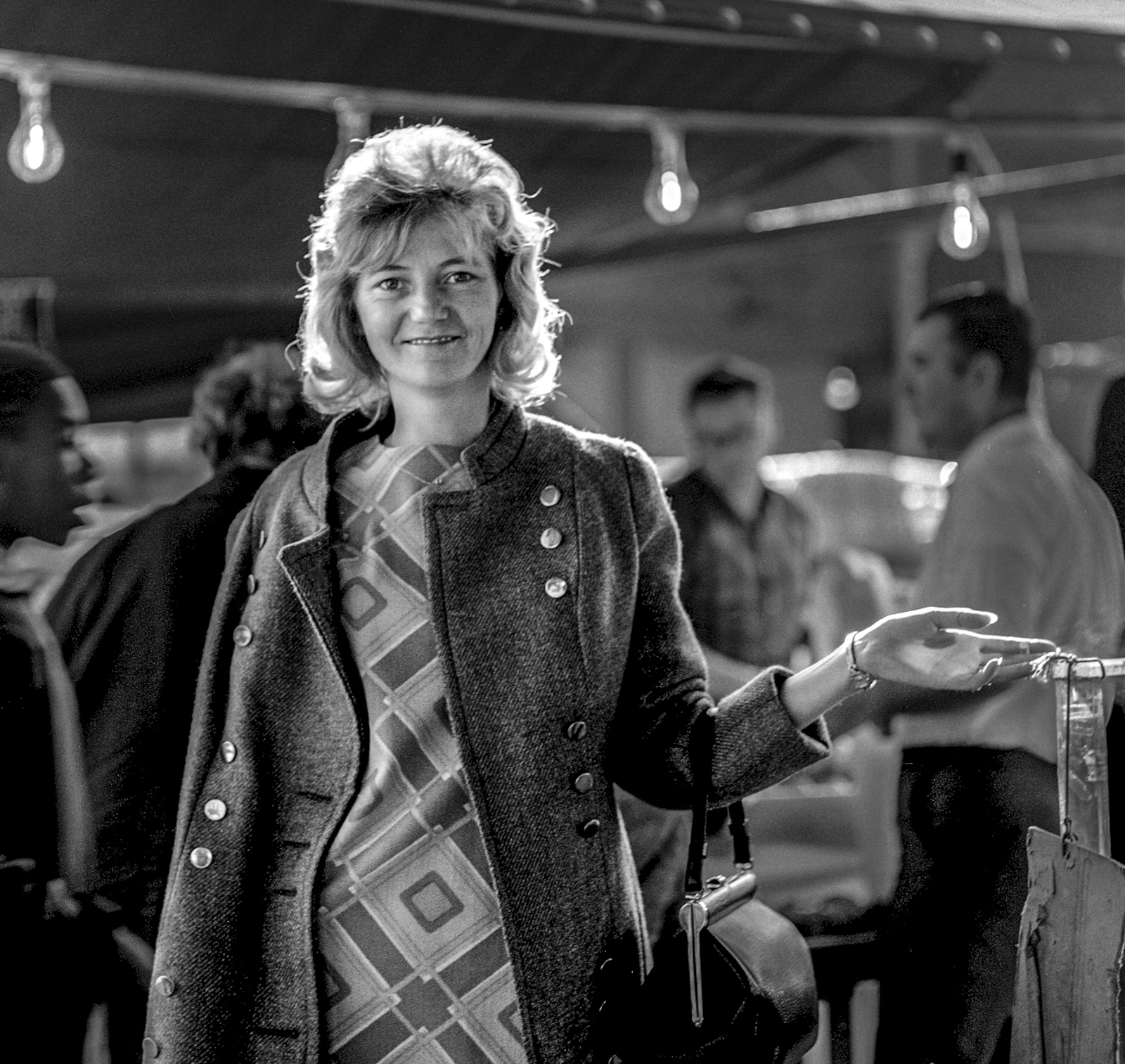
In the early 1960s I was photographing quite a lot in Cincinnati’s Findley Market downtown. This woman turned and saw that was pointing my camera at her, so she turned and posed. I took the shot, thanked her and we moved on.

After writing my post, “The Typewriter and Authenticity,” how words condition our perception of reality and how they can unite or divide us, I read Beatrice Bruteau’s sharp distinction between “Individual” and “Person” in The Grand Option: Personal Transformation and a New Creation. I think it’s significant in many ways, even having the potential to shift the current paradigm of “dominance” to “communion” at all levels.

Beatrice defines an “individual” as a self-contained unit, existing separately, competing for survival and recognition.” When asked,” Who are you?” the response would consist of one’s role, description or category having to do with their appearance or status, perhaps indicating what they are not in order to assert or protect the ego. Individuals are separate beings, identified by their descriptions, roles and unique attributes.

In contrast, a “person” is “inherently relational—a center of freedom, creativity and communion.” Beatrice says a “person is not the kind of being that can exist, or even be conceived, in singularity. We must always think persons, plural… (there’s a) transcendent, outpouring energy that indwells all other persons, so that the energy-exchange unites the many into one and forms a new being.” Gratefully, she specified several key features of this distinction.

Identity

Beatrice regards an individual as a singular instance of some description—gender, class, role, status, occupation and attributes, things like husband, black, tall, singer, smart or old. A person, on the other hand, is more than any description—properly considered a verb rather than a noun, something dynamic, relational and creative—and not reducible to roles or descriptions. She references Mahayana Buddhism, which recommends we see others as the seed of compassion and wisdom, specifying the Bodhisattva path that emphasizes the perception of others not as separate selves but as interdependent beings, each bearing the Buddha-nature.

The beginning of love is to let those we love be perfectly themselves… otherwise we do not love them, we only love the reflection of ourselves we find in them.

                        Thomas Merton, Trappist monk, theologian, mystic, poet

Relational status

Individuals are largely static with respect to other people. They’re external to them and separate. They’re known by comparison (“My hair’s longer than hers.”) and contrast (“He drinks wine, I’m a beer man.”). Persons relate in a deeper sense. Beatrice says they “reciprocally indwell” one another and are “capable of communion.” They enter into relationships in a way that transforms both self and other. Gabriel Marcel, a French philosopher who spoke of perceiving others as “mystery” rather than “problem,” said, “To encounter another is to participate in their being, not to analyze or reduce them.”

To love someone is not first of all to do things for them, but to reveal to them their own beauty, to say to them through our attitude: “You are beautiful. You matter.”

           Jean Vanier, Canadian Catholic philosopher, theologian

Consciousness / Self-awareness

An individual may have awareness, roles, functions and attributes, but the term is more restricted, more tied to ego and separateness. A person has a more evolved consciousness, is self-reflexive, other-centered, capable of “transcendent freedom,” (original thinking) giving of self and projecting being to others. Persons are aware of being in relation to others at a deep unitive level, beyond their description and attributes. In the Hindu Vedanta tradition, seeing others as the Divine in different forms actually leads to liberation.

Activity / Becoming

An individual tends to be identified with what one already is, with what one has—roles, statuses, titles and descriptions. A person is an active center of becoming, not static but unfolding and creative, an entity that projects fuller being and growing to others. Martin Luther King Jr.
wrote of perceiving others through the lens of dignity and beloved community: “To perceive another as less is to undermine one’s own humanity.” And Pierre Teilhard de Chardin S.J. regarded others, not as static individuals, but as co-participants in the evolutionary process leading to the Omega Point (Realization in Christ consciousness).

Communion / Unity

Individuals relate to others but remain external to them. Here, the foundation of relationship is comparison, contrast and separateness. “Me and you are different.” Persons participate in communion, in a deeper sense of unity. They are plural, many together, and yet unified. “Me and you are one.” The way I think of it— a person is, together with others, a member in a divine community. A person is never alone. German theologian Dietrich Bonhoeffer stressed the seeing of Christ in the other person, not reducing them to what they do for us but perceiving them as bearers of divine presence. Picking up on this, John Chrysostom, former Archbishop of Constantinople, encouraged the perception of Christ in the poor and stranger, saying, “How you see the other is how you see Christ.”

How we see others is never neutral. It either objectifies, diminishes or dominates, or opens into reverence, responsibility, communion and compassion. Fittingly, Beatrice writes about the “contemplative eye (which) perceives others not as threats to our existence but as partners in life. Fear gives way to compassion when we realize that each person is an energy of freedom and creativity, not a rival… The fate of society depends on which lens we use. To see others as individuals alone is to live by the Domination Paradigm, where rivalry and fear rule. To see them as persons is to enter the Friendship or Communion Paradigm, where mutuality and co-creation become possible.” (Italics are mine)

Contemplation

All of this relates to a little mind game common to Vedantic practice. To the question “Who am I?” I realize that I am not anything that I “have,” “own” or “do.” These can be destroyed or taken away. For instance, I have a body, so I am not that. I have a mind and thoughts, so I am neither of those. When the possibilities are exhausted, the only thing left is simply being—the “soul” in Western traditions, the “Self” in the Eastern traditions. The statement, “I am.” is absolutely true now and forever for every soul that ever has or will incarnate. That human persons (plural) are one, has its roots in shared being. If that’s the case, the answer to the question, “Who are you to me?” at the level of personhood, becomes obvious—”You are another instance of I Am.”

In this, our endowments, possessions, appearances, differences and contrasts completely dissolve. These are acquisitions, spoken of throughout this incarnation to help us distinguish one from another as being unique. Indeed, individuals are differently endowed and we assume unique attributes—including our perception of others—to fulfill our pre-birth plan. This is the finite level of consciousness; it’s how embodied beings (individuals) experience personal and social realities. In another moment, we can affect a shift in consciousness to the infinite and see others as persons, “sons and daughters of God” (2 Corinthians 6:18). Interestingly, the word Jesus the Christ used to refer to “God” in Aramaic was Ahlaha, “Divine Unity” or “Divine Oneness.” This helps us understand the Trinity—”One God; many persons.” Not “individuals.”

Does it matter?

The way we perceive one another shapes everything from family to our global future. If we look at others through the lens of separation and competition (“rugged individualism”), we reinforce the domination paradigm that fuels division in politics, exclusion in religion, environmental degradation and competition in trade and economics. If, however, we can see with the “contemplative” eye—perceiving others as “persons” rather than “individuals”—we open the possibility of a communion paradigm: all of us together building trust, healing divisions, fostering genuine dialogue and reshaping how we use social media. The smallest shift in perception can ripple outward, influencing how we talk to one another in our homes and workplaces, how we engage across differences in public life and how we imagine our personal and common future.

In Practice

How does this work in day-to-day living? The shift from seeing ourselves as individuals, toward embracing our “relational” selves as persons—who we are because of friends, family and community—changes lives. For instance, in a conflict we’re more likely to ask, “How is this affecting our relationship?” And rather than thinking about what I want from someone, I shift into “How can we both benefit?” Whatever the context, parents who think of their children as “persons” acknowledges not only their individual achievement, but how they feel about their relationships and making them work. In the workplace, seeing colleagues as persons would create a culture that values connection, engagement and teamwork beyond individual output or accomplishment. “Winning” occurs when everyone succeeds. In social media and politics, the shift would move from “I,” “I,” “I,” and “you” to “we” conversations that emphasize belonging, community and collaboration rather than division. Strengthening the relational—”personhood”side of ourselves can lead to more empathy, stronger social bonds, less loneliness and more cooperation. Seeing others as persons isn’t just nice. It’s mutually creative. 

As far as I know—and could find—Beatrice Bruteau is the only philosopher or spiritual writer who makes the distinction between “individual” and “person.” I think it took a thinker whose central spiritual concern was the nature and importance of human relationships, because that’s where, in the current era, the “rubber meets the road.” If we’re to have a future that’s largely peaceful, one where the emphasis is on the “quality” of life beyond acquisition and survival, we have to move into “right relationship” with each other and the planet. While the spiritual path is largely a private endeavor, it is also a co-creative work of communion.

Disagreeing with each other is normal, even necessary for the evolution of human consciousness, but the narrow close minded holding tight to a belief or idea to the exclusion of other ways of thinking and seeing could destroy us. For so long, we’ve been blind to the common core of our being (the Self/soul), competing, blaming, acquiring, protecting our turf and defending our ideologies. There comes a time when the adolescent awakens to the realization that, according to Beatrice’s central message—to have life in abundance (as an adult) all we need do is give it to one another. In her words, as we encounter others we say to ourselves, “I am—may you be in abundance.” How we see one another might be the most practical step we can take toward healing each other and our world.

We are not separate, but deeply one, while remaining ourselves.

           Beatrice Bruteau, contemplative, philosopher, author

Look again at the photo that heads this post. What do you see? An individual or a person?

______________________________________________________________

My other sites:

David L. Smith Photography Portfolio.com

Ancient Maya Cultural Traits.com: Weekly blog featuring the traits that made this civilization unique

Spiritual Visionaries.com: Access to 81 free videos on YouTube featuring thought leaders and events of the 1980s.
Making “Authentic” Decisions

Those in Alignment with Self (Soul)

Let’s begin at the beginning. Oh, actually we can’t—the soul is immortal, so there was/is no beginning. Okay, so I’ll fast-forward, ignore previous incarnations and just focus on this one. There too, the word “beginning” needs to be qualified, because decision-making—if it’s to be “authentic”—begins prior to assuming a physical vehicle, a body. I’ll be describing my personal belief system in this post, not to proclaim or persuade. I have no agenda, just passing on a soul-sourcing technique that many have found helpful.

If you believe the noises of the world, rather than the silences of your soul, you will be lost.

Neale Donald Walsh, author Conversations with God, screenwriter

I believe that, before we’re born, in concert with others in our soul family, we formulate a “plan” that continues our journey to “realization,” union with God (Source, Cosmic Intelligence, Ground of All Being…). Consideration of the soul is paradoxical: While it’s One with God, fully realized, indivisible, perfect and eternal, it has assumed an “aspect” that’s individual, separate from God, finite and evolving toward wholeness—a return to its divine nature.

Religions and spiritual teachers speak of a “Fall from Grace” that happened aeons ago, when we made the free-will choice to use our creative faculties of thought and emotion in ways that were not based in love. I picture this as myself and all other souls who made this choice, coming to Earth to climb a precipitous mountain called “Love.” Step-by-step it’s the return to wholeness, ONE with God at the peak. The realization attained there, is that we are IT. We’ve been THAT all along.

The pre-birth plan is a kind of prescription that souls “write” prior to incarnation. Based on a combination of lessons to be learned and karmic influences to be balanced, it consists of a series of contexts that will provide us opportunities to take the next step—or several steps—up the mountain, a component of which is primarily the lesson of universal, unconditional love. Once embodied, due to free will, we can adhere to the presecrption, ignore or disregard it—in part or altogether. We’re not required to advance, to grow in consciousness and expand love to all that is, but it becomes increasingly painful to remain on any one step for very long. Eastern spiritual traditions hold that sooner or later, over aeons of incarnations, every soul achieves the summit.

All adversity is really an opportunity for our souls to grow; all adversity is really a form of growing pains.

John Gray, self-help author, relationship counselor, lecturer

The prescribed experiences are revealed to us by the inner voice of “conscience.” Unlike a medical prescription that consists of pills, the pre-birth plan guides us into contexts, not experiences. The ego/mind thinks it’s just making choices, creating those contexts, but that’s an illusion. The various contexts are like college courses on the subjects necessary to advance in consciousness and love, throughout life. None are lectures; all are experiential. Sages tell us that realization can take millions of incarnations—or just one. Some of obvious contexts include the characteristics and circumstances surrounding—

  • Parents: The choice of parents, their ethnicity, ancestry, location…
  • Body: The choice of a vehicle…
  • Birth: Where, when and how to be born…
  • Parenting: The process of rearing children…
  • Education: Formal or not? Where and when to attend…
  • Jobs: Work circumstances…
  • Others: Interests, skill development, who we’ll marry (if we marry), where and how we’ll live, friends, health situations, economic and social status through adulthood and the time and circumstances of our passing.

Contexts do not “determine” experience. They are simply the “settings,” within which we encounter both positive and negative opportunities to choose, all of which are designed to develop consciousness and expand love in the direction of realization.

The soul is realized in love.

Phil Cousineau, author, lecturer, scholar, screenwriter

Throughout life we take command, researching, creating, preparing and planning what we want and don’t want, and responding to whatever comes our way. The ego mind needs to feel like it’s in control. And the conscious mind is, because of free will. But as noted, the soul presents the contexts for experiencing the lessons prescribed in its plan. As our true Self, it knows us better than we know ourselves, and guides us unerringly. It’s the only source of information and guidance that’s absolutely true about and for us and can be trusted. That’s because its individuated aspect has only one agenda—the realization of its divine nature. The great mental challenge for us, is trying to ascertain the plan.

Whenever a context appears—like deciding on a college to attend or a person to marry— whether or not we feel like we created it, we’re presented with a choice. Sometimes the choice is obvious or easily seen to be in alignment with our deeper Self. When that’s not so clear and there are many options, there’s a way to tap into the soul’s plan. It’s a brief mental exercise I refer to as a “Gifts Inventory.” By understanding our endowments, what the soul had provided, we can better align with its agenda. What this process reveals is our life’s purpose relative to who we are as a being, and what’s appropriate for us to do in order to authentically learn and contribute. Our unique gifts tell us why we came here at this time, in this place and with this body.

The evolutionary modality of the emerging humankind is the alignment of the personality with the soul through responsible choice.

          Gary Zukav, author The Seat of the Soul

Gifts Inventory (A self-inquiry exercise)

Set aside a time and place where you’re comfortable and certain not to be disturbed by anyone or anything like a phone, conversations or car noise outside. Take a pad of paper and something to write with, sit and get quiet. Do not use a computer. You can have your eyes open or closed, it doesn’t matter. All you’ll do is respond to the following questions. You’ll be asked to make a list. Write your responses in the order they come to mind. You don’t have to do this all in one sitting. And you won’t be sharing this with anyone.

STEP 1: The Questions

  1. What are the gifts you were born with?

These are the physical, mental, emotional and spiritual capabilities that you didn’t learn or earn. You awakened to them naturally, like a propensity to play a musical instrument, solve math problems, make people laugh, love animals or draw. Nothing is off limits. Take your time. Make the list as complete as you can.

  1. What are the gifts you have learned or earned?

Irrespective of the sources, list the skills, abilities, talents, knowledge or attributes that you acquired up until now.

  1. What are your abiding interests?

Some interests come and go. Others sustain over many years. Those are the ones to list.

  1. What do other people see as your gifts?

Sometimes we have a talent that others recognize but come to us as a surprise. What complements do you get? “Your meals are amazing! You could have been a chef.”

  1. If you could snap your fingers and completely resolve or improve three human challenges, what would they be?

STEP 2: Prioritize

Go back and prioritize your responses to Questions 1, 2 and 3.

STEP 3: Identify your “BEING” purpose

(Follow the above guidelines regarding comfort and non-distraction)

Consider your responses to Question 1. Star or circle the priorities that mean the most to you. Those are the gifts your soul has provided this time around, the exercise of which is necessary for you to fulfill part of your pre-birth plan. Now, write this heading: My Being Purpose. We are human “beings,” not human doings; being is fundamental, primary. It conditions everything else.

Close your eyes and go into a meditative state. With your primary gifts in mind, direct this question to your soul, your deepest inner voice: “What have I come here to be?” Pause, let your mind rest. When something comes to mind, open your eyes and write. Begin a sentence with, “I am here to be… Pay no attention to length, grammar, spelling or if it makes sense. Write all that comes to mind.

If nothing, think again about your gifts and ask again. Still nothing? Put the pad aside. Ideally, take a walk in nature and mull over your gifts—or go about your life. I can almost guarantee that, when you’re least expecting it, an answer will pop into your head. Whenever it comes, write and edit the first draft into one or two sentences, eliminating all words that are unnecessary. What remains must feel absolutely true. This is why you came here and why you’re still alive. I highly recommend that you never share this with anyone, not even a spouse or best friend. You don’t want to get any kind of reaction that could cast doubt on it. It’s among the most intimate statements you’ll ever make, so memorize it and often repeat it to yourself. If you like, destroy what you wrote. Or put it where it cannot be found.

STEP 4: Identify your “DOING” purpose

Afterward, or on another occasion do the same as the above. This time, take an integrated look at your top priorities relative to Questions 2, 3 and 4. I recommend transferring them onto a fresh sheet of paper; the insights come more easily that way. Now, the question to your soul is: “What have I come here to do?” As before, immediately still your mind and write whatever comes. What you’re writing now, is your “Doing Purpose,” what you have come here to do. Again, edit it into a two or three sentence statement that ring true. Memorize it.

STEP 5: Contribution

If you could snap your fingers and completely resolve or improve three human challenges, what would they be? Considering your Purpose Statements, along with your Gifts Inventory, what would be the smallest, most immediate thing you could do to heal or improve what’s going on in the world? Even a thought, a prayer or simply voting from the soul is a contribution.

Because our Being and Doing insight comes from the soul, everything we do that contributes to their fulfillment is supremely authentic, absolutely true to who and what we are and what we’ve come here to do. You’ll note that these act in concert. One accomplishes the other, because authentic behavior completes (satisfies) the whole person. Subconsciously, maybe even consciously, these acts are our unique and precious gifts to the world. When faced with an important decision, we can ask, deep down, which option is in harmony with our Purpose. By knowing why we’re here and what we’ve come to do, it becomes clear which thoughts, words and deeds are—or are not—advancing the evolution of the individuated aspect of the soul.

Our soul is using specific life settings as the stage on which we can play out our process of evolution. Through each event we take the journey of consciousness. We move through the layers of our unconscious self and begin to awaken, moving into a greater conscious realization. We ourselves are the process, the co-creator, experiencing an awakening through the events we call “my life.”

           Isira, Australian indigenous wisdom keeper

_________________________________________________

My other sites:

David L. Smith Photography Portfolio.com

Ancient Maya Cultural Traits.com: Weekly blog featuring the traits that made this civilization unique

Spiritual Visionaries.com: Access to 81 free videos on YouTube featuring thought leaders and events of the 1980s.


The Typewriter And Authenticity

Every Page a Lasting Fingerprint

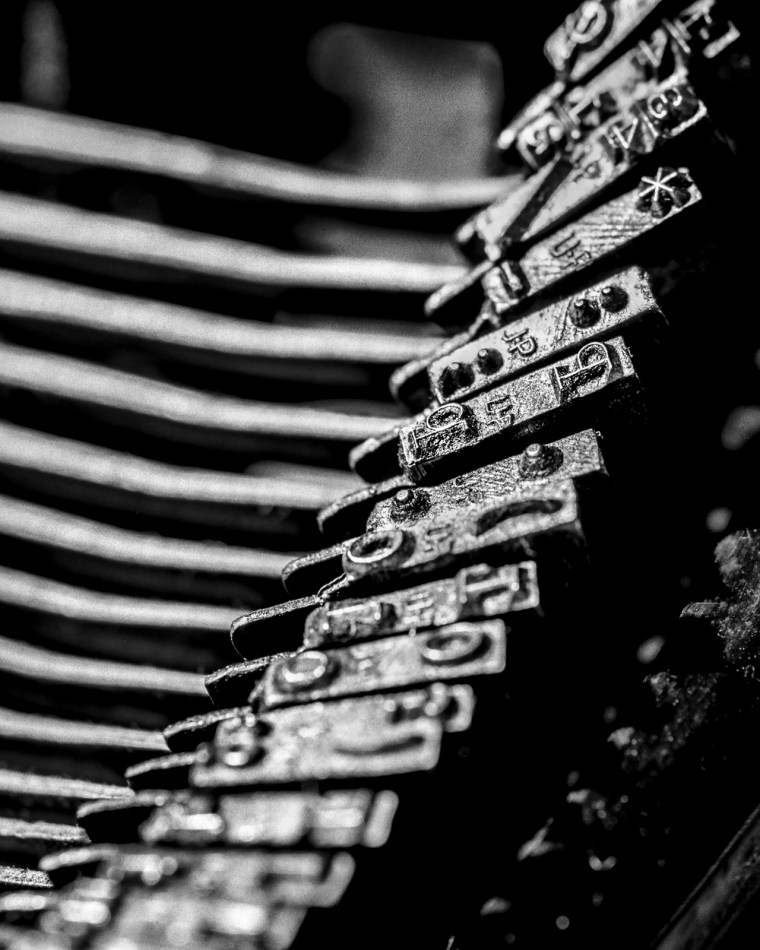
Browsing at an antique fair, I was attracted to this typewriter with crooked letters, yellowed keys and options no longer used on computer keyboards (ribbon, margin release, fractions, cent-sign).

In 1575 an Italian printmaker named Francesco Rampazetto built a machine that impressed letters on paper. Centuries later, variations on his invention were huge and impractical. Then in 1868, Americans Christopher Latham Sholes, Carlos Gladden and Samuel W. Soule invented the first commercially successful, small device that everyday people could use to type words on paper. Machinist Matthias Schwalbach and E. Remington and Sons (sewing machine fame) sold the patent of his prototype machine to Densmore and Yost for $12,000. To promote and sell this machine, which typed all CAPS, they called it a “typewriter.”

In 1878 the Remington #2 a machine was marketed with commonly used letters arranged in pairs, allowing their salesmen to quickly type the word “TYPEWRITER” using just the top row. Advertisers promoted the machines as a way for women to enter the workforce as secretaries and typists. Ernest Hemingway used a typewriter for drafts, then retyped the pages more quickly. He said it helped him hear the “rhythm of the words.” And during WWII and the Cold War, intelligence agencies (FBI, CIA, NSA) identified documents by analyzing the “fingerprints” of specific typewriters—tiny quirks in alignment, ink dust and wear patterns unique to each machine.

I used a mechanical typewriter until the early ’70s. Having taken a typing course in high school, I could type pretty fast. I liked punching the keys, the ding! at the end of each line and pushing the return handle. There was a sense of momentum, like a train of thoughts clicking on. What I didn’t like was ink on my fingers from changing ribbons, needing to punch the keys harder when using carbon paper between sheets to make copies and using “White Out” to make changes or correct errors. It was messy, dried crust fell into the keys and the pages looked bad on final drafts.

With a typewriter, you don’t erase, you live with your words. That permanence sharpens the thought.

                        Tom Hanks, actor

The Alphabet

According to Google, the English alphabet has its earliest roots in Egyptian hieroglyphs, where pictures were adapted by Semitic peoples into symbols that represented sounds. This system developed into the Phoenician alphabet, which spread widely through trade and has influenced many cultures. The Greeks adopted it and added vowels, and the Romans eventually shaped it carrying traces of its ancient origins.

Evolving Technology

Marshall McLuhan famously pronounced, “The medium is the message.” That is to say, the  significance of all forms of “media” is that they extend human capacity—thought and expression in particular. The typewriter mechanized writing making it fast, uniform and widely accessible in academia, government, commerce, publishing and personal communication. In time, the keys showed up in the form of a computer keyboard, which transferred to the smartphone. And given the evolving forms of memory and processing media (silicon, quantum), direct speech could obsolete the keyboard. Futurist Barbara Marx Hubbard referred to this pattern of ephemeralization: “Our technology is helping us catch up with our consciousness… Technology is becoming less mechanistic and more bio-psycho neurological.”

Potential

The beauty of combining letters of the alphabet to give tangible form to thought, is that, unlike spontaneous speech, it requires me to slow down and consider, more accurately present what I want to say. Also, a keyboard presents a field of infinite potential. Because the letters can be combined to produce an infinite number of words and their arrangement, I’m required to “engage mind before fingers.” Typing encourages awareness: Is this accurate? Is that what I really want to say? And experimentation—writing a sentence or paragraph to see if it works. And I can easily make corrections to change the meaning, spelling or grammar.

Whatever the word-making medium, what matters is not only what we have to say and how we say it, but where it comes from—is it authentic, true to what we think deep down, believe or want to convey? Or does it originate outside us, perhaps an expectation, someone else’s opinion or belief or artificial intelligence? And tied to this, is motivation. I make these distinctions, because today the truth is under attack by politicians, foreign governments and Internet exploiters.

Words Matter

Words condition our perception of reality. They influence our emotions and guide our actions. They can heal or harm, inspire or discourage, unite or divide. It’s how we share ideas, transmit values, preserve memories and create meaning. They can clarify truth or distort it, affirm dignity or diminish it, contribute to understanding or confusion, inspire confidence or fear, empower or discourage action. Whatever the technology, the thoughts expressed enter the minds or readers, influence the culture and contribute to the “noosphere,” the subtle field of global and timeless consciousness in which all thoughts, energies and experiences are recorded. Both Western and Eastern spiritual traditions agree—from first to last breath, every thought, every word we think, speak or set down in some form is a contribution (positive and negative) to the whole, the human project. Accordingly, the species evolves in consciousness.


What lies behind us and what lies before us are tiny matters compared to what lies within us

Ralph Waldo Emerson, essayist, philosopher, poet

______________________________________________

My other sites:

David L. Smith Photography Portfolio.com

Ancient Maya Cultural Traits.com: Weekly blog featuring the traits that made this civilization unique

Spiritual Visionaries.com: Access to 81 free videos on YouTube featuring thought leaders and events of the 1980s.

 

Patterns

Evidence of cosmic order

All evolution is a dance of wholes that separate themselves into parts and parts that join into mutually consistent new wholes. We can see it as a repeating, sequentially spiraling pattern: unity to individuation to competition to conflict to negotiation to resolution to cooperation to new levels of unity and so on.

Elisabet Sahtouris, evolution biologist, futurist, author

In 1979 I was interviewing noted scholars, authors, scientists and artists for a television documentary I wanted to produce on the life and philosophy of Pierre Teilhard de Chardin. The film never got made but in the course of the research I came to understand that, although the evolutionary process is not predetermined, it is pre-patterned, driven by features that are constant and consistent. Among them are the conservation of energy, increased order and complexity, innovation and reciprocity. In the 80s when chaos theory emerged and mathematician Benoit Mandelbrot displayed his fractal images, these and other patterns became visible, demonstrating that beneath the apparent chaos, in all of nature there is order. From quarks to the cosmos, it’s revealed to us as patterns.


Computers create relationships based on patterns, and clocks display them in segments of time. Patterns of thought bring order and consistency to everyday living, for instance in our routines. Artists in every field look for and incorporate patterns in their works, in large part, consciously or not, because they evidence and reflect the order—some would say the “intelligence”—of the universe.

At a certain point, probably by noticing that I had already photographed lots of patterns, I decided to seek them out. Reading in physics helped me to appreciate that all patterns, whether found in nature or in man-made objects, were evidence of the order intrinsic to the cosmos. This especially became clear in the 90s when scientists learned that matter itself turned out to be patterned arrangements of energy.

And then I gained some perspective on the order within the atom. For instance, if Yankee Stadium were an atom, the nucleus would be smaller than a baseball sitting in center field, and the outer part of the atom (electrons) would be tiny gnats buzzing about in orbits and altitudes where commercial airplanes fly. In between the baseball and the gnats there appears to be nothing, but various technologies reveal them be patterned energy fields.

Human-made patterns are evidence of our ability to repeat behaviors and create objects and images that are consistent, even identical, and organize them into coherence. They’re strongly associated with culture, for instance, in building materials, branded shopping carts, clothing and fabric made of Scottish plaid,  architecture as seen in Islamic geometry, and in values.

In Patterns of Culture, anthropologist Ruth Benedict observed that “A culture, like an individual, is a more or less consistent pattern of thought and action.” Each culture, she said, chooses from “the great arc of human potentialities” a set of characteristics that become its leading personality traits, and constitutes an “interdependent constellation of aesthetics and values” that make up its unique world view. Here, a conception of the ancient Maya world view and Chak, the rain god, are reflected in the motifs on this building.

Nature-made patterns reveal the underlying order of universal forces including gravity, magnetism, planetary and geologic movement, seasons, climate, wind and wave motion and electric force to name a few.

In some patterns, the order is regular, for instance in snowflakes, spider webs, and fish scales.

In others, such as a tiger’s stripes, tree bark, and soil erosion, the pattern is irregular.

Contemplating Pattern in Personal and Social Contexts

Pattern recognition is critically important in making decisions and judgments, acquiring knowledge, advancing the sciences and expressing creativity. Writing in Psychology Today, psychologists Michele and Robert Root-Berstein write that “The drive to recognize and form patterns can be a spur to curiosity, discovery, and experimentation throughout life.” They cite M.C. Escher and Leonardo da Vinci as artists who purposefully looked for patterns in wood grain, stone walls, stains and clouds—to use in their works and to stimulate thinking beyond convention. They note that every living thing that repeats a form, behavior or process has found a way to survive.

Psychologist, Jamie Hale adds a caution noting that “the tendency to see patterns in everything can lead to seeing things that don’t exist.” His examples of pattern recognition gone awry include “hearing messages when playing records backward, seeing faces on Mars, seeing the Virgin Mary on a piece of toast, superstitious beliefs of all types, and conspiracy theories.” I’d add to this, the turning of a blind eye to the increasing patterns of climate change.

Once in a while it’s good to look at our most repetitious behavioral patterns, the things we do almost every day and ask if they’re producing positive results for ourselves, others, society and the planet. To get a different result, the challenge is to adopt a different pattern—habit. For instance, when ordering iced tea in a restaurant I ask for a paper rather than a plastic cup.

On the social side, Tony Zampella, a sociologist, and leadership coach provides examples of exploitation in several area citing them as destructive social and environmental patterns.

In Labor—exploiting child labor, overworking employees without benefits or overtime, underpaying women in the workforce and hyman trafficking.

In Production—flouting regulations or cutting corners to maximize shareholder value or profits, (think Ford Pinto, the GM switch recalls, the recent Wells Fargo scandal).

In Public policy— exploiting fears to benefit an industry or voting block (think the congressional ban on gun violence research, willful ignorance of tobacco’s link to cancer and denial of climate change).

In Resources— ravaging the planet for political or monetary gain (consider the current fracking debacle, or the Exxon Valdez, or the BP Deepwater Horizon oil spill).

As the behavior patterns of these and other cultural, commercial and political systems break down, they’re affecting change in the way we think about ourselves in relation to the Earth. As a consequence, we’re increasingly needing to rethink the workability and philosophy of materialism—the notion that the world is made up of dead atoms, that human consciousness emerged as a development of complex brains, that the resources of the planet are ours to subdue, that securing property, goods, wealth and varieties of experience are the road to happiness and that the purpose of religion is to gain a reward in an afterlife or beneficial rebirth. This—the “domination paradigm”— has been and continues to have dramatic and catastrophic consequences for the environment, the quality of life for humans and animals, and the ecosystems that sustain all life.

Atmospheric scientist, Michael Mann, writing about the jet stream as The Weather Amplifier (Scientific American March 2019), said, “The safest and most cost-effective path forward is to immediately curtail fossil fuel burning and other human activities that elevate greenhouse gas concentrations.” According to philosopher and social scientist Beatrice Bruteau, our best hope lies in the emerging paradigm, what she refers to as the “communion paradigm,” the perception that the earth does not belong to us, that we belong to it, and that all things and people are interconnected in the web of life.

In The Universe Story: From the Primordial Flaring Forth to the Ecozoic Era–A Celebration of the Unfolding of the Cosmos, eco-theologian Thomas Berry and cosmologist Brian Swimme show how the old sectarian story about how the world came to be and where we fit in, is not only dysfunctional but toxic to living systems. Importantly, Dr. Berry distinguishes the “environmental” movement from the “ecological” movement, the former attempting to be a respectful adjustment of the earth to the needs of human beings, whereas the latter is an adjustment of human beings to the needs of the planet. It’s why I’m always looking for leaders whose concern is “ecosystems” rather than “the environment.” According to these authors, the basic tenants of ecosystems are differentiation, which is the foundation of resilience (creating and celebrating variety in all things including people), subjectivity (preserving the inner aspects of life, the “vast mythic, visionary and symbolic world with all its numinous qualities”), and communion (the co-creative, mutually beneficial interrelatedness “that enables life to emerge into being.”) They observe that these three elements are fundamental patterns in the evolution of living systems.

Of course, a change in perception is not enough. It must be matched with commensurate action by individuals and governments, religions, educational institutions and corporations—as filmmaker Michael Mann urges, getting off fossil fuels. Thomas Berry is even more adamant: “All human institutions, professions, programs, and activities must now be judged by the extent to which they inhibit, ignore or foster a human and Earth relationship.”

So what can we do as individuals? We can develop a pattern, a regular practice—habits of recycling, minimizing our carbon and consumption footprints, supporting local and national initiatives in safeguarding or restoring ecosystems, educate ourselves, speak about ecology with family and friends—in person and through social media, and affect even broader influence by consistently voting for leaders who are knowledgeable about ecology and committed to making appropriate responses to climate change a top priority. It deserves that status because the survival and vitality of everything else, without exception, depends on humanity getting into patterns of right relationship with each other and the planet.

The human might better think of itself as a mode of being of the Earth rather than simply as a separate being on the Earth.

Thomas Berry, priest, “ecologian”

For further reading on what we can do, I recommend Active Hope: How to Face the Mess We’re in without Going Crazy by Joanna Macy and Chris Johnstone.

(For pattern photographs in black and white, visit my monograph: Patterns: Evidence of Cosmic Order. Click on the book, enlarge and turn the pages).

_____________________________________________

My other sites:

David L. Smith Photography Portfolio.com

Ancient Maya Cultural Traits.com: Weekly blog featuring the traits that made this civilization unique

Spiritual Visionaries.com: Access to 81 free videos on YouTube featuring thought leaders and events of the 1980s.

Reverence for Light

Attending to light fosters deep perception and appreciation

I was nineteen and majoring in photography at Rochester Institute of Technology when I made a commitment to the regular practice of black & white photography as a medium of personal growth. Prompted by insights gained from some images I’d made, I sat alone in my car overlooking Lake Ontario and became overwhelmed with tears of joy. I said to myself: Whatever else happens in my life, I will always photograph and learn from the results. Unwittingly, I had adopted an admonition that I encountered years later in the writings of scientist and philosopher Pierre Teilhard de Chardin S.J. “The more one looks,” he said, “the more one sees. And the more one sees, the better one knows where to look.” Many years later I am still on that path, exercising a growing capacity to experience beauty, discover essences and ultimates within commonplace forms and circumstances, and express feelings of appreciation and joy that come as a result.

Within a few years of making that commitment I realized that subject matter was taking a back seat to light. Beyond its direction, intensity and color, I hungered for circumstances and a quality of “illumination” that would evoke a sense of the subject’s essential being in relation to All Being—including its process of becoming. I’d experienced this in the works of Ansel Adams, Paul Caponigro, Ruth Bernhard, Edward Steichen and Minor White, so I knew the light without could reveal something of the light within.

But what was that “light within?” And where could I find it? Two experiences suggested a direction. The first was reading Teilhard’s description of love as an energy, “the affinity of being for being.” The other was when I heard Buckminster Fuller say that love is “evolutionary gravity,” the thing that holds everything in the universe together. Signs of affinity are readily available in nature, particularly in objects that display the fundamental order and patterns observed by scientists and mathematicians.

It’s readily available in nature.

But could it also be observed in people?

In the built environment?

In commonplace objects we make and use?

Perhaps seen in a new light or from a different vantage point?

What about objects that no longer serve a purpose? Indeed, the more I looked, the more I saw. And the more I saw, the better I understood where to look. Fast-forwarding through many more years of photographing and scrutinizing the results, I learned that deep perception—-seeing beneath the surface and with understanding eyes— requires both knowledge and imagination.

In 1978 I toured a mushroom farm and came away with a photograph of a dirty old wrench lying on an oil drum. While moving the print from one tray to another, I began thinking about what had to happen in order for that wrench to exist in front of my camera. What was its history? I thought about the farmer who used it last and set it down. I wondered what it was used for and how many other people had used it.

In my mind’s eye I back-timed to see the wrench shiny and new hanging on a pegboard in a hardware store, available for purchase. That led to imagining the steps in its making: the forging process, the molten liquid being poured into a mold, and before that the minerals being mined while a great distance away  in time someone sat at a drawing board drafting its form and dimensions. Prior to that, well down the evolutionary spiral, another someone was the first person to visualize the wrench-and-nut as a solution to a problem. And in order for the vision to materialize there had to be an accumulation of knowledge about the properties of metals, especially how to shape and strengthen them. Further down the spiral, I contemplated the frustrations and challenges, the failed experiments and happy accidents that resulted in that knowledge. And what did that require? All the people, time and learning that came before it, including the millions of years of human evolution that led up to it. And what did that require? Billions of years of planetary, solar, galactic and cosmic evolution. And what did that require? The Big Bang. And what did that require?

Up and down the evolutionary spiral: affinity and joining, love and union. “Fuller being is closer union,” Teilhard said. By joining in ways that promote viability and growth, simple forms brought about new, more complex and conscious forms. Primordial forces and sub-atomic particles merged to form atoms. Atoms joined to become molecules. Molecules joined to become cells. Cells joined to become organisms. Organisms joined to become creatures. Human beings joined to become societies. And societies joined to become nations.

That image of the wrench, isolated and illuminated to accentuate its form, texture and context was a statement of being that precipitated my journey down the evolutionary spiral—all the way to Source. At some point, particularly when the light is exquisitely illuminating a person, object or situation, backtiming to the Ground of All Being became natural.

If you wish to make an apple pie from scratch, you must first invent the universe.

Carl Sagan, astronomer, author

For more such images, visit my book: Reverence for Light: A contemplative approach to photography. Click on the book, expand the screen and turn the pages.

________________________________________

My other sites:

David L. Smith Photography Portfolio.com

Ancient Maya Cultural Traits.com: Weekly blog featuring the traits that made this civilization unique

Spiritual Visionaries.com: Access to 81 free videos on YouTube featuring thought leaders and events of the 1980s

The Illusion of Control

What can we do in the face of unsettling change, eroding confidence and civility?

The world has tilted in the direction of uncertainty. Social, economic and cultural norms are shifting and many are being dismantled.[1] Droughts, tornados, fires and flooding are becoming more frequent and severe. Technologies are evolving faster than the wisdom to manage them responsibly. Politics has become more of a contest between adversaries than a process for securing citizen welfare and well-being. Screen-based communication is increasingly preferred and inserted into social situations, often at the cost of personal engagement.2 More than personal engagement, people are using electronic devices to communicate, and gossip dominates conversations.3 And Cable television and streaming platforms are emphasizing programs designed for comfort, fantasy and distraction reflecting a move away from broad, culturally unifying programming and toward personalized escapist content.4

Evolutionary Drivers

While we tend to think of these phenomena as “negative” or “problematic,” they can also be seen as “evolutionary drivers,” perturbations or systemic stresses that are the birthing pains of a more refined, coherent and unified humanity. The long picture—it appears that humanity is in the process of learning responsible human-planet management. By experiencing breakdowns and dysfunctions due to self-centeredness, on the next turn of the spiral we’ll come to understand that survival requires coherence, whole-centered consciousness and collaboration, particularly being in right-relationship with each other and the planet. By actually living the teachings of the founders of the world religions and fostering love of the planet, we can—and I believe will— achieve this.

Cause

The leaders of every great spiritual tradition tell us the same quiet truth, that the fundamental cause of separation, self-centeredness and dysfunction is ignorance of who we are, what we are, why we’re here and what’s possible if we were to unite. The Dalai Lama wrote that “Ignorance is the true enemy, not the other person. It is ignorance that imprisons us in the cycle of suffering.” Spiritual teacher Eckhart Tolle says, “The greatest illusion is the illusion of separateness. It is ignorance of who we truly are that gives rise to fear and conflict.” Philosopher Beatrice Bruteau considered that the root problem of humanity is not sin, “but ignorance of our real identity as participants in divine life.” And in a 2024 talk to students at a school in Northern Italy, Pope Francis warned: “Ignorance breeds fear, and fear breeds intolerance.”

What unites these voices is the understanding that our urge to control is born of fear and separateness. We imagine ourselves apart from God, apart from life, apart from one another. But in surrender, in trust, in letting go, we discover we were never separate at all. Control closes the hand; surrender opens it. And only the open hand can receive. The ideal model for this is life itself, which thrives on unpredictability.

Trees unfurl their leaves without a plan or schedule.

Flowers blossom without an algorithm.

Rivers and streams wend their way and merge through the landscape without a map.

What Can We Do?

Considering the many and dramatic changes going on worldwide, concerned citizens are asking, “What can I do?” When asked, one of my simpler responses has been to “focus on what’s in front of us”—concentrate on work, better manage schedules, undergo a health discipline, spend time in nature, engage more with family and friends and think positively. This can help for a while, but pervasive media reports of breakdowns, disasters and previously unimaginable events in the media keep fueling uncertainty and helplessness, in some cases, depression and suicide.

Positive Visions

Must we learn the hard way? Many are suggesting otherwise, building on and contributing to visions of a positive future. Futurist Barbara Marx Hubbard envisioned humanity on the verge of a great evolutionary leap, “moving toward a planetary birth of a united humanity, capable of co-evolving with nature and co-creating with God.” Her hope resonated with priest-philosopher Teilhard de Chardin’s conviction that one day we’ll harness not just the forces of nature but “the energies of love,” discovering a new fire in the heart of humanity. Engineer-philosopher Buckminster Fuller echoed this same belief, urging us to become “architects of the future, not its victims.” And contemporary theologian Ilia Delio observed that creation itself is unfinished, that “God is doing new things, and we are invited to participate in the future that is rising up through us.”

Buckminster Fuller and Barbara Marx Hubbard

In 1983 I produced a one-hour video: Our Spiritual Experience: A Conversation with Buckminster Fuller and Barbara Marx Hubbard in which they expressed their positive visions for humanity.

Uncertainty and Control

In the face of uncertainty the tendency is to exercise more control over our lives, to dream, plan, schedule, research and close ranks. Wisdom teachers say that’s an illusion, freedom from the stresses of confusion and uncertainty actually lie in letting go. For instance, Thomas Merton wrote, “We must relinquish our control over the deepest ground of our being and let God take possession of it.” He said the “false self” is constantly trying to achieve security through mastery of the situation, while the “true self” knows that security already rests in God. Our task is not to seize but to yield, not to hold or close but to open and allow.

The same perspective is echoed in the East. In the Tao Te Ching, Lao Tzu warns, “The world is sacred; it cannot be controlled. Whoever tries to control it ruins it.” Life is like a river. It cannot be dammed or forced without damage; to live in harmony with it is to move as the current moves—sometimes swiftly, sometimes in quiet eddies—trusting the flow more than the map. Chuang Tzu adds, “Flow with whatever may happen, and let your mind be free.” Beyond their choosing, clouds form, drift and then dissolve, shaped by the wind. And the Buddha taught that a mind gently steadied like a flame shielded from the wind, brings happiness, because it no longer grasps at what it cannot hold.

Seek Guidance From Within

Regarding what to do, I favor a simple comment made by Lebanese novelist Mikhail Naimy. In The Book of Mirdad, he wrote “When in doubt about the next step, stand still.” The implication is to get quiet and look within, because that’s where all life’s lessons reside. In an atmosphere of troubling change and uncertainty, our most appropriate and authentic response can be found by consulting the soul, the place in us that knows the deepest truth of who we are, why we’re here and what we need to experience and learn this time around—for our sake, and that of the greater whole.

This is not to suggest we do nothing to influence or affect change. Just that guidance or validation that come from the soul (whatever we choose to call the animating higher intelligence within) will be in concert with our pre-birth plan and purpose—rather than any emotional trigger or outside influence. Think about it: What would happen if we all did that? One other thing to do—easiest and quickest— is to express gratitude for everyone and everything we enjoy and appreciate.


We sense that we are living at the end of an era, and that something more beautiful is struggling to be born.

Charles Eisenstein, author and activist

__________________________________________________________________________________


[1] Bicchieri, C., Centola, D., & Gelfand, M. (2023). Social norm change: drivers and consequences. Philosophical Transactions of the Royal Society B: Biological Sciences, 378(1879).

2 CliffsNotes. “The Effect of Technology on Face-to-Face Communication.”

3 Dunbar, R (2004). “Gossip in evolutionary perspective”. Review of General Psychology. 8 (2): 100–110.

4 Media, Society, Culture and You. “The Relationship Between Television and Culture.” Boise State University Pressbooks.

______________________________________

My other sites include:

David L. Smith Photography Portfolio.com

Ancient Maya Cultural Traits.com: Weekly blog featuring the traits that made this civilization unique

Spiritual Visionaries.com: Access to 81 free videos on YouTube featuring thought leaders and events of the 1980s.