Vibration And Form

Energy is vibration. It’s largely invisible, but when energy takes a form it’s always geometrical, prescribed by the fundamental laws of physics including gravity and the three Laws of Thermodynamics:

1. Conservation of Energy: Energy cannot be created or destroyed, just changed.

2. Entropy: Matter dissipates; disintegrates. Entropy either stays the same or gets bigger.

3. Heat: As temperature approaches absolute zero, the value of entropy approaches a minimum.

What creates vibration in the first place? The current theory, gaining traction among physicists, is consciousness. (See my posting: “Potential” 9/24/17 for details) Simply put, it’s the interaction of positive and negative forces within atoms. Positives “want” to join with negatives and vice versa.

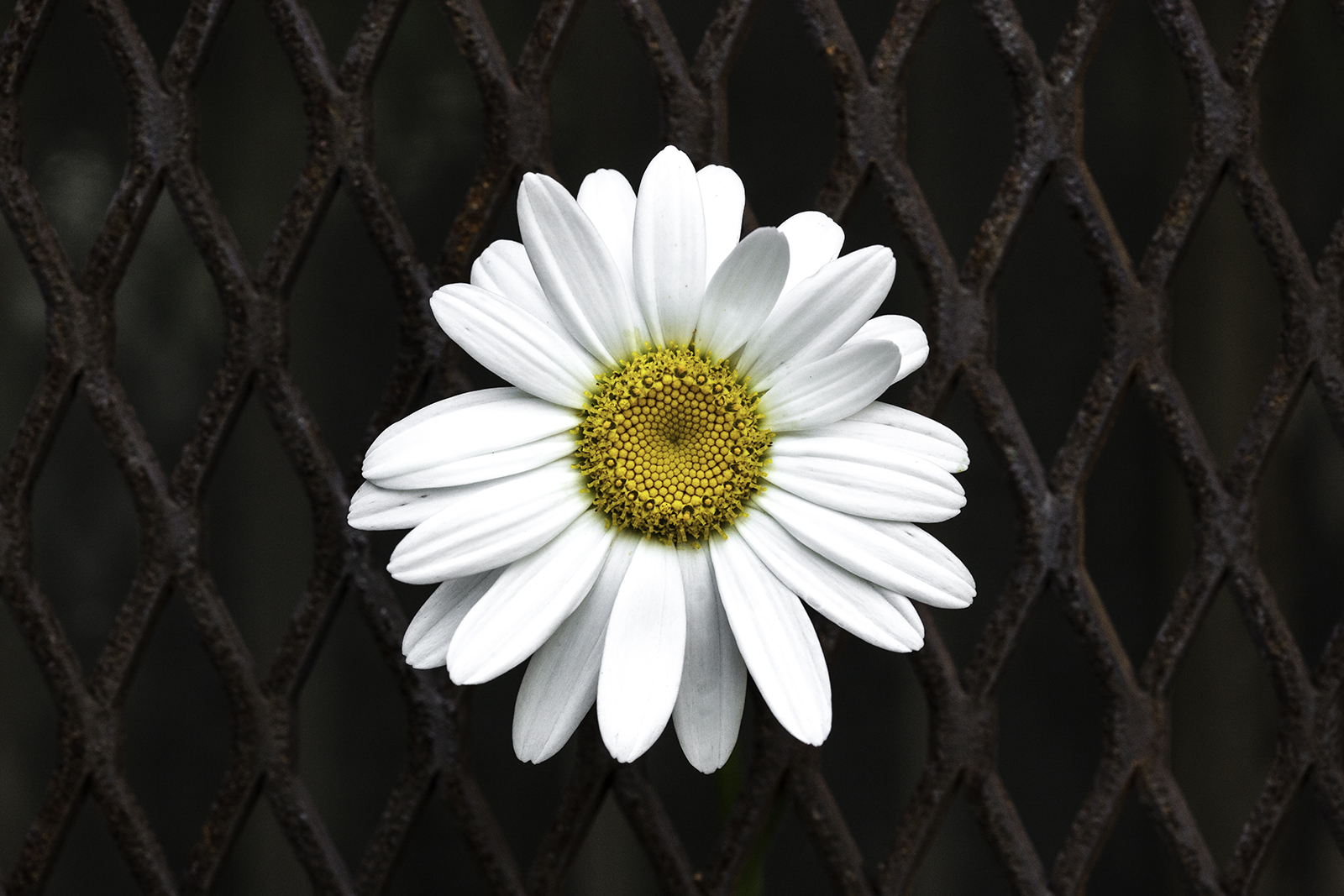
Recently I’ve been making images that combine a nature-made subject with something that is man-made. The above is an example. Here, on the one hand, I’m intrigued by the visual contrast between the living blossom and the rusting metal, and on the other by the differences in these forms. Their “vibrations” and shapes are distinctly different—they are in contrast to one another, but share the same destiny; they’re also equally under the influence of entropy.

Because it is a living system, the visually more vibrant flower disintegrated in just a few days. In contrast, the fence will take decades more to succumb to entropy, even if the structure that supports it is demolished. Eventually, both will revert back to pure energy, the ground state of the universe where nothing is added or lost. And from that ground, vibrations in similar form will once again emerge.

What is anything but spirit taking form?

Alex Gray (Artist)

This continuity of forms, in all their diversity, human or otherwise, reflect the consciousness of the universe. They are said to be “expressions.” And once established, evolution “plays” variations on the form, from sea shells and dinosaurs to automobiles and skyscrapers. Acknowledgement of the fact that forms reoccur is evidenced in sayings such as, “There’s nothing new under the sun,” and “Everything that can be photographed has been photographed.” Insects, automobiles, skyscrapers and human beings are variations on the same universal themes—creatures that crawl, vehicles that transport human beings, buildings that rise to the sky and beings who are self-aware.

Another observation: The “recycling” of forms is much more dynamic in living forms, than in non-living forms: their lifespan is shorter. In the case of human beings however, where form and consciousness are intrinsic, the former is subject to entropy but the latter is not. As Pierre Teilhard de Chardin S.J. said, “We are not human beings having a spiritual experience, we a spiritual beings having a human experience.”

Each time a geometrical form is produced, an expression of the universal oneness is made; it is at once unique in time and place and also timeless and transcendent, representing the particular and the universal.

Nigel Pennick (British author)

Models And Modeling

Children are influenced most by what they see

Boy Watches Man In Doorway

Joseph Chilton Pearce, a respected author on the subject of brain development, wrote that a child’s capacity to operate in the world is determined entirely by the models he experiences in everyday life. He observed that all human intelligences—music, math, art, logic, mechanics, even emotions and intuition—are built into us genetically at birth. As potentials. “Their awakening,” he says, even for adults, “requires stimulus from the external world, from someone who has developed that intelligence to a functional level.”

This was certainly true for me. For you as well? Had I been able to interact with a practicing fine art photographer or motion picture director early on, I could have begun to awaken my visual potentials—and careers—that much sooner. Instead, in my youth, I resorted to the only resources at hand—books and magazines, which were highly inadequate. Learning theory says we learn best from having behavior modeled and reinforced, by seeing someone do what we want to do. And, it cultivates the confidence-building attitude, “If she can do it, so can I.”

Having taught at the university level and managed a television production facility for twenty-six years, one of the most important lessons I learned about teaching was to acknowledge and celebrate a student’s potential when it shows up, and then feed it by providing face-to-face, first-hand experiences in that area. I can’t overestimate the extent to which so many of my students benefitted from visits to television stations, commercial and corporate video and audio production facilities and post-production houses—and the professionals who came to class to speak. In addition to subjecting students to working professionals, “real” world models and environments, I encouraged them to introduce themselves and build relationships with these people, and many students gained internships and jobs that way, even developed careers in the field as a result.

The child in the above image, observing the behavior and possibly hearing the conversation between the adults has momentarily diverted his attention away from the toy car. It’s just a moment. But the triangle of attention speaks to me of the significance of modeling, particularly for children. It raises the social question: What are we exposing our children to? And it challenges me to address personal questions: Who and where are my models? Where do get my inspiration? What social and media experiences empower me to live more authentically? What are my potentials? Which of them do I want to nurture? Am I appropriately prioritizing them? What am I modeling for those with whom I interact? This kind of questioning has undoubtedly helped me discriminate between distraction and purpose.

In part, I choose this image and theme because of the domestic and ideological violence being reported in the news lately. In all these instances I watch and think about the children being exposed to models of dysfunction, young minds whose potentials are being radicalized, neglected or suppressed. I’m reminded of Buckminster Fuller who, after I’d produced a program featuring him, took my hands and said, “Keep on doing what you’re doing, young man. We need more of this kind of (constructive) programming.” It was he who wrote that, “You never change things by fighting the existing reality. To change something, build a new model that makes the existing model obsolete.” Indeed, create a new, more functional model.

Children have never been very good at listening to their elders, but they have never failed to imitate them. 

James Baldwin


Everyday Beauty

It abounds when and if we look for it

                                           Sunlight reflecting off sink fixtures

Whenever I hear “Beauty is in the eye of the beholder,” I take it to mean that some people find beauty where others do not. An artist friend who designs and sells jewelry once remarked that he made it a practice to experience beauty every day. I thought that was wonderful. But between work and family life, the only time I found available to search for beauty was when I was out with a camera looking for it.

Searching for opportunities to compose elements within a frame in ways that fed my aesthetic hunger, I frequented scrap yards, construction sites, abandoned buildings, tractor-trailer parks, empty fairgrounds, railroad graveyards and musty antique shops. As a consequence of creating order out of visual chaos, I was experiencing beauty in unconventional places and subjects. I first noticed this when I realized that I didn’t need to go to the beaches, national parks or anywhere else to find beautiful subject matter. It was at hand. To transform an ugly or ordinary object into a beautiful one, all I had to do was to decide to see it that way—with or without a camera. That said, beauty is a choice we make.

My curiosity about it has been an evolution. As a child, I thought certain people, places and things were intrinsically beautiful and others were not. Through readings and formal education I learned that beauty is subjective and it varies widely between individuals. Camerawork taught me that beauty can be manufactured, as when  lit or arranged objects in a more pleasing way. And that by deliberate choice, an ordinary object can be transformed into something beautiful. Actually, working for film and television companies, my job was to often to make everyday situations and products (sheets and pillow cases, jewelry, toys, food, car dealerships, corporate interiors—look beautiful.

As subjective experience, beauty (along with goodness and truth) evades description. Nonetheless, each of us can, with contemplation, find some words to better understand its place in our lives. Currently, the experience of beauty presents me with feelings of joy and harmony, sometimes awe. Especially it comes whenever I encounter nature’s design principles at work, even in man-made objects.

The above image reminds me that beauty can be found anywhere—literally in the kitchen sink. And I can predispose myself to experience it by choosing to see it in everyday places and objects. Beauty is not only something to be found, it’s something to be open to—or made. It may be in the “eye” of the beholder, but it’s also in the heart touched by an appreciation of all that is.  

It’s not what you look at that matters, it’s what you see.

Henry David Thoreau, American naturalist, essayist, poet, philosopher


Light Bulbs and Electricity

Life before and after them

In the summer of ’76, the year Linda and I were married, we went to the Cayo district in Belize so I could better appreciate where and how she’d lived for a year, teaching English to high school students under the auspices of the Papal Volunteer’s—the Catholic church’s version of the Peace Corps. We hired a taxi at the Chetumal, Mexico airstrip to drive us a hundred miles into the jungle. For hours, the only lights we saw were the taxi headlights on the deeply pitted dirt road and occasional kerosene lamps flickering through the trees.

Linda’s dear friends were excited to reunite with her and they welcomed us to stay with them. That same night, a roach as big as my forefinger was on the sheet when Linda pulled back the blanket. And the fluttering I heard as I brushed my teeth in a basin, turned out to be a bat. I said I wanted to leave in the morning. But she informed me that there weren’t any taxies in town, there was no bus that day and the only telephone line had been destroyed by the Maya burning their fields for planting. So I resigned myself to stay one more day. The next morning I stepped outside and into a jungle with dripping leaves, parrots, glistening lime trees and sparkling bright sunlight. I ran and got my camera. I was in photography heaven.

So what’s that got to do with a lightbulb? Appreciation—for the gift of electric power and the lack of it. At that time, San Ignacio had neither televisions nor electric refrigerators. The town’s electric generator shut down at ten o’clock after three hours of use in the evening, so as darkness approached our hosts, friends and Linda and I sat around a 60 watt bare bulb that hung from the ceiling on a wire. There was nothing to do but talk. As I remember it, these were less like conversations and more like family reports on who did what, who went where, when certain animals would be slaughtered for market, who said what to whom and what politicians were doing—or not doing. When the generator shut down the talk continued for another hour by the light of a kerosene lamp.

The light bulb in this image evokes memories of that challenging and wonderful week, in particular an appreciation for the luxuries—and necessities—that electric power affords. I understand now, how the light bulb became the symbol for the word “idea.” Now, instead of sharing the news and gossip of the day with family, friends and neighbors electricity allows us to converse, interact, connect, read and watch movies at night in the comfort of our well-lit air-conditioned homes. It’s staggering to consider how much has been gained because of access to consistent, affordable and abundant electricity. Don’t we notice, whenever it goes down for whatever reason, our appreciation awakens and grows with every passing hour?

But something has also been lost. We no longer sit together face-to-face in the evenings, sharing the close-in happenings of the day with family members, friends and neighbors. It’s not that I miss what’s been lost. But the light of that 60-watt bulb in San Ignacio, Cayo gave me a fresh appreciation for how people—and our not-to-distant relatives—managed and thrived without electricity. The light of that little bulb created a context, a call to gather without distraction and share face-to-face.

We forget just how painfully dim the world was before electricity. A candle, a good candle, provides barely a hundredth of the illumination of a single 100 watt light bulb.

          Bill Bryson, British author on travel


Vibration, Resonance, Synergy

Forces and processes that optimize human potential

Vesica Piscis

Take the full range of individual piano tuning forks and stand up them in a row. Take another one, unmarked, and strike it with a mallet. Of the many forks, the one that sounds will match the unmarked fork—and identify it. For instance, f-sharp only sounds when it “hears,” or resonates with, an f-sharp frequency. All the others frequencies remain silent. Like attracts like. And like responds to like. I originally made this image to see if I could visually convey the sensibility of vibration. Now, it points me to considerations of resonance and synergy as well.

Two discoveries in quantum physics come to mind. One is the observation that all sub-atomic “particles”—electrons, photons, quarks and so on—are actually interacting and vibrating “fields” within fields. Not solids. None of them, nowhere are solid. The other is the more recent discovery of the Higgs boson, the sub-atomic field that gives matter its mass. Combining these, Dr. Donald Lincoln, a particle physicist who divides his time between Fermilab and CERN in Switzerland says, “Everything—and I mean everything—is just a consequence of many infinitely-large fields vibrating. The entire universe is made of fields playing a vast, subatomic symphony.”

The description of vibrating fields calls to mind an experience I had where the “vibes” were so resonant they induced synergy, a circumstance where the whole (outcome) was greater than the sum of its parts (participants). In this instance, an astute television producer together with a multi-talented actor who had a vision, assembled a team of like-minded, skilled and creative people to produce a weekly children’s television program so entertaining that parents would want to watch it with their children— and ideally discuss its themes. Long story short, the thirty-nine episodes of “Max B. Nimble” accomplished its goals, had a long play and won national awards. In many ways, it exceeded expectations.

It wasn’t until much later that I appreciated how this producer, call him Oscar, created a resonant team capable of synergy. Reflecting on his methods, I began to see that they reflect the way nature works. All of nature vibrates and interacts in ways that contribute to cohesion. In a social or business context, it’s the quality of interaction, the personal expressions—fields within fields—that build coherence. To clarify, I offer Oscar’s methodology.

He identified and brought on board the most talented people he could find. In our first meeting, rather than have us introduce ourselves, he went around the table, presented our resumes and made glowing remarks about each one of us. Feeling like we were in the company of giants, we had to live up to his descriptions, which set the bar high and established the collective vibration. His articulation of our objectives were clear and inspirational. To insure that we all understood the nature of the communication challenge, he included a scholar who helped us put theory into practice. I for one, wondered if we could pull it off.

From day one, the process of writing and producing was intensive and exhilarating. We pushed ourselves and each other to perform at our highest levels. Every day. And we loved doing what each of us did best. The entire team met for daily script readings. And we had weekly meetings where every detail was discussed—down to the sandbags that secured the light stands so people wouldn’t trip over them. No detail was too small for consideration—and elaborate discussion. Every day we were eager to get to work. And at the end of the day we convened to review what happened and especially, screen what we produced.

With each screening there was praise, applause, and toasts when things went right. When they didn’t, rather than blame or criticize, the energy went into finding solutions. In this way we could see our progress and how each of us was contributing, thereby fueling our creative fervor even more. Oscar championed the best—advisors, talent, crew, resources and technologies—and he convinced each one of us that what we were doing was both meaningful and significant. As a result, we took ownership of the vision and assumed responsibility for realizing it. Every workday for nearly two years, we went to “play” with our colleagues, many of whom became long-term friends.

Rupert Sheldrake, who developed the theory of morphic resonance (The theory that memory is inherent in nature) wrote that “Energetic resonance occurs when an alternating force acting on a system coincides with its natural frequency of vibration.” Applied to a small group with a goal, people in resonance, basically in love with a vision and engaged in its creative realization, naturally become synergistic. As a vibration, love and being appreciated makes us capable of transcending individual limitations. Besides the bonding that results, participating together in meaningful and joyful enterprises heightens our faculties and encourages us to realize our higher potentials.

High performance techniques and processes, including the “Six-Sigma” techniques used in business to identify and remove the causes of defects and breakdowns within an operating system, result in outcomes where one plus one equals a qualitative two. Clean and neat; outstanding accomplishment when it happens. But rigorously speaking, synergy isn’t about high-performance, it’s about transcendence through coherent and resonant engagement. And when that happens, one plus one equals five. That’s its signature.

Here’s the formulation in a nutshell:

Everything vibrates.

Like vibrations produce resonance.

Resonance activated and directed to a common goal can produce synergy.

Synergy, through coherence, is capable of transcendent outcomes.


Synergy requires a circle of equals in resonance.

Carolyn Anderson, Author, co-founder of Global Family


Potential

The nature and extent of what’s possible

Reflecting on this single point of light emerging from the darkness, I think about the Big Bang or Big Breath and connect it to the notion that from nothingness the universe burst forth into “pure potential.”

To see what I might have on this subject, I went to my Vision For Television database. Not surprisingly there were many references to the word “potential,” among them the phrase containing the quote by physicist Amit Goswami that sparked further research.  He wrote “The universe is pure potential, waves of possibility. The elementary particles, the atoms, all the way up to the brain, are waves of possibility, not actuality. We, as observers, are required to choose (scientists use the term “collapse”) actuality from possibility.”

The significance of an observer determining what’s real derives from a paradoxical thought experiment by Erwin Schrodinger, who showed that a cat in a box with a capped vile of poison is both living and dead—until the box is opened and the cat is observed. The moment of observation collapses potential into a “reality,” such that only one of the possibilities becomes actualized. Quantum physicists are still exploring aspects of his experiment, but the notion that the universe is pure potential, waves of possibility until we choose what is actual, mysterious as it is, holds up. From my perspective it adds weight to the idea that consciousness is fundamental to the universe.

Dictionaries vary on the definition, but they share the general idea that a “potential” exists as a possibility that something can be actualized. Manifested. Michelangelo famously said that he cut away the parts of the block of Carrara marble that were not David. He actualized the potential he saw in the stone. Matter has potentials. The ones that realized are those in the mind of a beholder.

The more complex the object or system, the greater its potential. For instance, a computer has enormous potential compared to a typewriter. Their potentials are latent until someone uses them. Even in the case of artificial intelligence (AI) softwares, what is realized of their potentials is a function of the operator’s intention and action. The same tool can be used to build or  destroy.

Tools also differ in the nature and the extent of their potentials. A gun for instance, has a relatively limited range of potential; it’s primarily designed to threaten or kill (targets or living beings). An equally complex tool, a hand calculator has vastly more potential, including the exceptionally low possibility of it being used to kill.

To see how potentials are enhanced, imagine two houses on the same street where the families are exact duplicates of each other. The individuals in both families are equal in terms of their potentials for good and evil. When a gun is introduced into the system, say in “House A,” its mere presence enhances the potential for death or disaster by gunfire, irregardless of the gun’s attributes, secure location or condition. By nature, it’s a weapon.

Of course the potential for harm or death by a weapon exists in “House B” as well. Other objects, cooking knifes, poisons and heavy objects carry that potential as well. But the likelihood that someone in House B will be injured or killed by one of them is much closer to zero compared to the family in House A. Household items weren’t designed or intended to be used as weapons.

When it comes to human beings the potentials are unfathomable. It’s said that within all of us there resides the saint and the sinner. There’s a Native American story that speaks to this. A grandmother was teaching her grandson about life and the world. “A fight is going on inside me,’ she said to him. ‘It is a fight between two bears. One is angry, greedy and jealous. She complains about everything. She thinks she knows better than anyone and puffs herself up. The other bear is filled with joy. She is grateful for all that is given, accepting it as it is given. She is kind and generous. Her manner is humble and gentle. As you can imagine, the two bears are constantly fighting. It is a fight that is going on inside of you as well,’ the grandmother said. “It is going on inside all human beings.” The grandson asked, “Which bear wins?” His grandmother leaned close and said, “The one you feed, grandson.”

Indeed, the potentials we feed are the ones that become actualized in our lives and in the world. On the positive and constructive side, voices in many areas of human endeavor have addressed the subject of human potential. I let them speak for themselves.

Evolution then is the grand adventure of matter exploring its own innate potentials: from its first appearance after the big bang—from the first atom, molecule, and cell—to the magnificence and glory of the human brain. The greatest unfolding of evolution is literally the story the universe is telling to itself. 

Christian DeQuincy, Philosopher, cosmologist

Light is energy and it’s also information, content, form, and structure. It’s the potential of everything. 

David Bohm, Theoretical physicist

Free the child’s potential, and you will transform him into the world. 

Maria Montessori , Physician and philosopher of education

That society is good which fosters the fullest development of human potentials, the fullest degree of humanness. 

Abraham Maslow, Psychologist

When driven into far-from-equilibrium conditions, systems do not just break down, they generate new structures that pull higher forms of order out of the surrounding chaos. It is as if nature reaches into herself and draws forth structures that reflect the inherent potential of the system for higher orders of self-organization. 

Duane Elgin, Author, system’s theorist

Our mass media are only a poor shadow of what they could be—not for lack of technology, but because of our imperfect understanding of their potential power. 

Hazel Henderson, Economist, futurist

Every work of art that does not cause God to be felt misses the true potential of art. 

Alex Gray, Artist

Individual success depends on environments that trigger the fulfillment of our genetic potential. Environments that motivate through fear literally shut down the potential for growth. Those that motivate through vision, open us up to express unforeseen possibilities. 

Bruce Lipton, Biologist

With realization of one’s own potential and self-confidence in one’s ability, one can build a better world.

Dalai Lama

We’re all equally divine, but we’re all at different stages of actualizing our divine potential. The fullest expression of our divine potential is to be someone who helps others actualize their potential. 

Gordon Davidson, Leadership and social investment consultant

The City

The consequence of collective, enduring and respectful attention and collaboration

Dictionaries tend to define a “city” as an inhabited place of greater size, population or importance than a town or village. While size is a factor, social scientists emphasize that a city represents the collective consciousness—beliefs, values, aspirations and visions—of the people who live and work in a center of commerce and culture. Reflecting on this image of the Cincinnati skyline, I see the city upside-down and observe that it evolved from the Ohio River up, so to speak.

Since the mid-forties I have witnessed both top-down and bottom-up development—wealthy individuals initiating major projects (building skyscrapers and three sports stadiums) and major progress being made by small group initiatives (tree planting, waterway cleanup, downtown mural arts program). Across time and diverse cultures, monumental structures came into being as a result of charismatic and wealthy visionaries—pharaohs, kings and queens, religious leaders, captains of industry, philanthropists and business executives. Those at the top of the social pyramid provided livelihood, incentive and opportunities for those below.

City skyscrapers may be monuments to commerce that reflect the dreams and aspirations of those at the top, but those buildings and the city streets below would be empty and would crumble were it not for the simpler and more fundamental values and aspirations of the everyday workers who built and sustain them. We know the names of corporations (Apple, Chrysler), philanthropists (Bill Gates, Warren Buffett) and businesspeople (JP Morgan, Rockefeller Plaza) associated with grand structures but it’s important to remember that without the legions of laborers, craftsperson, artisans and professionals who struggled to feed their families and advance through education and hard work, these buildings would never have been built.

When I see the downtown areas of cities in crisis—abandoned office towers and stores, dilapidated housing, broken sidewalks and impoverished neighborhoods I remind myself that cities are dynamic living systems where people congregate, largely because they catch the spirit of the place. Something’s happening there and they want to be part of it—or they don’t want to be part of it and they leave.

When that spirit is gone, the buildings become empty shells. Revitalization initiatives often fail or fall short because the substantive challenge—beyond window dressing, attracting businesses and government loans—is the more difficult task of generating and vitalizing a new and fresh spirit, one that gives people a reason to care enough to want to work or live  there.

The world around, ancient indigenous peoples vitalized a place by ensouling it with guardian spirits, and by continuously enacting rituals that brought people together. Respectful attention is how “sacred sites” came into being and were sustained. I’m reminded of an early morning when I watched man sweep the dirt in front of his little shop in Taxco, Mexico. That small act demonstrated respect for himself, his family, the shop and those who  would come to browse. It makes me wonder what American town centers and neighborhoods would be like if more people and businesses cared for the property they own, manage or rent.

Continuous and respectful attention to a place, indoors and out, keeps its spirit alive. As a photographer, I observe that the slightest tasks such as cleaning a lens, editing images, signing prints, cutting mattes and entering metadata are acts of respect. They demonstrate caring for the whole by attending to the parts—subsystems, that constitute and determine the quality of one’s experience and that of others.

Systemically, by attending to the integrity of the parts, the functionality of the whole is maintained and the dark shadow of entropy is averted. At least for a time. Conversely, the way to eliminate something, to hand it over to the forces of entropic dissipation and decay, is simply to deprive it of attention. “Give it no energy,” as the saying goes—neither positive nor negative thoughts or deeds. A prominent example in the political sphere was when The Late Show With Steven Colbert instituted a policy of never mentioning the name of a former President.

From this perspective the reflected Cincinnati skyline prompts me to see the city’s populous, our interaction and commerce as a consequence of collective, enduring and respectful attention payed to specific values, dreams and aspirations. And they help to define us. Personally, it encourages me to pay attention and offer respect to the aspects of city life—the people, places, institutions and events—that I find uplifting, educational, inspiring and empowering.

The Great Society is a place where every child can find knowledge to enrich his mind and to enlarge his talents. It is a place where the city of man serves not only the needs of the body and the demands of commerce but the desire for beauty and the hunger for community. It is a place where men are more concerned with the quality of their goals than the quantity of their goods.

Lyndon B. Johnson, Former President of the United States

Flowers, Evolution and Humanity

Can they provide a model and direction for human evolution?

Red Hibiscus

Color texture and geometry combine here to elicit an immediate visceral response—a Wow!— whether from a potential pollinator or a human observer. It’s the energy of attraction. But from where does it originate? From the flower itself? From the image of the flower? From the colors and the arrangement of elements? Likely all of these, but my mind wants to dig a little deeper. As I write this, I feel like there is something more going on here, but I don’t know what it might be. What is it exactly, that attracts? Exploring, unfolding the implicate order of possibilities, is one of the joys of contemplation, each a spontaneous experience. So I proceed.

First things first: Flowers, more specifically “blossoms,” evolved their appearances and fragrances as a way to reproduce. For human beings the combination of color, form and odor exerts a pull. We want to come closer. Attraction to flowers is basic and obvious.

Then there’s the image of the flower—which is not the flower—yet it too, perhaps even more so for some, exerts a pull. In this instance, a two-dimensional substrate such as paper or a computer screen represents the subject, not as it is but as someone chooses to see it according to and enhancing the qualities that appeal to that person’s aesthetic sensibilities.

The quality of image reproduction is so good these days, the mind tends to believe that the image of an object is an accurate, one-to-one representation of it. It’s not. Never is. For instance, the above image does not very well represent the hibiscus blossom that I saw when I photographed it. According to my preferences, I manipulated the image by intensifying the color saturation and sharpness, darkening the outer petals and cropping it overall so the pistil would occupy the center of the frame. The photographer’s consciousness has entered in, manipulating the subject in order to increase the appeal. I used to tell my television production students, “No matter the format, everything you see on the screen is a reflection of the consciousness of those who produced it.”

In thinking about the influence of color, form and geometry I’m reminded that when we look at a flower, it’s the complex of wavelengths, lines, edges, contrasts, textures and other parameters that stimulate the retina, which in turn generates electrical impulses that travel to the brain. There, they are combined and compared to past experiences of objects with similar qualities, and the result is the experience of a blossom. There is no picture in the brain; It’s the mind that sees—experiences.

This is too simplistic, of course, but the general outline suggests that the aesthetic dimensions of wavelength, line, texture and so on trigger something more than the word or experience of a blossom. They combine to elicit the subjective experience of such things as radiant being, beauty, peace and vitality—qualities that touch and feed the soul. We can and do make more of what is actually there in front of us.

What then are the qualities of a person’s being and expression, beyond window dressing and personality? What are the authentic and subjective qualities that have long-term survival value for human beings? Might they include radiant being, beauty, peace and tranquility? Of course, responses to these questions will be different for everyone.

I look at the images of flowers in my collection and observe that they are the result of billions of years of evolution, and that flowers provide both a model and a direction for our own evolution—personally, socially and globally. Radiance. Beauty. Peace. Vitality. Just a few of the qualities that contribute to health and have long-term survival value.

One way or another, we all have to find what best fosters the flowering of our humanity in this contemporary life, and dedicate ourselves to that.

Joseph Campbell


The Individual

The “individual” is an expression of a whole. Depending who’s looking and how, a singularity can appear as a fractal, a hologram or simply an object or person. The blossom above and the stone below, seen in isolation, reflect the “wholes” of which they are a part—a geranium plant and a mountain respectively. If someone were to hold out these objects for us to examine, our inclination would be to name label them. Well and good. But they’re just symbols that we use to talk about them. But by isolating and photographing an object, it becomes special as well as representative of the whole.

As a whole, the plant and the mountain are visually complex, perhaps even commonplace. They’re beautiful, we stand in awe of them—or pass them by. By isolating the individual representatives, the beauty is retained. The magnitude and presence of the whole is missing certainly, but what’s added through it’s stark presence is the sensibility of its “beingness.”

We might say, “Wow!” to the plant or mountain; they can be dramatic experiences. Here, the isolation and simple framing of blossom and stone makes them feel precious and deserving of deeper consideration. For instance, although they represent their respective wholes, they are unique expressions of them. No two blossoms on the plant are identical; neither are any of the other stones on the mountain. Individuals are identical in substance, different in expression.

I think of other whole systems in this regard—cell to human being, person to corporation and nation—and cosmos. Because lower order beings unite to form higher order beings—atoms join together to form molecules, molecules unite to form cells, cells unite to form… there is a natural, “inherited” relationship all the way up the line. The blossom is the tree individuated. The stone is the mountain individuated. Perhaps one of the core challenges of our era is to see the individual as an expression of the whole.

The universe presents itself to us as a system composed of parts-within-wholes, of systems within systems, organized through time and evolution as interdependent levels of complexity. Each part, including you and me, is integral to the whole; and, in some holographic sense, each part is a microcosm of the greater macrocosm. Each part contains within itself the seed or template of the whole.

Christian de Quincey

______________________________________________

My other sites:

David L. Smith Photography Portfolio.com

Ancient Maya Cultural Traits.com: Weekly blog featuring the traits that made this civilization unique

Spiritual Visionaries.com: Access to 81 free videos on YouTube featuring thought leaders and events of the 1980s.


Stewardship

Personally taking responsibility for the whole

Birds On Wires

I always enjoy seeing how birds space themselves along a wire. How do they know when close is too close? I’ve watched them land in a space that seems wide enough to maintain a proper distance between them and their neighbors, but if it isn’t enough they’ll adjust. And then there’s the individual, seen here, who prefers to be alone. Or is he just waiting for a spot?

In this image, the additional elements of sky and jet trail evoke in me a sense of how the earth is filling up. Is there space enough for everyone? Will there be in the future, considering the trend in population growth? We’re definitely crowding out wildlife. “Lions and tigers and bears, oh my!” Considering the increasing loss of habitat, where can the birds and animals go? Where can we go to avoid traffic, street noise, apocalyptic movies and television hype?

Some folks say the planet is finite and fear that, if we keep multiplying, the quality of life for everyone will deteriorate until the earth becomes uninhabitable. My preferred perspective has two parts: that expansion is the norm at all levels, from atoms to universe, and life makes more of itself while matter transforms to accommodate increasing complexity. As we know from the tumultuous geologic past and the history of civilizations, evolution does not favor individuals. Rather, it favors expansion—now most noticeably from a human perspective in the form of increased complexity and consciousness. So I tend to view the increasing human use of space on earth and everything that’s expanding within it, as life’s way of providing the pressure we need in order to learn effective and responsible planetary management. Stewardship. It can be uncomfortable and chaotic, even tragic, but sometimes that’s how we learn.

Like those birds on the wire, we are all watching and seeking in our own way, relating and adjusting to life as it becomes more complex. Intolerance, the clash of ideologies, environmental irresponsibility and climate change are some of the predominant and long-term forces that are providing the impetus for humanity to learn and implement appropriate and responsible management systems and processes that are life affirming and sustainable—at every level and in the long term. Evolution favors the big picture. It brought forth life and intelligence. Now it’s up to us to care of its parts, the members that have the capacity to envision and co-create. As the song goes, “We have the whole world in our hands.” Is there enough space for everyone? Will the apocalyptic movies and television programs contributing to a self-fulfilling prophecy? Or will we build a world that works for everyone, in harmony with nature? No doubt, one way for some of us to learn, is to see what we don’t want.

From a whole-systems evolutionary perspective, individual integrity and species survival have less to do with fitness, wealth, governance or who has the most or “badder” weapons of mass destruction. It has far more to do with how we perceive and think about ourselves, each other and the world. Breakdowns such as war, crime, corruption and even domestic violence and incivility are telling us current modes of thinking are not working. They’re leading us down a more divisive and destructive path.

Viewed constructively, the established paradigms of separation and fear are forces that are pressuring us to adopt a shift toward unity and love., from “subdue the earth; me first, last and always,” to “respect the earth; we will prosper together or perish together.” Beyond sentimentality and wishful thinking, love, compassion and collaboration are the practical and realistic forces that encourage us to respond more appropriately to change. They transcend narrow and limited, short term, winners and loosers thinking. Crisis precedes transformation, it doesn’t block it. The pressures we’re experiencing may be nature’s way of showing us how we’ve been creating, prompting us to change course so we can build a world that works for everyone including the lions and tigers and bears. And birds. Oh yes!

Stewardship is the willingness to be accountable for the well-being of a larger organization by operating in service, rather than in control, of those around us.

Peter Block, American author, consultant, and speaker in the areas of organization development, community building, and civic engagement.