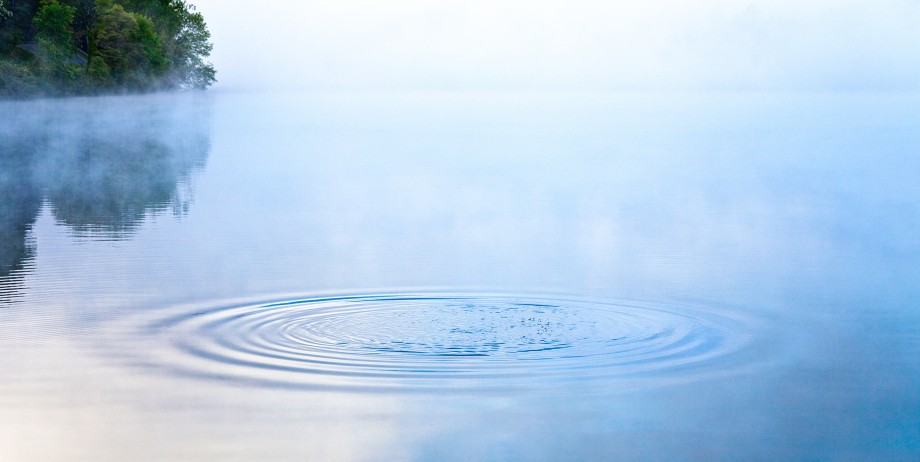
Silence

Fence Shadows On Snow

Precious silence often accompanies a fresh and heavy snowfall. The contrast between it and the sounds we normally tune out, calls our attention to it. We go outside to watch and listen closely. We even seem to breathe easier as the snowflakes make a barely perceptible sound. Before the shovels and snowblowers come out, before the sounds of laughing kids and car engines turning over, there’s that moment when we stand still and relish the quiet.

I made this photograph in one such moment. I remember it well because it was one of those instances where, after I made several exposures, I lingered a while to listen to the stillness and watch as the evening light gradually diminished. For me, the sensibility of silence in this image is reinforced by the iron “guards” standing at attention with their spears, oblivious to the cold, wind and coming darkness. The regularity of the spear-shadows contrasts with the chaotic shadows of the trees, suggesting an integration of humanity (orderly lines) living in harmony and nature (disorderly shadows). Further, I notice that although the shadows take different forms, their brightness values are the same—a visual demonstration of unity in diversity.

In my experience silence seems to encourage more silence. Might the memory of past quiet moments, having been so refreshing and enriching—sometimes eliciting awe—prompt us to thirst for more? I think the centering that comes from being in nature at any time of year can be attributed as much to sound as to sight. The song of a bird, snow falling or leaves crunching underfoot, dripping or falling water or wind blowing through the trees are just a few of the sounds that connect us to the deepest roots of our physical being.

I find it curious, the role that the fence plays in contributing to the sensibility of this image. It seems the evocation would not be as potent without it. Wrought iron, being metal, dark and black somehow looks colder than the snow itself. Its spears, literally frozen in place, enhance the qualities of cold and silence. Workers and travelers often see snow as a nuisance. Kids see it as an opportunity for fun and a day off school. Practical considerations aside, stopping to take in its beauty and listen to the sounds of silence can be very enriching.

When words become unclear, I shall focus with photographs. When images become inadequate, I shall be content with silence.

Ansel Adams

Serenity

Where peace precipitates the power of potential

On the evening this photograph was made, the dominant sound in this airport parking lot was birds—a stark contrast to the busyness and clamor of cars, shuttle-busses and conversations that once pervaded it day and night for several years. The difference between the activity then and the serenity I experienced is heightened, I think, because the central structure existed, literally, to provide shelter. Ironically, the emptiness of the space in this image sort of fulfills the site’s purpose aesthetically by conveying the sense of peace.

The emptiness and quiet of the landscape encourages me to reflect upon its elements. Had there been cars, shuttle-busses and people in the photograph, my attention would have been drawn to the human rather than physical aspects of the image. Instead, the simplicity of elements and the long shadows direct my attention to the expanse of asphalt. I think of the forest it must have replaced, the animals and birds that were displaced, the mountains of sand and gravel, oil and paint that were used in its construction. It’s not that I object to this use of natural resources. I don’t. Building is what we humans necessarily do—it’s the activation of energy flowing from the desire to create and grow.

In addition to the raw materials that it took for this landscape and shelter to exist, I appreciate the army of individuals who envisioned, designed, leveled, supplied and built them, including the electricians who wired it for lighting and those who manufactured the glass and aluminum. Having traveled in countries where paved roads and electricity were barely functional, this facility stands as a testament to the power of collaboration.

The emptiness of a space designed to facilitate the movement of lots of people has a haunting quality. Not in a spooky way, but in the sense that purpose here is at rest. Potential. And because everything looks fairly new—no weeds pushing up through the asphalt, no fallen light poles or broken glass—there’s the hope of renewal. (And that hope has recently been realized. Today, this parking lot is back in action serving as an airline hub for a major freight company).

In serenity it’s easier to touch impermanence, ebb and flow, rising and falling, coming and going. It gives rise to the place in us where purpose discovers its most appropriate and creative action, for in the state of potential, all things are possible.

The more tranquil a man becomes, the greater is his success, his influence, his power for good. Calmness of mind is one of the beautiful jewels of wisdom. 

James Allen, British philosopher

Ladder of Success

How we define it moves us in that direction

Construction Ladder

Personally, spiritually, professionally, economically, socially, and politically we’re all climbing ladders toward “success.” What prompted the selection of this image for contemplation was hearing someone in a television commercial ask, “What do all artists seek?” His answer: “Recognition.” Ugh! I couldn’t let that go.

Did Michelangelo sculpt and paint to be recognized—or for money? What about Vincent Van Gogh or any of the masters of Eastern and Western civilizations? Twenty-first century, Western culture is so saturated with materialistic, competitive, end-product and celebrity values it’s hard for us to imagine anyone defining success as other than fame and fortune.

Case in point: My wife, Linda, observed that in an English class discussion her students said what they valued most was “making a contribution.” Ten years later the consensus was wanting to be known—famous. The latter perspective was echoed in my own teaching experience.

Since we largely define success for ourselves—consciously or unconsciously, I thought I would share some of the observations on the subject that I collected as quotes. Before presenting them, however, a perspective that I feel is important and missing from these perspectives is that success for many people is achieved more through process than product, particularly when the activity is aligned with their purpose. Not just “doing,” but “being”— why they’re here, on this planet. As noted on the home page, I write and photograph to feed my soul. Anything that may come of it for others is just “icing on the cake.” I know I’m not alone in this. So here’s what conventionally successful people said about it.

To laugh often and much; to win the respect of intelligent people and the affection of children; to earn the appreciation of honest critics and endure the betrayal of false friends; to appreciate beauty, to find the best in others; to leave the world a little better; whether by a healthy child, a garden patch or a redeemed social condition; to know even one life was breathed easier because you have lived. This is the meaning of success.

Ralph Waldo Emerson, philosopher


My mother said to me, ‘If you are a soldier, you will become a general. If you are a monk, you will become the Pope.’ Instead, I was a painter, and became Picasso.

Pablo Picasso, artist, painter


History has shown that the success of cultures and even of great civilizations is measured by the way they deal with crises; the greater the challenge, the greater the opportunity for positive response. The same is true for individuals.

George Leonard, author, social scientist


Individual success depends on environments that trigger the fulfillment of our genetic potential. Environments that motivate through fear literally shut down the potential for growth. Those that motivate through vision, open us up to express unforeseen possibilities.

Bruce Lipton, biologist


The key to modern success is human resources. How well you educate, train, and treat people in your society becomes more important than the coal you dig, trees you fell, or rivers you dam.

Herbert Striner, Economist, educator


We now have the technology, the resources and the know-how to make this world a 100% success for every human being on Earth.

R. Buckminster Fuller, engineer-philosopher


The soul of an enterprise bonds it together as one force giving it identity, purpose, direction and a reason for being… Many pooh-pooh the reality and value of soul in the corporate world but it is truly amazing how, given the same business circumstances, some companies do so much better than others. It is not soul that assures success, but it is the presence of soul that unifies the mission to achieve success… Companies with soul never lose sight of one thought – If you are not making history, you are history!

Bob MacDonald, Author, science journalist


Try not to become a man of success, but rather try to become a man of value.

Albert Einstein, scientist


Growth And Development

Nautilus Shell


The chambered nautilus is a creature that inhabits the Pacific and Indian oceans, today between depths of 600 to 1200 feet. Appearing in the fossil record before fish, dinosaurs and mammals some 500 million years ago, they grew up to 20 feet long! The spiral occurs as walls are formed to seal off and make chambers to regulate buoyancy. As displayed here, the image moves me to considerations of human growth, development and beyond.

In the shell’s central spot I see the point of creation and emergence, be it the womb of an individual mother, our Earth Mother or dark energy at the beginning of the universe. It can represent any beginning: the birth of a project, career, a new direction in life or the birth of a nation. With movement, the spiral begins, not as a straight line, but as a curved one. Largely because clocks tick off present moments, we think of time as a straight line between yesterday, today and tomorrow. But indigenous peoples all over the world perceived time as a spiral, repeating periods marked by the regular “journeys” of celestial bodies—gods in their view that were given names and personalities. For instance the ancient Maya—whose calendar was derived solely by observation and is accurate to within decimal points of our own—made detailed charts to indicate what happened in various cycles so the same or similar experiences could be anticipated on the next occurrence of the cycle. Researchers today refer to these periods as “calendar rounds.”

Movement gives rise to form—cells, walls in the nautilus shell, dark matter, stars and galaxies in the cosmos, knowledge in human beings, cities and governing constitutions in nations. Personally, I think of how many different people I have been since I became aware of myself as an individual. Form after form, experience after experience, role upon role, as interests, people and opportunities came and went, my personality, consciousness and priorities evolved. I’ve often said, “On this turn of the spiral…” I see things differently. I no longer believe “X” or want “Y.” With experience and education, the chambers of consciousness and perception widen, become more expansive and inclusive. It’s a process of reaching outward while remaining  connected, grounded perhaps. More boyant. All that came before is not lost, is present still, contributing to the next, more expansive part of “me.” As with everything in nature, growth and development is never a straight line. It’s a spiraling ascent—rounds that come around, providing opportunities to reexamine and do better than repeat.

All evolution is a dance of wholes that separate themselves into parts and parts that join into mutually consistent new wholes. We can see it as a repeating, sequentially spiraling pattern: Unity—Individuation—Competition—Conflict—Negotiation—Resolution—Cooperation—New levels of unity and so on. 

Elisabet Sahtouris

As Above, So Below

Realities that appear separate are one

DC6844

One of the benefits of a photographic image is that it presents us with a moment, a fraction of a second that holds us there so we can reflect and appreciate the subject matter—and possibly some significance it might have.

The live scene or situation in front of the camera is part of our continuous experience, so mentally and physically we’re always on the move with respect to it. We give it fleeting attention. Ah, nice forest, we think. Beautiful trees! And then we’re on to the next thing. Thoughts change in microseconds. We loose interest. We become distracted. And the scene changes. Everything changes.

But when we sit with an image, the act of focused attention—contemplation—promotes the inner assimilation of the subject matter in that captured moment. Spending time with a beautiful image can have the same, albeit more subtle, effect of recharging our batteries and resetting our priorities, like when we spend time in nature or goes on a retreat. We especially recognize these benefits are occurring when the experience or observation produces an inhale, a deep “breath of fresh air.” It’s an indication that we’ve made a connection, tasted the Ultimate Reality, and all is well. A bit of the life force has been assimilated.

Beyond assimilation, there’s more to be gained by contemplating an image (thus the nature of this blog). For instance in the above image the colors are beautiful and they mark a transition from one season to another. But spending more time with the image we go deeper and begin to see what else is going on.

There are meanings to be gleaned beyond surface appearances in every image, whatever the medium. A consideration for me here, is the nature and source of color—the sun and an interpreting brain, the experience being a mental construct based on a complex of wavelengths, surface characteristics, biological, neural and social conditions. I also think about the diversity of different species of trees and how they blend together to create a “symphony” of harmonizing colors, forms and textures. Going deeper still, the image serves as a metaphor for change itself—life, death, transformation and renewal.

As I observe the reflection of the forest on the water, an ancient adage came to mind: “As above, so below”—how human beings shape their world based on what we observe in the cosmos.  But the analogy doesn’t quite hold in this image. The reflection on the water is not a detailed or even accurate representation of the forest. Nonetheless, it is complimentary.

The reflection itself generates an opportunity for meaningful contemplation. When I put my hand up to the screen and crop out the line of trees, the reality and its “message” is “forest.” The reflection presents a different reality, prompting a sense of blending, merging, motion, and unity. Where we are, in time, space, family and culture determines what we see. And believe. Above, the forest reality representing the absolute is clear without distortion. Below, the reflected reality representing human consciousness— thoughts about what is real— is limited and distorted, constantly changing and blending. Nonetheless, it’s shimmering. Beautiful in itself. And a tantalizing preview of what’s to come.

Meanwhile, we keep looking up—literally and figuratively. Those who have stood back far enough, tell us that, although our personal realities are as diverse as there are persons, they and the Absolute are actually One.

As above, so below.

Hermes Trismegistus, Legendary Greek sage


Branching

How life moves in sustainable ways

Morning Glory

From universe to “nanoverse,” one of nature’s most common structural features is “branching.” Networks of all kinds, physical and intellectual, are grounded in a pattern that chemists refer to as “child” (smaller channels) and “parent” (larger) branches.

At the human level we see it in living systems—the brain, arteries and veins, leaves and trees. Branching occurs in chemistry, for example, when carbon atoms are cross-linked to form the hard plastic used in safety glasses. Branching made computers and the Internet possible. Flying at night we can clearly see the extensive branching of highway systems. Railways branch. There’s branching in mathematics and geometry. And we speak of “branch libraries” and businesses with branch offices and facilities. The phenomenon occurs wherever there is connection and flow—cities and suburbs, electrical systems, plumbing and sewer systems, streams and rivers, erosion, sand dunes and musical tunes. Branching is of the natural order.

Reflecting on the above image, I observe order within the chaotic, irregular lines. There isn’t one straight line, and no two of them are alike or even aligned. Yet there is cohesion, functionality and aesthetics. Systemically, I see the “parent” channels carrying water and nutrients to “child” and sub-offspring channels throughout the leaf. A microscope would reveal that each of the barren looking “fields” in between channels actually consists of a myriad of more interconnecting and intercommunicating cells. For me, the intricacy and complexity of these connections and flow channels triggers a deep appreciation of this pattern—seen on other celestial bodies as well—one that’s economical, resilient and life-supporting.

I also appreciate the pattern’s grace and harmony. Absent the color, and knowledge of the subject, one could imagine an extensive land with interstate highways, roads and lanes running through it. Zooming in would reveal a heavily populated area with living, thinking, decision-making beings—individual cells that have unique needs, wants and aspirations relating to survival, development, personal space and relationships. And they function together in harmony, as a whole! There are no battlefields, no indication of intolerant, greedy or power-hungry cells. The visual evidence alone would point to a system where sharing and collaboration are occurring throughout the land. Bring back the color and the entire space   would live up to the word “verdant.” Alive.

Might this pattern and process, which appeared on the Earth about 130 million years ago and is still visible and viable, suggest something in the way that human social systems ought to work—behaving  as we are in truth, interconnected and interdependent?

The vigorous branching of life’s tree, and not the accumulating valor of mythical marches to progress, lies behind the persistence and expansion of organic diversity in our tough and constantly stressful world. And if we do not grasp the fundamental nature of branching as the key to life’s passage across the geological stage, we will never understand evolution aright.

Stephen Jay Gould, Paleontologist, historian of science

Vibration And Form

Energy is vibration. It’s largely invisible, but when energy takes a form it’s always geometrical, prescribed by the fundamental laws of physics including gravity and the three Laws of Thermodynamics:

1. Conservation of Energy: Energy cannot be created or destroyed, just changed.

2. Entropy: Matter dissipates; disintegrates. Entropy either stays the same or gets bigger.

3. Heat: As temperature approaches absolute zero, the value of entropy approaches a minimum.

What creates vibration in the first place? The current theory, gaining traction among physicists, is consciousness. (See my posting: “Potential” 9/24/17 for details) Simply put, it’s the interaction of positive and negative forces within atoms. Positives “want” to join with negatives and vice versa.

Recently I’ve been making images that combine a nature-made subject with something that is man-made. The above is an example. Here, on the one hand, I’m intrigued by the visual contrast between the living blossom and the rusting metal, and on the other by the differences in these forms. Their “vibrations” and shapes are distinctly different—they are in contrast to one another, but share the same destiny; they’re also equally under the influence of entropy.

Because it is a living system, the visually more vibrant flower disintegrated in just a few days. In contrast, the fence will take decades more to succumb to entropy, even if the structure that supports it is demolished. Eventually, both will revert back to pure energy, the ground state of the universe where nothing is added or lost. And from that ground, vibrations in similar form will once again emerge.

What is anything but spirit taking form?

Alex Gray (Artist)

This continuity of forms, in all their diversity, human or otherwise, reflect the consciousness of the universe. They are said to be “expressions.” And once established, evolution “plays” variations on the form, from sea shells and dinosaurs to automobiles and skyscrapers. Acknowledgement of the fact that forms reoccur is evidenced in sayings such as, “There’s nothing new under the sun,” and “Everything that can be photographed has been photographed.” Insects, automobiles, skyscrapers and human beings are variations on the same universal themes—creatures that crawl, vehicles that transport human beings, buildings that rise to the sky and beings who are self-aware.

Another observation: The “recycling” of forms is much more dynamic in living forms, than in non-living forms: their lifespan is shorter. In the case of human beings however, where form and consciousness are intrinsic, the former is subject to entropy but the latter is not. As Pierre Teilhard de Chardin S.J. said, “We are not human beings having a spiritual experience, we a spiritual beings having a human experience.”

Each time a geometrical form is produced, an expression of the universal oneness is made; it is at once unique in time and place and also timeless and transcendent, representing the particular and the universal.

Nigel Pennick (British author)

Models And Modeling

Children are influenced most by what they see

Boy Watches Man In Doorway

Joseph Chilton Pearce, a respected author on the subject of brain development, wrote that a child’s capacity to operate in the world is determined entirely by the models he experiences in everyday life. He observed that all human intelligences—music, math, art, logic, mechanics, even emotions and intuition—are built into us genetically at birth. As potentials. “Their awakening,” he says, even for adults, “requires stimulus from the external world, from someone who has developed that intelligence to a functional level.”

This was certainly true for me. For you as well? Had I been able to interact with a practicing fine art photographer or motion picture director early on, I could have begun to awaken my visual potentials—and careers—that much sooner. Instead, in my youth, I resorted to the only resources at hand—books and magazines, which were highly inadequate. Learning theory says we learn best from having behavior modeled and reinforced, by seeing someone do what we want to do. And, it cultivates the confidence-building attitude, “If she can do it, so can I.”

Having taught at the university level and managed a television production facility for twenty-six years, one of the most important lessons I learned about teaching was to acknowledge and celebrate a student’s potential when it shows up, and then feed it by providing face-to-face, first-hand experiences in that area. I can’t overestimate the extent to which so many of my students benefitted from visits to television stations, commercial and corporate video and audio production facilities and post-production houses—and the professionals who came to class to speak. In addition to subjecting students to working professionals, “real” world models and environments, I encouraged them to introduce themselves and build relationships with these people, and many students gained internships and jobs that way, even developed careers in the field as a result.

The child in the above image, observing the behavior and possibly hearing the conversation between the adults has momentarily diverted his attention away from the toy car. It’s just a moment. But the triangle of attention speaks to me of the significance of modeling, particularly for children. It raises the social question: What are we exposing our children to? And it challenges me to address personal questions: Who and where are my models? Where do get my inspiration? What social and media experiences empower me to live more authentically? What are my potentials? Which of them do I want to nurture? Am I appropriately prioritizing them? What am I modeling for those with whom I interact? This kind of questioning has undoubtedly helped me discriminate between distraction and purpose.

In part, I choose this image and theme because of the domestic and ideological violence being reported in the news lately. In all these instances I watch and think about the children being exposed to models of dysfunction, young minds whose potentials are being radicalized, neglected or suppressed. I’m reminded of Buckminster Fuller who, after I’d produced a program featuring him, took my hands and said, “Keep on doing what you’re doing, young man. We need more of this kind of (constructive) programming.” It was he who wrote that, “You never change things by fighting the existing reality. To change something, build a new model that makes the existing model obsolete.” Indeed, create a new, more functional model.

Children have never been very good at listening to their elders, but they have never failed to imitate them. 

James Baldwin


Everyday Beauty

It abounds when and if we look for it

                                           Sunlight reflecting off sink fixtures

Whenever I hear “Beauty is in the eye of the beholder,” I take it to mean that some people find beauty where others do not. An artist friend who designs and sells jewelry once remarked that he made it a practice to experience beauty every day. I thought that was wonderful. But between work and family life, the only time I found available to search for beauty was when I was out with a camera looking for it.

Searching for opportunities to compose elements within a frame in ways that fed my aesthetic hunger, I frequented scrap yards, construction sites, abandoned buildings, tractor-trailer parks, empty fairgrounds, railroad graveyards and musty antique shops. As a consequence of creating order out of visual chaos, I was experiencing beauty in unconventional places and subjects. I first noticed this when I realized that I didn’t need to go to the beaches, national parks or anywhere else to find beautiful subject matter. It was at hand. To transform an ugly or ordinary object into a beautiful one, all I had to do was to decide to see it that way—with or without a camera. That said, beauty is a choice we make.

My curiosity about it has been an evolution. As a child, I thought certain people, places and things were intrinsically beautiful and others were not. Through readings and formal education I learned that beauty is subjective and it varies widely between individuals. Camerawork taught me that beauty can be manufactured, as when  lit or arranged objects in a more pleasing way. And that by deliberate choice, an ordinary object can be transformed into something beautiful. Actually, working for film and television companies, my job was to often to make everyday situations and products (sheets and pillow cases, jewelry, toys, food, car dealerships, corporate interiors—look beautiful.

As subjective experience, beauty (along with goodness and truth) evades description. Nonetheless, each of us can, with contemplation, find some words to better understand its place in our lives. Currently, the experience of beauty presents me with feelings of joy and harmony, sometimes awe. Especially it comes whenever I encounter nature’s design principles at work, even in man-made objects.

The above image reminds me that beauty can be found anywhere—literally in the kitchen sink. And I can predispose myself to experience it by choosing to see it in everyday places and objects. Beauty is not only something to be found, it’s something to be open to—or made. It may be in the “eye” of the beholder, but it’s also in the heart touched by an appreciation of all that is.  

It’s not what you look at that matters, it’s what you see.

Henry David Thoreau, American naturalist, essayist, poet, philosopher


Light Bulbs and Electricity

Life before and after them

In the summer of ’76, the year Linda and I were married, we went to the Cayo district in Belize so I could better appreciate where and how she’d lived for a year, teaching English to high school students under the auspices of the Papal Volunteer’s—the Catholic church’s version of the Peace Corps. We hired a taxi at the Chetumal, Mexico airstrip to drive us a hundred miles into the jungle. For hours, the only lights we saw were the taxi headlights on the deeply pitted dirt road and occasional kerosene lamps flickering through the trees.

Linda’s dear friends were excited to reunite with her and they welcomed us to stay with them. That same night, a roach as big as my forefinger was on the sheet when Linda pulled back the blanket. And the fluttering I heard as I brushed my teeth in a basin, turned out to be a bat. I said I wanted to leave in the morning. But she informed me that there weren’t any taxies in town, there was no bus that day and the only telephone line had been destroyed by the Maya burning their fields for planting. So I resigned myself to stay one more day. The next morning I stepped outside and into a jungle with dripping leaves, parrots, glistening lime trees and sparkling bright sunlight. I ran and got my camera. I was in photography heaven.

So what’s that got to do with a lightbulb? Appreciation—for the gift of electric power and the lack of it. At that time, San Ignacio had neither televisions nor electric refrigerators. The town’s electric generator shut down at ten o’clock after three hours of use in the evening, so as darkness approached our hosts, friends and Linda and I sat around a 60 watt bare bulb that hung from the ceiling on a wire. There was nothing to do but talk. As I remember it, these were less like conversations and more like family reports on who did what, who went where, when certain animals would be slaughtered for market, who said what to whom and what politicians were doing—or not doing. When the generator shut down the talk continued for another hour by the light of a kerosene lamp.

The light bulb in this image evokes memories of that challenging and wonderful week, in particular an appreciation for the luxuries—and necessities—that electric power affords. I understand now, how the light bulb became the symbol for the word “idea.” Now, instead of sharing the news and gossip of the day with family, friends and neighbors electricity allows us to converse, interact, connect, read and watch movies at night in the comfort of our well-lit air-conditioned homes. It’s staggering to consider how much has been gained because of access to consistent, affordable and abundant electricity. Don’t we notice, whenever it goes down for whatever reason, our appreciation awakens and grows with every passing hour?

But something has also been lost. We no longer sit together face-to-face in the evenings, sharing the close-in happenings of the day with family members, friends and neighbors. It’s not that I miss what’s been lost. But the light of that 60-watt bulb in San Ignacio, Cayo gave me a fresh appreciation for how people—and our not-to-distant relatives—managed and thrived without electricity. The light of that little bulb created a context, a call to gather without distraction and share face-to-face.

We forget just how painfully dim the world was before electricity. A candle, a good candle, provides barely a hundredth of the illumination of a single 100 watt light bulb.

          Bill Bryson, British author on travel