Change

Aligning and allowing can make the best of it

This image has special meaning for me. I was in high school, a new member of the camera club, wandering the streets of downtown Cincinnati at night looking for something to photograph. A building had recently been demolished at the corner of 5th and Plum Streets and, unlike today where such places are fenced in, I was free to walk around. I  made several exposures of City Hall and the Cathedral in the distance, with beams and mounds of bricks and debris from the demolished building silhouetted in the foreground. The shattered glass on the ground caught my eye and this photograph is the result.

Eight years later I was employed by the television station that had built a new facility on that very spot—the same station where I’d performed on The Dottie Mack Show, as one-third of her special guests, The Pantomime Trio. I was eleven years old. Fast forward several decades and the TV station was replaced by a much larger structure that evolved into the current Cincinnati Convention Center. As if my being attracted to the place where I would be employed as a cinematographer were not enough of a synchronicity, when I took the position of director of the Television Center at Xavier University, I inherited the lighting grid from that same station—the lights that my sister, a friend and I had performed under.

Now, looking at this image, I reflect on the process of change. Buildings are demolished to make way for more, bigger and better structures. Mortar, glass and steel are still used, but in much improved and variable forms. We speak of “positive” and “negative change,” but the labels only apply to us because we are flesh and bone and have feelings, all of which can easily be hurt. From a much broader perspective, change is evidence of life. And as such, it affirms that life is evolving. Advancing. Nothing stays the same. When scientists define “life” as that which changes, they’re inadvertently stating that the universe and everything in it is “alive,” a living system.

At the human level, because I think and feel, I have preferences and expectations. I want the changes I experience to satisfy my physical, mental, emotional and spiritual needs and wants. When that happens I’m in my comfort zone, moving forward on the crest of the universal “tide.” On the other hand, when entropy manifests as breakdowns or blocks in these areas, it feels like the universe is not friendly, not cooperating, holding me back or making things difficult.

Placing blame is a natural first response. And then I search for reasons. Why is this happening? What does it mean? And then I remember, in themselves breakdowns and blocks are not the cause of my distress or disappointment. It’s my disappointment or  resistance to them that precipitates a negative experience, not getting my way, things not working they way I want or expect them to. For instance, my experience of the difference between a morning when the traffic flows on the expressway, and the next when it’s backed up entirely depends upon my response to it. I can rail against it and look for someone or something to blame. Or I can settle back, observe and allow that this is the way life is moving and wait for the situation to change. And it will. Nothing says the same. What’s “negative” about change is either the perception or the response.

It’s wonderful and inspiring to hear people expressing a desire to create “positive change” or “make a difference in the world” by improving conditions for individuals, systems and societies. I salute them and they give me hope for the future. Equally, I honor and respect those who, by the quiet manner of their courageous living—I think of my dad—the quality of their character or simply their loving presence are affecting change. Mathematician Petru Dumitriu wrote, “If I love the world as it is, I’m already changing it: a first fragment of the world has been changed, and that is my own heart.” What encourages my patience and optimism in the face of negative changes are those three little words—loving the universe “as it is”—stepping back to observe, allow and love the moment whatever it brings.

Through breakdowns, blocks and disappointments, I want to remember that today’s disaster, however small or large—symbolized here by the shattered glass—will give rise to something better tomorrow. And yes, that too will eventually succumb to entropy. But out of the ashes will come another advance, and another and another as life inexorably moves onward and upward. Life began on this planet about 3.7 billion years ago with self-replicating molecules. That we’re still here and considering how far we’ve come is for me, a source of confidence that life “knows” what it’s doing. My challenge and privilege is to accept it on its own terms.

The only way to make sense out of change is to plunge into it, move with it, and join the dance.

                                                                    Alan W. Watts, Writer, speaker, philosopher


Abundance

Having more comes great responsibility

Shopping Carts

In the 2010 movie, “Meek’s Cutoff,” a scout, claiming to know a shortcut through part of the treacherous Oregon Trail, led a wagon train of three families across a desert. Although the film doesn’t answer the burning question: “Did they find water after many days without it?” the artful and realistic depiction of their difficulties made a lasting impression on me. In one scene, to lighten their load, the settlers dumped their furniture and other precious items out the back of the buckboards. In another scene, a runaway wagon is destroyed and the family’s water barrel breaks open. And, adding to their mistrust of the guide and at times each other, they argue over whether the Indian they captured is leading them to water or away from it.

In my novel, Jaguar Sun: The Journey of an Ancient Maya Storyteller, the protagonist spends his days traveling jungle trails between cities, some of them seven days apart, on foot, through the tropical cycles of wet and dry seasons. I’m fascinated and amazed by the resilience and determination of those who came before us, across cultures. Relatively speaking, the abundant American lifestyle that we enjoy is a relatively recent development. Our Inter-state highway system is only a few generations old.  When I was a child, my grandparents used a coal-fired stove, had a dirt floor pantry, got water from a cistern and had no indoor plumbing. Now, for Linda and me, the prospect of moving, even within the same city, is quickly dampened by the need to move our—okay, mostly my—stuff.

I’m amazed by what it takes for me to live and be comfortable from morning to night. A recent road trip provided a demonstration. Just to spend a day photographing, my car needed to be filled with stuff—a map (now GP), peanuts in case I had a blood sugar problem, a cooler to keep water and film cold, four camera cases, two tripods, a flash unit, filter kit, exposure meter, log book and a flight bag with waders, socks, underwear, a spare pair of shoes, clothes on hangers and a cell phone.

As life and living become more complex, physical systems seem to expand. Early on, Eastman Kodak Company profited greatly by the fact that cameras needed to consume film and paper, these needed chemicals to be processed and there were variations on these to meet the demands of special circumstances and techniques, thereby generating even more revenue for the company.

Likewise, every appliance is a system that needs to be continuously fed or maintained. We can’t just buy a computer. We need the  peripherals, a warranty and service contract, certain apps, special cables, a backup drive and a printer that consumes paper and ink. The same with smart phones, televisions, DVD players and other entertainment systems. Professionals and hobbyists alike, in every area, need a lot of “stuff” in order to do their work or exercise their creativity. Businesses have an insatiable appetite for consumables, as do sport-related systems that require permissions, contracts, equipment and uniforms. It’s a guess, but I estimate that we use twenty times the number of disposable batteries we used just five years ago.

Those of us who live in an abundance society are privileged, but with it comes the responsibility to minimize our ecological footprint. So also, state and governmental agencies that should be managing resources wisely—sustainably. While “consumerism” and the uncaring, unconscious production and consumption attendant to it can rightly be cited as a contributor to global warming and a variety of social ills, the argument that the earth is finite, a closed system, doesn’t hold water. As a living system, the planet is “autopoietic,” self-creating. At every level, it’s continuously making itself over. Evolutionary biologist, Elisabet Sahtouris, observed that the Earth is an autopoietic system, a whole system, “A giant cell within whose boundary membrane other smaller cells evolve, multiply, die and are recycled—(all these are) holons forming within the great Earth holon.”

The planet adapts and renews itself in response to natural and man-made change. Of course that doesn’t guarantee that the human species can or will survive such adaptations. And that’s one of the good reasons to cultivate foresight and invest in responsible planetary stewardship, to look ahead and plan responses to devastating potentials such as rising sea levels, rogue diseases, terrorism, fascism and asteroid bombardment.

What to do? We can get books, CD’s, DVD and more at a library rather than purchase them. We can donate books, clothing, furniture, cars, etc. We can fly and drive less, recycle our everyday waste and save fuel in a number of ways. The list goes on. But mostly, we can reduce consumption as an overall pattern by becoming more aware of the consequences of our consumption. Is this object or activity necessary? Is it a need or a want? Considering the above image, I can be more aware and selective in what I put in my shopping cart—on and off line.

Doing what you love is the cornerstone of having abundance in your life.

Wayne Dyer

Enrichment

What is it that feeds your soul?

Harvest Moon

Reflecting on this image, I thought about how, at various times of the year, farmers enrich the soil to get desirable results. It led me to consider what I do to enrich my life. And am I sufficiently engaging in those experiences and environments?

Movies, television programs and commercials show people having fun, but seldom do they show people engaged in activities that are enriching. Lately, I’ve noticed that in some cities the preference of park boards has been to provide facilities for recreation—picnic shelters and benches, playgrounds, merry-go-rounds,  playing fields, volleyball courts, golf courses, canoeing and walkways where vendors can set up for special occasions. Other cities place more emphasize on managing the natural environment.

The Metro Park system in Columbus, Ohio has as its stated mission, “To conserve open spaces, while providing places and opportunities that encourage people to discover and experience nature.” In one of their brochures I learned that each year, “More than 7 million people enjoy quality outdoor times in the parks, and more than 180,000 people participate in free nature education programs.” Nature first, human recreation second. Over the years, I’ve driven a hundred miles from Cincinnati to Columbus and back to photograph in those parks. Although there are picnic and play areas, the primary attraction of their parks is nature, largely undisturbed by man-made objects and structures.

Certainly, we who live in urban areas need outdoor places where our families can have fun. But we also need well managed and maintained wilderness places where the spirit can be renewed, where we can walk through tall forests and gorges, meander along creeks and discover meadows, ponds and marshes, diverse ecosystems where birds, reptiles and animals are protected. When in nature we can breathe better.

A recent study at the University of Michigan found that walking in nature improved short-term memory, restored mental energy (reducing fatigue), relieved stress, reduced inflammation, improved vision and concentration, contributed to sharper thinking and creativity, boosted the immune system and reduced the risk of early death. Didn’t we already have a sense of that? We say a walk in nature “re-charges our batteries.” We come away feeling “charged,” enriched with fresh inspiration and clear thinking. Also, the satisfaction from experiencing nature is like having a drink of water after being very thirsty. 

There are many sources of enrichment, such are family gatherings, education, books, movies and varieties of mass media. In our modern society, these sources can also be a distraction. Enrichment that from stillness, contemplation and meditation requires us to guard against the urge to play with our electronic toys, engage in social media or create projects motivated mostly by fame or fortune. Why do I continue to write this blog when the audience is limited and small? Why do I research, write and self-publish novels when the subject matter has limited appeal? And why do I continue to make and self-publish photograph in black and white? Because these activities are enriching, they feed my soul.

Of course, the sources of enrichment vary from person to person. Just as some plants thrive in nitrogen-rich soil, others abhor it. The challenge is to discover the experiences and environments, even the people and social situations, that feed our soul. And engage them regularly.

Everybody needs time to reflect and contemplate, and the most inspirational and peaceful place to do so is in nature.

                                                           —Akiane Kramarik, Artist, “Prince of Peace,” an interpretation of the face of Jesus

Continuity


The persistent seed

The Persistent Seeds

It’s not unusual to see vegetation sprouting through cracks in the pavement, but this little plant was growing in mud alongside a railroad track that had been thoroughly covered with oil. That it’s growing at all speaks to me of the resilience and continuity of life. However the seed got there and despite the conditions and a harsh winter, when the moment was right, they awakened to the call of Spring and, rising in the direction of heat and light, gave birth to the form of their “ancestors.”

Observing this process—and relating it to the lifecycle of maize plants—the ancient and modern Maya of Central America adopted the belief that death gives rise to life. While the ancients believed that only divine kings would reincarnate, the general population believed—as many do today—that their sons and daughters “replace” the souls of their grandfathers and grandmothers, providing continuity of their lineages essence.

Ethnographers studying the Maya report that within certain societies, when an elder dies his relatives begin to look for his “kex,” a newborn replacement for him within the extended family. This is somewhat similar to the Tibetan’s search for the reincarnation of the Dalai Lama. For the Maya, as with maize and other crops, birth and rebirth demonstrates conclusively that life is not a straight line of events from birth to death, but a continuous cycle, a “sacred round” wherein life “breathes” in and out, allowing old forms to die and new forms to be born.

Although the forms we take bear some resemblance to those of our fathers and mothers, and we carry within us their genes—along with many of their values, beliefs and aspirations—we are, like the plants in this image, new and unique individuals carrying forward and evolving our biological essences. And doing this in the context of fresh conditions with expanding social and technological complexity the capacity and direction of thought—consciousness—also evolves.

Just as the composition of the soil influences a plant, the physical, mental and social composition of the environments we grow up in condition our thinking, responding and creating in ways that are different from our parents. Because consciousness increases with complexity, each generation is more knowledgeable and aware than the last. And this increased awareness, particularly as it multiplies and globalizes, will lead us—gracefully at times; painfully at times—to assume greater responsibility for the quality of the “soils” that will nourish our grandchildren and their grandchildren when they “Touch the Earth,” the Maya way of referring to incarnation.

For indigenous people the world around, maize was the perfect metaphor for life because a single stalk cannot stand; it will easily be toppled by gusts of wind. To survive, it must grow in close community where there is mutual support.

To live is to communicate life, because life is essentially a spreading, growing phenomenon. Therefore, the more one communicates life, affirms life in one’s fellows, gives oneself to enhance their lives, the more one is alive, is truly living, and thus, is truly oneself.

Beatrice Bruteau, Philosopher

Author, Radical Optimism: Practical spirituality in an uncertain world

Perception

How and what we see are interpretations


In part, our uniqueness as individuals traces to our capacity to perceive, beyond merely looking. Aldous Huxley famously observed that “The eyes and the nervous system do the sensing, the mind does the perceiving.” The eyes gather information and the nervous system delivers it to the brain where it is sorted, referenced to memory and interpreted. The object of my reflection here is that everything we sense and know comes down to interpretations based on perceptions. In this light, the mystics and physicists who observe that this world is an illusion makes sense, particularly when we consider that our perceptions—and the acts that follow from them—are determined by the lenses through which we view each other and the world.

Even as we use instruments to learn about objective reality, interpretations relating to it are based on these lenses. They include our biological inheritance, family upbringing, peer group, physical and social environments, education, affiliations, status, belief systems and accumulated experience. In a sense, each personality is a culture unto itself,  uniquely formed and constantly under construction. I am not the person I was ten minutes ago, much less ten years ago because my personal and social lenses are dynamic, ever changing.

Recognizing that everyone is seeing through different lenses should urge tolerance and compassion in our interactions, or at least some respect and patience when our perceptions, judgments, preferences and choices differ. Yet across cultures, people are willing to risk everything for the satisfaction of being “right” or being in possession of “the truth” or the “best way” to accomplish something. We will even kill and be killed holding onto a perception or belief that derives from this strong sense of knowing. Is my personal reality fixed, so dependent upon my way of seeing things and being right that my world would crumble if it were proved otherwise?

I can’t imagine. But considering that one of our primary lenses are the stories we’re told—and understanding the power of story, which provides the basis for all religions, cultures and most everything we believe in—I can see how personal realities could become fixed and immutable. A lie or conspiracy theory told often enough and with passion can easily be accepted as true. And we’re seeing how perception can be weaponized, as in radicalization and brain washing.

On the other hand, there’s survival value where there’s the ability to see the manipulators behind the curtain and keep an open mind when exposed to different points of view and change. Writing of the power of story and storytelling, human potential author Jean Houston asserts “Change the story and you change perception; change perception and you change the world.” Given that, the way to win a war or succeed in political office is to tell stories that affect changes in perception.

In many instances, clashes over differences in perception have more to do with strategy than outcome. Americans generally agree on the fundamental rights and privileges articulated in the Constitution and Bill Of Rights, but we differ strongly on how to realize them. Some see political power as an opportunity to strengthen the whole of society by empowering the governing body to act on behalf of all citizens. Others, fearing the possibility that those who govern will overstep or abuse this power, prefer to empower individuals and corporations directly, believing they can and will take responsibility for themselves. We may want the same outcomes, but we see different ways to achieve them.

At the extreme end of the spectrum are dictators and tyrants who hold onto their perceptions so tightly, they feel justified in killing and waging war. Whatever their outer objective, they have to “win” in order to prove to themselves and others that their perception is the correct one. The genesis of their perception can be be simple or complex, but the severity of it is determined by how tightly they hold onto the notion that they know best. Publicly stated or privately held, it’s their signature position.

Differences in perception are often the root cause of conflict. Archaeologist David Freidel defines “culture” as “the shared conception and perception of reality in a society.” Indigenous peoples the world around perceived rocks, mountains and art objects as being alive, while we only attribute life to animated organisms. And now, the environment is paying the price for that perception. Farmers destroy rainforests in order to feed their families, whereas environmentalists view those same forests as the lungs of the planet. A dandelion for one person is an object of beauty; for another it’s a weed.

So what is the truth? Who is right? In one lens better than another? According to the Bible, it’s by our actions—consequences—that we shall be known. Philosophically we can say that, for the most part, each individual’s perception is valid for themselves. It’s their personal reality. But all actions have consequences. If the dandelions in my yard are crowding out the grass, I can run the lawn mower over them with impunity. But when I put down poison to kill them, animals and birds can be affected, and that has consequences for the neighborhood. (A neighbor of ours had a cat that died from eating another neighbor’s grass treated with weed killer).

We say that “Seeing is believing.” Like all good formulas, it works both ways: Believing is seeing. Thus the popular phrases: “We tend to see what we believe,” and “We see what we want to see.” Perceptions are always biased by what we already believe. The “truth” or “rightness” of a belief or perception is and can only be personal, a singular viewpoint. Characteristically, the more powerful one feels the more this is suppressed.

At all levels, perceptions gain credibility by consensus. The more people who agree with our perception on any issue, worldview or experience, the more we—and they—hold onto it. As we’ve seen, the lives of public figures and celebrities can easily become tragic. As egos become inflated, there’s a loss, confusion or misdirection of identity. One’s perception of self comes into question.

We do not see ourselves, others or the world objectively. The balanced position then is to practice tolerance, respect the perceptions of others and become more aware of our perceptions, always on the lookout for refining and aligning them with the truth as we discover more of it. Easier said than done, but we have a model. Arguably the greatest teaching on perception and its consequent behavior was Jesus, the Christ who advised us “Love they neighbor.”

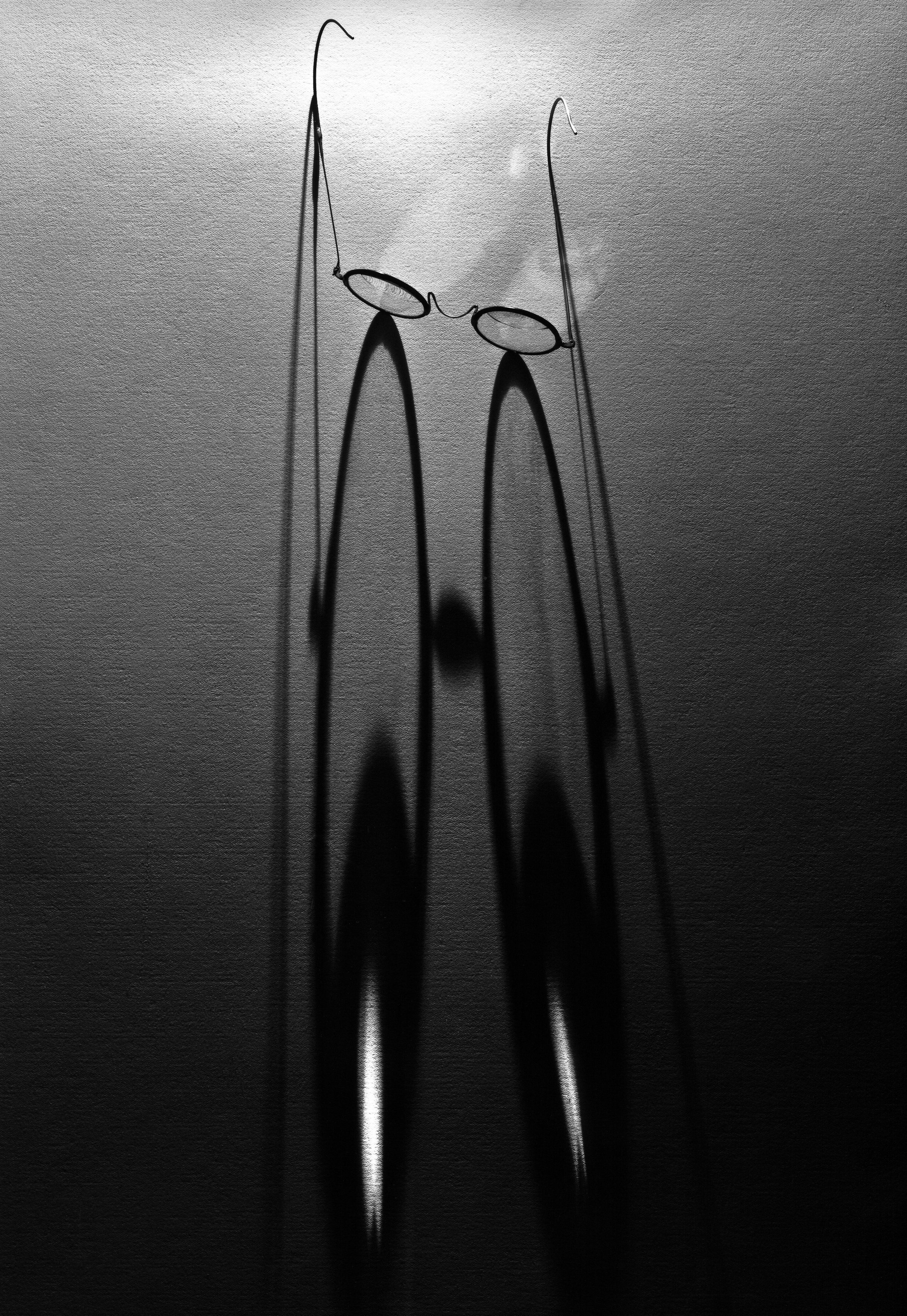
Whenever we encounter a viewpoint or behavior in contrast to our own, we can choose a loving response. Whether in thought, word or deed, rather than attack we can at least allow and respect a person’s right to see things as they do. And keep an open mind. In a constantly changing world, the truth of anything is always bigger than what one individual can see. The eyeglasses in the photograph above, remind me that we all see through unique and constantly changing lenses. 


A person has not only perceptions but a will to perceive, not only a capacity to observe the world but a capacity to alter his or her observation of it — which, in the end, is the capacity to alter the world itself. Those people who recognize that imagination is reality’s master we call “sages,” and those who act upon it, we call “artists.”

     Tom Robbins, American novelist


Power rests in the conjunction of what the individual perceives of his own internal being. What he perceives in the world about him, and how he relates these perceptions to establish his relations with other human beings.

Richard Adams, English novelist


The world you perceive is made of consciousness; what you call matter is consciousness itself.

Sri Nisargadatta Maharaj, Indian guru

Attention Capital

Staples in Telephone Pole

Our reality is shaped by how we spend it

Fundamentally, the job of the film and television director is “attention management,” capturing and holding the viewer’s attention and moving it from place to place within and between scenes. In ancient cultures, chiefs, rulers and landlords played that role, sending out “criers” who went around shouting the news and information they wanted their subjects to know about or take action on. The rapid evolution and expansion of communication technologies has occurred in part as a consequence of complex societies where producers and advertisers want to attract attention, and where consumers want their attention managed for enjoyment—and for many more reasons.

On October 31, 1517 Martin Luther, a monk, nailed a list of grievances against the Catholic Church onto the door of a chapel in Wittenberg, Germany. A consequence of this was the Protestant Reformation. In June of 1982, I tacked a notice on telephone poles and community bulletin boards around town to invite people to come to a local park to discuss ways to promote Cincinnati as a “City Of Light,” a place where notable thinkers and achievers in the arts, sciences and humanities would come to dialogue and express their views on stage and on television.

More than fifty people showed up. We met once a week for four months, but the financing we needed didn’t materialize and that was the end of it. In July, 2012 I photographed this thoroughly stapled telephone pole near Ohio State University in Columbus, Ohio. I imagined the consequences of all the notices that were attached to it. For instance, uncountable numbers of people attended a performance, convened at conferences, meetings, lectures and recitals, found lost animals, bought and sold property and goods, offered and secured services and met their significant others. And more. Represented on this pole is a nexus of attention. And while it may still be used to attract attention, we now have an intercommunicating network of technologies performing that function through fibre optic cables and between satellites and land-based towers enabling potentially every person on the planet to capture, hold and direct the attention of everyone else.

Technology pundit Esther Dyson wrote that “The most important finite resource in the late 20th century is people’s attention.” More recently, author David Shenk observed that “As competition heats up, in order to get our messages across, we have to wrap them in ever more provocative and titillating packages; we TALK LOUDER (his emphasis), wear more and brighter colors, show more cleavage and say shocking things.” And do shocking things. It’s the phenomenon of “desensitization.” Repeated attention diminishes our response to dramatic sights and sounds. Filmmakers and television producers feel they have to keep raising the bar on violence, sexuality and special effects in order to gain and hold our attention. It’s why the volume of movies in theaters continues to increase, and as a consequence of hearing loss, many more people have become “loud talkers.”

Executives in the radio, television and film industries say they’re in the business of delivering news, information and entertainment. Increasingly however, it has become apparent they are actually in the business of maximizing attention, arguably with less interest in content and more interest in securing “eyeballs for advertisers.” Having invested many years in the television industry professionally, and after having researched its history, structure and social function, I’ve come to the conclusion that commercial television is stuck in a period of prolonged adolescence.

Television is a social mirror. It reflects the mentality of the people it serves. So as long as viewers are passive consumers rather than active advocates calling for intelligent, inspiring, empowering, enriching, useful and socially responsible programming we will continue to complain that there are “hundreds of channels and nothing’s on.” Nonetheless, as a long term optimist, I believe there will come a time when television will reflect and serve a society that has grown into adulthood.

Actually, where we are right now is not a bad place; we’re just in transition. A multitude of pressures, especially those relating to truth-telling, economics, environment and security are urging us to learn that our communication “toys” can be used for higher purposes. But before these can be realized, we have to learn how to use them securely and responsibly. I believe that, through these pressures, including long term public dissatisfaction and industry experimentation, television professionals will come to appreciate the medium’s higher potentials and discover that delivering substance has survival value.

Currently, power is perceived as residing in the technologies themselves, but these are just the means of message production and delivery. The real and by far greater power for the communication industries resides in the delivery of real value, images and information that contain substance—content that matters, that helps us relate better, construct meaning and build more satisfying and contributing lives. As a nation becomes more complex and realizes its interdependence with other nations, it could even become necessary for the media to turn its attention more toward matters of personal safety, growth, social development and planetary stewardship. Public television has been a leader in this regard.

Because attention is a choice, it’s formative. It shapes us. What we attend to defines us and shapes our reality. A guideline prescribed for novelists is to reveal the truth of a character more through their actions than their words.  Socially, because the mass media, particularly television and the Internet, provides a common “reality” reference for most of us, our collective attention generates “memes”—units of culture, including colloquial language, gestures, fads and trends in fashion, food and music.

Memes largely define what is “cool” and acceptable in the culture, so advertisers keep them in front of us to entice us to “spend” our attention capital—dollars— accordingly. Anthropologist, Edward T. Hall, wrote that “Culture is what we pay attention to.” When we know that our our attention is simultaneously cultivating myself, my reality and society, we can more consciously choose how to direct it.

What we pay attention to is no trivial matter; we are what we attend to. 

                                               Mihaly Csikszentmihalyi, Psychologist

                                               Author, Flow: The psychology of optimal experience

Particularity

Ribbed Bivalve Shell

A strategy for making the ordinary look special

In the early years, I used to spend a lot of time walking up and down the many rows of vendors at outdoor antique fairs looking for that rare situation where the quality of light illuminating an object peaked my aesthetic sensibility.

Later on, I noticed that there was a pattern to the places where I was more likely to find something to photograph. These were the booths that were less cluttered. The objects on display were separated by some space; the more the better. When the items were all clumped together in one case or on a table, none of them seemed important. Visually, the experience was chaos, and that reflected upon the vendors, how much or little they cared about their offerings.

When one object was singled out for display, isolated, my eye went right to it. If someone doesn’t care enough about their goods, it’s not likely that I will either. Conversely, when I see objects separated out, displayed on a clean surface or cloth where the sunlight enhances its form, color or texture I’m drawn to it.

Our minds are visually impatient. When presented with a rose bush we look from one blossom to another. And when we’ve seen them all we move on. Whether it’s cars, food, furniture, seashells or paintings in a museum we want to see everything. That’s natural and appropriate. But by taking it all in—the wide view—we can miss the deeper experience that comes from focusing on just one thing and staying with it for a time. I’m reminded that the greatest compliment we can pay an artist is to spend time with his or her creation.

Novelists use the word “particularity” to describe a character, setting or situation to make them special. High value. Here’s the description of a scene: “Sam pounded the bar, insulted the bartender and threw his beer bottle on the floor.” We get the idea, but particularity makes it sparkle: “Sam’s eyes lit with rage. He pounded his hairy fist on the bar and grabbed his Budweiser by the throat. Cursing, he hurled it the floor where thick shards of glass, beer and foam scattered the peanut shells.”

In writer-speak, particularity amounts to “showing” rather than “telling” what happened. Since “God is in the details,” whenever there’s a multiple of anything, appreciation is heightened by going in close, examining one detail at a time. We don’t buy a Toyota; we buy a particular Toyota.

Particularity is well known strategy among jewelers. Diamond rings and necklaces surrounded by greater space suggests greater value. It’s why museums and galleries give as much space as possible to their important holdings. Artists use this technique to choose a wide mat within a frame to surround their painting with blank space. Writers know the value of including lots of white space on a page or screen. Likewise, filmmakers hold on a shot, so viewers have time to examine the elements within the frame. The message of space surrounding an item or image is clear: “This is precious, worthy of your undivided and sustained attention.”

Out in nature, our visual strategy is more often deductive, scanning the whole beach before looking for the spot that appeals. The shell in the above image is very common. Ordinary. But when it’s displayed alone with care and lit to enhance its features, it becomes exceptional. With our attention held on a particular shell—the inductive approach—we gracefully ease into appreciation and gratitude for all shells, and nature itself. When photographing, I’ve noticed that a forest can evoke a “Wow” in me, but a single tree can speak more poignantly to me of “treeness,” of essence beyond and including magnitude.

In environments like antique, flower and car shows where there’s a lot to see, the mind wants to move on once we’ve recognized an object for what it is. But the soul is better served by focused attention, beyond recognition. Having learned this, I walk past areas where there’s visual “noise” or chaos and stop where there’s evidence of order and caring in both subject and presentation. That’s where I’m more likely to find something worth photographing. (I mute the sound on television commercials and look away for the same reason).


 Always to see the general in the particular is the very foundation of genius.

Arthur Schopenhauer


Joy

The soul’s feedback mechanism

When I first printed this image, I thought it was a nice expression of childhood exuberance. Looking deeper now, I see  humanity standing between earth and cosmos expressing joy. Given how our bodies evolved from the earth, it’s like the planet’s rising up here, now conscious, reaching out in a celebration of life and a yearning to connect with the great mystery. 

Images coming from the Hubble and James Webb telescopes are revealing the unimaginable scale, beauty and variety of the cosmos. It’s humbling on the one hand, yet there’s also an immensity within. Noted poet-philosopher Ralph Waldo Emerson referenced it when he said, “What lies behind us and what lies before us are tiny matters compared to what lies within us.” Beyond plants and animals, we can   come to know and realize our potentials, and in the process discover what and who we are and why we’re here.

Shakespeare’s despondent Prince Hamlet, contemplating suicide, wonders whether it’s nobler “To be or not to be.” Living may be painful, extremely so at times, physically, mentally and spiritually. At the other end of the spectrum it can also be joyful. It’s been said that every experience is “Grist for the Mill,” an opportunity to realize what we’ve come here to learn. 

Philosophers from Socrates on, regarding happiness as the ultimate good, debated its nature and how to achieve it. Today, formulas and strategies abound in every medium to help us in the pursuit of happiness. I believe they should have been talking about and promoting “joy,” which is not the same as happiness. While joy can deliver happiness, it’s very different, a subtle quality of alignment with one’s reason for being and connection to the greater life—spirit. For me, it comes in moments of gratitude, appreciation and increased focus, brought on by a sense of satisfaction that comes from immersion—being in the right place at the right time, doing the right thing. 

Mihaly Csikszentmihalyi, author of Flow: The Psychology of Optimal Experience, defines “flow” as “A state of heightened focus and immersion in activities such as art, play and work.” In his talks he says flow is the secret to happiness. Indeed, but in my worldview, happiness stands on the shoulders of joy. As I see it, happiness is a positive emotion that ripples like waves on the surface of the ocean. Joy is more fundamental, an emanation from the depths, a confirmation that says the current thinking or activity is aligned with purpose, in harmony with the soul’s agenda for this lifetime. 

Soul emanations like joy are subtle. They tend to emerge in silence and calm emotions. And they usually surface in reflective moments after an immersive experience. May you have lots of joy, and may it bring happiness along with it!

With an eye made quiet by the power of harmony, and the deep power of joy, we see into the life of things.

William Wordsworth


V. Contrast / Social Contrast

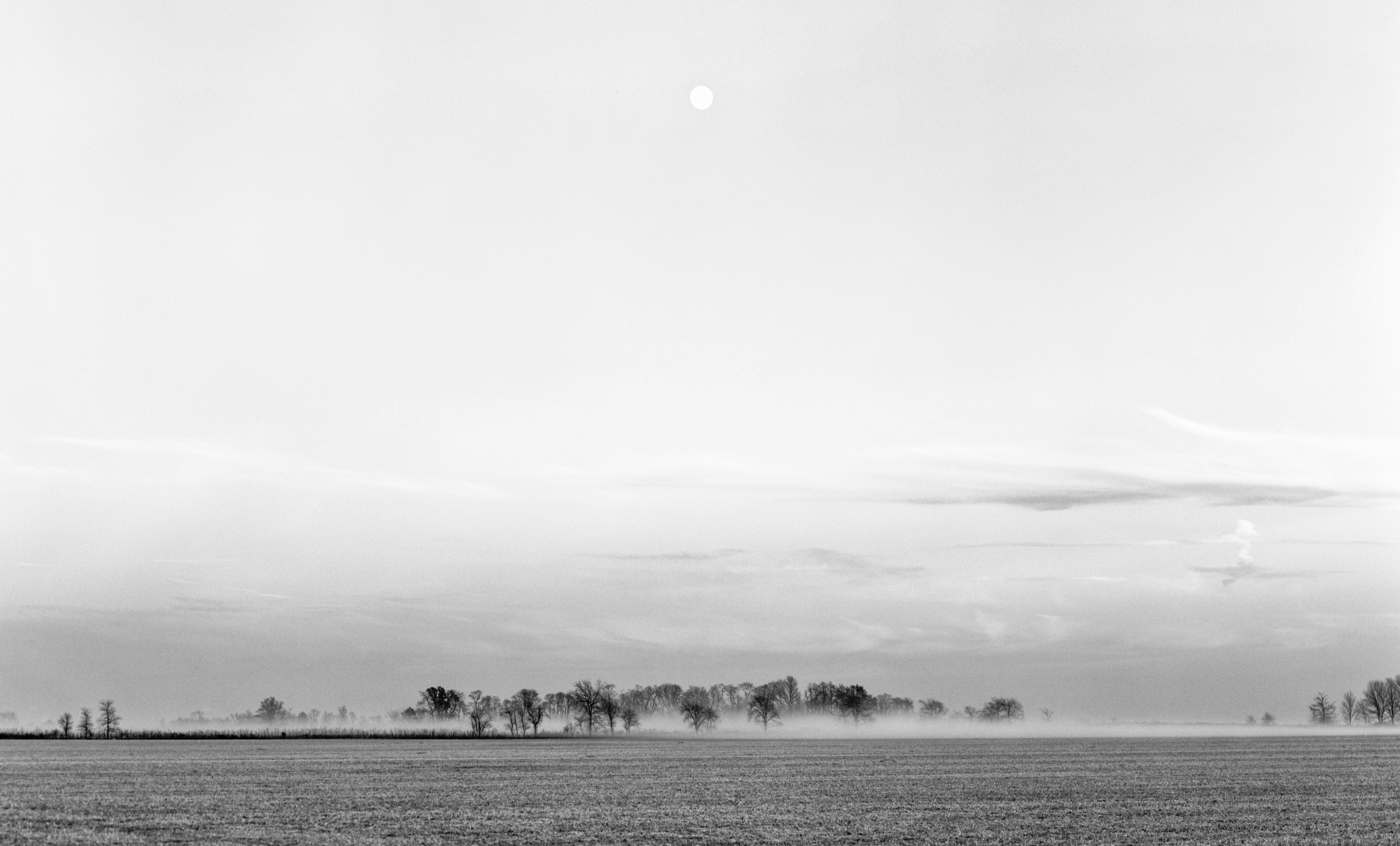
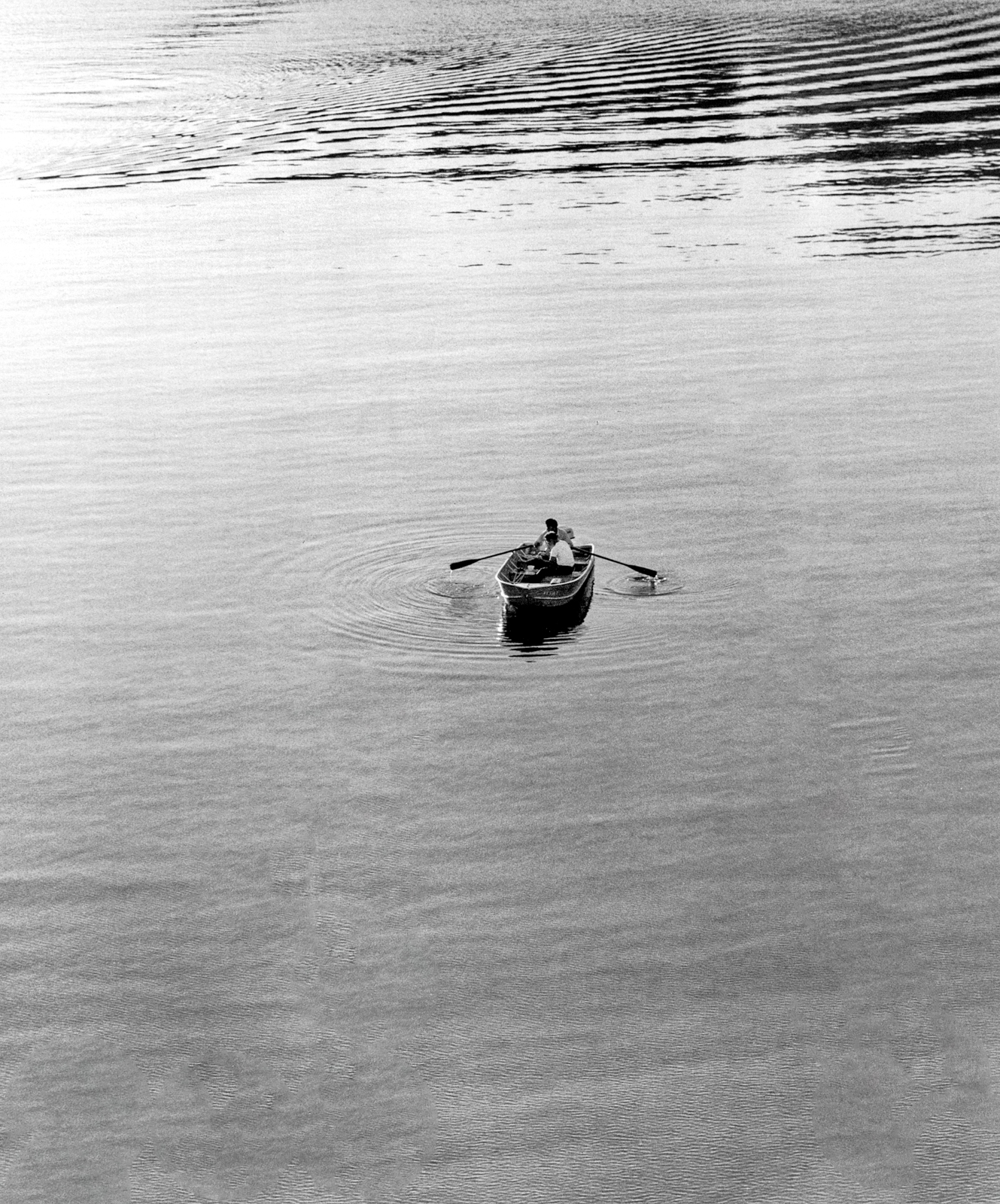
Technically speaking, “contrast” in the pictorial realm is the ratio between the darkest dark and the lightest light in an image. “Soft” contrast at one end of the continuum indicates that there’s very little difference between the lights and darks, the extreme being a “muddy” or “flat” image, gray overall—as in the image below.


In between the extremes of contrast is “medium” contrast, what we’re accustomed to regarding as “normal.” Contrast is never one thing, it’s the difference between two things. Below, there are bright whites, deep shadows and a full range of grays in between.


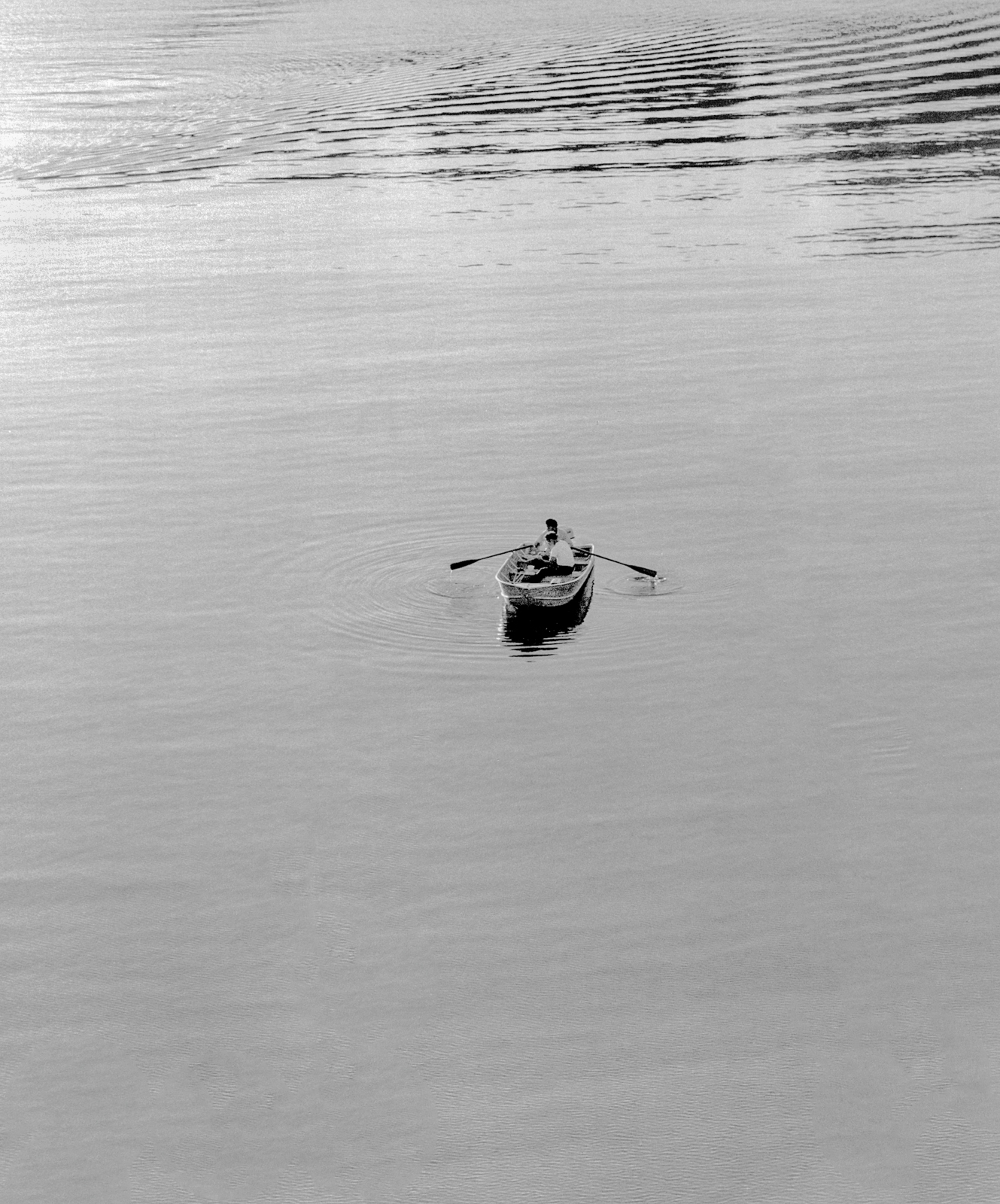
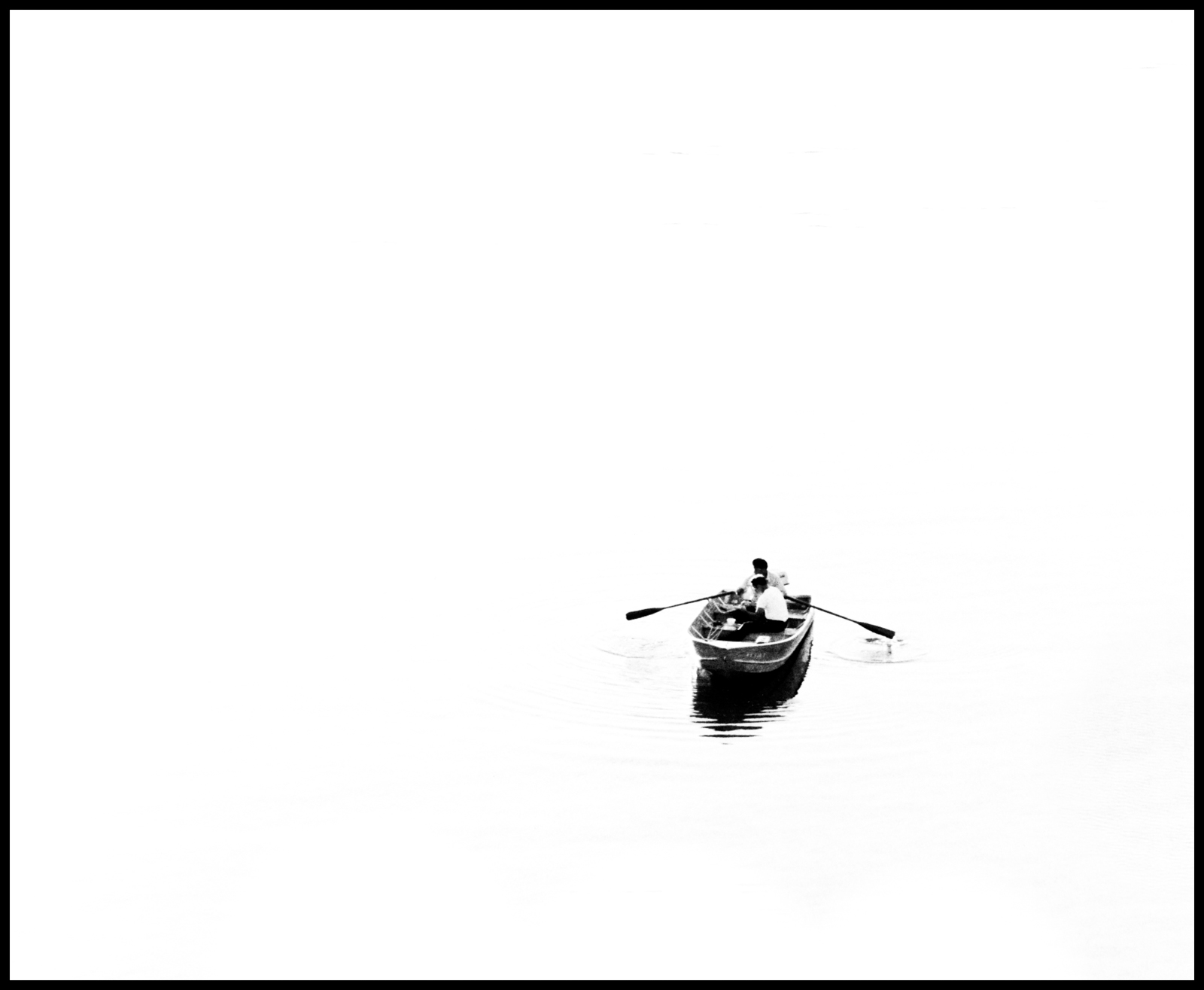
At the other end of the continuum, “hard” contrast is where the darks are as black as the medium can accommodate and the whites are as bright as possible, with no grays in between. Here, a duplicate of the negative was made on Kodalith film, a process emulsion that only “sees” pure black and white. Of course, a different composition was necessary in this case. Had the boat been in the center, the image would have been too static.


When considering a film negative, photographers speak of “Dmax” (maximum density, where no light passes through the film) and “Dmin” (minimum density, or clear film). In the digital world, cameras have a built-in histogram that displays brightness levels that can be adjusted for each of the primary colors. Whatever the medium, Dmax and Dmin are devoid of detail. Being able to control contrast is both technically and aesthetically important because it determines the amount of detail that will be visible in the shadows and highlights. 

Application

Aesthetically speaking, low contrast evokes a calm, flat, or soft sensibility. Such images are not seen very often because they’re not generally appealing. Extremely high contrast images are bold, evoking a sense of starkness and clarity. Commercial and fine art photographers working in black & white used to say the contrast adjustments were “right on” when the photograph exhibited “snap,” the full spectrum of tonalities—pure white and pure blacks with a full range of gray tones in between. Ansel Adams equated the tonal scale of photographic prints with that of a piano octave, and his ability to accomplish the full range of tones on photographic paper earned him a reputation as a master craftsman. For that reason alone, his original prints are far superior to the reproductions in books and posters. Seeing many of them when he spoke to our class at RIT, was a formative experience me.   

Technique

The first determinant of contrast is the light on the subject. The general rule is to not exceed the camera’s extreme brightness capacity—except in a few areas where it may be desirable or can’t be avoided—and then, look to see that there’s enough detail in the shadows where you want it. To get more detail, add more light. Controlling contrast amounts to adjusting the light on the subject or changing the exposure on the camera. Sometimes both. With film and photographic paper, contrast can also be increased by lengthening the development time.

Reflections On “Social” Contrast

There are innumerable social contrasts I could talk about, but the “elephant” in the nation at this time is politics—the contrast between “liberals” and “conservatives,” “Democrats” and “Republicans.” In the first posting of this series on the aesthetic dimensions—abstraction—I observed that one reason for the political polarization in this country and what sustains it, is the lack of agreement on the meaning of abstract words such as “liberty,” “freedom,” “justice,” “welfare,” “prosperity,” “militia.” Even simple words like “great,” and “fake” can have a wide spectrum of meanings. The assumption that everyone understands or agrees on the meaning of such words contributes to social contrast.

From photography, we can observe that low social contrast, where there’s little interest in public affairs and even less political engagement, a nation’s enthusiasm goes flat; the contrast range becomes contracted and dullness sets in. Feeling disenfranchised or helpless, citizens become disengaged and defer to the preferences of their representatives. The first image above represents this situation. The elements are all there, the subject matter can be recognized, but the expression lacks vitality.

On the other hand, when enthusiasm turns to fixated passion to the extent that neither side can abide the perspectives of the other, the contrast becomes so extreme it results in a war between the representatives, relationships become contentious and the system becomes dysfunctional. Extreme political contrast—represented by the last image—identifies citizens as either a black or a white pixel. You can’t be gray. Extreme contrast is militant: “Choose one position or the other and defend it!” There’s no detail, no middle ground, no substantive perspectives or open-mindedness in either of the positions.

Recent episodes of Madam Secretary and Blue Bloods on television provided demonstrations of how extremely high political contrast can be reduced to a functional level. In both instances, the characters representing the extremes fully expressed their perspectives with well-reasoned arguments, making sure their positions were clearly understood. (In formal debate, the first order of business is always for the participants to define their terms). With the point of disagreement clear, the characters came together and negotiated terms—in detail—that would satisfy both. They compromised and reached a workable, win-win arrangement. 

An argument is reasoned when it’s based on sensible thinking and logic that flows from statistical analysis or proven facts rather than an emotional appeal. For instance, an argument that begins, “The American people want… or know…” is the hallmark of an emotional appeal. Nations are constituted of diverse people having too many perspectives and preferences to be lumped into a single philosophical category, despite what surveys or poles might say.   

At the end of the Blue Bloods episode, Frank Reagan, the NYC Police Commissioner played by Tom Selleck, rebuilt a contentious relationship that had developed between him and his daughter, Erin Reagan, the Assistant District Attorney played by Bridget Moynahan, by citing a particularly nasty hockey game where the players on both sides shook hands after the game. Respect was regained in that situation by acknowledging that, although the game was difficult and people got hurt, the higher ideal of sportsmanship was maintained. I represent that situation in the middle image above.

Social contrast, like pictorial contrast, has to be managed. In the first place, that can only happen when both extremes loosen their grip on how to accomplish a common goal. That requires the participants to have open minds. Once the goal is clearly articulated and agreed upon, the means toward achieving it have to be presented in a reasoned argument on both sides, and that requires full concentration, understanding, respectful questioning and listening, again with an open mind. Finally, and critically important, the participants must consider the maintenance of their relationship as more important than winning any single argument. Shaking hands, having a meal together, meeting each other’s families, frequent personal interaction—these ensure that the next game will be played well.

“Thank you” to the writers, producers, and the cast of Madam Secretary and Blue Bloods. They are prime examples of television that’s socially responsible—showing the full range of tones, not just the extremes.

The critical contrast between seeing and looking-at cannot be overestimated. Seeing touches the heart. Looking-at is cold hearted. The difference may be a matter of life and death.

Fredrick Franck (Artist)

I welcome your feedback at <smithdl@fuse.net>

My portfolio site: DavidLSmithPhotography.com

My photo books: <www.blurb.com/search/site_search> Enter “David L. Smith” and “Bookstore” in “Search.”


Potential


Do you see the beautiful woman bathing at the foot of a waterfall? This isn’t a trick. It’s there. Do you see the elephant? There’s also the Empire State Building, a giant anaconda, the art collection at the Louvrè, my entire photographic collection and that of the Library of Congress. While it’s not a trick, it’s a perceptual challenge because they exist within the frame as potential. In fact, what the interior of this frame carries is potentially a depository of all the visual images ever produced in any form—drawings, paintings, X-rays, photographs, television programs, movies. They’re all there. So also, potentially, are the images that have never been seen, including those not yet imagined or produced. Like outer space which appears to be empty, the content of this frame is not. As with the atom, it’s full of invisible, vibrating fields and forces.

As a blog intended to model how photographs can be used as vehicles for contemplation, this edition is intended as an appreciation of the minds of scholars and researchers who are investigating the “unification” or “nondual” paradigm that’s gaining traction in the sciences. As I consider the areas that peak my sense of wonder and appreciation, I’ll let the professionals speak for themselves.

If you keep zooming in on the image above you’ll eventually see pixels. Each one is a hologram of the whole, pure potential individuated. It can be turned on or off, emit bright light, no light at all or the inconceivable combination of luminance values and colors in between. When a cluster of pixels are black, as above, or a blank television, computer, smart phone or movie screen, they are in the “ground state” of pure potential. Whether real or imagined, an infinite number and variety of images can be projected onto them. Okay, so what’s the big deal?

It’s that this simple insight is changing the way scientists are regarding the universe and the nature of Reality. It’s going to affect everyone and everything dramatically. It already has. The proliferation of electronic technologies in the last half-century was made possible by the conscious application of quantum mechanics, the knowledge of which has, in part, led to this shift in understanding. Up until recently the wildly held assumption among scientists has been that matter is fundamental to the universe and that eons of evolutionary process has resulted in a complex brain that produces consciousness. Without a brain there’s no thought. But that turns out to not be true.

Thousands of well-conducted experiments and case studies insist there is an aspect of consciousness that is not physiologically based, and is not limited by spacetime. More than that they propose consciousness itself is the foundation of all that is. Journals in fields as disparate as physics, biology, and medicine published papers of this research. There are so many that each discipline has its own literature. Everything we talk about, everything we regard as existing, postulates consciousness. We must assume behind this force the existence of a conscious and intelligent mind. This mind is the matrix of all matter.

Stephan Schwartz (Science journalist)

I regard consciousness as fundamental. I regard matter as derivative from consciousness.

Max Planck (Developer of quantum theory)

I am inclined to the idealistic theory that consciousness is fundamental, and that the material universe is derivative from consciousness, not consciousness from the material universe. The universe seems to me to be nearer to a great thought than a great machine. It may well be that each individual consciousness ought to be compared to a brain-cell in a universal mind.

Sir James Jeans (British mathematician and astronomer)

It is not only possible but fairly probable, that psyche and matter are two different aspects of one and the same thing. 

Carl Jung (Psychiatrist and psychoanalyst)

The universe is not conscious; consciousness is the universe.

Rupert Spira (International teacher of the Advaita Vedanta and an English studio potter)

That consciousness is fundamental is an ancient observation, articulated in most if not all of the ancient religions, East, West and indigenous, spoken of variously as “God,” “The Ground Of All Being,” “Ultimate Reality,” “spirit,” “soul,” “ether,” “akasha” and so on. In the 16th century, the Roman Church affected a separation between the emerging discipline of science and faith. Matter became the domain of science, and consciousness (spirit) was the business of the religion. One of the consequences of this was the separation of the individual self—the body perceived as a container for the soul, the brain a container for mind. Today, high school classes and university departments continue to divide science (objective analysis) and religion (subjective experience). Now, the emerging perception that our bodies, minds and spirits are different vibrations of one Reality—consciousness—has resulted in “integral” studies in science, art and business, and significantly, the blossoming field of “consciousness studies,” where rigorous research is underway.

The fundamental reality is not matter but energy, and the laws of nature are not rules of mechanistic interaction but the ‘instructions’ or ‘algorithms’ coding patterns of energy.

Ervin Laszlo (Hungarian philosopher of science, systems theorist, integral theorist and classical pianist)

Contemplating the above image and how it contains pure potential for every image ever produced—or will be produced—consider the screen you’re looking at right now. What you are seeing is the “collapse” or manifestation of my thoughts, represented in image and words, accessed from the Ground Of All Being. According to my readings, each individuated consciousness, as a derivative, participates in and draws from universal consciousness—that Ground. We experience it as imagination and inspiration, or simply “thought.” And we draw from it according to individual perception, needs and desires. An analogy often used to help us understand The Ground, is a computer or television screen turned off. Relative to the images projected onto them, the screen itself is stable, enduring, unlimited pure potential. It can display—actualize—the totality of visual information that exists in the universe. In this way, from unified nothingness, comes the potential for actualizing everything real or imagined.

Its ground state, the cosmos, is a coherent sea of vibration; pure potential. The waves that emerge in its excited state are the actualization of this potential, and they convey the vibration of the ground state. Consequently the clusters that constitute the manifest entities of the universe are in-formed by the vibration of the cosmic ground state. Object-like patterns and clusters of patterns in the high-frequency band are in-formed by the constraints and degrees of freedom that constitutes the laws of nature; and mind-like patterns in the low-frequency band reflect and resonate with the intelligence that permeates the wave field of the excited state cosmos.

Ervin Laszlo

The reason we all seem to share the same world is not that there is one world ‘out there’ known by innumerable separate minds, but rather that each of our minds is precipitated within, informed by, and a modulation of the same infinite consciousness. There is indeed one world that each of the shares, but that world is not made of matter; it is a vibration of mind, and all there is to mind is infinite, indivisible consciousness.

Rupert Spira

To illustrate the process of actualization, read the following descriptions and fix the image in your mind with your eyes closed. Take your time.

  • A blade of grass—make it green, then brown.
  • A bowl—make it wooden, then ceramic.
  • Put an elephant in the bowl—then a flower.

The words triggered your mind to tune into and download aspects of consciousness from The Ground—akasha, spirit, God—whatever name we want to give it. Instantly. And appreciate: images don’t exist anywhere in the brain. Their component energies—size, shape, softness, hardness, color, etc.—are energy stimulations, vibrations “collapsed” from the Ground, creating a composite “mentation,” a mental image  and a representative experience of an object.

Imagine your senses completely turned off. You can’t see, hear, taste, touch or smell. You have no reference for where you are or what is supporting you, because you can’t sense gravity. This is the Ground state, and the only thing that can be said about it is that it is. It exists. Personally, it’s the state of “I am”—a singularity, an individuated Ground actualized from the One, Ground Of All Being. Again, from my readings, evidence comes from the fact that every human being who ever lived and ever will live claims the same name in referring to him or herself—I.

In religious language, the feeling of love is God’s footprint in the heart. It is the experience of our shared being. Likewise, the thought ‘I am’ is God’s signature in my mind. The knowledge ‘I am’ is the shared light of infinite, indivisible consciousness refracted into an apparent multiplicity and diversity of selves or minds.

Rupert Spira

There’s a lot to contemplate here. As individual “grounds” of the Universal Ground—holograms of a sort—might each of us, and humanity as a whole, have unlimited potentials to create? Already we create our personal, professional and collective realities. And what’s the dynamic here? We can only experience the world in duality, in subject-object relationship, so how do we relate to the deep reality of nonduality?

Consciousness has to divide itself—into a subject that knows and an object that is known—in order to manifest creation. It has to sacrifice the unity of its own infinite, and indivisible being and seem to become a separate-self world, which now appears, as a result, to acquire its own independent existence. Thus, the inside self and the outside world are the inevitable duality that constitutes manifestation. They are two sides of the same coin: the apparent veiling of reality.

Rupert Spira

Everything already is. All we have to do is pull it out and make it be.

Linda Smith (My wife and editor)

Okay, given these perspectives, what would be an appropriate response? Science recommends the study and investigation of the material universe. Faith traditions—spirituality—advise prayer and meditation. Seems to me their integration makes sense. Study activates and focuses the mind; prayer and meditation stills it, takes it to Ground.

Below is an image that came into being when I reached out to The  Ground and “asked”—through wondering, imagining and playing—how I could combine something nature-made with something man-made.

Resources

Laszlo, Ervin. The Connectivity Hypotheses: Foundations of an Integral Science of Quantum, Cosmos, Life, and Consciousness. 2003.

Whole systems orientation.

Laszlo, Ervin. What Is Reality? The New Map of Cosmos and Consciousness. 2016

Scientific orientation.

Spira, Rupert. The Nature of Consciousness: Essays on the Unity of Mind and Matter. 2017.

Spiritual orientation.

Wilber, Ken. The Eye Of Spirit: An Integral Vision for a World Gone Slightly Mad. 2001.

Integral, human development orientation.