II. Autopoiesis (Self-Making)

This is the 2nd in a series of postings on whole systems thinking. In the coming weeks, after the topic is introduced, I’ll offer a contemplation that relates the information to our personal lives and higher order systems.


Living systems are cognitive systems, and living is a process of cognition. The statement is valid for all organisms, with and without a nervous system.

                                                                        Humberto Maturana (Chilean neuroscientist)

This statement led Maturana and his colleague, Francisco Varela, a neuroscientist at the University of Santiago, to conclude that a fundamental characteristic of biological systems, is that they are self-making. The word they coined for it is “autopoiesis.” Auto means “self, and poiesis is Greek for “making.” Living systems are individual and interdependent. Unlike machines, which are closed systems, they don’t have an external regulator. They operate on their own.

These researchers observed that “the function of each component is to participate in the production or transformation of other components in the network.” It’s how the system makes itself. In closed, mechanical systems the component is referred to as a “part.” In open, living systems that exchange and express within their environment, the term for the component is “member.” A part is an independent and interchangeable singularity, like an engine part or circuit board. A member participates in a network of interactions where discrete individuals are continuously being produced by its components and in turn contribute to the production of the network’s components.

It’s important to note that autopoiesis is Nature’s way of constructing, maintaining and renewing living organisms. The temptation is to apply it in total to social systems, but human beings are more than their biology. The challenge of managing human social systems is compounded by the facts that their members are intelligent, and no two are alike. Each is an independent decision-maker, and the larger systems within which they are a component are themselves intelligent, decision-making wholes.

What I think we can safely borrow from the phenomenon of autopoiesis, is that the character and functionality of a human social system, whether it works or not, is a function of how it is organized and the quality of interaction among the members. Because these systems are open and not determined or controlled, there’s a need for continuous self-assessment in order to produce feedback on performance. Further, when human systems are unable or unwilling to self-regulate—by merging their needs with the needs of the whole systems above and below it—as we have seen in some corporations—a higher order social system, for instance, a government, can and needs to impose regulations to bring the system into optimal performance according to its design or purpose.


Contemplation on Autopoiesis (Self-Making) 

A personal example of this is a lesson I learned early on in the process of long-term film production. Members of the crew were showing up late or at the wrong location, were too tired to work, weren’t appropriately dressed, forgot a prop or didn’t call to say they couldn’t make it to the shoot. They were not self-regulating, so I imposed regulations, one of which was for the production manager to make a “courtesy call” to everyone involved the night before a shoot, to ensure that they would show up, on time, at the right place, have their sleep and food needs met and have the proper equipment, props or costume.

One of the principles of closed system management that applies equally to social systems in the context of autopoiesis advises: “Attend to the parts and the whole takes care of itself.” It’s one of the points made in the novel, Zen And The Art Of Motorcycle Maintenance by Robert Persig. When a mechanical system breaks down, the way to get it working again is to locate the dysfunctioning part and attend to it—ascertain what it takes to repair or replace it, then follow through appropriately. When all the parts function according to their design and work together, the whole system will operate as was intended. Systems thinking encourages us to understand relationships. And autopoiesis provides a model from Nature, suggesting that there is wisdom in allowing her to take her course, more often letting life guide relationships and interactions, as opposed to trying to manage or force them.

A benefit of age is hindsight regarding a phenomenon we all experience. Why, when we get a good idea and follow it through with a passion, it doesn’t work out? If only I’d known that ahead of time! Why does the Universe let me invest hours, a day, week or years trying to accomplish something when it doesn’t or can’t happen? Sometimes I’ll drive around to several stores before I find the object I’m looking for. It seems like a waste of time. Why doesn’t my mind—or the Universe—direct me to the one right place? I’m convinced there’s no way to avoid situations like that. And when I think about it, nothing is really a waste of time. Learning occurs. And patience. And those are real values, even an investment that pays dividends in the process of future decision-making.

From the living systems point of view, human beings are self-making, autopoietic. But there’s a paradox. On the one hand, the human body is continuously and automatically maintaining and renewing itself. We can and do influence its health, but it’s largely operating on its own. On the other hand, and sometimes interfering with the body’s natural functioning, we “make” ourselves as “persons”—an integration of body, mind, spirit—based on the assumption that we are in control, that we know what’s best for us. We know what we want, and we generally know what we want to make of ourselves. Nature, or life, wants us to go one way, while the mind or ego inclines us to go another. The net result—conflict. And when conflict becomes acute we experience pain—a signal that indicates system breakdown.

There are two routes to choose from in order to repair human breakdowns—allow Nature or life to move in the direction it will, or continue on the path of willful self-making. As conscious creatures, there’s a fundamental question to be addressed as life unfolds: Am I in charge? Or is life in charge? What I’ve found, operating under both assumptions, is that the latter brings more comfort, joy, confidence and peace. I love the following quote. It’s an expression of complete trust that life, the Universe, the soul—whatever word you prefer—is working out and all is well.

When we stop searching, we start finding. By looking less, we see more. When we allow the light within us to merge with the light that guides us, we experience oneness. Without any effort, we relax into a state where we have no decisions to make. There is no confusion, second-guessing, thinking, or searching for answers. There is just beingness—acceptance of life as it is.

Jacob Israel Liberman

I welcome your feedback at <smithdl@fuse.net>

My portfolio site: DavidLSmithPhotography.com

My photo books: <www.blurb.com/search/site_search> Enter “David L. Smith” and “Bookstore” in “Search.”

XXII. Unity / Harmony

Aesthetically considered, unity is the arrangement or blending of visual elements in a way that’s pleasing. When it works, there’s a feeling of completeness, order, and wholeness. Not one element is out of place or distracting the eye from the central message, feeling or theme. 

I’m reminded of Italian filmmaker Federico Fellini’s comment to an interviewer who asked if he noticed that in one of his films there was a dog in the background relieving himself in the street. I paraphrase: “Of course I saw it! And I allowed it. There’s not one element in any frame of my films that isn’t there purposefully! I either put it there or allowed it to be there.”

In the third posting of this series I talked about “color harmony.” Here, I’m referring to harmony as a design principle that contributes to unity through the use of similar elements, colors, shapes, lines, textures, and patterns. Like Fellini’s comment, everything within the frame is there on purpose—justified.   

Application

Ordinary perception, viewing our everyday world as part of managing day-to-day living, is characterized by shifts in attention from one thing to another within a dynamic and immensely diverse visual field. We look at what’s in front of us and imagine the rest in relation to what’s happening in our lives. It’s egocentric and normal, necessary in order to survive, grow and accomplish. Although this image is an accurate representation of the scene, it is not unified. It’s also a good example of a “complex” image, composed of many elements—sky, barn, shutters, grass, stone, shadow, silo, windows, wires and so on. It provides a lot of information but lacks any emotion or impact.

On the other hand, conscious perception is a choice. It’s seeing as opposed to looking. And that’s not our usual way of engaging the world visually. It’s an activation of the “aesthetic nerve,” an altered state of consciousness where we isolate a subject from its environment in order to see it with understanding eyes, that is, to better understand and appreciate its being, independent of its identity, utility or benefit other than experiencing or capturing the perceptual experience. It’s what drives the creation of art. Art is the creative act or experience, not the end product, which is an artifact—art after the fact. 

Unity is best accomplished through that kind of perception, first by seeing the subject for what it is in itself, then, possibly, introducing elements that relate to it. It’s a matter of reducing or minimizing complexity and variety in favor of simplicity and focus. That’s not to say a complex image, one with many elements, cannot be unified. It can. But it reduces the experience of impact. Consider the following landscapes, for instance:

Here again, an okay image. There’s lots of information here—hills, grass, sky, haze. But the image lacks impact because it doesn’t express a unified message or theme. It’s important to note: there’s nothing wrong with complex images that lack unity—different approaches depending on what you want to convey. Information or feeling.

Here’s the same kind of subject matter, but now the expression is unified. The image is about ONE THING, and one thing only. Not a lot of information here, but the image has an impact.

Technique

Unification involves the gathering together of elements in a way that the whole is greater than the sum of its parts. As it says on the dollar bill, “out of many, one.” A unified image communicates one message or expresses a single feeling. Nothing about it dilutes or distracts the eye. And an excellent way to accomplish this is through the application of harmony—choosing visual elements and composing them so they’re in an appropriate relationship to the central message or emotion. As recommended in an earlier posting, accentuate the features that define a subject and eliminate any visual elements that distract the eye from where it should be. The challenge of harmony is to find a balance between unity and variety. 

“Harmony is the reflection of unity on the plane of multiplicity.”

Darryl Jones (Photographer)

All of the aesthetic dimensions discussed in this series are tools that can be used to unify images. In constructing and assessing and editing my images relative to unity, I strive for focus upon a single or “core” feeling with the other elements contributing to it. Basically, I don’t want any elements that compete or distract from that core message or feeling.

Contemplating Unity and Harmony in Personal and Social Contexts

The challenge of unity is bringing diverse parts into right relationship with each other and the whole will take care of itself. And that’s accomplished by ensuring the functionality of every part in the system. Otherwise, “one weak link will break the chain.” It’s the fundamental principle of systems science. 

We’ve mastered this when it comes to mechanical and electric systems. Henry Ford capitalized on it by envisioning the whole, an automobile, and making its constituent parts identical so they were interchangeable and functioned together in harmoniously. It resulted, on course, in the assembly line. The same systems principles resulted in the exponential growth in technologies from silicon chips to the Large Hadron Collider, the most complex machine ever built. Currently, it appears that humanity is undergoing a metacrisis of perspective and values, a series of breakdowns that are demonstrating the failures in our thinking and behaviors since the dawning of the Industrial Revolution. But breakdown precedes and urges transformation. 

We know how to make machines and electronic devices that work. We know their parts are designed so they function in right relationship with each other toward a designed purpose. But social systems are composed of thinking parts, more properly “members,” of larger bodies. And each member has a unique perception of themselves and the whole—and their place within it. 

All system designs begin with a vision of the whole. In the United States of America, that vision has been articulated in the founding documents. In living systems—at all levels—it’s neither desirable nor possible to produce members that are identical. To function effectively according to the vision, attention has to be given to the members—all of them, so there are no weak links. 

This is accomplished in the first place by ensuring the health and well-being of all the members. And critically, each member needs to understand that they are an important and needed part of the system. It gives them perspective and purpose. Also, in order for a member to discover their place in the system, they need guidance and opportunity to discover and develop their unique potentials—what’s in their heart to be and do.

In this, the whole system—community, church, interest group, state, nation—has to draw upon the fully functioning members at the top of the social pyramid to support those at the bottom. At the same time, the smallest social system, the family, plays the critical and fundamental role of nurturing and developing children as healthy, unique and whole human beings. Bringing them into right functional relationship—where members support each other—is both a bottom-up and top-down enterprise. And what makes it all work at all levels is open, honest and respectful communication. 

Knowingly or not, all of us are embarked on a common journey in consciousness whose goal is our full awakening to unity with everyone and everything.

Anna Lemkow (Author)

To learn more about part-whole relationships I recommend a paper entitled How Parts Make Up Wholes by Scott Findlay and Paul Thagard. The science is excellent, complex when they deal with physical systems. Later on, however, they describe family and social systems.

I welcome your feedback at <smithdl@fuse.net>

My portfolio site: DavidLSmithPhotography.com

My Photography Monographs

XXI. Texture

Texture influences how we experience the world through the sense of touch—directly. The tactile sense is so acute and pervasive, images of texture are enough to elicit an experience vicariously. This makes it an important tool for communication and creative expression. When looked at up close or under a microscope, what makes an object textured is consistency in contrast between elements that rise above a surface—hair or fur growing out of the skin, loops rising out of a carpet, bark encompassing a tree trunk. As our fingers or sight moves across a surface we experience the peaks relative to the valleys. 

In looking at an object we reach out for it. With an invisible finger we move through the space around us, go out to the distinct places where things are found, touch them, catch them, scan their surfaces, trace their borders, explore their texture.

Rudolf Arnheim (Art theorist and perceptual psychologist)

When the contrast between surface peaks and valleys is low, the surface “feels” smooth. 

As the brightness difference between peaks and valleys increases, so does the texture. It becomes coarse.

Application

Photographically, coarse textures increase the “sensibility” of a subject by tapping into the memory of direct experiences. Think of the difference between a fluffy cat and a hairless cat. Across the board, texture matters! I’ve noticed that gardeners, in particular, are sensitive to texture as well as color. For instance, Linda’s English country garden is full of color, and one of her friend’s garden consists of almost no color, but with a variety of textured plants and trees. In between these extremes, I’ve heard gardeners on television talking about an integrated approach where color and texture blend to achieve a balanced experience. The same can be said of photographers. Having come from the “classical” black & white tradition, I’m always looking for and trying to enhance textures. Others are looking for rich and bold color. And then there are those who strike a balance between them by integrating color and texture in their single images and themed presentations.   

Technique

Regardless of the subject, because texture consists of differences between hills and valleys, it’s the direction of light that determines whether it is diminished or enhanced. 

Here, diffused sunlight coming from above minimizes the appearance of texture. So also does front-lighting, even if it’s not diffused. Also, the farther a subject is from the camera, the less noticeable is its texture.

This is a similar subject with identical texture as the above image, but the sunlight is now specular (undiffused) casting sharp shadows not only from the latches but also the hills and valleys in the wood. To maximize texture, position the subject or the main light at a 45º angle to the side. Side lighting “rakes” over the peaks, leaving the valleys in shadow. Also, the closer the camera to the subject, the more prominent the texture.

Contemplating Texture in Personal and Social Contexts

Physically and emotionally, texture plays an important role in our lives. When we need some emotional comforting or just need to relax, we turn to soft chairs, pillows and blankets, and children gravitate to stuffed animals. And we use texture to create the spaces where we live and work. Hard, textureless surfaces such as upholstery, furniture, wall coverings, flooring, plants, and lampshades convey a clean, executive, sharp-edged, masculine sensibility, while these same objects with textured surfaces or coverings contribute to a soft and warm, more comfortable and feminine atmosphere. A luxurious room tends to feature soft or “plush” textures. And while business offices can also be elegant, hard surfaces convey a sense of strength and durability.

There are no colors in the real world. There are no textures in the real world. There are no fragrances in the real world. There is no beauty. There is no ugliness. Nothing of the sort. Out there is a chaos of energy soup and energy fields. Literally. We take all that and somewhere inside ourselves we create a world. Somewhere inside ourselves, it all happens. The journey of our life.

Sir John Eccles (Noble Prize in physiology)

Stand back far enough and it becomes clear that there’s also a lifestyle correlation. The observation that the structure of any texture is characterized by its peaks and valleys, raises a question about the “texture” of our lives. Specifically, as a general pattern, where do we stand on the continuum between rugged and smooth, coarse and refined, excitation and equanimity? 

Of course, there is no good or bad, better or worse assessment. And it changes from time to time throughout our lives. But I found it useful to consider my former self at various junctures relative to where I am today. You’d have to tie me down now to get me on a roller-coaster. And what was I thinking, standing at the top of a waterfall, three feet from a 200 ft. drop? For years now, I’ve noted how blessed I am with day-to-day “normal.” I’ve had “peaks” and “valleys” in every domain. Maybe that’s why I now, much prefer the middle path. 

Every time we invest attention in an idea, a written word, a spectacle; every time we purchase a product; every time we act on a belief; the texture of the future is changed… The world in which our children and their children will live is built, minute by minute, through the choices we endorse with our psychic energy.

Mihaly Csikszenthihalyi (Psychologist)

I welcome your feedback at <smithdl@fuse.net>

My portfolio site: DavidLSmithPhotography.com

My photo books: <www.blurb.com/search/site_search> Enter “David L. Smith” and “Bookstore” in “Search.”


XVIII. Simplicity / Complexity

The nature of this aesthetic dimension is expressed as a continuum, determined by the number of visual elements within the frame. A photograph of the moon against a black sky with no stars counts as one element. If the light of an airplane is visible, or if there are stars, each is another element. Changes in color, texture, or contrast are not considered elements. A complex image has many elements, a simple one few.

On the one extreme is simplicity where there are very few visual elements. 

On the other end of the continuum, there can be an uncountable number of elements.

Application

When constructing an image toward the accomplishment of an objective—

  • A complex image provides more information, a left brain appeal.
  • A simple image has a greater impact, which has right-brain appeal. 
Technique

When shooting candidly, on the fly, just be aware of how many elements are included in the frame. And have a sense of why you’re taking the picture. Is it to convey information? Or express a feeling? The wider the shot, the more elements. The closer-in you get—or zoom in—the fewer, and generally the greater impact. 


In a situation where elements are being placed, as they would be in a studio, a good approach for achieving simplicity is to position all the possible or desirable elements within the frame, then one at a time remove an element to see whether or not it’s really necessary relative to the communication objective. Keep removing elements until the “message,” the point of the image, is singular and powerful. One object in the frame with no visual modifiers is much more impactful than one where the viewer’s eye has to move from point-to-point to understand what the photographer is trying to say or express. The fewer the elements, the closer one comes to the expression of a subject’s essence—reaching the place where, if any one part or element is removed, the subject would no longer identifiable for what it is.

Contemplating Simplicity/Complexity in Personal and Social Contexts

In psychology, the Law of Simplicity states that the whole of an object or situation is more important than its parts. In systems theory, the equivalent is “the whole is greater than the sum of its parts.”  Walking in the forest we observe a tangle of individual trees, bushes, and weeds—chaos. Seen from above, however, perhaps from the vantage of a drone, it reveals itself as a whole entity—a forest, a unified ecosystem that’s more complex than any of its trees. A painting or photograph is more—carries more potential for meaning and emotion—than its elements lined up on a table. Consider further, the frames in a movie, the pixels on a computer image, and a person relative to the cells of the body. 

In the area of perception, gestalt (“worldview”) theorists observe that “We don’t just see the world, we actively interpret what we see, depending on what we’re expecting to see.” The French author Anais Nin said: “We do not see the world as it is; we see it as we are.” In other words, our personal realities are constructs, seamless and continuous attempts to observe or create order and harmony out of chaos—the particulars in life where everything appears to be separate and disconnected. Another tenant of gestalt psychology states that the mind is always seeking the simplest interpretation of experience and unifying it. Acknowledging our tendency to simplify, create order and unify is the principle of Occam’s razor: Simpler explanations of observations should be preferred to more complex ones. 

In terms of practical, everyday living, I’m reminded of Michelangelo’s famous strategy for sculpting the statue of David—in order to maximize order and meaning, chip away the chaos, everything that’s not essentially David. Taking this to heart personally, we can work at chipping away everything within and without that’s not authentically us.

The Law of Simplicity is a top-down way of considering reality. The emphasis is on the whole. Equally valid, just the other side of the reality “coin,” is the Complexity Theory which is bottom-up, placing the emphasis on the parts. Atoms unite to form molecules, which unite to form cells, which unite to form organs, and so on all the way to the universe. Big things have small beginnings. Beyond mechanical systems, the significance of living systems, besides exhibiting the greatest complexity, is that their parts—more properly referred to as “members”—self-organize and emerge in unpredictable ways. This is because each member has a “mind” of its own and makes its own decisions factoring in the environment and relationship to its neighbors. 

Groups of members constitute a kind of “community,” and they self-organize into larger scale structures. Societies arise from and are supported by their members. There can be no elite or administrative head at the top, without cohesion at the bottom. A nation, being composed of a myriad of thinking and deciding units, is a living system. As such, it’s the collective decisions of the members that determine the health, well-being, and growth of social systems, despite top-down influences. Humanity as a whole, has yet to learn from the example of Mahatma Gandhi and a handful of others, that the power to affect relatively rapid and peaceful change at the top resides in the coordinated action of everyday people—for instance, no one going to work or attending school—basically shutting down commerce—until the offensive element(s) at the top step down. They have to because systemically they are no longer in power. Of course, the great challenge is to create mass coherence when it requires personal sacrifice—“skin in the game.” 

Ilya Prigogine, a Nobel Prize laureate in physics, observed that complex systems tend to build pressures within the system—especially understandable in a system divided by strategic philosophies. An example is mass demonstrations. He goes on to say that when the pressure reaches a level which can no longer be contained, change occurs to release it. At the global level, wars are a prime example. The stock market crash of 2008 is a national example. And at the personal level, we’re experiencing the release of pressure in the form of active shooters, individuals whose worldview is so negative and self-defeating the only change they can envision is violence or self-destruction.

What can be done? Systems management that’s bottom-up—promoting the health and well- being of individuals. Everyone has “skin in the game.” It begins with loving and socially responsible parenting at home, including student-parent-teacher-community engagement in schools, and an education that prepares students for happy, well-adjusted and meaningful lives as well as careers. And critically important, home life and educational systems that promote higher values and high aspirations with an emphasis on moral-ethical attainment. The result of a strong and meaningful foundation will be adults well-equipped to learn and grow and face the challenges of the future in ways that fulfill their lives and build the earth for at least seven generations out.  The lesson is simplicity: have concern for the whole. The lesson of complexity: be the best we can be.

For a living system to survive and thrive, from bottom to top, each member needs to feel needed and valued, aware of their contribution to the whole. And they need access to the goods, services, and information necessary to grow, achieve and relate appropriately to other members of the system.

Simplicity is the ultimate sophistication.

Leonardo da Vinci

I welcome your comments at <smithdl@fuse.net>

My portfolio site: DavidLSmithPhotography.com

My photo books: <www.blurb.com/search/site_search> Enter “David L. Smith” and “Bookstore” in “Search.”

XVI. Shadows

Shadows are a part of most images, yet they’re generally not given much attention. They do, however, contribute greatly to the illusion of three dimensions and “normal” everyday reality by providing evidence of depth and contrast.

Used with awareness and purposefulness, they can be a valuable tool as an aesthetic dimension, even turn an ordinary subject into an image that “pops.”

Application

If the communication objective, the point of an image, is to document or convey information, it’s good to be aware of the shadows. Here, I wanted to enhance the sensibility of roundness, so I chose an angle that lengthened the shadows of the ladder and let them lead the eye into the graded shadow to the left. 

When the point of an image is to express a feeling for the subject, shadows can be manipulated so they enhance the positive features of a face or object, and hide less attractive features. It’s the Johnny Mercer song: “You gotta ac-centuate the positive, e-liminat the negative. And don’t mess with Mr. In Between.”

Technique

Shadows have four characteristics: intensity, sharpness, length, and directionality.

Relative Brightness Of Shadows

The relative brightness of a shadow depends on how much ambient or “fill” light there is in the situation. Indoors, professionals begin with three lights to create a flattering portrait. A “key” or main light, which is always the brightest, indicates the light’s quality (color), brightness, and direction. With only the key light turned on, it casts a shadow on the opposite side of the face, so a “fill” light is placed on that side to lighten the shadows. The fill light is either less bright than the key or placed at a greater distance from the subject. It’s the fill light—often just a reflector these days—that determines the relative brightness of the shadows. The third light is a backlight, placed high and behind the subject to create a barely noticeable rim of light around the head and shoulders to create separation from the background. This “3-point” lighting setup is an industry guideline, a way to establish a starting point upon which to build variations. Here, the key light is on the left side of my face and the fill light on the right, providing some detail in the shadows.

Shadow Sharpness — Notice the edges

The more “specular” the light source, the sharper the shadow it creates. A specular source often called a “point source,” is tiny and bright with little or no diffusion. It’s the sun at noon on a cloudless day, and it’s a bare 500-1000 watt quartz bulb with no diffusion.

As a light source becomes more diffused, the shadows spread out. Outside, clouds or anything else in the atmosphere diffuses the rays of the sun. Inside or in the studio, diffusion can be created by putting any translucent material in front of a light. High-end camera stores stock a wide variety of materials and equipment for diffusion. 

Shadow Length

The length of a shadow is determined by the angle of the light source to the subject matter. A high light source diminishes the length of the shadows it creates. Conversely, the lower the source, the longer the shadows. Here, the shadows were made to dominate by exposing the film to maintain some detail in the highlights. Doing that makes the shadows go dark to the point of nullifying the ambient light. In reality, because my eyes were adjusted to the situation the shadows were not as pronounced as they are here. 

Shadow Direction

Shadows always fall away from the light source. Regarding the direction they fall, the choice is either to ignore them or use them within a composition to a greater or lesser extent. Photographers and painters will use “cast shadows” to emphasize the size or shape of an object or person.

Contemplating Shadows in Personal and Social Contexts

An anonymous quote in my database says, “The shadow side is just the unconscious not yet enlightened.” If we could see our true nature illuminated, there would be no perception of the shadows side.  

Just as shadows are projections of darkness relative to a light source, so the light within can project shadows, dark areas we prefer not to let out or see. But like shadows cast from the sun or a lamp, like it or not, the dark areas in life keep us grounded in reality and provide a sense of depth and dimension. What do we tend to keep in the shadows? 

As a category, I think they’re the things that appear as discrepancies compared to an idealized perception of how life should be. We’d prefer not to see, hear, or experience poverty, suffering, or violence directly. Experiencing them vicariously in novels, movies, and television is quite enough. Psychiatrist Carl Jung, who had a deep interest in the shadow aspect of personality, said “our failure to recognize, acknowledge and deal with shadow elements is often the root of problems between individuals and within groups and organizations; it is also what fuels prejudice between minority groups or countries and can spark off anything between an interpersonal row and a major war.” 

His comment made me wonder: How best to react or respond to the “shadow elements” that we or others express in everyday living? For insight, I looked for quotes by religious leaders who dealt with them head-on.

Poverty — Jesus

  • Whoever says he is in the light and hates his brother is still in darkness. Whoever loves his brother abides in the light, and in him, there is no cause for stumbling. But whoever hates his brother is in the darkness and walks in the darkness, and does not know where he is going, because the darkness has blinded his eyes.
  • If you pour yourself out for the hungry and satisfy the desire of the afflicted, then shall your light rise in the darkness and your gloom be as the noonday.
  • It is more blessed to give than to receive.
  • Come, you that are blessed by my Father, inherit the kingdom prepared for you from the foundation of the world; for I was hungry and you gave me food. I was thirsty and you gave me something to drink. I was a stranger and you welcomed me. I was naked and you gave me clothing. I was sick and you took care of me. I was in prison and you visited me.

Suffering — Buddha

  • Radiate boundless love towards the entire world — above, below, and across — unhindered, without ill will, without enmity. 
  • When watching after yourself, you watch after others. When watching after others, you watch after yourself.
  • Have compassion for all beings, rich and poor alike; each has their suffering. Some suffer too much, others too little.
  • As you travel through life, offer good wishes to each being you meet… May I hold myself in compassion. May I meet the suffering and ignorance of others with compassion.

Violence — Mahatma Gandhi

  • I object to violence because when it appears to do good, the good is only temporary; the evil it does is permanent. 
  • Violence is the weapon of the weak, non-violence that of the strong.
  • Once one assumes an attitude of intolerance, there is no knowing where it will take one. Intolerance, someone has said, is violence to the intellect and hatred is violence to the heart.
  • Conquer the heart of the enemy with truth and love, not by violence.

I welcome your feedback at <smithdl@fuse.net>

My portfolio site: DavidLSmithPhotography.com

My photo books: <www.blurb.com/search/site_search> Enter “David L. Smith” and “Bookstore” in “Search.”


XIII. Pattern

Patterns are pervasive. Visually, through repetition, they set up a rhythm that suggests order. We see them in the most fundamental energy fields within the atom, in the immensity of the cosmos, and the way we function, behave and spend our time. Machines, computers, and time itself reveal patterns in seconds, minutes, hours, days, weeks, months, etc. And patterns of thought bring order and consistency to everyday living, including the capacity to relate and create. Artists in every field look for patterns and incorporate them into their works, in part because they evidence and reflect universal patterns and evolution. 

Human-made patterns are evidence of our ability to repeat behaviors and create objects and images that are consistent, even identical, and organize them into coherence. They’re strongly associated with culture, for instance, in building materials, branded shopping carts, clothing and fabric made of Scottish plaid,  architecture as seen in Islamic geometry, and in values. 

In Patterns of Culture, anthropologist Ruth Benedict observed that “A culture, like an individual, is a more or less consistent pattern of thought and action.” Each culture, she said, chooses from “the great arc of human potentialities” a set of characteristics that become its leading personality traits, and constitute an “interdependent constellation of aesthetics and values” that make up its unique world view. Here, a conception of the ancient Maya world view is reflected in the motifs on this building.

Nature-made patterns reveal the underlying order of universal forces including gravity, magnetism, planetary and geologic movement, seasons, climate, wind and wave motion, and the electric force to name a few.

In some patterns, the order is regular, for instance in snowflakes, spider webs, and fish scales. 

In others, such as a tiger’s stripes, tree bark, and soil erosion, the pattern is irregular.  

Application

In a world where visual chaos is more evident than order, ordered patterns are stark. If the objective is to create an image that will grab the viewer’s attention, a highly ordered pattern would be appropriate. The downside is its asset actually, once the subject is identified and the pattern appreciated, the regularity can become monotonous and the viewer moves on. Above is a magnolia leaf. 

If on the other hand, the object is to create an image that will capture and hold the viewer’s attention longer, an irregular pattern is a good choice because the eye wants to explore the differences. Here, because there’s more to explore, the attention works a little harder to appreciate what’s going on.  

Technique

Patterns are relatively easy to find, especially in nature and where natural subjects such as flora and fauna are displayed—for instance, gardens and zoos. For years, one of my most productive locations for flowers has been greenhouses. The diffuse lighting is excellent. There’s no wind. There’s always a variety of plants. And unlike some conservatories, owners readily give permission to set up a tripod as long as it doesn’t block customers. The only downside to shooting in greenhouses is the limited growing season. Avove is a succulent plant.

Patterns are enhanced by eliminating any element that’s not part of them. More often, this means getting in close. In nature I plan my expeditions by searching locations—especially “ecosystems” on the internet, favoring places where patterns and other strong geometries are likely to be found. These include tide pools, sand dunes, forests, meadows, snow drifts, and water or wind-formed rock features. 

Contemplating Pattern in Personal and Social Contexts

Pattern recognition is critically important in making decisions and judgments, acquiring knowledge, advancing the sciences and expressing creativity. Writing in Psychology Today, psychologists Michele and Robert Root-Berstein found that “The drive to recognize and form patterns can be a spur to curiosity, discovery, and experimentation throughout life.” They cite M.C. Escher and Leonardo da Vinci as artists who purposefully looked for patterns in wood grain, stone walls, stains, and clouds—to use in their works and to stimulate thinking beyond convention. Wanting to understand how Nature creates, they and other great artists looked for patterns. Any living thing that repeats a form, behavior, or process, has found a way to survive. 

Psychologist, Jamie Hale adds a caution noting that “the tendency to see patterns in everything can lead to seeing things that don’t exist.” His examples of pattern recognition gone awry include “hearing messages when playing records backward, seeing faces on Mars, seeing the Virgin Mary on a piece of toast, superstitious beliefs of all types, and conspiracy theories.” I’d add to this the turning of a blind eye to the increasing patterns of climate change. Once in a while it’s good to look at our most repetitious behavioral patterns, the things we do almost every day and ask if they’re producing positive results for ourselves, others, society, and the planet. To get a different result, the challenge is to adopt a different pattern—habit. A recent little example of my own has been to reduce my use of plastics by not asking for an iced tea to go in restaurants if it comes in a plastic cup. Waiters respect this, even strike up a conversation about it. Now I make my own tea and keep it in mason jars. 

On the social side, Tony Zampella, a sociologist, and leadership coach provides examples of exploitation in several area citing them a destructive social and environmental patterns.  

In Labor—exploiting child labor, overworking employees without benefits or overtime, underpaying women in the workforce, forced prostitution or human trafficking.

In Production—flouting regulations or cutting corners to maximize shareholder value or profits, (think Ford Pinto, the GM switch recalls, the recent Wells Fargo scandal).

In Public policy— exploiting fears to benefit an industry or voting block (think the congressional ban on gun violence research, willful ignorance of tobacco’s link to cancer, and denial of climate change).

In Resources— ravaging the planet for political or monetary gain (consider the current fracking debacle, or the Exxon Valdez, or the BP Deepwater Horizon oil spill).

As the behavior patterns of these and other cultural, commercial, and political systems break down, they are affecting a change in the way we think about ourselves in relation to the earth. As a consequence, we’re increasingly needing to rethink the workability and philosophy of materialism—that the world is made up of dead atoms, that human consciousness emerged as a development of complex brains, that the resources of the planet are ours to subdue, that securing property, goods, wealth, and varieties of experience are the road to happiness and that the purpose of religion is to gain a reward in an afterlife or beneficial rebirth. This, the “domination paradigm,” has been and continues to have dramatic and catastrophic consequences for the environment, the quality of life for humans and animals, and the ecosystems that sustain all life. 

Atmospheric scientist, Michael Mann, writing about the jet stream as The Weather Amplifier (Scientific American March 2019), says “The safest and most cost-effective path forward is to immediately curtail fossil fuel burning and other human activities that elevate greenhouse gas concentrations.” 

According to philosopher and social scientist Beatrice Bruteau, our best hope lies in the emerging paradigm, what she refers to in Eucharistic Ecology and Ecological Spirituality as the “communion paradigm,” the perception that the earth does not belong to us, that we belong to it, and that all things and people are interconnected in the web of life. (I encourage you to download and read Beatrice’s exceptional and brief article. It’s very inspirational!) 

In The Universe Story: From the Primordial Flaring Forth to the Ecozoic Era–A Celebration of the Unfolding of the Cosmos, eco-theologian Thomas Berry and cosmologist Brian Swimme show how the old sectarian story about how the world came to be and where we fit in, is not only dysfunctional but toxic to living systems. Importantly, Dr. Berry distinguishes the “environmental” movement from the “ecological” movement, the former attempting to be a respectful adjustment of the earth to the needs of human beings, whereas the latter is an adjustment of human beings to the needs of the planet. It’s why I’m always looking for leaders whose concern is “ecosystems” rather than “the environment.” According to Berry and Swimme, the basic tenants of ecosystems are differentiation, which is the foundation of resilience (creating and celebrating variety in all things including people), subjectivity (preserving the inner aspects of life, the “vast mythic, visionary, symbolic world with all its numinous qualities”), and communion (the co-creative, mutually beneficial interrelatedness “that enables life to emerge into being.”) These three elements are fundamental patterns in the evolution of living systems.

Of course, a change in perception is not enough. It must be matched with commensurate action by individuals and governments, religions, educational institutions, and corporations—as Michael Mann urges, getting off fossil fuels. Thomas Berry is even more adamant: “All human institutions, professions, programs, and activities must now be judged by the extent to which they inhibit, ignore, or foster a human and Earth relationship.” 

So what can we do as individuals? We can develop a pattern, a regular practice, habits of recycling, minimizing our carbon and consumption footprints, support local and other initiatives in safeguarding or restoring ecosystems, educate ourselves and speak about ecology with family and friends—in person and through social media—and affect even broader influence by consistently voting for would-be leaders who are knowledgeable about ecology and make climate change a top priority. It deserves that status because the survival and vitality of everything else, without exception, depends on humanity getting into patterns of right relationship with the planet, the biosphere, and other people.  

For further reading on what we can do, I recommend Active Hope: How to Face the Mess We’re in without Going Crazy by Joanna Macy and Chris Johnstone (4.3 stars / 66 reviews on Amazon).  

The human might better think of itself as a mode of being of the Earth rather than simply as a separate being on the Earth.

Thomas Berry

I welcome your feedback at <smithdl@fuse.net>

My portfolio site: DavidLSmithPhotography.com

My photo books: <www.blurb.com/search/site_search> Enter “David L. Smith” and “Bookstore” in “Search.”

XVII. Shape / Geometry


A shape is an enclosed space, a two-dimensional form that has length and width. In many instances in photographs, it’s the element that first catches the eye to reveal the subject’s identity. Students learning to draw begin with the fundamental shapes—circles, rectangles, triangles, and ovals. From these, all forms can be drawn by adding and then erasing lines that don’t belong to the subject.

In the early two decades of the twentieth century, single-image “modernist” photographers moved away from the soft focus, painting-like quality of “pictorialism,” preferring sharp focus, clean lines, an emphasis on shape, form and interesting viewpoints that better lenses made possible. Notable photographers in this movement, particularly for their images of objects that emphasize shape, are Ed Weston, Ruth Bernhard, and Paul Caponigro. 

Application

If the purpose of an image is to inform or to communicate quickly, an emphasis on shape is ideal, because it immediately suggests a subject’s size and importance relative to the environment and other visual elements. 

On the other hand, if the purpose is to express a feeling, an emphasis on shape is again warranted, but now with an emphasis on lighting in a way that makes the subject fascinating or unusual. And it’s important to pay attention to the background so it doesn’t compete with the subject. Expressive images need to have an impact, and that’s mainly accomplished by out-of-the-ordinary lighting—in many instances, just one light. 

There are three types of shapes: Organic, geometric, and abstract

Organic shapes are natural, generally consisting of ovals and curves. They’re rarely straight or hard lines, eliciting the sensibilities of order, flow, and beauty.

Geometric shapes often consist of straight lines, usually with clearly defined edges. Unlike organic shapes, they can even be symmetrical.

Abstract shapes are obvious creative constructions. The value of such images is the fascination they provide by being either unreal or a variation on the real.

Technique

In the few books I’ve read on drawing, one of the first lessons is an emphasis on learning to really see a subject, beyond looking at it. The advice to accomplish this is to observe the subject without naming it or even thinking of its function. Instead, to see it as a shape or a combination of shapes made up of lines with highlights and shadows. This is excellent advice for photographers because it strengthens the aesthetic “eye.”

If the objective is to convey information, several shapes can work together with no problem—aesthetically speaking. But when the objective is to convey a feeling, if the situation can be controlled, it would be better to minimize the number of shapes.

Silhouettes emphasize a subject’s shape by diminishing its detail, which is kept in the shadows. They also tend to separate the space into positive (subject) and negative (background), while contributing to a sense of depth.

A lesson learned from my watercolor painting books is that shapes running diagonally across the frame are more dynamic than those that run in a straight line. They may not make sense, but they capture the viewer’s attention.

Considering Shape in Personal and Social Contexts

According to the Merriam-Webster dictionary, the first definition of “shape” is “to give a particular form or shape to (something). Another is “to make fit for a particular use, purpose, etc.” The latter definition is curious when applied personally because it raises the question, “Am I fit, in good enough shape to accomplish what I’m here to be and do—physically, mentally, emotionally, and spiritually? It’s a good question for contemplation, not only to gain some perspective but also to consider our fitness relative to what appears to be on the horizon.

Socially, we can ask the same question—and even more questions. As a people, what shape are we in nationally? Is the social “body” physically, mentally, emotionally, and spiritually fit, able to perform and create forms that can respond appropriately to change given the possibilities of what lies ahead? Are we planning ahead or spending our time and capital managing real or perceived crises? Are we prioritizing properly? Are our speech and actions reflecting our true values? Are we keeping our “eye on the ball,” not letting ourselves become distracted by the voices of negativity, sensationalism, and hate? While at the personal level these questions appear to be unanswerable beyond opinion or speculation, I think they provide some food for thought.

I welcome your feedback at <smithdl@fuse.net>

My portfolio site: DavidLSmithPhotography.com

My photo books: <www.blurb.com/search/site_search> Enter “David L. Smith” and “Bookstore” in “Search.”


XV. Proportion

As an aesthetic dimension, proportion expresses the relationship of elements within a frame—to each other and to the whole image. Traditionally, paintings and photographs displayed logical proportion where everything within the frame conformed to observation. The part-whole relations made sense, so little to no interpretation was necessary. 

Then in the early ‘20s, Picasso and Salvador Dali among others advanced the “surrealism” movement that used illogical proportions as one of its techniques, for instance, showing a tree that grows out of a table with a pocket-watch the size of a quilt draped over a lone branch. Photographers caught on and adopted the movement, creating a wide variety of subject and image manipulations that were surreal. Here’s one of my own—early-on—atttempts.

Today, computers with image manipulating software have taken illogical proportions and other effects to a level where anything that can be imagined can be visualized. Under consideration here, is the singular topic of proportion, in particular, logical proportion. If illogical proportion is of interest, the best example I can provide in contemporary photography is the work of Jerry Uelsmann.   

Application

Proportion tells the viewer what’s important. If the purpose of a photograph is to communicate information, the primary subject should be critically sharp and generally occupy the most space. It creates a sense of balance and harmony.

However, if the purpose of a photograph is to express a feeling, the photographer needs to identify the element(s) that contribute to that feeling most vividly and compose the image to make it dominant.

Technique

Logical proportion is accomplished by maintaining the real world size relationships within the frame.

More dramatically, use space as a compositional element and place the dominant subject somewhere within it that breaks the rule of 3rds and “balanced” composition. The dissonance captures and holds the viewer’s attention longer.

Contemplating Proportion in Personal and Social Contexts

In the personal domain, proportionality expresses a relationship between two variables, for instance, right and wrong, true and false, good and evil. In the Catholic church, there’s a “principle of proportionality,” discussed by Thomas Aquinas (Summa Theologica II-II 47:8). Paraphrasing here, it says the moral value of an action is proportionate to the good it will do, over against its negative consequences. It’s this principle that gave rise to the Church’s injunction, “the end doesn’t justify the means.” 

To discern the difference between means and end, good acts and their not good consequences, Aquinas recommended prudence among the highest of virtues. Isidore of Seville, a 6th Century saint cited by Aquinas, said, “A prudent man is one who sees as it were from afar, for his sight is keen, and he foresees the event of uncertainties.” I have the quote in my database because it echoes the Native American philosophy of considering the consequences of human action seven generations into the future.   

In the social domain, proportion is expressed as the ratio of the difference between two social entities or conditions—for instance, gender, class, race, health, and the economic gaps that are studied by sociologists. My research on this latter situation turned up some eye-opening statistics that I present further on. 

Curiously, a psychological study by Shai Davidai and Thomas Gilovich indicated that the public is indifferent to economic inequality because of our distinctly American cultural optimism. “At the core of the American Dream is the belief that anyone who works hard can move up economically regardless of his or her social circumstances… Americans are willing to accept vast financial inequalities as long as they believe that with hard work and determination anyone can prosper and achieve success.” It’s the reason these investigators give for not concerning ourselves personally or politically with the fact that “the United States exhibits wider disparities of wealth between the rich and poor than any other major developed nation.” If you would like to research this topic further I recommend inequality.org. 

Historian James Truslow Adams coined the term “The American Dream” in 1931. He said, “It’s that dream of a land in which life should be better and richer and fuller for everyone, with opportunity for each according to ability or achievement. It is a difficult dream for the European upper classes to interpret adequately, and too many of us ourselves have grown weary and mistrustful of it. It is not a dream of motor cars and high wages merely, but a dream of social order in which each man and each woman shall be able to attain to the fullest stature of which they are innately capable, and be recognized by others for what they are, regardless of the fortuitous circumstances of birth or position.”

Today, a Lumen Learning course in sociology defines The American Dream as “the belief that with hard work, courage, and determination, anyone can prosper and achieve success. Their research into class structure indicates that “one’s membership in a particular social class is based on educational and career accomplishments.”

Here are the eye-opening statistics I found:

“Three Men (Bill Gates, Jeff Bezos, Warren Buffett) own as much as the bottom half of Americans.” (Forbes 400 Richest Americans, 2018) 

“Over the past three decades, America’s most affluent families have added to their net worth, while those on the bottom have dipped into “negative wealth,” meaning the value of their debts exceeds the value of their assets.” (National Bureau of Economic Research)

“The richest 5% of Americans own two-thirds of the wealth.” (National Bureau of Economic Research)

“The nation’s top 0.1% have income over 188 times the income of the bottom 90%.” (Emmanuel Saez, UC Berkeley)

“Paychecks at the top have spiked while flattening at the bottom.” (Economic Policy Institute)

“High levels of inequality… negatively affect the health of even the affluent, mainly because, researchers contend, inequality reduces social cohesion, a dynamic that leads to more stress, fear, and insecurity for everyone.” (Inequality.org)

“Families that have zero or even “negative” wealth (meaning the value of their debts exceeds the value of their assets) live on the edge, just one minor economic setback away from tragedy. Black and Latino families are much more likely to be in this precarious situation.” (Institute for Policy Studies)

“Men make up an overwhelming majority of top earners across the U.S. economy, even though women now represent almost half of the country’s workforce. Women are scarce at the top and overrepresented at the bottom.” (U.S. Department of Labor and Fortune) 

The reason they call it the American Dream is because you have to be asleep to believe it.

George Carlin

I welcome your feedback at <smithdl@fuse.net>

My portfolio site: DavidLSmithPhotography.com

My photo books: <www.blurb.com/search/site_search> Enter “David L. Smith” and “Bookstore” in “Search.”


XIV. Perspective

In art, perspective is used to create the illusion of three dimensions on a two-dimensional surface. It was the Renaissance artist Leon Battista Alberti and architect Filippo Brunelleschi in the fifteenth century who first started talking about “linear perspective,” the use of straight lines or lines created by light to understand the change from near to far from a particular point of view. Alberti’s “vanishing point,” the place where parallel lines converge, has been used by artists, architects, and designers ever since.

Application

Whatever the imaging objective might be, whether to inform, persuade, sell, or express a feeling, perspective will create depth to a scene and enhance its forms, giving the image an overall more natural and real-looking sensibility. It’s how we see the world. 

Technique

Perspective can enhance the illusion of depth by looking for and becoming aware of vanishing lines, considering the camera’s point-of-view (POV), placement of the horizon line, and location of subjects, particularly people, relative to the vanishing lines. 

If the point of the image is the convergence itself, a low camera angle can stretch the converging lines to make them more pronounced. If converging lines are only part of a broader image objective, a higher angle can reduce the amount of space devoted to them. It’s a matter of emphasis. Is the image “about” the converging lines? Or something else?

Vanishing Lines

Some converging lines are obvious.

Others are less obvious but still contribute to the feeling of depth. Here, the buildings and the diminishing size of people and vehicles consist of vanishing lines.

Point Of View

 A high point of view shows a lot of ground.

A medium point of view divides the frame in half—not a good strategy because it divides the viewer’s attention between the features on the ground and the sky.

The low point of view with the camera looking up makes the sky prominent.

  Horizon Line

The placement of a horizon line cues the viewer to the primary subject matter. 

Again, with the horizon in the middle of the frame, the elements are equally weighted and the “message” is unclear. Is this about the sky or the water? If both, the viewer’s attention shifts back and forth top to bottom. The composition is static and the message is diffused rather than focused.

Here, the image and its message are focused. It’s about the sky because more of it is showing.

Because more weight is given to the water, it’s clear that the image and its message is about the sunlight on the water.

Placement of People

The illusion of depth can also be established by the placement of people—or objects of known size—farther away on the vanishing line. Notice the engine in the back to the left. The large object shown small indicates great depth.

Contemplating Perspective in Personal and Social Contexts

One’s personal perspective involves two factors—where we stand and how we regard what we see or experience from that point of view. In the first instance, the human viewpoint or perspective, unlike a camera that has a single and objective “eye, is entirely subjective. We don’t see the objective world. Instead, the body experiences sensations of the physical world and the brain-nervous system interprets them according to a complex of inherited beliefs, perspectives, and opinions which continually evolve with experience and education. 

No two human beings stand in the same place, not even identical twins. Every point of view is unique. And it has been my observation and experience, that this is the fundamental challenge of communication—sharing our personal reality, what we think we know, believe, feel, and experience with others, and defending it when we want our way or need to be understood. It’s really difficult, in part, because words and how they’re expressed can carry a multitude of meanings. When communication works it’s grand, we say the person or group “gets” where we’re coming from, our point of view, even if they see things differently. When it doesn’t work, when our perspective is out of alignment with someone, it can be frustrating or discouraging, even have dire consequences—as when a doctor and parent have different perspectives on how to treat a child’s serious illness. 

The other component of personal perspective is how we regard what we see or experience from our point of view. We don’t just experience the world, we make judgments about it based on where we stand and how we feel about a situation. We’re comfortable as long as there’s social agreement, consensus on a particular reality. For instance, we all know what a knife is. But the word “knife” is not the thing, it’s a symbol of the thing. Someone in the deep past vocalized a sound to describe a sharp object used for cutting, and others adopted the sound—“knife”—to describe similar cutting tools. But while there’s agreement on what an object is, there can be great disparity relative to its use. For instance, a sous chef and a physicist differ in how they see the same kind of object. The chef regards his knife as an object that has dimensions, weight, balance, thickness, durability, and a very sharp cutting edge. The physicist, however, views a knife as an arrangement of compounded elements wherein every atom is 99.999999999999% space. Thus the adage on perspective: “If all you have is a hammer, everything looks like a nail.”

Given that perspectives are constituted of beliefs and experiences that differ, sometimes dramatically, how can we ever agree on a collective level? 

Researching this question, I found an article where Dee Hock, founder and former CEO of Visa credit cards, was interviewed, and it resonated. To my mind, his perspectives on business leadership easily applied to the governing of society as well. After saying “the heart and soul of every organization is purpose and principles,” he went on to define them.  

“A purpose is not an objective, it’s not a mission statement—a purpose is an unambiguous expression of that which people jointly wish to become. And a principle is not a platitude—it is a fundamental belief about how you intend to conduct yourself in pursuit of that purpose. You have to get very precise about these things. If the purpose and principles are constructive and healthy, then your organization… will release the human spirit and will be constructive of the biosphere.

I believe that purpose and principle, clearly understood and articulated, and commonly shared, are the genetic code of any healthy organization.  To the degree that you hold purpose and principle in common among you, you can dispense with command and control. People will know how to behave in accordance with them… and the organization will become a vital, living set of beliefs.

Once you get a group of people who really begin to understand this, then energy, excitement, and enthusiasm literally explode out of them—they know what to do.”

It’s Mr. Hock’s first sentence that hooked me: “A purpose is an unambiguous expression of that which people jointly wish to become.” I’m reminded of the American presidents—whom you can choose to name—who continuously called us to higher aspiration and identified us as champions of virtue. Applied to upcoming candidates for public office, it’d be wonderful to hear they articulate their vision of who we wish to become. Equally important, would be to see a candidate living the virtues they put forward. Good leaders, like good teachers, lead and teach best by modeling their purpose and principles, not just talking them. 

We each have a valid and important perspective on what is. And to the extent that we can acknowledge the partiality of this perspective, what we say stays clear and true.

Joanna Macy

I welcome your feedback at <smithdl@fuse.net>

My portfolio site: DavidLSmithPhotography.com

My photo books: <www.blurb.com/search/site_search> Enter “David L. Smith” and “Bookstore” in “Search.”


XII. Vectors

Vectors have different meanings and applications in mathematics, biology, psychology, computer science, and other fields. Because the application considered here is their use as an aesthetic tool,  a vector will be considered any visual element that guides the viewer’s eye within or around a frame. I think of them as lines of force that give direction. 

Vectors can point to other elements within the frame, lead the eye out of the frame, create a sense of motion in the two-dimensional space or all of these at once. A favorite pose of portrait photographers has been to position the arms and hands of the subject so they lead the eye to the subject’s face. For instance, this can be accomplished by having the chin resting on folded hands, or hands holding an object like eyeglasses below the chin. This is often seen in talent agency “head shots” where the face needs to dominate. And actors are taught to move or positions their hands so they keep directing the attention to the face. Vectors are all about managing the viewer’s attention. 

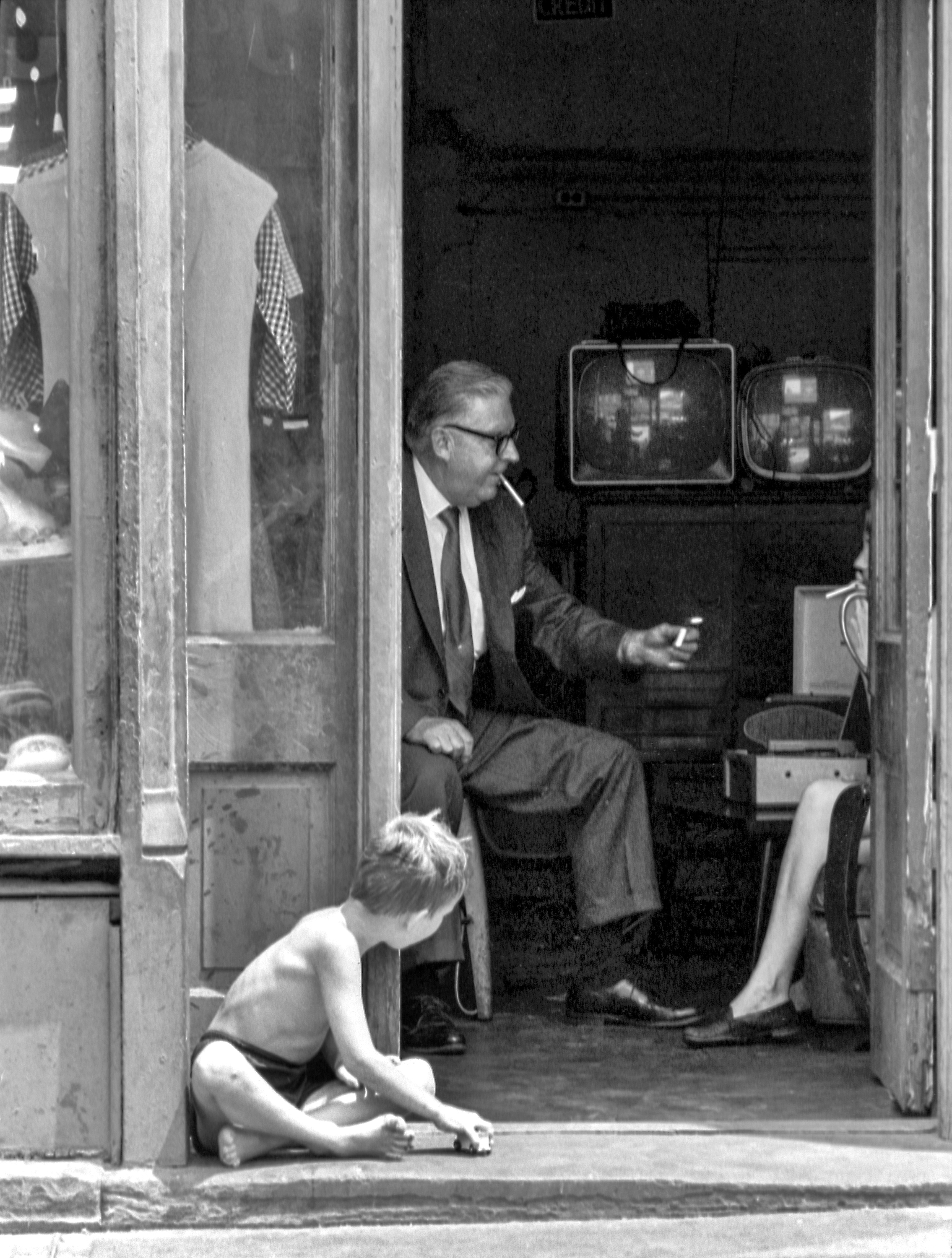
Here, the eye-line of the child directs the viewer to the man, his cigarette points to the lighter in his hand, which points to the woman’s cigarette, and then her leg points back toward the child, creating a circular motion to maintain the viewer’s attention in the frame. After that, the eye moves around the fame to see what else is there. 

Vectors can direct attention through the use of bright lines or lines of light. Above, the lines converge to the point of interest.

Here, the lines point to a mass and aid in the interpretation of the subject.

Vectors can be dark or black.

They can surround or encompass as well as point to the primary subject.

They can suggest depth an perspective.

Make a statement.

Or enhance a sense of motion.

Application

Vectors are put to good use when the objective is to hold the viewer’s attention within the frame. The trick is to compose the shot so the vectors move from one to another around the subject, without leading the eye out of the frame. 

Technique

As with many of the other aesthetic dimensions, the challenge is to become aware of the light or dark lines or shapes within the frame and then compose with vectors so they either point to or encompass the primary subject matter, the point of critical focus. This is easier to do when the camera is on a tripod. There’s more time to work the composition. Otherwise, the composing has to be done on the fly.

Contemplating Vectors in Personal and Social Contexts

The consideration of vectors as visual elements that direct attention within and around a frame, draws me to consider the elements—vectors—that direct our attention within and around our everyday lives. What are the forces that command our attention, and where do they want us to focus? 

Of course, the sources of influence vary by individual, time, place, circumstances, and culture. But generally, and for the sake of reflection, they include the “still small voice within,” the environment, people close to us, religious, medical, and educational institutions, political and business associations, artists, sports figures, special interest groups, the mass media (radio, television, movies), the internet, social media networks, and reading materials. It would take volumes to consider the nature of their influence, but in examining some of these sources I found it very enlightening to note the direction the vectors are pointing, and what they want me to focus on. Ranking them was even more insightful, allowing me to make some critical adjustments. It took only a couple of minutes. Whether you write down your sources of influence or not, I highly recommend a close look as a way to bolster the ability to discriminate, understand the sources that are most influential, and provide a defense against negative valuation.

I welcome your feedback at <smithdl@fuse.net>

My portfolio site: DavidLSmithPhotography.com

My photo books: <www.blurb.com/search/site_search> Enter “David L. Smith” and “Bookstore” in “Search.”