Gratitude

Farm And Corn Field

I grew up in the city. My grandparents lived in the country, about thirty miles from us. We visited them most Sundays, year round, from the time I was born through high school. Although this is not a picture if their farm, it brings back vivid memories it.

Topping the list of the downside of going to grandma’s house was the two-hole outhouse (Who ever thought two holes was a good idea?) with pages of the Sunday Supplement covering the walls, spider webs in the dark corners and, well, the odor. When I was little, I had to be convinced that I wouldn’t fall in and nothing would come out of there to bite me in the butt. Because the house was heated by a wood stove in the back room, aided at times by the kitchen stove, the downstairs was warm enough in the wintertime with sweaters on, but I froze upstairs, napping under three or four blankets with my clothes on. With the exception of my father and me, the men in my family were very much into sports and cigars. So while they were watching “the game” and the women played cards around the kitchen table, it fell to my dad and occasionally my aunt, to keep my sister and me occupied. And that leads to the upsides.

My dad took us on walks to the nearby Clermont County Fairgrounds, where we would wander around the empty livestock stalls and climb the steps of the grandstand that overlooked the oval buggy track. In the summertime we would go to the corner market where, out in front, there was a bin where we reached in and fished among the blocks of ice for a bottle of pop.

At Thanksgiving and Christmas the main event was, of course, the meal. The scene in the dining room was straight out of a Norman Rockwell painting. Grandma was known for her cooking, so the long table was pulled out even further to accommodate all its leaves, and extensions were added as needed. There could be fifteen or more people seated around the table, passing turkey with stuffing, ham, mashed potatoes and gravy, green bean casserole, corn, peas, carrots, cranberries… Then came the pies, always cherry, apple and pumpkin. Years later I realized that grandma had been making everyone’s favorites on those occasions.

I took a lot for granted when I growing up. I thought everyone did what we did and had what we had. Now, I’ve grown to respect farmers especially. It took a long while for me to realize that food doesn’t come from grocery stores. I’d like to think it comes from fields like the one in the above image, planted, nurtured and harvested by people who respect the land and care about the health of the people they will feed. But I understand the “business” of farming is very different now. I read and observe that small farms are on the rise and increasingly trending toward more healthy and sustainable practices. And greater numbers of people are supporting them. For all these folks and their initiatives, I am grateful.

My daughter, Jennifer Miller, has a blog for parents who are actively supporting kids’ social and emotional development. Below, are quotes from it. For more, visit: <confidentparentsconfidentkids.org> I recommend the site, not just because I’m her dad. But because the content is always insightful and practical. She has over over 20,000 followers and has just published a book on the subject by the same name: Confident Parents Confident Kids.

Research shows that grateful people have better physical health, less stress and depression, better sleep and a greater sense of well-being. The Templeton Foundation found that 90% of people say they are grateful but only 52% of women and 44% of men express it on a regular basis.

One of Jennifer’s colleagues

As we express our gratitude, we must never forget that the highest appreciation is not to utter words, but to live by them.

John F. Kennedy

About This Image

I like to photograph after a heavy snowfall. It affords the opportunity to shoot in high key. Particularly exciting is to shoot in bright sunlight when the ground is covered with fresh snow. It’s a challenge in two particular ways. First, it’s a race to shoot while the snow is pristine. And second, all that whiteness tricks the exposure meter whether it’s built-in or separate.

Exposure meters interpret what they “see” as middle gray—in order for the image to contain the full range of values from black to white, even in color photographs. That’s what meters are designed to do. So if you point your camera at a field of snow, it will render it gray in the photograph. Of course, this can be fixed in editing, but that degrades the resolution somewhat. Better instead, on location, to determine the exposure by using a standard photographic Gray Card, or set the camera to “Manual” or “P” for professional mode and point it at something that’s neutral gray. That way, the snow comes out white.

This photograph was made in Sabina, Ohio toward the end of the day when I “lost” the light. I was disappointed at the time. But now I think the gray sky with only a hint of blue adds to the sensibility of the cold that day. I was wearing gloves and a hat. Sometimes, when conditions aren’t optimal, it can be a good thing.

I invite you to visit my portfolio site: David L. Smith Photography

Emptiness, Peace and Quiet

On the evening this photograph was made, the dominant sound in this airport parking lot was birds—a stark contrast to the busyness and clamor of cars, shuttle-busses and conversations that once pervaded it day and night for several years. The difference between the activity then and the serenity I experienced is heightened, I think, because the central structure existed, literally, to provide shelter. Ironically, the emptiness of the space in this image sort of fulfills the site’s purpose aesthetically by conveying the sensibilities of rest and peace.

The emptiness and quiet of the landscape encourages me to reflect upon its elements. Had there been cars, shuttle-busses and people in the photograph, my attention would have been drawn to the human rather than physical aspects of the image. Instead, the simplicity of elements and the long shadows direct my attention to the expanse of asphalt. I think of the forest it must have replaced, the animals and birds that were displaced, the mountains of sand and gravel, oil and paint that were used in its construction. It’s not that I object to this use of natural resources. I don’t. Building is what we humans necessarily do—it’s the activation of energy that flows from the desire to create and advance.

In addition to the raw materials that it took for this landscape and shelter to exist, I appreciate the army of individuals who envisioned, designed, leveled, supplied and built them, including the electricians who wired it for lighting and those who manufactured the glass and aluminum. Having traveled in countries where paved roads and electricity were barely functional, this facility stands as a testament to the power of collaboration.

The emptiness of a space designed to facilitate the movement of lots of people has a haunting quality. Not in a spooky way, but in the sense that purpose here is at rest. And because everything looks fairly new—no weeds pushing up through the asphalt, no fallen light poles or broken glass—there is the hope of renewal. (And that hope has recently been realized. Today, this parking lot is back in action).

In serenity we touch impermanence, ebb and flow, rising and falling, coming and going. It gives rise to peace and quiet, the place in us where purpose discovers its most appropriate and creative action.

The more tranquil a man becomes, the greater is his success, his influence, his power for good. Calmness of mind is one of the beautiful jewels of wisdom. 

James Allen
About This Image

I took an overnight visit to Wilmington, Ohio because the wide open fields provided an opportunity to use my 4×5 view camera. The airport had been a huge sorting center for DHL until the shipping company moved elsewhere in 2009. When I visited in 2011 there was very little activity, no planes flying in or out. Thus, the absence of people and cars in the parking lot.

Arriving there just moments before sunset, I saw the cast shadows, stopped the car and worked quickly to set up the tripod and change the lens. If the sun went behind the trees, the streaming effect would be lost. TheMyprocess was anything but serene.

The 90mm wide angle lens distorted the light poles considerably, especially at the edges. So I made the vertical correction in Lightroom. By doing so, some of the bottom of the image was lost. But I decided to sacrifice even longer shadows in the foreground for the lack of distortion.

Success

Construction Ladder


Personally, spiritually, professionally, economically, socially, and politically we’re all climbing ladders toward “success.” What prompted the selection of this image for contemplation was hearing someone in a television commercial ask, “What do all artists seek?” His answer: “Recognition.” Ugh! I couldn’t let that go.

Did Michelangelo sculpt and paint to be recognized—or for money? What about Vincent Van Gogh or any of the masters of Eastern and Western civilizations? Twenty-first century, Western culture is so saturated with materialistic, competitive, end-product and celebrity values it’s hard for us to imagine anyone defining success as other than fame and fortune.

Case in point: My wife, Linda, observed that in her English class discussions of forty years ago, her students said what they valued most was “making a contribution.” Ten years ago the consensus was that they wanted to be known—famous. The latter perspective was echoed in my own teaching experience.

Since we largely define success for ourselves—consciously or unconsciously, I thought I would share some of the observations on the subject that I collected as quotes. Before presenting them, however, a perspective that I feel is important and missing from the perspectives below is that success for many people is achieved more through process than product, particularly when the activity is aligned with one’s personal purpose, their reason for being. As noted on the home page, I write and photograph to feed my soul. Anything that may come of it for others is just “icing on the cake.” I know I’m not alone in this.

To laugh often and much; to win the respect of intelligent people and the affection of children; to earn the appreciation of honest critics and endure the betrayal of false friends; to appreciate beauty, to find the best in others; to leave the world a little better; whether by a healthy child, a garden patch or a redeemed social condition; to know even one life was breathed easier because you have lived. This is the meaning of success.

Ralph Waldo Emerson


My mother said to me, ‘If you are a soldier, you will become a general. If you are a monk, you will become the Pope.’ Instead, I was a painter, and became Picasso.

Pablo Picasso


History has shown that the success of cultures and even of great civilizations is measured by the way they deal with crises; the greater the challenge, the greater the opportunity for positive response. The same is true for individuals.

George Leonard


Individual success depends on environments that trigger the fulfillment of our genetic potential. Environments that motivate through fear literally shut down the potential for growth. Those that motivate through vision, open us up to express unforeseen possibilities.

Bruce Lipton


The key to modern success is human resources. How well you educate, train, and treat people in your society becomes more important than the coal you dig, trees you fell, or rivers you dam.

Herbert Striner


We now have the technology, the resources and the know-how to make this world a 100% success for every human being on Earth.

R. Buckminster Fuller


The soul of an enterprise bonds it together as one force giving it identity, purpose, direction and a reason for being… Many pooh-pooh the reality and value of soul in the corporate world but it is truly amazing how, given the same business circumstances, some companies do so much better than others. It is not soul that assures success, but it is the presence of soul that unifies the mission to achieve success… Companies with soul never lose sight of one thought – If you are not making history, you are history!

Bob MacDonald


Try not to become a man of success, but rather try to become a man of value.

Albert Einstein


May your New Year be filled with joy, love, peace and health. And success.


About The Blue Ladder Image

File #: DC669

Location: Columbus, OH

Not much to report. Walking the upper part of High Street in Columbus, Ohio, looking for things to photograph, I came upon a construction site. I saw this, took the shot and moved on. What I take from this is that evocative images don’t always require travel, special equipment, planning or technique. To quote Henri Cartier Bresson who, when asked the secret of his success as a street photographer, replied “Be there and f8.”

Form And Function

Aside from the beauty of the reflections, this motorcycle urges me toward two lines of contemplation. The first is a deep appreciation for our capacity to extract elements from the earth and shape them into virtually unlimited forms. Size, shape and surface, even strength of materials and temperature tolerances are a few of the variables that designers and engineers can manipulate—which amazes me! My father, who made tools for the Ford Motor Company, often said that he could make anything from metal. When he heard that I was chipping fossils in creek beds with a hammer and screw driver, he surprised me with a professional looking pick and hammer that he made from a single piece of steel. The handle was textured for gripping and the head had a needle point on one end and a flat prong on the other for prying. I still cherish it.

Having gained the ability to shape the earth into anything we can imagine was certainly a key step in humanity’s ongoing physical and intellectual transformation. By literally having “the whole world in our hands,” the forms we have made, and are continuing to create, are informing us about our values and choices. Do they sustain and build? Or otherwise? This particular form, the motorcycle, peaks my aesthetic nerve. I never owned one, but this image helps me appreciate how so much potential power, visually and literally, can be contained in such a relatively small and beautiful vehicle.

Another line of contemplation derives from the observation that many different forms have been organized into a highly functioning whole. A motorcycle is an excellent example of the often misused term, “synergy,” initially used to describe a system where the whole is greater than the sum of its parts. Indeed, extract any part, no matter how small, and the system will not function as it was designed. There’s also a lesson in diversity here. If all the parts took the same form or performed the same function, they wouldn’t constitute a whole capable of functioning at all. In both physical and social systems, differentiation and diversity are essential for full functioning. It’s the survival and growth strategy that bacteria learned around two billion years ago. “You bring the costumes. He’ll bring the lights. I’ll bring the music. They can sing and dance and we’ll put on a play!” Every part in a machine, and every member of a society has a role to play.

What is anything but spirit taking form?

Alex Gray (Artist)

About This Image

Title: Motorcycle

Theme: Form And Function

File: DF 640

Lebanon, Ohio

I often photograph at classic car shows. I’m not so much interested in a vehicle’s mechanical attributes or performance, although these are sometimes remarkable. What draws me are the impeccable forms and pristine surfaces that are highly reflective. I even dress for these occasions, wearing dark pants, shirt and shoes to avoid or moderate my  reflection. Unfortunately, on the day I made this image, I was wearing a plaid shirt and it shows in the photograph.

Because I go looking for reflections, exquisite light and strong geometries my car images tend to be abstractions rather than whole cars. If you would like to page through a book of these images—and monographs featuring other themes—the title is “Auto Reflections: The Intersection Of Form, Light and Color.” (The link is to www.Blurb.com/bookstore). These are all available through amazon.com by searching: “david l. smith ohio photographer.”

Models And Modeling

Boy Watches Man In Doorway

Joseph Chilton Pearce, a respected author on the subject of brain development, wrote that a child’s capacity to operate in the world is determined entirely by the models he experiences in everyday life. He observed that all human intelligences—music, math, art, logic, mechanics, even emotions and intuition—are built into us genetically at birth. As potentials. “Their awakening,” he says, even for adults, “requires stimulus from the external world, from someone who has developed that intelligence to a functional level.”

This was certainly true for me. For you as well? Had I been able to interact with a practicing fine art photographer or motion picture director early on, I could have begun to awaken my visual potentials—and careers—that much sooner. Instead, in my youth, I resorted to the only resources at hand—books and magazines, which were highly inadequate. Learning theory says we learn best from having behavior modeled and reinforced, by seeing someone do what we want to do. And, it cultivates the confidence-building attitude, “If she can do it, so can I.”

Having taught at the university level and managed a television production facility for twenty-six years, one of the most important lessons I learned about teaching was to acknowledge and celebrate a student’s potential when it shows up, and then feed it by providing face-to-face, first-hand experiences in that area. I can’t overestimate the extent to which so many of my students benefitted from visits to television stations, commercial and corporate video and audio production facilities and post-production houses—and the professionals who came to class to speak. In addition to subjecting students to working professionals, “real” world models and environments, I encouraged them to introduce themselves and build relationships with these people, and many students gained internships and jobs that way, even developed careers in the field as a result.

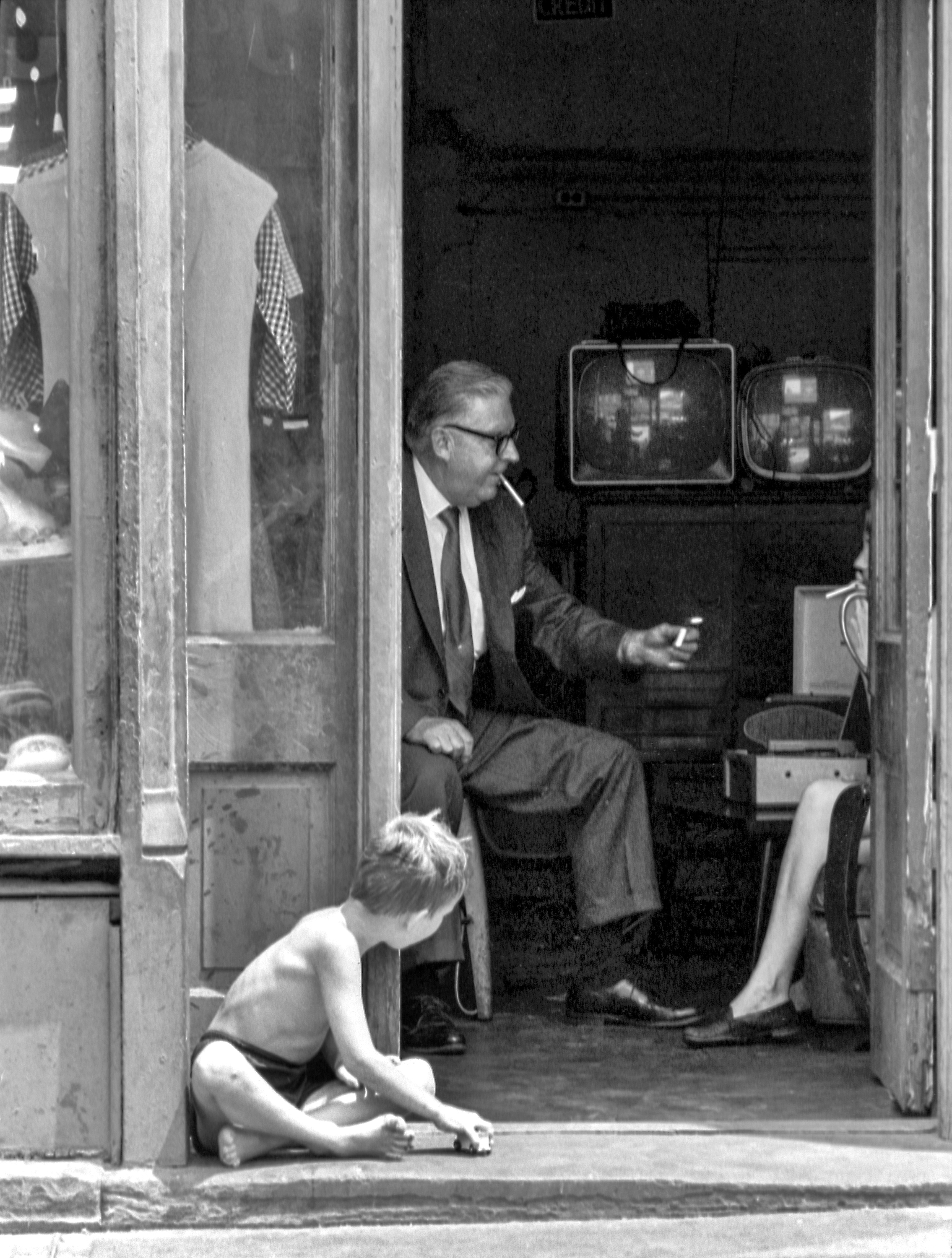
The child in the above image, observing the behavior and possibly hearing the conversation between the adults has momentarily diverted his attention away from the toy car. It’s just a moment. But the triangle of attention speaks to me of the significance of modeling, particularly for children. It raises the social question: What are we exposing our children to? And it challenges me to address personal questions: Who and where are my models? Where do get my inspiration? What social and media experiences empower me to live more authentically? What are my potentials? Which of them do I want to nurture? Am I appropriately prioritizing them? What am I modeling for those with whom I interact? This kind of questioning has undoubtedly helped me discriminate between distraction and purpose.

In part, I choose this image and theme because of the domestic and ideological violence being reported in the news lately. In all these instances I watch and think about the children being exposed to models of dysfunction, young minds whose potentials are being radicalized, neglected or suppressed. I’m reminded of Buckminster Fuller who, after I’d produced a program featuring him, took my hands and said, “Keep on doing what you’re doing, young man. We need more of this kind of (constructive) programming.” It was he who wrote that, “You never change things by fighting the existing reality. To change something, build a new model that makes the existing model obsolete.” Indeed, create a new, more functional model.

Children have never been very good at listening to their elders, but they have never failed to imitate them. 

James Baldwin

About This Image

Title: Boy In Doorway

File #: 012-A5

On lunch hours when I worked for Brand Studios as a technician in their color lab, I often drove the extensive and old German neighborhood known as Over The Rhine in downtown Cincinnati. No matter the weather, I would keep the car windows down so when I saw a potential shot I could stop and shoot without the interference of glass. For two years, I “cruised” the area looking for interesting faces and situations, shooting with a telephoto lens on a 35mm camera. If someone saw me or scowled, I just put the camera down and drove on.

I didn’t have to worry about copyright infringement because I wasn’t shooting for profit or publication, not even for exhibition. Besides, a release form is only needed when the photographer directs the subject in some way.

I remember this particular circumstance like it happened yesterday. I’d stopped at a red light, observed the situation through the passenger-side window and took the shot. The light changed to green, but seeing that there were no cars in back of me I exposed a few more frames. As it happened, the first frame was the best.

Whenever I think about street photography, I’m reminded of Henri Cartier-Bresson who was asked: What’s the secret of your success as a street photographer? He replied, “Be there and f8.” So true, especially when photographing people. You have to BE THERE, with a camera, in order to capture “the precious moment.”

I invite you to visit my portfolio site: DavidLSmithPhotography.

Nature’s Design Principles

Winged Red Maple Seed

Over time, a species of tree that evolved into the maple did so in part because it succeeded in finding a way to disburse numerous seeds over a greater distance. As kids we called them “pinwheels” or “helicopter seeds.” Hedging no bets in the area of reproduction, between 12,000 and 90,000 of these seeds can fall from a single tree in one season.

In this image I see a delivery system, a “package” perfectly designed to accomplish its mission. The heavier bulb containing the seed responds to gravity, pointing downward so it can penetrate the ground, while the aerodynamic “wing” system takes advantage of the wind to disperse the seed beyond the tree’s roots where it can germinate in fresh soil with the added advantage of increased sunlight. The design alone increased the odds of successful reproduction.

Because creation begins with imagination, when I think of seeds, I think of ideas. Of the number of ideas I’ve had, relatively few passed beyond germination. Fewer yet reached maturity. With time and experience we become more selective in our wanting, but how is it that some goals, even when pursued with passion and persistence, do not come to fruition? Two examples, one from business the other from teaching, come to mind for me, both of which—in hindsight—provided the same simple but profound lesson: Apple trees don’t grow from peach seeds. They are both fruit trees, but their inherent designs, growth needs and strategies are very different.

If I were king of the world, students would be exposed to nature’s design principles and strategies before they graduate from high school. Like many of us with vivid imaginations, I generated many ideas about what I could do and what I wanted to do. Had I known, even metaphorically, that ideas and initiatives grow organically from the ground up (not the top down), from seeds (ideas) planted in soils rich in nutrients (money and resources) with lots of sunlight (intelligence and wisdom) and caring hands (a collaboration of peers), the ideas mentioned above would likely have blossomed. Instead, they now reside in folders in my “Uncompleted Projects” file drawer.

On the other hand, perspective: had those ideas manifested, I would not be the person I am today. And although those ideas still tug at my heartstrings, I consider myself better off for having learned what doesn’t work. Certainly, had either idea matured my lifestyle would have been chaotic. I needed to learn some very important lessons by missing the brass ring. And that’s perfect. Still, had I understood something of nature’s design principles and strategies, I might have directed my attention differently.

In our consciousness, there are many negative seeds and also many positive seeds. The practice is to avoid watering the negative seeds, and to identify and water the positive seeds every day.

Thich Nhat Hanh

About This Image

Title: Winged Maple Seed

Theme: Nature’s Design Principles

File #: 732-C2

There are many times when an object of interest can best be photographed under controlled conditions of lighting and background. So one of the best tools a serious photographer can have is what used to be called a “copy stand.” Basically, it’s a device where a camera can be fixed to an adjustable arm that moves up and down so it can be positioned closer or farther away from the subject. The option of bringing objects home to photograph expands the possibilities of subject matter.

For this image, I put the seed on a piece of glass with white paper beneath it and positioned photoflood lights on both sides to light the paper evenly. With a macro (close-up) lens on my camera I was able to come within inches of the seed and fill the frame.

Soul Train: The Novel

PUBLICATION ANNOUNCEMENT

Coming on the heels of my posting on “Fiction And Empathy,” the novel I’ve been working on for three years went live on Amazon.com last week. In Soul Train an African American railroad worker reflects on conversations he had with passengers, significant happenings including tragedies and his exceptional family life. His wife refers to his story as a “spiritual journey,” but he thinks of it as a life spent in “soulful investigation.”

The book is available in paperback and on kindle. Story details are provided on the back cover. Click here.

Fiction And Empathy

I recently came across some insightful statistics on reading. They vary somewhat by state, but here’s an overview.

  • Women read more than men.
  • Most Americans don’t read fiction.
  • Between 1982 and 2012 fiction reading declined from 56% to 46%
  • Men mostly read nonfiction.
  • Women mostly read fiction.
  • Executives far outpace the general population in the number of books read per month.
  • The biggest driver of literary reading is education; the higher, the more books read
  • The genres that make the most money in order: romance/erotica, crime/mystery, religious/inspirational, science fiction/fantasy, and horror.
  • A 2018 survey asked why people read fiction. In order, the reasons included: For entertainment, to appreciate other places and people in the world, to understand the circumstances of others, to escape the everyday world, to learn, to pass the time. 
  • The sale of print books is declining. Only 54% of Americans cracked open a book of any kind last year—print or digital, fiction or nonfiction. Fiction suffered most.
  • In the past decade, poetry suffered the steepest decline. Only 6.7% of American adults read poetry last year, versus 12% in 2002. 
  • 28% of adults read an e-book in 2013, up from 23% the year before.

In 2013, MarketWatch published an explanation for the overall decline in reading. Now, six years later, especially considering the popularity of selfies, their perspective is worthy of consideration. It’s narcissism the author said. “Americans may be more fascinated with their own lives than with those featured in great works of literary fiction: Some 56% of Internet users have searched for themselves online, such as by typing their own name into Google, according to the Pew Research Center. Studies also show that people’s attention spans are getting shorter, in part because “adults have been presented with a tidal wave of easily accessible and affordable entertainment.”

Further, “Students have been abandoning the humanities in favor of the sciences: The number of students taking bachelor degrees in humanities hovers at around 8%, less than half the number four decades earlier, according to the American Academy of Arts and Sciences. And in a study released in 2013, the Organization for Economic Cooperation and Development ranked Americans just 16 out of 23 industrialized countries in literacy.”  

I cite this data because I think it relates to empathy, the loss thereof, which is being reflected in public policy here and abroad. In Emotional Intelligence, Daniel Goleman defines empathy as “the ability to know how another feels…. to perceive the subjective experience of another person.” In that same book, Martin Hoffman argues that “the roots of morality are to be found in empathy because empathizing with someone in pain, danger, or deprivation moves people to act.” It leads me to wonder if the systems responsible for managing immigrants—worldwide—would be more humane if their administrators sat down and had a conversation with those detained.     

I’m not alone in believing that reading works of poetry and fiction can awaken and activate empathy. A recent article in Trends in Cognitive Sciences observed that “fiction is the simulation of selves in interaction. People who read it improve their understanding of others. This effect is especially marked with literary fiction, which also enables people to change themselves. These effects are due partly to the process of engagement in stories, which includes making inferences and becoming emotionally involved, and partly to the contents of fiction, which include complex characters and circumstances that we might not encounter in daily life. Fiction can be thought of as a form of consciousness of selves and others that can be passed from an author to a reader or spectator, and can be internalized to augment everyday cognition.” That’s key: reading fiction can contribute to how we think and perceive the world. I’d like to see some savy journalist ask our political leaders in both parties if they read poetry or fiction.

Unfortunately, “Empathy levels have been declining over the past 30 years.” Research led by Sara H. Konrath of the University of Michigan found that college students’ self-reported empathy has declined since 1980, with an especially steep drop in the past 10 years. To make matters worse, during this same period students’ self-reported narcissism has reached new heights, according to research by Jean M. Twenge, a psychologist at San Diego State University. I was particularly fascinated by the methodology that Dr. Konrath used—the Interpersonal Reactivity Index which measures empathy by asking whether responders agree to statements such as “I often have tender, concerned feelings for people less fortunate than me.” And “I try to look at everybody’s side of a disagreement before I make a decision.”

I was almost an exclusive reader of nonfiction until I married Linda. Even for a long time afterward, I mostly read to supplement my work, projects or worldview. Browsing her bookshelf somewhere in the early ’80s, I picked up John Steinbeck’s Grapes Of Wrath, and I was hooked. The journey was fascinating and the ending shocking, nothing I could have imagined. Being emersed in a time, place, people’s lives and circumstances that were totally foreign to me—and based in historical fact—was a wakeup call. I didn’t know my general empathy for human beings could be so poignantly activated by reading. 

From then on, I became a regular reader—and eventually a writer—of fiction. Because of my interests and work, I never stopped reading nonfiction, but it was works of fiction that stirred my capacity to empathize and approach an understanding of how other people think and respond to challenges. When I observe what’s going on in the news these days, I’m reminded of a Daniel Goleman quote. He said, “Lacking a sense of another’s need or despair, there is no caring.” Empathy then is real caring based on understanding someone else’s perspective and circumstances. Importantly, he explained that “rapists, child molesters, and many perpetrators of family violence alike are incapable of empathy.” It speaks to cause. “They’re emotionally handicapped, incapable of understanding what their victim is feeling in the situation. These and other crimes are pursued as though the victim has no feeling of their own.” This appears to be a mental health issue that isn’t even being talked about.

There’s an opportunity here. Encouraging and promoting the reading of fiction and poetry meant to enlighten—humanities publications in general—could be an easy way to awaken empathy and ease social decline due to mental health. This isn’t the whole answer, of course. But the lack of empathy is a serious problem, evidenced by the worldwide trend toward pulling in (nationalism) which suggests self-serving motivations, fear and a lack of trust. The strategy of a person lacking empathy is exactly that, pulling in and drawing lines in the sand—“I don’t need you.” “Keep out.” “I can go it alone.” It’s an illusion. It has been proven that human beings and human societies can’t go it alone. They become dysfunctional and then die because living systems are, by definition, interdependent networks of functioning relationships. As the ancient Maya and other civilizations have demonstrated, building protective walls—physical or psychological—around cities cuts them off from the great and necessary advantage of diversity, an essential evolutionary component that creates resiliency. Creative works that awaken empathy help us to respect and value diversity, and in doing so make us resilient. 

We think we listen, but very rarely do we listen with real understanding, true empathy. Yet listening, of this very special kind, is one of the most potent forces for change that I know. 

Carl Rogers (Psychologist)

About The Photograph

This has been a favorite photograph of mine since it was taken in the early ’70s. It beautifully records Linda’s love of literature—poetry in this instance. And it expresses the sensibility of peace of mind that both of us cherish. The shot wasn’t posed. You see her here in a quiet moment. I just happened to have a camera with me. Often, having a camera at hand has resulted in unexpected gems.

I welcome your feedback at <smithdl@fuse.net>

My portfolio site: DavidLSmithPhotography.com

My photo books: <www.blurb.com/search/site_search> Enter “David L. Smith” and “Bookstore” in “Search.”

VIII. Emergent Properties (In Systems)

This is the eighth in a series of postings on whole systems thinking.

SPECIAL ANNOUNCEMENT

I invite you to check out my new blog on the ancient Maya. A description follows at the end of this posting.

______________________________________________________________________________

Life is an emergent property—a property that is not present in the parts and originates only when the parts are assembled together.

Fritjof Capra

When individual parts—such as these boards—are integrated, a feature emerges and a process takes place that’s greater than the sum of the parts. None of the individual parts of a house constitute a home. Likewise, the parts of a smartphone are not smart. But put them together in a coherent manner—according to their design—and an array of advanced capabilities emerge.

When it comes to non-living systems such as books, computers, cars, tools and appliances, it’s the hoped-for or intended emergent properties that first motivated their existence. Initially, they were expressed as an imagined need, and the fulfillment of that need motivates the owner to keep it functioning through maintenance. In living but non-human systems, the emergent property is autopoeisis, the capacity to make more of itself—reproduce. In addition to this, the emergent properties of human systems include self-reflexion, inner and outer awareness, creativity, the ability to manage change and do work. What’s important to note, in all systems, is that properties emerge from the integration and coherence (functional relationship) of their component parts.

Because living systems are dynamic, constantly changing due to the capacity of their members to make choices, the established ordered arrangement at any time can break down when something new is introduced or when something happens to alter the functionality of the whole or its parts—like climate change. Whatever the source, to manage change effectively, rigidity has to give way to the more complex emerging order. The name we give to the continuous process of emergence is “evolution.” The simpler name is “growth.” 

Because living systems experience and adapt to change they grow—or they don’t. One of my earliest introductions to this idea was Grow Or Die: The Unifying Principle of Transformation by George Ainsworth-Land. It’s an expensive book now because it became a cornerstone in strategic planning and corporate transformation. I highly recommend a check to see if your library has or could order a copy. Particularly insightful, Dr. Land explains why species don’t adapt to their environments nearly so much as they adapt environments to themselves. It’s the mantra of successful entrepreneurship: “Find and need and fill it.” Facilitating emerging—higher-order—properties is how civilizations grow. If not, they die.

Contemplating Personal And Social Emerging Properties
The universe is not a place, it’s a story or an irreversible sequence of emergent events. It’s an ongoing creative event. The universe as a whole, and each being within it, is permeated with the power of emergence.  
Brian Swimme (Evolutionary Cosmologist)

Higher-order properties lie within us individually and collectively as potentials. As authors of our experience, we have the capacity to identify and realize them. The quest begins with an assessment of existing talents and motivations, and a close look at what gives us joy. The process of specifying these, can give us a sense of what we have yet to do. What unrealized potential is waiting to emerge? Size and social acceptability don’t matter. It can be as simple as choosing a different frame of mind, like deciding to do an odious job well instead of just getting it done.  It could be a change of perspective from negative to positive, or a change of a mood pattern from irritable to allowing. What emerges in instances such as these, is a more loveable self-image and confidence in the ability to change for the better. And it can transform the lives of those around us. A prominent example of this was when First Lady Michelle Obama said, “When they go low, we go high.” That was an emergent moment for her, and for us—a call to rise above name-calling and blaming.

Within the image of the clouds above, barely visible on the left-hand side and seeming to connect the clouds, there’s a tiny jet-trail. Whenever I see those, I think of the many people aboard the plane, each of whom is living a story of emergence from childhood to adulthood, from having little to having much—knowledge, status, relationships or wealth. And they’re on their way to realizing more of that potential in a different place. Whether it’s to spend more time with a loved one, consider or assume a new position, build a new relationship or accept an invitation to walk on a beach, the emerging potential will likely be growthful.

Change the story and you change perception; change perception and you change the world.

Jean Houston (Visionary, Human Potentials Scholar)

From an evolutionary perspective, the individual human lifespan is so short as to appear insignificant. But from a personal perspective, it’s quite the opposite. Every individual is unique and precious, here to live and by their emerging story, ideally, advance their own higher-order being, thinking and doing. We live and breathe in an atmosphere of stories. And each of us, like the dust and water particles that form clouds, contributes to the quality and movement of our collective atmosphere. Sometimes it’s calm; other times turbulent. Always, it’s vibrant and alive.

Social innovators are people who specialize in emergent properties. They have been referred to as “emergents,” “positive change agents,” “social engineers” and “activists.” They’re in the business of moving beyond the dysfunction of the status quo, of dreaming better ways to live and work, and as soon as possible live the dream. Beyond a paycheck, wealth, status or celebrity, they want their lives to matter. They are their own people, authentic to the core, the modern-day equivalents of the “rugged individualists” who settled the American West. 

In business and industry, the emergents are developing and promoting alternatives to carbon-based energy, sustaining and improving ecosystems, preserving and managing forests, conserving wildlife and habitat, improving health and law enforcement systems, promoting nutrition, discovering applications of nanotechnology, testing energy-efficient transportation systems, and exploring the potentials of space travel. These and others like them are the visionaries, authors, life-coaches, globally conscious motivational speakers and teachers who champion improvements in every field. Emergents are easy to identify because they live principled and disciplined lives.

Less dramatic but equally deserving of the adjective “emergent,” are family members and neighbors, everyday people who are quietly living moral and ethical lives, people actively looking for ways to work more creatively, smarter and kinder with consideration for those around them. They do a good job and take pride in it, no matter how menial the work may seem to others. Opting out of popular culture, they prefer the more peaceful and substantive values of personal enrichment, fulfillment and service.

Because the contributions of emergents have survival value for the planet and all its inhabitants, I see them as paving the way toward a positive and more sustainable future. For this reason alone, they deserve to be acknowledged, encouraged, and supported—by all. 

Transcendence, emergence, and integration of the components are the very pattern of the cosmic movement.

Beatrice Bruteau

I welcome your feedback at <smithdl@fuse.net>

My portfolio site: DavidLSmithPhotography.com

My photo books: <www.blurb.com/search/site_search> Enter “David L. Smith” and “Bookstore” in “Search.”

Announcing

I recently launched another weekly blog, entitled “Ancient Maya Cultural Traits.” After decades of researching and organizing information from the fields of anthropology, archaeology, ethnography, and epigraphy, I began to experience the ancient Maya lifeways and worldview in my imagination. Every day. They became so potently familiar, I felt like I’d entered their world and taken on a second identity.

In June of 1998, I spent an entire night and morning imagining, then outlining The Path Of The Jaguar, a series of stories that would feature these people, their places and history. Literally overnight, I found a use for my databases and set out to learn how to tell a compelling story. Twelve years later, I self-published Jaguar Rising. Then came Jaguar Wind And Waves and Jaguar Sun.

The guideline I set for myself in writing these stories, was that every scene and situation had to pass the test of plausibility. The historical information had to be accurate, based on the latest scholarship, and the characterizations needed to be reasonable and representative of the times and patterns of ancient Maya thought customs and behavior. Also, I wanted to immerse readers in the jungle and the cities when they were new. Rather than depict the culture as the “mysterious” Maya, I present them as real people confronting universal human challenges.

I invite you to check out Ancient Maya Cultural Traits. Categories include food, trade, customs, costumes, worldview, rituals, warfare and weapons, prophecy, marriage alliances and more. Gods, goddesses and underworld demons come to life as each posting includes a related excerpt from the novels. The first topic is “blood.”   

VI. Equifinality

Alphabet Letters


This is the 6th  in a series of postings on the theme of whole systems thinking.

The whole system’s principle of “equifinality,” a term coined by the father of systems theory, Ludwig von Bertalanffy, holds that in open systems, for those that have external interactions, a given end state can be reached by many potential means. To lock on to a single pathway, observation or solution can overlook a simpler or better way to reach a goal. The advice then is to reserve judgment and keep an open mind.

Beyond ideas and perspectives, equifinality has implications for individuals within social systems, suggesting that each member has equal opportunity to affect the outcome of the whole—by paying attention to potential solutions and staying open to alternative pathways to reach a goal—noting that any change will affect the output or outcome. Change any element, person or function, however slightly, and the system will perform differently than it otherwise would. Stated positively, no matter how small, invisible or seemingly insignificant a person’s function within a system, they exert an influence on its performance and outcome.

A rock group is an open system composed of interacting members. As such, it performs differently each time the performers take the stage. Things happen. One musician substitutes for another. A guitar is not properly tuned. The drummer is trying out new sticks. The lead singer is depressed. An amplifier is replaced and now the sound is different. Likewise, corporate cultures change when an employee begins to eat lunch at his desk, when a mother brings her toddler to work and when an executive begins wearing jeans. It’s the reason we can’t step into the same river twice. Every millisecond, the water molecules are exchanged; stones move; leaves fall in; the wind and fish contribute to turbulence. The example I cited for my students has to do with film and television production considered as a social system. Change one word in a script, decide not to stop for lunch, swap out a microphone or a light—every decision alters the outcome. We see it in television series, where success in the first season generates more money, more expensive talent and new writers who have their own ideas about what will succeed in the next season. Time and larger budgets bring about changes and suddenly The Good Wife isn’t so “good” anymore, Sherlock’s cases become more complicated and are anything but Elementary and Person Of Interest shifts from stories about people to cyber warfare.

Contemplating The Personal And Social Consequences of Equifinality

In the above photograph, each chip is a bit of data. Displayed as they are, the whole represents a field of potential, meaning the letters and numbers could be put together in a staggering number of ways. Like magnetic letters on a refrigerator door, a child could use them to spell the word “dog.” Another child could come along and use the same three letters to spell the word “god.” And within the whole system in everything we see, there’s equal opportunity to affect an infinite variety of changes.

Personally, equifinality gives us a reason to appreciate that everyday choices and behaviors make a difference, whether intended or not. Linda’s switch from merely “fresh” to “organic” head lettuce affected changes—in our bodies and in the local supplier, farming systems and health systems, even the economy. Slight, yes. But nonetheless real. And little things add up. Every time we turn on the radio or television or engage in social media, we contribute to the sustainability of the medium and cast a vote for more of its content. Recently, we’re beginning to see the marketers behind the curtain, quantifying every decision we make, and modifying their systems accordingly. There’s big money in monitoring our choices and behaviors. And the principle of equifinality can be used to affect change. For instance, Linda and I are telling restaurant employees why we bring along our own paper straws and cloth napkins—we want them to know that it cuts down on plastic and paper. Again, a small thing, but in every instance, people understand and appreciate our choice.

Knowing that my choices and behaviors are affecting change, I can be more aware and deliberate in my communication and interactions. What message do I want to send? Do I really want to sustain this activity? Do I want to cast a vote for more of this product to be produced? Is this information, service or philosophy in alignment with my values? Does this situation lift me up or inspire me? Do I want to support a company that isn’t socially responsible?

It occurs to me that this sounds like a lot of self-regulating introspection. Editing this post, I hesitated and observed that the individual words, ideas, and questions I’m expressing are affecting my readers, and who knows what else. I paused. Do I really want to put this information and these self-regulating questions out there? Indeed, I do, because I’m advocating that we dig deep into our authentic selves before making choices and engaging others. Doing so with more awareness of the consequences, however small, seems to me to be a contribution to the greater whole systems—holons—in which I participate.

I have to admit that there are times when I go against the voice of my authentic self, as when I consume more sugar and television than I know I should. Sometimes we just want what we want—and we accept the consequences. On balance, however, I find comfort in the act of making “a good faith effort.”

Never doubt that a small group of thoughtful, committed citizens can change the world; indeed, it’s the only thing that ever has.

Margaret Mead

I welcome your feedback at <smithdl@fuse.net>

My portfolio site: DavidLSmithPhotography.com

My photo books: <www.blurb.com/search/site_search> Enter “David L. Smith” and “Bookstore” in “Search.”