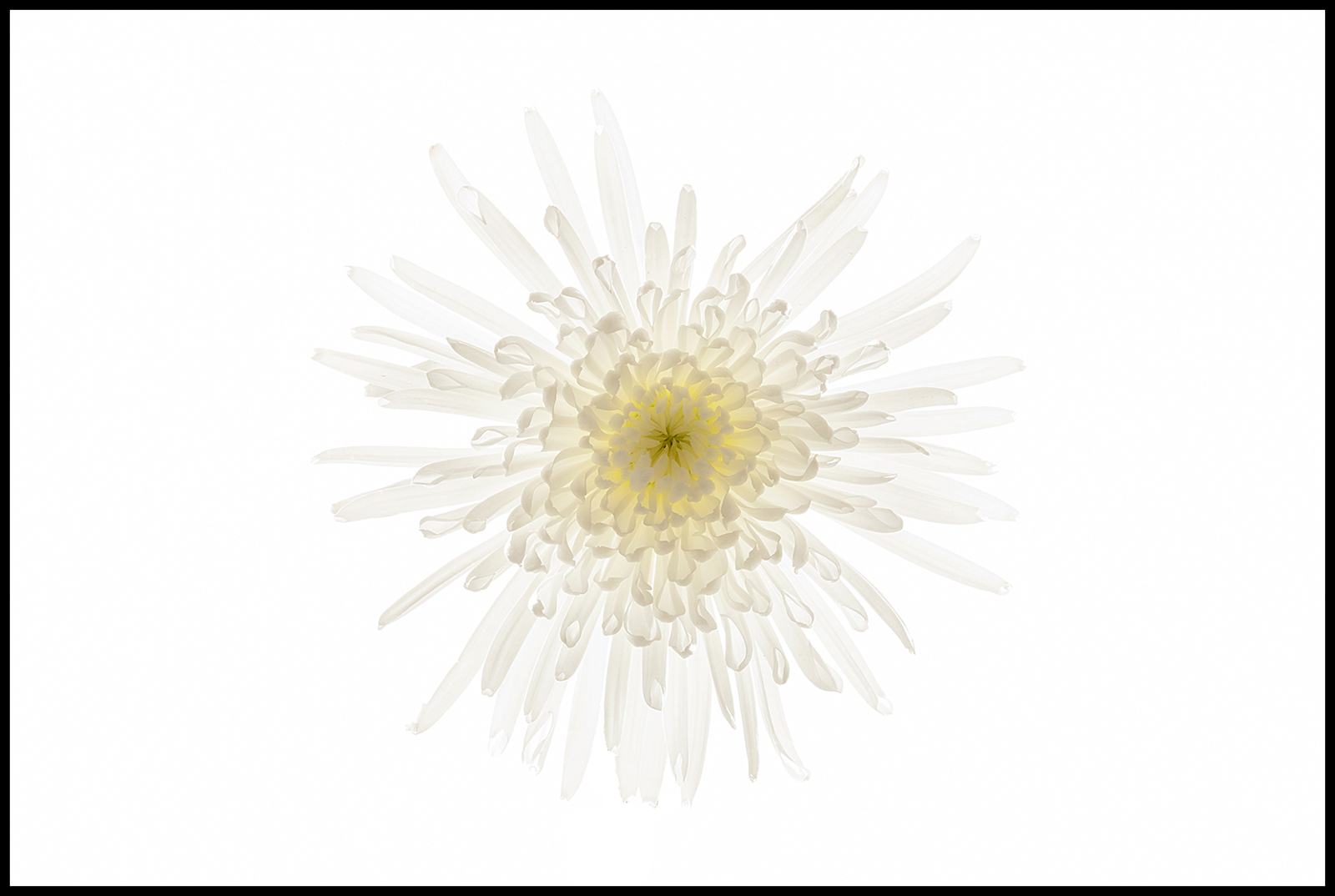
High Key

An art style that sheds light on the value of choice

In a dream, I walked around an art gallery where all the large black and white photographs were made in “high key”—white subjects on white backgrounds with some grey values but no blacks. Attempting to achieve this with film was challenging because it required special lighting, exposure, processing and printing techniques. Also, it was not easy to find white subject matter, and evenly light a white background. Upon awakening from the dream—and loving the images I’d seen—I realized that I would have greater control by using digital technology. The above image is one of the results.

Fueled by the memory of the photographs I saw in the dream; I made some attempts at producing some high key images and the results were quite nice. Working with the above image to prepare it for printing, I realized that the high key technique contains some important parallels with respect to everyday living—most notably, as the song in Monty Python and the Holy Grail advises, “Always look on the bright side of life!”

To achieve a high key result—in an image and in everyday living—the subject matter needs to be white or bright. In everyday living we confront sights and sounds that alternate between the dualities of light and shadow personality expressions, aspects of our human nature. Our exposure to positive and negative perceptions and judgments is so commonplace and persistent it doesn’t seem like we have a choice. But we do.

With some resolve and mental discipline, we can choose to move more in the direction of selecting positive, empowering and uplifting perceptions, behaviors and experiences—the psychological equivalent of white subject matter in photography. High key imagery often affects a shift toward heightened aesthetic appreciation, even a Wow! —by displaying a brighter than normal representation of the subject. Just so, a more positive perception of others and the world can list the spirit. One way or another, our developing view of the world will guide us further into the light. Or not.

To produce a high key effect in a photograph, it’s not enough to have a white subject. It also needs to be situated on or within a predominantly white background that is or can be rendered at least as bright, ideally more so, than the subject. This accounts for high key photography being mostly done in a studio. Socially, we find these backgrounds—environments—in the company of other people. We even speak of people in the terms of their “key”—she “brightens my day,” or on the contrary, “he brings me down.”

Of course, within all of us there’s the potential for light and darkness. Embodiment presents the soul with dual realities—up/down, pain/pleasure, hot/cold, attraction/repulsion—ensuring that we learn, and karma gets fulfilled. The trick while attending the University of Planet Earth is to favor environments and people that celebrate and bring out the light that we are, usually in the form of speech and behavior.

How and where do we find these? Increased illumination or lightening occurs wherever we experience the energies of love, resonance, empowerment, connection and joy. After an encounter with a person or group, do I feel uplifted, encouraged or inspired, feeling better about myself and the world? Or the opposite? Low-key experiences feed the darkness. And of course, there’s a full spectrum of environments and expressions between the extremes.

The final component needed for a high key photograph is control of the exposure. A white vase sitting on white paper will be rendered gray, unless the exposure is adjusted as well—away from “normal,” in the direction of overexposure. Photographically, this lightens the black and shadow areas. In life, frequent or prolonged exposure to the light of higher consciousness, increased awareness and spirituality is achieved either through grace (discussed in a previous posting), or choice—spiritual reading, self-inquiry, prayer, meditation and being with people whose light shines brightly. Through these and other uplifting experiences, the dark and gray values in life gradually become lifted into the higher tonal range.

As noted at the outset, the production of a high key effect is challenging. But the simple act of taking note of the darks and grays can be illuminating. The more light we shed on the dark side through introspection or intuition, the more we move toward the light of truth, freedom and contribution.

High key photographs stand out because the effect is rarely seen in nature or everyday living. It’s a clean look, the word “simplicity” comes to mind. The words “high key” can easily evoke a sense of high octane excitement, but the creation and maintenance of a high key lifestyle—lightness in mind, associations and being—requires movement in the other direction, toward simplicity.

There are two ways of spreading light: to be the candle or the mirror that reflects it.

                        Edith Wharton, American writer and designer, first woman to win the Pulitzer                               Prize in Fiction, for her novel The Age of Innocence.

__________________________

My other sites—
Love And Light greetings.com: A twice-weekly blog featuring wisdom quotes and perspectives in science and spirituality intended to inspire and empower
David L. Smith Photography Portfolio.com: Black and white and color photography
Ancient Maya Cultural Traits.com: Weekly blog featuring the traits that made this civilization unique 

Generations

They apply to everything, not just families

This image conjures for me an imagined family, perhaps two or three generations of farmers. The decaying barn speaks of a generation when the field was plowed with horses that, along with feed, seed, tools and machines required a shelter that didn’t require plumbing or heating. And wood was the building material of choice. I contrast this with the white modern structure in the background, which was more likely to be made of durable aluminum siding. Rather than a few horses, it can shelter horsepower by the hundreds in the form of combustion engines used to reshape and plow the land, plant seed, fertilize the soil and harvest crops. Mechanization changed everything for farmers.

Today, I imagine the farmer who lives in this house with his family, separately and at times together, using the tools of the electronic era where televisions provide information and entertainment while smart phones and computers connect them to relatives, friends and others a world away. All this for a year at about the cost the farmer’s grandfather would have paid for a bucket of nails to build the barn.

Rewinding the calendar, I observe that this little piece of land was inhabited and cultivated for probably less than three hundred years. Before that it was part of the great mid-eastern woodland where Native Americans reported to settlers that a squirrel could climb a tree on the east coast and not touch the ground until he reached the Pacific ocean.

An imaginary motion picture camera established on this spot after the extinction of the dinosaurs would record a lush jungle and then it would be submerged in a vast sea. When the water receded and the land became lush with forest again, there would come a period of increasingly cold winters with the eventual buildup of snow and ice forming glaciers two hundred feet above where that barn is now. I notice the time scale of these climate changes and compare them against the comparatively instantaneous changes that began to take place with the first people who settled on this property.

Through all these changes there have been two physical components that were common throughout—the sky above and the earth below. Whatever the extremes of climate, the watery atmosphere held back the harmful rays of the sun and let through those that promoted the emergence and growth of living systems.

Because the earth condensed from a ball of cosmic fire, it had the right combination of elements in just the right places to encourage the water and life that, as physicists theorize, was brought here by asteroids. A photograph such as the one above, helps me to reflect on what happened and extend the contemplation to the places where I live and visit. Another impetus in this regard is the memory of places that were significant in our lives but are no longer there.

For instance, the apartment building where I lived until I was ten is now a series of stores, and the factory that was next to us is now a restaurant. Passing by them, I remember much about the neighborhood and wonder if anything other than forest was on that land prior to the apartment building. Actual and imagined perspectives such as these remind me to appreciate what is. It also provides a touch of insight into the grand universal currents of change at a time when dramatic change is literally in the air and on the airwaves.

When we speak of “generations,” the reference is usually to human families. But the term can be expanded to include all cycles of change. Everything changes. Actually, the signature characteristic of living systems is change. Fearing change with respect to our bodies, families and properties is natural. However, the observation of larger cycles can also elicit our appreciation, particularly when they display order and resilience.

In Quantum Enigma: Physics Encounters Consciousness, Bruce Rosenblum and Fred Kuttner point out that If the initial conditions of the universe were chosen randomly, there would only be one chance in 10 to the 120th power that the universe would allow life. Roger Penrose has it vastly more unlikely: 10 to 123rd power. The chance that a livable universe like ours would be created is less than the chance of randomly picking a particular single atom out of all the atoms in the universe.” And yet, here we are.

The probability of life evolving through random genetic variation is about the same as the probability of a hurricane blowing through a scrap yard assembling a working airplane.

Fred Hoyle, English astronomer

_________________________

My other sites—
Love And Light greetings.com: A twice-weekly blog featuring wisdom quotes and perspectives in science and spirituality intended to inspire and empower
David L. Smith Photography Portfolio.com: Black and white and color photography
Ancient Maya Cultural Traits.com: Weekly blog featuring the traits that made this civilization unique 

Happy “Incidences”

There are no “accidents”

Look closely. Anyone who has engaged in sustained creative activity, irrespective of medium and expression, has encountered a multitude of “happy accidents,” positive outcomes that occur spontaneously, without intention or planning. Here, a dragonfly happened to be in the frame when I was photographing the sun and clouds.

Somewhere in my early sixties I’d experienced so many happy “accidents” that their frequency, impossibility and accumulation opened my awareness to the fact that these could not be accidents. And it’s not just a matter of the “prepared mind.” As time went by, my suspicion grew that these were the result of guidance. Eventually, the evidence became so clear, so unmistakable, that I’m confident that this is so. I can feel when it’s happening. And when these incidences occur, gratitude prompts me to say a silent “Thank you!” to the Universe.

We say we were “inspired” when we produce something that felt beyond our capability. Artists have been crediting their “muses” for centuries, and scientists cite their “aha!” or “eureka” moments” as inspiration coming from dreams or psychological preparedness punctuated by a period of rest or distraction. From time to time, we all experience moments like these. Whatever name we give the source— “spirit guides,” “angels,” “Universe”—I’m convinced that we are actually, all of us, continuously receiving guidance from another dimension.

Deepak Chopra identifies three universal realities—the material domain that we experience with the senses, the quantum domain which is not available to the senses yet is fundamental to the material world and the virtual which is the domain of spirit, the ground of all being, the “field” within which certain discarnate entities can operate as our guides and teachers. In his book, How to Know God: The Soul’s Journey into the Mystery of Mysteries Dr. Chopra writes—

It is my belief that the brain is the last stop downriver, the endpoint of impulses that begin on the virtual level, flow through the quantum level, and wind up as flashes of electricity along the trunks and branches of our neurons. When you remember anything, you move from world to world, maintaining the illusion that you are still here among familiar sights and sounds. 

I continue to experience an awareness—as I think everyone has—of distinct guides and teachers in various circumstances, particularly when it comes to problem solving, creative activity and expressions of wisdom. When we speak of “accessing our inner wisdom,” I think we’re in a state of being receptive, in the flow, open to guidance from that virtual realm.

As part of this dynamic I’ve also observed that happy incidences (and synchronicities), small or grand in scale, have the effect of consolations, their appearance evoking an approval of an activity or the appropriateness of a thought that occurred just before or during the event. Whenever that happens I direct my attention to what I was doing or thinking, and take it as an indication that in that moment, I was aligned with my reason for being here.

In The Seat of the Soul, Gary Zukav’s bestselling book, he advises us to—

Think of what you are doing as entering into partnership with Divine Intelligence, a partnership in which you begin to share your concerns with the understanding that there is an Intelligence receptive to what you are saying that helps you create within your own environment of matter and energy the most effective dynamics to bring you into wholeness. You do not need to think that you are creating alone, but rather that you are guided strongly in ways to help co-create in the most effective way for your healing and for the fulfillment of your contract. 

The “contract” he’s referring to is one made by the soul prior to incarnation. In another part of the book his recommendation is to—

Take your hands off the steering wheel. Be able to say to the Universe, “Thy will be done,” and to know it within your intentions… The final piece of reaching for authentic power is releasing your own (intentions) to a higher form of wisdom.

It is not my intention in these blogs to persuade or promote any philosophy, idea or practice, rather it’s to demonstrate and encourage the use of images in evoking contemplations along the lines of appreciation and gratitude. So, when a dragonfly made an appearance at the precise moment I clicked the shutter (1/1200’s of a second) I take it as a co-creative incident, a consolation that tells me I was at the right place at the right time doing the right thing with respect to my soul’s purpose. Interestingly, a little research turned up the information that, in every part of the world, Dragonfly’s symbolize “change in the perspective of self-realization.”

In this regard, I appreciate that I am not, as Gary Zukav says, “creating alone.” It’s a realization that provides enormous comfort because I can relax and let go of any anxiety about what to do or think in all the areas of my life. I can “take my hands off the steering wheel” and assume a posture of aligning and allowing rather than trying to figure things out, make something happen or take control. Indeed: “Hey Universe! Thy will be done.”

Full disclosure: While I am the specifier and organizer of these postings and photographs—the bringer of form, their contemplator and appreciator—I believe that any wisdom they contain comes from the virtual domain.

In a universe that’s an intelligent system with a divine creative force supporting it, there simply can be no accidents. As tough as it is to acknowledge, you had to go through what you went through in order to get to where you are today, and the evidence is that you did.

Wayne Dyer, American self-help author and a motivational speaker

_________________________

My other sites—
Love And Light greetings.com: A twice-weekly blog featuring wisdom quotes and perspectives in science and spirituality intended to inspire and empower
David L. Smith Photography Portfolio.com: Black and white and color photography
Ancient Maya Cultural Traits.com: Weekly blog featuring the traits that made this civilization unique


Grace

A gift freely given

Oddly enough, the word that came to mind when I came across this image was “grace.” Considering the thorns and this subject being no longer living, I wondered why. I think it lies in the composition, the uplifted “arms” that seem to “praise” the thistles; the buds on each side have their arms raised as well, the totality expressing receptivity.

In grade school the nuns taught us that “grace” was a spiritual benefit, a freely given gift from God as sort of a step toward what they said was “redemption,” what I would call realization. What I remember about grace was that it was neither deserved nor earned. Given that, I think that everything that comes our way that lifts us up is such a gift, whether it be a dried thistle, rain, a pet, five-way chili, brisk walk or a good book. Come to think of it, it’s all a gift. Even the disagreeable and disastrous, suffering and cruelty—one way or another, it’s all the gift of being, choosing, doing, challenge and learning.

And part of learning, I think, is seeing the thorns—in life as in nature—not just as ways to get stuck, but as one of nature’s ways of insuring growth and evolution. I also think it’s the artist in all of us to see thorny structures as beautiful. Arguably the greatest gift aside from Being, is being able to see beyond and within.

You can have the other words—chance, luck, coincidence, serendipity. I’ll take grace. I don’t know what it is exactly, but I’ll take it.

Mary Oliver, Poet

You in the very immediateness of your present awareness, are in fact the entire world, in all its frost and fever, in all its glories and its grace, in all its triumphs and its tears. You do not see the sun, you are the sun; you do not hear the rain, you are the rain; you do not feel the earth, you are the earth.

Ken Wilber, American philosopher, writer on transpersonal psychology and integral theory

The Color “Green”

It’s not “out there.” It’s in us.

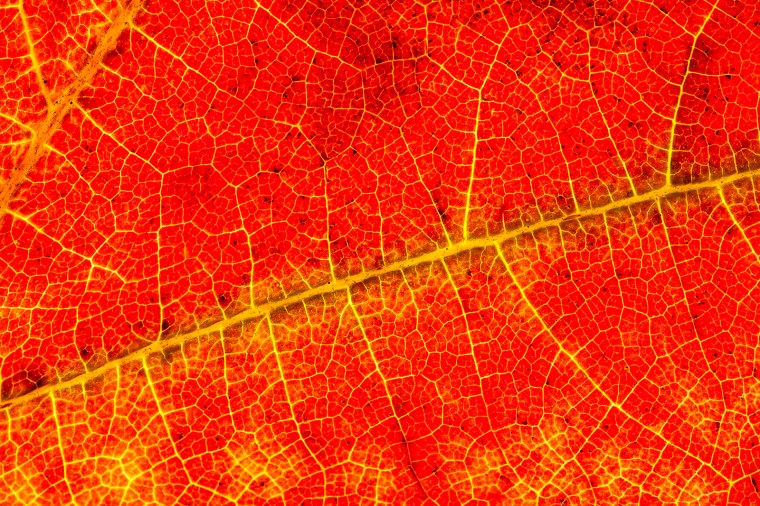
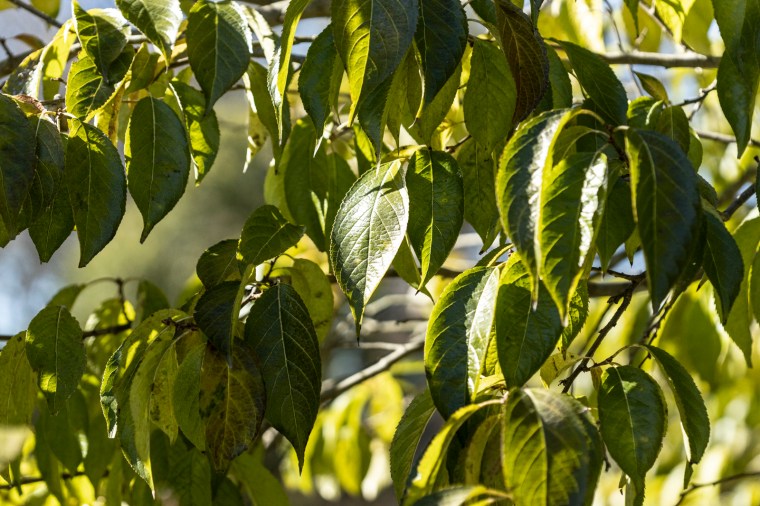
The above color and form evoke in me a sense of calm, and at the same time a feeling of strength and vibrancy, of life rising up—life both simple and complex. The cells are like pixels, individual packets of information, each unique with a life and mind of its own, contributing to the maintenance and growth of the organism.

All living systems consist of holons, whole systems composed of living sub-systems. In the human body there are an estimated 30 trillion non-human cells, each of which makes split-second decisions about its functional relationship with its neighboring cells and neurons. Red blood cells live for about four months; white blood cells live on average more than a year; skin cells live about two to three weeks; colon cells die after about four days.

In keeping with my propensity to trace subject matter back to its origins, I see in these leaves the genetic inheritance of structure and color—a system that maximizes surface area for the absorption of light coming from above (the sun) with vertical channels that, like rivers, deliver nutrients from the soil below—a perfectly integrated living system.

Plants are “green” because of photosynthesis, their ability to absorb sunlight and convert it into energy for growth. The key ingredient is mostly chlorophyll, a pigment molecule that absorbs “blue” and “red” frequencies, allowing green to be reflected. That’s the gist of the scientific explanation. Objectively however, there is no color in the world or in the brain. It’s the interpreting faculty of the mind—consciousness—that gives all light its apparent color. When signals sent from the eyes to the brain report the absence of blue and red spectral frequencies the brain says in effect, “Considering that red, green and blue are the primary colors of the spectrum, if it’s not blue and red, it must be green!” And of course, that happens continuously at the speed of thought.

Nonetheless, the experience of a particular color can generate meaning and trigger emotions that we share. For instance, “green” is associated with positive feelings. NIH’s National Library of Medicine cites the results of studies on the positive effects of green as it occurs in nature. “Green natural environments generated therapeutic and positive effects, such as fostering recovery from surgery (Ulrich, 1984) and subjective well-being (Kaplan, 2001van den Berg et al., 2003). Studies focused on exercise under controlled laboratory environments also revealed that perceiving green enhanced positive affective and cognitive outcomes (e.g., enjoyment, self-esteem, motivation) and diminished negative ones (e.g., mood disturbance, anxiety) (e.g., Akers et al., 2012Barton et al., 2012Briki et al., 2015Briki and Hue, 2016).”

We tend to relax when we’re experiencing or even observing nature, which is mostly green. As reported in a 2019 National Geographic article, the Japanese initiated a physiological and psychological exercise called shinrin-yoku  (“forest bathing” or “taking in the forest atmosphere”)  as an “eco-antidote to tech-boom burnout and to inspire residents to reconnect with and protect the country’s forests.” My appreciation of green is further enhanced considering that without plant life, animal and human life would never have evolved—at least not on a watery planet and in the forms we know today.

In one of my novels of the ancient MayaJaguar Sun: The Journey of an Ancient Maya Storyteller—the protagonist wonders why trees and plants are green. Since red is the color of blood and blood is the source of life according to his view of the world, shouldn’t the forests and plants be red rather than green? That makes sense. But fifteen hundred years later we understand that neither blue nor red has the capacity to photosynthesize, to absorb sunlight and reduce CO2 into sugars or other biological reactions necessary to sustain plant life.

I  want you to understand that there are no colors in the real world. There are no textures in the real world. There are no fragrances in the real world. There is no beauty. There is no ugliness. Nothing of the sort. Out there is a chaos of energy soup and energy fields. Literally. We take all that and somewhere inside ourselves we create a world. Somewhere inside ourselves it all happens. The journey of our life.

                        Sir John Eccles, Noble Prize-winning neurophysiologist

______________________________

My other sites—
Love And Light greetings.com: A twice-weekly blog featuring wisdom quotes and perspectives in science and spirituality intended to inspire and empower
David L. Smith Photography Portfolio.com: Black and white and color photography
Ancient Maya Cultural Traits.com: Weekly blog featuring the traits that made this civilization unique

Singular Purpose or Vision

Many Become One Through a Process of Coalescence

Systemically, an orchestra consists of a whole greater than the sum of its parts. Through loving collaboration—the characteristic feature of “synergy”—each musician contributes to a complex of sounds beyond the capability of his or her competence with an instrument, even beyond the full realization of their individual potential. In this image I observe the interplay of the many and the one. At a performance it appears that the musicians are playing the notes on the page, so much so the conductor may appear to be superfluous.

The conductor doesn’t just synchronize the players according to the score, he coalesces them into a whole that presents his or her interpretation of the composer’s intent. Having played third saxophone in my high school orchestra, I experienced the significance of the conductor firsthand. Our teacher, Mr. Bushley, provided the vision and shaped our diverse abilities and instruments into unique and hopefully stirring performances. As interpretations, no two performances are exactly alike.

Certainly, the score could be played without a conductor. Indeed, the musical composition would occur, but it would not “sing.” It would not express a singular vision, not even that of the composer. Although Mozart wrote the score for each instrument, it was the manner of his interpretation and conducting that gave the notes tonalities and rhythms, a vitality and richness that had been fixed on the page.

In system’s parlance, notes on a page are simply “data.” So strictly speaking, the performance is not the score. Like a recipe for stew, the sound attains quality through a process of combining the right ingredients at the right time and in a certain way. A conductor might say “Louder here, softer there; here with gusto, there not so much; let the woodwinds carry this phrase.” In that way, each performance is unique. That’s why an orchestra can have only one conductor, one interpreter. Otherwise, there would be breakdowns and chaos.

Whatever the collaborative field—movies, business, media, government or military—outstanding performances more often come from systems where individual members perform under the guidance of one person who has a vision of the outcome and is authorized to manifest it. Certain popular novels written by two authors fall flat compared to the those written by the “name” author. In the case of screenplays, those written by committee aren’t as compelling as those written by one person, especially when the writer is also the producer and director, a singular visionary. This also applies to sports where competition is institutionalized. From experience, coaches need to have the vision of a winning team and hopefully the motivational skills needed to coalesce the players into a functioning whole. It’s the task of ship captains, religious leaders, small business owners, publishers, museum directors, CEO’s and the President of the United States.

Collaboration under the direction of a single individual can be a daunting challenge, in part just to convince the participants to value and respect the vision in the first place, and then trust that the visionary can deliver it, enough that the members will surrender to it, ideally to wholeheartedly embrace it. And here’s a crucial point across the board. In the example of an orchestra, it can appear that the musicians organize themselves for the good of the whole—the performance. In system’s theory however, the principal is reversed— “the whole organizes the parts.”

It’s the love of music, that brings musicians together. Because thought always precedes action, the challenge of leaders is to communicate what they envision clearly and with passion so they will attract the best “players.” And the challenge of those aspiring to be leaders is to find leaders within their field and learn from them, noticing in particular how they are uniting the many into one.

In my Lifestyles and Workplaces in Television and Film classes, I observed that employers in creative fields hire the best players, the most competent and responsible people, they can find. They must do that to insure the realization of their goal or vision. Rather than look for jobs (a contract exchanging time and energy for money), I recommended that students understand their special gifts, what they have to offer, and consider instead looking for work (time and energy directed toward fulfillment as well as money). And while growing in knowledge, building skills and researching prospective employers, immediately demonstrate competence and responsibility by doing what they say they will do.

I also pointed out to students that most of their grandparents didn’t have the luxury of pursuing work that was fulfilling. Of necessity, their choices were limited to earning a living through jobs however they could, wherever there was an opportunity. It’s important for young people to appreciate and not take for granted the family, social and political circumstances that allow them the freedom and opportunity to fulfill their dreams as well as earn a paycheck.

Individual success depends on environments that trigger the fulfillment of our genetic potential. Environments that motivate through fear literally shut down the potential for growth. Those that motivate through vision, open us up to express unforeseen possibilities.

Bruce Lipton, Biologist

Author, The Biology of Belief: Unleashing the Power of Consciousness, Matter & Miracles

________________________

My other sites—
Love And Light greetings.com: A twice-weekly blog featuring wisdom quotes and perspectives in science and spirituality intended to inspire and empower
David L. Smith Photography Portfolio.com: Black and white and color photography
Ancient Maya Cultural Traits.com: Weekly blog featuring the traits that made this civilization unique

Silence / Stillness


Sometimes a photographer is gifted with an image that’s just too precious for words. The evocation is so pure, so gentle and quiet the only thought I want to give to this one is a silent “Ahhh!” Perhaps that’s the greater appreciation.

Silence is God’s language, everything else is a poor translation.

Deepak Chopra, Indian-American author, philosopher and alternative medicine advocate

____________________________

My other sites—
Love And Light greetings.com: A twice-weekly blog featuring wisdom quotes and perspectives in science and spirituality intended to inspire and empower
David L. Smith Photography Portfolio.com: Black and white and color photography
Ancient Maya Cultural Traits.com: Weekly blog featuring the traits that made this civilization unique 

Seeking Substance

From Above and Below

Whether planted by a human being or disbursed by an animal or bird, seeds gravitate downward toward life-giving substances—water and elemental nutrients. The root of this dried Queen Anne’s Lace plant shows how it reached into the soil in a variety of directions, and we can estimate by the size of the roots which of the “fingers” were more successful in finding those nutrients.

Rather than have one descending root, the evolutionary strategy of a plant or tree is to fan out many fingers, each of which develops a unique profile depending upon the “riches” that it finds. In this way each finger makes its own contribution to the growth and development of the whole, enabling it to rise where there’s even more life-enhancing substances—air and sunlight. So, nutrients from below combine with light and air above to promote growth, vitality and the ability to reproduce—actions that continue the species and provide higher species—birds and mammals—the nutrients they need to survive, grow and reproduce.

Of course, there’s much more science involved. But from the point of view of this general reflection on the seed-to-plant process evoked by this little root, some key dynamics stand out in relation to my own process of seeking life-giving substances. And they evoke some self-assessment questions.

For instance, to whom, what and where am I reaching out to find and secure the physical, mental, emotional and spiritual substances that contribute to my growth and development? Am I choosing real substance, or am I substituting artificial or imitation goods and experiences that, while satisfying or entertaining, don’t contribute to my growth? Some of these include drinking beverages loaded with sugar or caffeine, overeating fast foods, eating processed rather than organic foods, engaging in mundane absorptions like mindless television viewing or spending an inordinate amount of time with electronic devices rather than reading, studying, working, exploring nature or engaging with others. I know, “easier said than done.”

And then there’s the social questions. Am I associating with people who bring me down or lift me up? And what of the content of my conversations—on the phone or face-to-face? Do I spend much time with gossip or trivialities, as opposed to meaningful or uplifting exchanges of information, ideas and experiences? While it’s easy and can be enjoyable to indulge our base tendencies, we also have a built-in hunger for substance, nutritional input and engagement. (Here again, the caveat: “easier…”).

Our “fingers” yearn for the energies and elements that nourish body, mind and soul. But are we engaging them? What are they contributing to our lives? And what is taking shape—in me and in the world—as a result? While the soul reaches for enrichment, inspiration and fulfillment the many mental and physical stimuli in today’s world—some of them necessary—distract us so we only occasionally dip our roots beneath the surface or reach for the light of increased appreciation, understanding and awareness.

Aside from the satisfaction gained by going for substance rather than fluff, the best way I know to assess the growth of the whole person is to ask how much joy derives from our view of the universe and the choices we make. I’m not speaking of excitement or happiness, but the experience of feeling in the flow, attuned to and fulfilling our reason for being here.

And that provokes another assessment. Am I doing something every day, no matter how seemingly small or unproductive, that contributes to the realization of my purpose? And do I at least occasionally feel that I’m engaged in an activity where I lose track of time and well up with feelings of awe, gratitude or appreciation? Considering the analogy of a plant’s growth pattern, joy is the equivalent of basking in sunlight with occasional light rain. By seeking and taking in genuine substance, the stuff that feeds body, mind and soul, our reach expands and we become lighter.

Upon being asked who he was, Itzmat Ul responded, “I am the substance of heaven, the substance of the clouds.” 

Itzamat Ul was a deified Maya king of Izamal, Yucatan


Human beings are biological creatures who require meaning in their lives as much as the oxygen they breathe and the nutrients they put in their bodies.

James O’Dea, Former President of the Institute of Noetic Sciences, Washington office director of Amnesty International, and CEO of the Seva Foundation.

Author, The Conscious Activist: Where Activism Meets Mysticism

__________________________________

My other sites—

Love And Light greetings.com: A twice-weekly blog featuring wisdom quotes and perspectives in science and spirituality intended to inspire and empower

David L. Smith Photography Portfolio.com: Black and white and color photography

Ancient Maya Cultural Traits.com: Weekly blog featuring the traits that made this civilization unique

Two Difference Aspects of Reality


Inside and Outside; Hidden and Revealed

Strong backlighting reveals the intricacies of form, pattern and texture in this daylily. It’s a wonder to me that the plant has chosen, over eons of evolutionary time, to reveal its complexity and beauty in individual flowers for just one day depending upon multiples for pollination. Flowers— like every other lifeform, including human beings—have a particular strategy for maintaining survival and growth as a species. What’s going on there? Probing the peculiarities of the quantum world, physicist David Bohm published an explanation in his groundbreaking book called Wholeness and the Implicate Order. (A pdf copy can be downloaded here).

A flower’s appearance provides an excellent example of his perspective, that the reality we experience follows from an underlying reality that we don’t see. He refers to it as an “order.” The analogy he uses to represent reality is a rolled-up carpet—

Consider, for example, a carpet. The carpet may be regarded as consisting of two basic aspects: its explicit, measurable aspect (its length, width, color, texture, etc.), and its implicit, unmeasurable aspect (its overall design, the way the colors and textures are interrelated, etc.). Now suppose the carpet is rolled up and put away. In this state, the explicit aspect is hidden, but the implicit aspect remains, folded into the rolled-up carpet. This implicit order can be made explicit again by unrolling the carpet.

Similarly, in the implicate order, the universe is like a rolled-up carpet. The explicit aspect of the universe (the manifest world of separate objects and events) is like the unrolled carpet, while the implicit aspect (the enfolded, unmanifest order) is like the rolled-up carpet. The implicate order is not manifest, but it can be unfolded into the explicate order of manifest reality. (Pages 11-12 of his book)

What we’re experiencing moment-to-moment is a reality that’s not predetermined, but underlying it are universal rules, connections and principles. While the physical manifestation follows these rules without question, human beings possessed of free will could choose to align themselves with them. Or not. Dr. Bohm speaks of the implicate order as being universal. “Space,” he said, “is not empty. It is full, a plenum as opposed to a vacuum, and is the ground for the existence of everything, including ourselves.” A plenum is a “field” of energy, a deeper level of objective reality that emphasizes “the primacy of structure and process over individual objects.” So, what we take for reality, even time and space, are surface phenomena, forms that have unfolded out of this underlying (implicate) order, the ground from which reality emerges.

Here is an instance where science has codified a theory—that an inner dimension (field, order, spirit) gives rise to the outer (material, manifested) reality—long acknowledged by indigenous and formalized Eastern and Western religious traditions.

For decades, I’ve been photographing flowers and other plants, not only because they’re beautiful, but because this underlying order is evident in diverse forms, colors and geometries. Having witnessed the luminous qualities in the original photographs of Ansel Adams and several others, I realized that the light without could reveal the light within. And that became my modus operandi.

One of my photography books, a monograph entitled Patterns: Evidence of Cosmic Order, is essentially a celebration of it. Another is Weeds: God by the Side of the Road. (Click on the book to open it and click on the pages to turn them. The arrow at the top expands the book to full screen).

The opening and closing of daylilies have long been a metaphor for lifecycles—rising and falling, breathing in, breathing out, life and death. When I first took daylilies into the studio to photograph them, I thought they would die without a bright light on them to mimic sunlight. I was wrong. I left a cut plant in water overnight in total darkness, yet the blossom was open and brilliant in the morning. With some research, I discovered that the flower’s opening and closing mechanism is less a factor of sunlight, than a result of its biological clock. It just “knows” when a day begins and when it ends, irrespective of whether the sun is shining, rising or setting. Even in a coal mine the flowers would open and close as the day begins and ends. Remarkable!

Fractal Geometry

The strong backlight in this image reminds me of fractal geometry, one of the principals of the implicate order. The irregular appearance around the end of the daylily petal displays the same kind of irregularity as that seen around the coastline of islands and continents. Were we to continuously zoom in closer to the edge of the petal at any point, we would see ever smaller version of the same pattern on down to the cellular level. The same is true of the veins in the leaf. So, the underlying rules of the universe operate at every level of manifest reality. And running through them all is a common foundation—consciousness—from quarks to cosmos, the shaper of these rules and patterns.

The correspondence of broccoli florets, a firefly’s eye, courtship rituals, and dreamscapes with galactic nebula reveal a natural, folded up self-similarity. These examples point to the universality of the fractal as a central organizing principle of our universe; wherever we look, the complex systems of nature and time in nature seem to preserve the look of details at finer and finer scales. Fractals show a hidden holistic order behind things, a harmony in which everything affects everything else.

Jean Houston, American author involved in the human potential movement.

Everywhere we look, particularly in the patterns and geometries of living systems, we find pervasive and consistent—evolutionary—order. It gives us confidence that, even in the vagaries of the unfolding material world, Mother Nature knows what she’s doing. And that’s a reason to hope for the future.

At the heart of the most random or chaotic event lies order, pattern, and causality, if only we can learn to see it in large enough context.

 Corinne McLaughlin, American author and educator.

_______________________________

My other sites—

Love And Light greetings.com: A twice-weekly blog featuring wisdom quotes and perspectives in science and spirituality intended to inspire and empower

David L. Smith Photography Portfolio.com: Black and white and color photography

Ancient Maya Cultural Traits.com: Weekly blog featuring the traits that made this civilization unique 
The Fabric of Society

Social values are right only if the individual values are right

Notice the cloth is fraying in places, threads are broken, and holes are appearing. Is it beyond repair? Or is there something we can do to keep it from unraveling further?

One of the lessons I learned from Robert Pirsig’s Zen And The Art of Motorcycle Maintenance was that when a system is breaking down, whether a flag, motorcycle or social system, what’s needed is attention to the places where the breakages are occurring—attention and studied analysis rather than emotional reactions or expedient band aid solutions. I found so many gems of wisdom in his book, that I can imagine a conversation between Mr. Pirsig and myself. It would go something like this.

DS: So, Robert—this cloth, this whole system I’m concerned about, it’s enormous, beautiful and complex. In addition to a hole, there are many rips and tears, and I don’t want it to get worse.

RP: Remember the systems principle, David. “Attend to the parts and the whole will take care of itself. Think of yourself as a single thread in the system.” Attend to that and you will have made the first step, which is caring.

DS: But I’m just one “thread,” barely visible on the surface. Where should I begin?

RP: “The place to improve the world (system) is first in one’s own heart and head and hands, and then work outward from there. Wherever you are and with whatever gifts you have been given, act with love in your heart, positive thoughts and creative hands.” To maintain or improve the whole cloth, be the best thread that you can be. And do what you can to empower and aid the threads closest to you so they can be the best that they can be. Strong threads joined together and standing in place with integrity makes the cloth strong.

DS: But my little community of threads, my domain, is very modest. Neither I nor those close to me have the power or influence that the larger strands have.

RP: The strength and influence of the larger strands derives from the binding together of threads like yourself. They are wholes that depend upon the parts. Ultimately, the strength of a cloth depends upon the strength of the individual threads.

DS: When I look closely, I can see that this cloth was originally constituted by an interweaving of different colored threads, all aligned toward a common image. Now, to the detriment of the whole, the “strands” are competing for prominence. Abuses of all sorts seem to be pulling the cloth apart. The unity of vision and intention that went into its making is rapidly diminishing.

RP: All along the journey toward realizing the vision, “you look at where you’re going and where you are and it never makes sense, but then you look back at where you’ve been, and a pattern seems to emerge.” So, regain the vision of the whole again, one united whole.

DS: The original pattern, huh? Looking closer I see what you mean. Chaos seems to be normal for complex systems. Each thread has a “mind” of its own and unlimited potential. I can understand why some threads don’t want to fall in line with certain other threads. There’s competition and resistance; some don’t even feel like they belong. From my perspective the strident, coarser threads, the ones who shout the loudest, tend to overpower the refined, smoother ones in their attempt to make themselves stronger.

Others are bound tightly, maybe for rear of unraveling, but that boundedness itself is causing stresses that are resulting in more and bigger breaks. The coarse strands are so bent in their ways they’re not open to considering the potentials of the gentler, more congenial threads. With so much resistance within the system repair seems unlikely.

RP: “You are never dedicated to something you have complete confidence in. No one is fanatically shouting that the sun is going to rise tomorrow. They know it’s going to rise tomorrow. When people are fanatically dedicated to political or religious faiths or any other kinds of dogmas or goals, it’s always because these dogmas or goals are in doubt.”

DS: You’re saying the strands who resist the most do so because they’re insecure, that the vehemence and consistency of their resistance suggests a lack confidence in their position within the system? Maybe their vision is in doubt, or they don’t have one? Maybe they’re so focused on their position, they don’t concern themselves with the whole cloth? I can see how that would create stress and friction, even constriction, a holding on to the way things were when the cloth was new rather than adapting to the changes presented by entropy, the natural tendency for things to fall apart. And seeing things unravel, their future and that of the whole cloth is in jeopardy. It creates an existential fear. No wonder they’re shouting; they want to go back to a time when they felt secure.

RP: It is a difference in perspective, David. “To arrive in the Rocky Mountains by plane would be to see them in one kind of context, as pretty scenery. But to arrive after days of hard travel across the prairies would be to see them in another way, as a goal, a promised land… To live only for some future goal is shallow. It’s the sides of the mountain which sustain life, not the top. Here’s where things grow.”

DS: So basically, you’re saying the integrity and viability of a system depends upon the integrity and strength of its parts, and how they come together.

RP: That they come together! Also, “peace of mind produces right values, right values produce right thoughts, right thoughts produce right actions and right actions produce work which will be a material reflection for others to see the serenity at the center of it all.”

DS: Serenity. Nice word. Peace. It reminds me of a TED talk given by peace activist Jamila Raquib. She told how a group of twelve regular citizens in Guatemala brought down their corrupt president and his regime. They put out a call on Facebook, asking their friends to meet in the plaza carrying signs that read: Renuncia Ya, “Resign Already!” To their surprise, 30,000 people showed up. After protesting for a week and getting no results, they organized a strike. “In Guatemala City alone,” she said, “over 400 businesses shut their doors. Farmers throughout the country blocked the roads. Within five days the president and dozens of corrupt officials resigned and were indicted on charges of corruption. The former president and the others are currently in prison.” The story demonstrated her thesis, that “non-violent action works by destroying an opponent—not physically, but by identifying the institutions the opponent needs in order to survive and then denying them those sources of power.” Right action—as opposed to ranting, raving and violence.

It’s Mahatma Gandhi’s admonition to be the change we want to see in the world. So, speaking personally, to repair this fabric you’re saying I should, first and foremost, attend to the thread that I am by maintaining my strength of character and hold my place in the fabric—peacefully with flexibility and integrity to my vision of the whole. And at the same time withhold energies—the sources of power—from those whose actions are stressing the fabric. You’re talking about self-work basically, and that can be hard.

RP: “It’s having the right attitude that’s hard.”

DS: Right thinking and right acting, you said. How will I know when this self-referential and non-violent approach is working?

RP: “The test of the machine is the satisfaction it gives you. There isn’t any other test. If the machine produces tranquility, it’s right. If it disturbs you, it’s wrong until either the machine or your mind is changed… The real cycle you’re working on is a cycle called yourself. The machine that appears to be out there and the person that appears to be in here are not two separate things. They grow toward quality or fall away from quality together… The social values are right only if the individual values are right.”

DS: Obviously, you’re not talking motorcycles. I get it. The system is me. I am the system—the fabric of society and the government. You’re saying, one way or another, right where I am, how I am and what I say and do right now contributes to—or reduces—the quality of the larger systems’ functioning. Also, in maintaining the integrity of my function as a citizen I also provide a model for others of what works, what promotes tranquility and benefit for all. Is that right?

RP: Good David. You not only read my book, but you also understood what I was trying to say.


Care and Quality are internal and external aspects of the same thing. A person who sees quality and feels it as he works is a person who cares. A person who cares about what he sees and does is a person who’s bound to have some characteristic of quality.

Robert M. Pirsig, American writer and philosopher

Author, Zen and the Art of Motorcycle Maintenance

___________________________

My other sites—
Love And Light greetings.com: A twice-weekly blog featuring wisdom quotes and perspectives in science and spirituality intended to inspire and empower
David L. Smith Photography Portfolio.com: Black and white and color photography
Ancient Maya Cultural Traits.com: Weekly blog featuring the traits that made this civilization unique