Energy And Expansion

Early Morning Pond

Drop a pebble in a pool of water and waves ripple out. Drop a word or  and idea and these ripple out as well. So also emotions, behaviors and the products of creativity. At some level, given enough time, everything affects everything. And everyone else.

This is the entire image that I use for my home page. I share it here because it illustrates a fundamental property and process of the universe and everything in it—energy and expansion. From photon to cosmos, whatever the matter or medium, energy characteristically expands. It radiates in characteristic wave frequencies.  I find it fascinating that, in this image, it’s not the water that’s radiating, it’s the energy moving through it. Had a cork been floating three feet from the center, it would have bobbed up and down and remained in place.

Although physicists don’t actually know what energy is, they know a lot about its properties, effects and measurement. The textbook definition of energy is the capacity of a system to perform work. And “work” is defined as the movement of force through a distance. That being the case, it seems to me that force is movement itself. Nothing in the universe stands still. Even the atom and its myriad of sub-atomic particles (more appropriately considered fields although they are still talked about as particles) are constantly in motion.

This begs a fundamental question. If the substantive characteristic of energy is movement, how did it get started? What got it going? What sustains it? And what is it that actually moves? I believe that consciousness is fundamental. Whatever it is, it precedes matter. So could it be that within matter there is—both grand and rudimentary (as in rocks)—a “desire” or “intention” to expand? To express? I like this idea because it ties to “affinity,” attraction or love energy, which binds and seeks expression by expanding.

Of course these ideas raise questions that cannot be answered definitively, but expansion of this kind of internal energy (call it yearning or attraction) helps us create meaning and approach the Great Mystery. Where there’s a question there’s always the potential for an answer. And that provides some satisfaction. In this regard I observe that the surface of the pond in this image is largely obscured by fog that’s in the process of clearing. As a species we may as yet be seeing through a fog, but what we are seeing so far is exquisite beyond words.

On a more personal level, the radiating waves evoke in me a quiet and soft sensibility that speaks to the potency of influence that occurs when the thoughts and expressions that ripple out are coherent with the deep currents of life, as opposed to the big splashes that are so bold and dramatic they interfere with or distract us from the underlying currents.

An example of this would be the energies of  hype, glamour and trash-talk in the mass media. Of course there’s a time and place for both excitement and calm. Wisdom, on the other hand, is expressed with calm, discernment and balance.

Any being with energy will disperse that energy. To radiate is the law of the universe. And this is true of all manifested reality… The universe cannot contain the magnificence it houses. Instead, it is compelled to express itself in ten million different ways.

Brian Swimme, Cosmologist

_____________________________________

My other sites—

Love And Light greetings.com: A twice-weekly blog featuring wisdom quotes and perspectives in science and spirituality intended to inspire and empower

David L. Smith Photography Portfolio.com: Black and white and color photography

Ancient Maya Cultural Traits.com: Weekly blog featuring the traits that made this civilization unique 

smithdl@fuse.net

Confidence and Trust

The safety of system’s syntropy against the forces of entropyGuard Rail

Obviously, guard rails are intended to keep vehicles from running off the road and to reduce the severity of injuries when they do. Not so obvious is the observation that their presence indicates a lack of trust. Appropriately so. Bad accidents, even death, may have occurred had we trusted—ourselves and the other guy. This image reminds me that, because human beings cannot be trusted, safeguards are necessary, increasingly so in proportion to the level of distrust, which in highly mobile societies increases with population density and social complexity. Without safeguards, the odds of breakdown increase as more people are on the road with more distractions.

At the same time, the presence of guard rails on roadsides generates a (largely unconscious) bit of trust. These metal barriers actually have served their purpose. Systemically speaking, they are “syntropic.” They reduce the effects of entropy, which is the tendency of systems to dissipate heat. In other words, break down. In the case of a highway system, entropy amounts to the dis-integration of roadway integrity. If entropy goes unchecked by safeguards such as improvements in the areas of car design, road maintenance, guards and signage, more and more severe accidents will occur. The many innovations, requirements and regulations surrounding car and passenger safety are prime examples of how syntropy reduces the frequency and severity of mayhem and catastrophe.

I reflect on the human body, mind and spirit, which are equally susceptible to the forces of entropy—from tooth decay to depression. At base, advertisers are in the business of selling syntropy: products and services that help prevent, retard, manage or eliminate the effects of entropy. (In living systems, 100% entropy equates with death. Maximum equilibrium). So to gain more confidence in the components of our personal and social lives, ultimately to increase  health and well-being for both, regulation is essential. A social example is the national economy. It’s heavily regulated, not so the few can disadvantage the many, but to insure stability and increase public confidence, which directly influences the nation’s health and well-being.

The word “regulation” in some spheres—mine was the broadcast television industry—has been seen as a threat to individual liberty. “Don’t tell me how to run my business.” Whether the social unit is a family, church congregation, community, business, corporation, nation or the global family, without regulation entropy will inexorably result in more and more severe breakdowns. Systemically speaking, zero regulation equates with no growth. Such an entity would completely dis-integrate if nothing is done to reign in the propensity to act solely in its own self interest and preservation.

Socially, the free flow of entropy is enhanced when the members of a system act primarily in their own interest (in some instances justifying it as a “right”), as if their health and well-being are independent of the other members of the system. It’s not. Never was, never will be because humans are social beings, interconnected and interdependent physically, emotionally and economically. Independence is both an illusion and an entropic idea. So is “nationalism,” which takes independence to a grand scale. Proof of the viability of grand ideas can be had by applying them to the lowest level possible. For instance, how long can a person survive without any outside resources? How long could a family survive, and what quality of life would it have, without any assistance from outside? Interdependence is syntropic. So is diversity, because it promotes resilience in the face of social and environmental breakdown.

I tend to see systemic break downs, in part, as the impetus for break throughs. Futurist and author, Barbara Marx Hubbard, observed that “Crisis precedes transformation.” Breakdown itself signals that change is happening and for good reason, suggesting it’s time to pay attention and shift gears, to perceive and think differently about the system. Sometimes, personally and socially, we need to experience what doesn’t work in a system in order to rethink and redesign it so it does work. In physical systems we have highway guardrails, seat belts and toothpaste. The Center for Disease Control (CDC), the Civil Rights Act and the Medicare and Medicaid Acts keep social systems functioning. Religion is an example of a spiritual system. Ideally, the learning that occurs in periods of breakdown, eventually contributes to breakthroughs. If not, entropy becomes a downward spiral resulting in systemic dis-integration and death.

Trouble is, it’s easy to tolerate breakdowns and shrug them off as someone else’s responsibility—even to the point of crisis—as we’re experiencing in climate change, political division and increasing lawlessness. Social systems (democracies, dictatorships, mass media, religions) are not capable of new thinking because they have a vested interest in maintaining the status quo. They just want it to grow. Evolution has shown, and the future will favor the everyday people at the bottom of the pyramid changing their minds and preferences, no longer tolerating self-centered leaders or systems, refusing to “feed” egos and short-term thinking, by deciding to live in harmony with the earth and others. Social scientists refer to them as “emergents.”

If ten people walk beyond civilization and build a new sort of life for themselves, then those ten people are already living in the next

Daniel Quinn, American author (Ishmael, the novel), cultural critic, publisher of educational texts

_________________________________

My other sites—

Love And Light greetings.com: A twice-weekly blog featuring wisdom quotes and perspectives in science and spirituality intended to inspire and empower

David L. Smith Photography Portfolio.com: Black and white and color photography

Ancient Maya Cultural Traits.com: Weekly blog featuring the traits that made this civilization unique 

smithdl@fuse.net

Context And Order

Principles underlying information in human communication

Intersection

I was thinking about the complexity represented in this image when I noticed that it’s also rich in context, providing both time and space perspectives. The nighttime and elevated point of view displays pattern, while the time-exposure reveals motion. Combined, the image speaks to me of complexity, interaction, order, flow and intersection. My contemplation could have gone in any of these directions—and perhaps will another time—but for now I’m drawn to considerations of context and order.

Information theorists consider “data” to be the objective and meaningless elements presented to mind: the letters that form these words, pixels on a computer screen, notes on a music score, tonalities of light and dark in a photograph. One of my favorite quotes regarding a step up from data comes from visual anthropologist, Gregory Bateson, who observed that “Information is a difference that makes a difference.” Alone, locked between pages or in a file, a gathering of words, pixels, notes or tonalities is meaningless data. But when a mind examines that data and finds that it makes or would make a difference, it becomes information.

For example, the above image is loaded with information. A traffic engineer would derive more and different information, as would a police officer or legislator. Each would notice things the others don’t see. And that takes us to context, considerations of time, place and perspective including the photographer’s motivation, purpose and intent. Frames (context) such as location and time enable the development of personal meaning, which becomes the springboard for judgement and decision making. Frames themselves—all frames—communicate. The one doing the framing or providing context says, in effect, “Focus on this, not that. Pay attention to what’s within the bounded frame. There’s significance here. You may find it meaningful as well.”

As part of our quest for meaning, we’ll sometimes place our everyday, ordinary perceptions of people, places, experiences and objects in larger frames. Broader contexts enhance meaning by providing more information potential. We’re standing on the curb waiting for the light to change, shifting our gaze from a car to a child and then to an ad on the side of a truck. And suddenly, for no apparent reason, our field of view goes from close-up to wide angle, like our consciousness has instantly changed lenses. And with it, awareness expands. Instead of thinking about the ad or our next appointment, we’re watching the unfolding life of the city, a sense of humanity as a whole rather than a collection of busy individuals. Context, framing does that. It happens with any dramatic shift in perspective. It’s how film directors manipulate attention. “Look here! Now there!” Wide to extreme closeup.

For some, the above image might provide insight or trigger a memory of a particular time or place. Photographs document. They store data so information can be had and meaning generated. For others, it might express the orderly flow of traffic in a busy city. Still others might zoom in to the signs and lines on the sidewalk, the traffic lights, benches, newspaper boxes and streetlights, which could lead to an awareness of city highways, infrastructure and the individuals responsible for them. Point of view (POV) applies to the viewer as well as the photographer, particularly when the intent it to make images that are evocative.

For me, the linearity, coherence and convergence of the light trails in this image evoke the flow of unique individuals, each with their unique perceptions, concerns, experiences, ideas, potentials, desires and pursuits—and in the blending lines, their convergence. Within this frame—a hotel window around the corner from Lincoln Center in New York City—I see the myriad of diverse backgrounds and thoughts ordered and blending, a demonstration that beneath the dynamic complexity and chaos of the city, there are organizing principles at work, guiding our actions and the ascent of life. .

At the heart of the most random or chaotic event lies order, pattern, and causality, if only we can learn to see it in large enough context.

           Corinne McLaughlin, American author, educator, executive director of The Center for Visionary Leadership, Fellow of The World Business Academy                                                     and the Findhorn Foundation in Scotland.

________________________________________________

My other sites—

Love And Light greetings.com: A twice-weekly blog featuring wisdom quotes and perspectives in science and spirituality intended to inspire and empower

David L. Smith Photography Portfolio.com: Black and white and color photography

Ancient Maya Cultural Traits.com: Weekly blog featuring the traits that made this civilization unique 

smithdl@fuse.net

What’s Your Story?

Our backgrounds reveal who we once were and how we got to where we are

While writing my novel Soul Train, I wanted to model one of the characters after a dear friend and colleague of twenty years. He’d recently passed away and I realized that the only thing I knew about his personal life, aside from what I learned from his wife, was the university he attended. I knew his worldview and philosophy of life, but I knew very little about the experiences that had shaped it. Fortunately, after contacting some of our mutual friends and colleagues, I was able to piece together some of the amazing places he’d been and things he’d experienced and done. In the process, I became aware of how little I knew about many of the people who, on many business and social occasions, sat across from me.

When we apply for a job we hand over our resumes and curriculum vitae to strangers, but chances are members of our family and friends would be surprised by some of the items on them. Maybe we don’t share that information out of modesty, or because it would bore people. But in an appropriate context, such as informal get-togethers, the sharing of stories about a person’s family, education, employment, travels, significant others and formative experiences can promote understanding and deepen our appreciation, perhaps even provide life lessons for young people and others. It would certainly provide topics for future conversations and deepen our respect for the person’s life journey.

To avoid the “Do you want to talk about me or should I?” embarrassment, the host or someone else could suggest, “You know what would be great? How about we go around and each one take ten minutes to tell the highlights of your story?” My first experience of this was in a Dale Carnegie class when I was in high school. The lesson being taught was “Speak in terms of the other person’s interests.” I came away knowing the names and backgrounds of thirty adults (I was the youngest). Much later, as an adult, I experienced this again on several occasions with various interest groups. Each time it was so delightful, to this day I remember many of the people and their backgrounds. And importantly, those “round-robin” stories invigorated our conversations on other matters. 

The sharing of personal histories within the family is especially important for young people. It helps to shape their identity, ties them to the past and provides lessons for the future. Whatever the context, family, fun or business, the sharing of personal backgrounds stimulates a great deal of wonder, appreciation and laughter. 

Telling our personal story constitutes an act of consciousness that defines the ethical lining of a person’s constitution. Recounting personal stories promotes personal growth, spurs the performance of selfless deeds, and in doing so enhances the ability of the equitable eye of humanity to scroll rearward and forward. Every person must become familiar with our communal history of struggle, loss, redemption, and meaningfully contemplate the meaning behind our personal existence in order to draft a proper and prosperous future for succeeding generations. Accordingly, every person is responsible for sharing their story using the language of thought that best expresses their sanguine reminiscences. Without a record of pastimes, we will never know what we were, what we now are, or what we might become by steadfastly and honorably struggling with mortal chores.

Kilroy J. Oldster, Author, Dead Toad Scrolls

______________________________________________________________________________

My other sites—

Love And Light greetings.com: A twice-weekly blog featuring wisdom quotes and perspectives in science and spirituality intended to inspire and empower

David L. Smith Photography Portfolio.com: Black and white and color photography

Ancient Maya Cultural Traits.com: Weekly blog featuring the traits that made this civilization unique 

smithdl@fuse.net

Reflection


I recently encountered a metaphor relating to reality. I passed over it quickly so I’m not able to reference the source, but the image stuck with me—perhaps because it aligned with Plato’s notion that the reality we experience is akin to shadows projected onto the wall of a cave. In my reading, the author created the image of a rowboat floating on a lake. The author observed that we couldn’t see the boat, only its reflection. The boat itself represented ultimate reality and its reflection our experience of that reality. Similar to Plato’s observation, the point being made was that the reflection is not the boat; the physical universe is a reflection of  ultimate reality, the obvious example being how we are blind to the quantum dimension that constitutes and sustains the world of matter.

That was nice. But what kept me thinking about the metaphor was the author’s comment that the clarity of a boat’s reflection, our perception of it, is determined by the state of the water. When the lake is still, the reality is more perfectly reflected and there’s more of a one-to-one relationship. As the water becomes more agitated the reflection becomes distorted. The more the agitation, the more the distortion.

On a recent photography expedition to the Everglades, I went farther south to photograph some turquoise water. In Key Largo, gateway to the Keys, I asked at the Visitor’s Center where I could find the closest access to clear water. I was surprised when the lady indicated that the best place was Key West. I didn’t want to drive 100 miles, so I asked if there was any place closer. “Not really,” she said. “It’s private property all the way down.” And it was. On both sides of the divided highway it was wall-to-wall shops and trees and signs, no water to be seen. After driving about forty miles I finally pulled into a restaurant that advertised “Waterfront Dining.” Indeed, after cruising the parking lot until a spot opened, I was shown to a picnic bench where, beyond the piers of a three-story deck where people sat at a bar I could see the water—and a small beach boarded by fences with no access, no place to walk along the water. As it happened, the “music” was so loud I had to leave. After two more such places I realized that, while the Keys had plenty of entertainment venues, they were not conducive to appreciating or photographing nature. I turned around and headed north.

Reflecting on that experience, I think about the juxtaposition of the beautiful and calm, clear water and the disturbed reality just thirty or forty feet from the beach. What I learned is that, along with travel comes the turbulences of traffic congestion, noise, rushing, frustrated waiting, the anxiety of making connections on time and spoiled environments. One of the reasons why, after traveling, we say “it’s good to be home” is that it’s the place where the “waters” are calm and the reflections are clear.

You can’t see wisdom, but you can see its reflection. Its reflection is happiness, fearlessness, and kindness.

Silvia Boorstein, Author, psychotherapist, Buddhist teacher

___________________________

My other sites—

Love And Light greetings.com: A twice-weekly blog featuring wisdom quotes and perspectives in science and spirituality intended to inspire and empower

David L. Smith Photography Portfolio.com: Black and white and color photography

Ancient Maya Cultural Traits.com: Weekly blog featuring the traits that made this civilization unique 

smithdl@fuse.net

Part-Whole Relationship

Individual expression matters

Image

Do you see the jetliner? Remove any one of the pixels in the above image and there would be a hole in the whole (photograph). It wouldn’t be complete. It wouldn’t be the same photograph. Some might say it would have a flaw.

The universe presents itself to us as a system composed of parts-within-wholes, of systems within systems, organized through time and evolution as interdependent levels of complexity. Each part, including you and me, is integral to the whole; and, in some holographic sense, each part is a microcosm of the greater macrocosm. Each part contains within itself the seed or template of the whole.

Christian de Quincey, Philosopher and author

Each and every individual pixel within a digital image is a necessary part of the whole picture—if it’s to be complete. Because pixels have unique characteristics such as size, color, luminance and value they are also individuals by virtue of their boundaries, each bearing a strong relationship to those in close proximity, less so for those farther away. Even the myriad of individual pixels so distant they appear to be unrelated are present and contributing to the whole picture.

Had the above scene been photographed on film, the parts would have consisted of grains of silver halide which are “fixed” entities. They couldn’t be changed. On the other hand, because digital pixels are “virtual,” consisting of  units of electron excitations, they can quite easily be manipulated—for instance, made lighter or darker with changes in color and saturation. Whether the image substrate happens to be paper or a computer screen, photographic images are mechanical systems, constituted of parts that can be manipulated—in the developing and printing processes or using software applications such as Photoshop in the case of digital images.

Not so with living systems, which are composed of other living systems each of whom continuously makes choices regarding their function and relationships. At every level, a living system is referred to as a “holon” because the uniqueness and integrity of the whole depends upon the integrity of its parts. And because each individual holon—cell, organism or person—makes decisions for itself relative to its condition, purpose, function, environment and host of dynamic considerations, such systems are said to be constituted of “members” rather than parts. When parts are interchanged within a mechanical system it returns to its functional design. But when members are replaced in a living system it is newly constituted. At every level then, as change occurs—within a living system or its environment—the holons change. They become new by adapting, or they die. (Thus the expression relating to human beings, “Grow or die.”) And when a human holon dies, the system within which it was a member—family, business, organizations—adapt to the change.

System scientists refer to the decision-making capability of a holon as autopoiesis “self-making.” By our choices we constantly make ourselves new, not just our experiences in life. My dear friend and philosopher of science, Beatrice Bruteau, wrote that “In all living systems it’s the interactive union of the parts, the sharing of their being, their energies, that constitutes the new whole.” The sharing of their being—atoms unite to make molecules, molecules unite to make cells, cells unite to form organisms, that in turn unite to make organs, that unite to make… You get the picture.

Whether we share, what we share and how we share our beingness, beyond but including what we do, how we do it and how we behave and talk makes a profound difference for the wholes in which we are members. This is especially so for those within our close circle. But it’s also the case, by extension and facilitated by the electronic media, for those beyond it, the larger holons within which we function as members—family, community, church, business, industry, nation, species. As members of a church, community and political systems, we remake these larger holons by our presence and everyday choices. For instance, one of the lessons we’re learning on this turn of the evolutionary spiral is that the person or persons we elect or allow as our leaders, directly impacts the reality of a nation.

Considered broadly, in the above image I’m reminded that every human being (pixel in the analogy), regardless of circumstances, is an integral part of the emerging picture of the human family. Every day, the quality and manner of our character, choosing and relating contributes to the making of this picture.

What happens in and to one of the system’s parts also happens in and to all its other parts, and hence it happens in and to the system as a whole.

Ervin Laszlo, Systems scientist, philosopher

Image

This is a a greatly enlarged section from the lower right corner of the sky image above, to demonstrate how individual holons (pixels in this case) contribute to and constitute the larger image. To better discern the jet aircraft, step back from your screen about fifteen or twenty feet.

_____________________________

My other sites—

Love And Light greetings.com: A twice-weekly blog featuring wisdom quotes and perspectives in science and spirituality intended to inspire and empower

David L. Smith Photography Portfolio.com: Black and white and color photography

Ancient Maya Cultural Traits.com: Weekly blog featuring the traits that made this civilization unique 

smithdl@fuse.net

History And Perception

Imagination is at the heart of contemplation


Wrench

My reflection begins with the observation that someone, likely a man with dirty hands, placed this wrench on an oil drum inside a mushroom farm in Loveland, Ohio. But where was it before that? Might it have been used in a factory, a gas station or railroad yard? Did it hang on a pegboard above someone’s basement workbench? Was it cherished? Was it even used? Had it sat in a metal or wooden drawer filled with other wrenches? Had it been dropped in the dirt and rained upon? Not this wrench. There’s no of sign of rust. With each of these possibilities I imagine the environment, what the users would be wearing, the grease on their hands, dirt under their fingernails—the calendar on the wall, the smell of oil and gasoline, the sound of a baseball announcer coming from an cheap plastic radio and the voices of workmen talking, perhaps yelling, sounds absorbed and held in this object’s metallic memory cells. Yes, these are stereotypical images. But flights of imagination, like pieces of a puzzle, contribute to the picture of human evolution, the strengths and vulnerabilities that spark appreciation and evoke compassion.

My imagination shifts to when the wrench was new, when it looked its best, gleaming bright steel with the manufacturer’s name engraved on it. Was it on display in a window? Or was it one of the many that were wrapped in brown paper and put in a box with a drawing or photo on top, specifications and serial numbers on the side? There are no right or wrong imaginings in contemplation. Each and every reflection contributes to the unfolding development of self and the perception of reality. Imagining is at the heart of contemplation. As well as enabling the exploration of times, places, events and abstractions that we could not otherwise experience physically, and sidestepping everyday thinking, imagination inspires creativity and fuels our appreciation of what was and is, as it is.

Back to the wrench. I think back to the manufacturing process. I see minerals being scooped from the ground by giant, loud and smoke-belching diggers. They’re crushed and dumped into a crucible where rock transforms into molten, smoking and fiery liquid. Sparks fly. Gloved men with black goggles handle the controls in a dark factory with a dirt floor. The cars parked outside are vintage 1930’s. Men in the office wear double-breasted, three button suits, starched collars and ties with finger-length clips to hold them in place. Their office managers wear suits, and secretaries wear dresses with nylons that have seams down the back.

Further back, I see a gray haired man sitting at a drafting table wearing spectacles. He wears a tie, but his sleeves are rolled up and he smokes unfiltered cigarettes. With fine-pointed pencil in hand he transposes a sketch with notes on dimension and weight into a blueprint that will be used to create the model and mold for this wrench.

Much farther back is the visionary (or visionaries) who met the challenge of a connection problem. How does a man connect two pieces of metal in a way that they will almost never come apart without purposefully being separated? Trial and error. After many attempts and failures, someone (innovation more often begins with an individual rather than a group) imagines a threaded bolt with flat sides and a tool with a handle that would turn it. Tighten and untighten. Brilliant!

Descending the historical ladder even further, where did the iron ore for this particular wrench come from? China most likely. Other possibilities include Australia, Brazil, India, Russia, South Africa, Minnesota and Michigan. And whose idea was the making of a molten soup consisting of iron oxide, magnetite, hematite, goethite, limonite and siderite, particularly when these minerals are scattered around the world? I think about motivation, the need for a material harder than any rock, the desire to build things that would last—and win wars. Motivation leading to innovation.

I can see this wrench new, old or ancient. I can see it whole or as a conglomerate of parts. I can think about it as a solid or liquid, even as fields within fields of quantum energies. Perception is a choice we make. What is the consequences of our perceptions? There’s beauty in the eye of the beholder, and so much more when we trace anything to its beginning.

There is nothing in all the world that is not God’s manifest glory and essence.

Kabbalah: A Jewish mystical discipline that explores the nature of God and the universe 

______________________________

My other sites—

Love And Light greetings.com: A twice-weekly blog featuring wisdom quotes and perspectives in science and spirituality intended to inspire and empower

David L. Smith Photography Portfolio.com: Black and white and color photography

Ancient Maya Cultural Traits.com: Weekly blog featuring the traits that made this civilization unique 

smithdl@fuse.net

About This Image

Wrench

Theme: History And Perception

Negative #: 516-C2

Fred’s Mushroom Farm

Lebanon, Ohio

September, 1978

I was riding country backroads looking for something to photograph when I saw a sign that read Fred’s Mushroom Farm. The place intrigued me, so I went in and told the manager I was a photographer; would he mind if I photographed his facility. Not only did he grant permission, he gave me a tour and described the process of growing mushrooms. He introduced me to his employees and displayed great patience while I photographed anything that caught my eye.

I shot about six rolls of 120 film in that facility, all by available light. Of the images I printed, not one was of mushrooms. In passing from one room to another, I saw this wrench sitting on an oil drum. I composed the shot and made one hand-held exposure. The light level was very low, so I was not surprised when the slow shutter-speed resulted in an image with shortened depth of field and slight blur. I didn’t print the negative. Years later I was paging through my contact sheets and decided that, because of the simplicity and graded light, the image might have possibilities. Now, it peaks my imagination ever time I see it.

Besides being exhibited and published, I used this among other images in my Visual Communication classes to illustrate a comment made to a reporter when he asked one of the masters of street photography, Henri Cartier-Bresson, the secret of his success. His response: “Be there and f8.”

© Copyright, David L. Smith, 2014. The images and the associated contemplations on this site are protected against any and all commercial and promotional use without the permission of  the author. However, permission is granted for individuals to download the images and print them for private, non-commercial, non-promotional use.

Vision And Realization

The primacy of consciousness

Construction Workers

The relationship between the workers seen here and their towering creation took me to that place of amazement over what and how fast we can build. Prior to these steel structures being set in place, beams that would eventually support the bleacher seats in a football stadium, there were innumerable people involved—those with the vision and desire: geologists, engineers, architects, attorneys, politicians, bankers, investors and city planners. I think of the tonnage of paper documents, the multiple terabytes of information and images, the specification and sourcing of raw materials, contracts and the scheduling of contractors, all needing to be coordinated before the golden shovels could even break ground.

Consistently, I’m puzzled by how so few men can erect such enormous structures involving so many parts and heavy materials in such a short amount of time. How do they know where to move the dirt? I see conduits and all manner of PVC pipes sticking out of the mud without any indication where the walls will go—a testament to precise planning and measurement. How do builders determine structural stresses in advance? And how do they manage every aspect of the process so the structure will be plumb and sound? Another wonder is how supervisors manage  to maintain teamwork, keeping multiple contractors on the same page, coordinating their activities in proper order? It seems to me that the building trades have arrived at, or are quickly moving toward, the realization that moviemakers enjoy, that whatever can be imagined can be built.

Pondering the notion of vision and realization, I think of the causal relationship between mind and matter, thought and form. I think about some of the great engineering feats: the Giza pyramids, the Great Wall of China, Teotihuacan in Mexico, the Panama Canal, the Manhattan Project, the Apollo missions, the Palm Islands in Dubai, the International Space Station. They all began with a vision to honor the gods, solve a problem, end a war, explore the cosmos, build a nation or fill a need like the U.S. Interstate Highway system.

It’s easy to look back and celebrate that the human mind has accomplished great things. Looking forward, however, is the vision of what’s possible reason enough to create it? Just because we can envision a weapon, drug or deadly virus, should we produce it? As technologies advance, the ethical questions compound exponentially. Excitement over discoveries can overshadow the consideration of ethical consequences.

We create what we can imagine, in part because it’s a challenge. Can it be done? If we build it, will they come? Looking around my room I can’t identify even one object that was not first a thought or influenced by thought. Look out your window. Is there anything there that was not first a thought or influenced by thought? The only thing that comes to mind for me are clouds. Not the garden. Not the trees that were planted, moved or modified in some way. Not even the rain drops that left acid stains on my car. Wait. Not the clouds either. In addition to water vapor, they’re composed of a myriad of man-made compounds, aerosols and particulate matter, all the residue of thought-produced products and processes.

Is there anything anywhere on the planet that was not first a thought or influenced by thought? What about insects, birds and animals? Consider how human beings have influenced their evolution, migrations and the foods they eat. The moon bears our imprint, as does the bottom of the ocean. Might the deep ice at the poles, magma and the worms growing around oceanic hydrothermal vents be exceptions? What about the planet itself? The solar system? The Milky Way galaxy? Everything emerges from thought, even thinking about thought. If not from the human mind, the mind of the Creator.

I personally believe that consciousness does indeed permeate the universe, that the universe proceeds intelligently in its evolution and must therefore be conscious… Consciousness is inherent in every level of the universal holarchy by logical argument.

Elisabet Sahtouris, Evolutionary biologist

___________________________________

My other sites—

Love And Light greetings.com: A twice-weekly blog featuring wisdom quotes and perspectives in science and spirituality intended to inspire and empower

David L. Smith Photography Portfolio.com: Black and white and color photography

Ancient Maya Cultural Traits.com: Weekly blog featuring the traits that made this civilization unique 

smithdl@fuse.net

The Evolutionary Spiral

From darkness we advance toward the light

Oil Tank Stairway #1

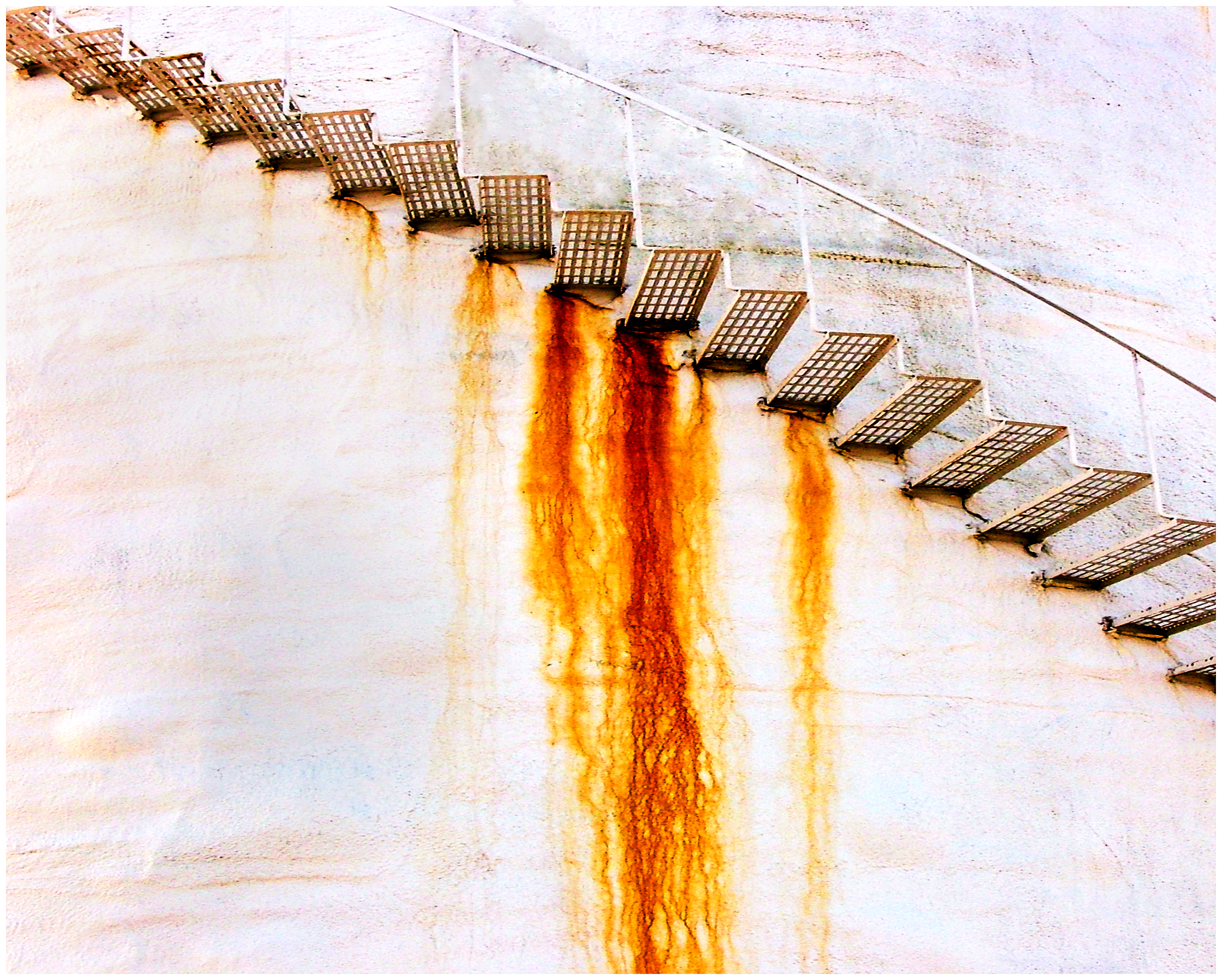
The metal stairway in this image evokes in me considerations of the evolutionary spiral, the universe’s operating system, which we know to “favor” increased novelty, diversity, adaptation, complexity and order. Along the bottom steps of the oil tank, I see the significant ordering that has already occurred. In the steps above and combined with the railing, the lighted way indicates that the direction is onward and upward. Finally, conveying purpose to this ascending pathway is the mass of the structure behind it—the universe.

Extending the metaphor, I would place the current generation of humanity in the area of transition, where light and order are emerging from the darkness (wherein dwells ignorance, short-sightedness, intolerance, self-centeredness and the illusion of separation). I imagine the transition toward the light being fueled physically by health and well-being, safety and security, strong economies, innovations in every domain, the pursuit of excellence and what works for everyone. And because consciousness gives rise to form, I imagine that love, compassion, tolerance, collaboration, empowerment, ethical behavior and the like are the energies at the leading edge of illumination.

To some this may sound saccharine or unrealistic, particularly in light of how we’re portraying ourselves in the mass media and entertainment venues. But evolution is a universal, unbounded and dynamic process that has operated, and will continue to do so, with or without human beings. What’s different in our time is that we understand this and we’ve gained some knowledge about the patterns that support living systems.

In his study of 26 societies, Historian Arnold Toynbee found that a civilization’s  prospects for survival were greatly enhanced by the movement of information and resources from the top of the society to the bottom. Those that accomplished this feat of uplifting citizens at the lowest level survived the longest. On the other hand, collapsed civilizations had in common an “inflexibility under stress and the concentration of wealth in a few hands.” He also observed that civilizations disintegrated when their leaders stopped responding creatively, and they “sank owing to nationalism, militarism, and the tyranny of a despotic minority.”

Addressing the challenge of moving in the more positive direction, systems scientist Dr. Janis Roze, advised: “We must now give equal time and focus, equal or even greater energy to those human qualities that are constructive, growth enhancing, confidence and trust inspiring, so that the power of these qualities can be consciously developed and applied both to individual lives and to the directing of societal and world affairs.”

Psychologist Mihaly Csikszentmihalyi connected the dots, tying the individual to evolutionary process by observing: “What evolves is not the self trapped in our physical body, which will dissolve after death. Rather, what will survive and grow is the pattern of information that we have shaped through our existence: the acts of love, the beliefs, the knowledge, the skills, the insights that we have had and that have affected the course of events around us. No matter how smart, wise, or altruistic a person might be, he or she is not going to contribute to evolution except by leaving traces of complexity in the culture, by serving as an example to others, by changing customs, belief or knowledge in such a way that they can be passed down to future generations.”

As far back as we’ve been able to see, human evolution favors the passing on—physically, mentally and socially—of characteristics, qualities and thinking that promote survival and growth.

Pursuing the metaphor further, light doesn’t emerge from the darkness, it dispels and gives form to it, creating well-ordered shadows. Consciousness (light) is fundamental, illuminating a particular direction. Progress is not a straight line, but a spiral. The direction toward a better life, individually and collectively, is in alignment with the patterns in the evolutionary spiral. The direction of choiceful change is either up or down. There’s light on the steps ahead, darkness on those below, so personally and socially we’re deciding every day to step up or step back down.

We live on a different planet now, where not biology but symbolic consciousness is the determining factor for evolution. Cultural selection has overwhelmed natural selection. That is, the survival of species and of entire ecosystems now depends primarily on human activities.

Brian Swimme, Cosmologist

_______________________________

My other sites—

Love And Light greetings.com: A twice-weekly blog featuring wisdom quotes and perspectives in science and spirituality intended to inspire and empower

David L. Smith Photography Portfolio.com: Black and white and color photography

Ancient Maya Cultural Traits.com: Weekly blog featuring the traits that made this civilization unique 

smithdl@fuse.net

Coalescence

Making the slightest contact, separate masses tend to “pull” to one another

Reflecting upon these raindrops, I’m drawn more to their  journey than to my usual inclination to trace subject matter back to its origins—perhaps because the first appearance of water on Earth has not yet been ascertained. Water known however, that gravity keeps it contained. None of it escapes into space. According to the United States Geological Survey: “If the total amount of water vapor fell as precipitation all at once, the Earth would be covered with only about one inch of water.” But “If all the world’s water was poured on the contiguous United States, it would cover the land to a depth of about 107 miles.”

Considering this image, each of these drops and droplets began to take shape as invisible molecules of water vapor high in the atmosphere by attaching themselves to a nearly invisible dust particle. As more and more water molecules attached—coalesced—and their weight increased, gravity pulled them down, through the atmosphere, causing even more coalescence. When a gazillions of these infant droplets grouped together, attracted by their electrical charges, their size increased to form a cloud where more attraction and more coalescence resulted in a drop that literally, well, dropped. Coalescence continues even when a drop splatters and runs.

The drops in this image didn’t land on the leaf and line up this way. Their sizes and alignments are a product of their travels, conditioned by the physical forces and electrical fields they encountered along the way. And the continue to change state, evaporating back into the atmosphere. In the liquid state, drops of water assume a rounded shape because a sphere requires the least amount of energy to form and has the least possible area for the volume it encloses. That makes it the most economical, energy-efficient way of enclosing and separating two volumes of space—water and surface. Aside from the physics, I love the aesthetics—how the drops are transparent and reflect the sky. Earth and sky integrated as one.

Another feature that comes to mind when contemplating this image is the water cycle, the change of state itself: liquid—vapor—solid (ice). It’s a perfect metaphor for transformation because water is constantly changing. Like the universe and all it contains, there’s a continuous rising and falling, birth and death, breathing in and breathing out. Lub dub, lub dub. Drip. Drip.

In preparing this post, I was delighted to find Ken Wilber’s quote in my database. It beautifully conveys the transcendent perspective of coalescence, connecting being with perception. Having enjoyed a career as a visual communicator, I appreciate the significance of perception and the opportunity to expand it. We become more by seeing—ourselves, humanity, environment, God—as more. Indeed, looking deeply into everyday objects and processes generates appreciation. And that can take us to the place where we are the sun, the rain and the earth.

You in the very immediateness of your present awareness, are in fact the entire world, in all its frost and fever, in all its glories and its grace, in all its triumphs and its tears. You do not see the sun, you are the sun; you do not hear the rain, you are the rain; you do not feel the earth, you are the earth.

Ken Wilber

____________________________________________

My other sites:

Love And Light greetings.com: A twice-weekly blog featuring wisdom quotes and perspectives in science and spirituality intended to inspire and empower

David L. Smith Photography Portfolio.com: Black and white and color photography

Ancient Maya Cultural Traits.com: Weekly blog featuring the traits that made this civilization unique 

smithdl@fuse.net