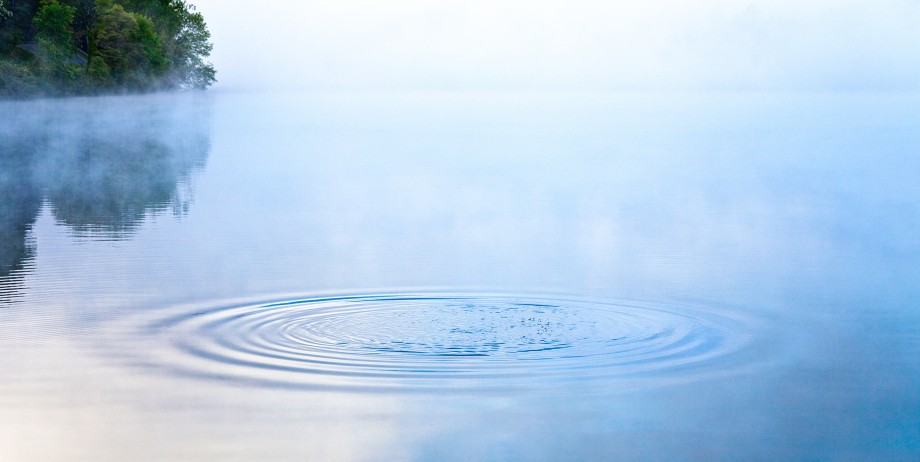
Perspective and Perception

From where we are looking, what is our view of the world?


Being six-foot-five, I’ve always viewed the world from a slightly higher perspective than most people. For instance, I see the tops of furniture and people’s heads, and I can see farther in a crowd. No big deal. But that each of us perceives the world and other people from different perspectives, sometimes dramatically so due to our unique physical and mental endowments and upbringing, it is a big deal.

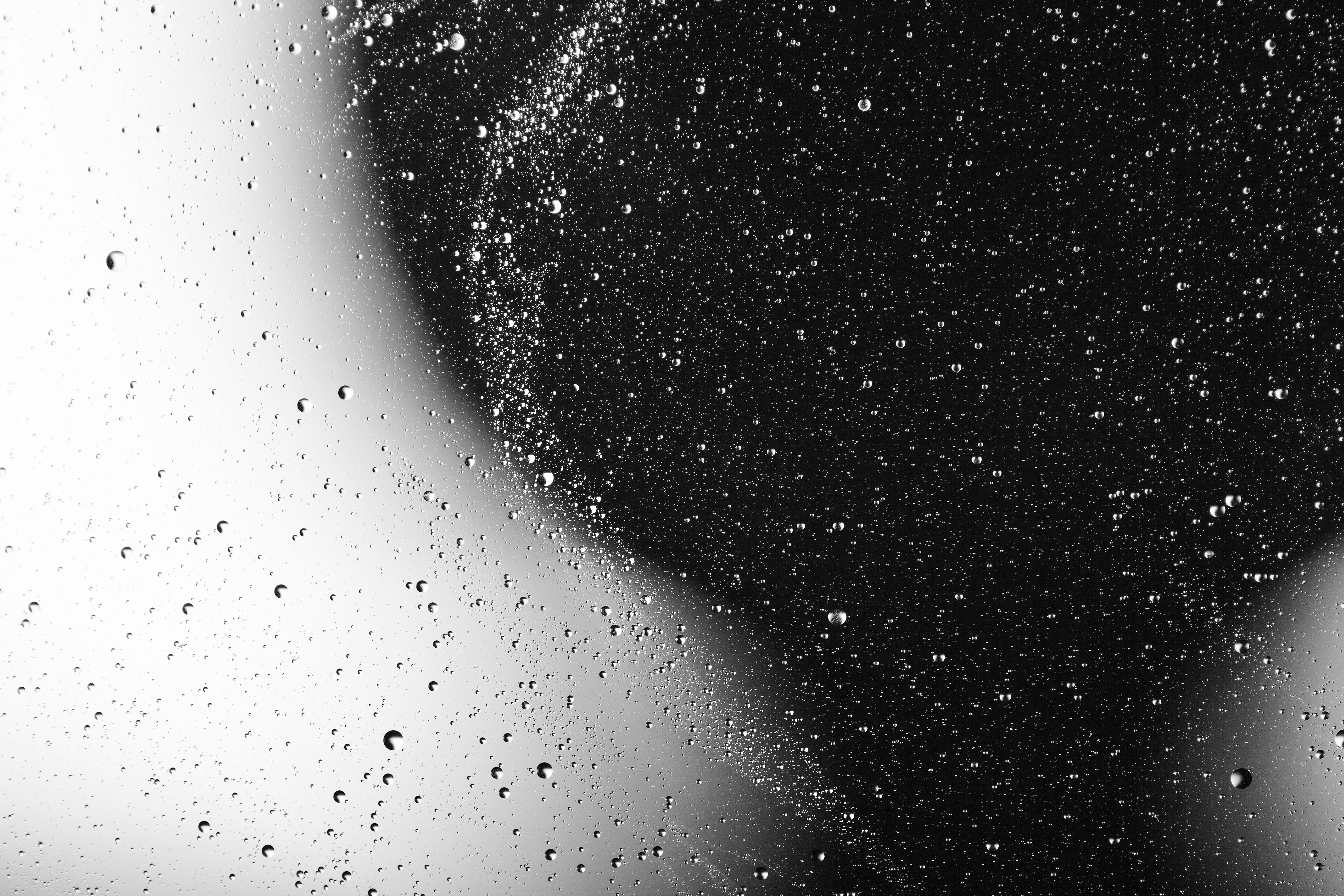
Differences in perspective and perception, with its attendant communication challenges, is at the root of prejudices, disagreements and abuses that can provoke violence, even war. I selected this image for contemplation because it depicts the nature of perception in the context of a whole system, the part-to-whole relationship. Here, individual drops of oil are seen moving in relation to one another on the surface of water. Although the composition of the drops is identical, they are each unique in size, shape and tonality due to their position relative to the light source and each other. If they had eyes, each drop would perceive a “reality” different from the others, so different we would not be surprised to hear them proclaim such things as “I’m bigger than you!” “I was here first!” “You’re blocking my light!”  

As individual drops, they’re looking from and only considering self, defining and ordering their world from a narrow and limited point of view. Given our five senses, we do the same thing. Eyes, for instance, evolved at the top of our bodies so we could survey the immediate physical and social surroundings. But we also have brain-minds that have the capacity to learn about and envision systems that can only be detected with instruments. For instance, the Hubble and James Webb telescopes are expanding our perception of the universe dramatically, challenging us to shift our perspective on who we are and where we are. Consider:

  • The big bang occurred about 14 billion years ago, giving birth to the universe.
  • 75% of the universe is dark energy; 25% is dark matter; 5% is the matter we’re familiar with.
  • It takes one million years for the light from the center of our galaxy to reach the Earth.
  • The Milky Way galaxy is 100,000 light-years (distance light travels in a year) across and 1,000 light-years thick.
  • There are more than 200 billion stars in our galaxy. 
  • Nearly 99% of our solar system’s mass is in the sun.
  • Our solar system orbits the Milky Way every 200 million years—at a speed of 570,000 mph.
  • Earth resides 25,000 light-years from the center of the Milky Way.
  • Light from the sun takes 8 minutes to reach us. We never see the sun in the present moment.
  • The Carina Nebula lies 7,500 light years from Earth. It’s 140 light-years wide.
  • There are at least 125 billion + galaxies in the universe.
  • Star V838 is 600,000 times brighter than the sun. Its size would engulf the solar system out to the orbit of Jupiter.
  • In the center of the Sombrero galaxy there’s a black hole with a mass equal to a billion suns.
  • Hubble has imaged 10,000 galaxies in the Fornax constellation, which is 13 billion light years from here.
  • Galaxies 300 million light-years from us are moving away at about 16.5 million mph—and the expansion is speeding up.
  • By one astronomer’s calculation, “There are tens of billions of potentially habitable planets in the Milky Way galaxy alone.”

Occasionally, we’re reminded that the universe is vast and beautiful. But for many that perspective is fleeting, not very relevant. The quantum reality and cosmic immensity seem to have nothing to do with earning a living, parenting, managing work or getting an education. Except for certain circumstances, we tend to keep our focus narrow, on what’s in front of us. 

Narrowly focused perceiving has had, and continues to have, survival value. It’s how living systems survive, grow and reproduce. But on December 7th, 1972 the astronauts of Apollo 17 opened our eyes to what the Earth looks like from space. Overnight, our perspective changed. An imagined image suddenly became visible, real—an enormous blue body floating in the immensity of space, appearing as a whole system. And we realized that beneath the clouds, ourselves and everything we know has transpired and is unfolding. 

How to respond to such immensity? What are we to think? How does it affect our perception of ourselves? Of God? Of the future? Astronomy magazines and images from space online always increase my sense of wonder and appreciation. Given the context of what’s going on over our heads, personal, social and political challenges seem trivial. And in the context of evolution, we’re a very young species, barely out of the womb, just opening our eyes to where we are, struggling to learn and adapt to each other and changing conditions through trial and error. Combined, these perspectives position us in a place that recommends patience and compassion rather than fear, confusion or pessimism with respect to the future. 

A broader perspective can contribute to the management and healing of negative consequences due to conflicting perceptions. The Congress of the United States provides an excellent example of the consequences of head-in-the-sand narrow perspectives. Dysfunction, divisiveness and stalemate occurs in a living system when the members vigorously champion and cling to their own or a group’s perspectives rather than reason together to discover the best, most workable solution to challenges. Eventually, self-centeredness fails at every level because it serves a narrow and limited perspective relative to the greater whole. Unlike the oil bubbles in the above image, by consciously deciding who we are, the nature of our relationship to everyone else and the planet and how we will use our energy, we create the world of our experience. 


The impossibility of arriving at ultimate formulations of reality does not represent a defeat for the inquiring mind. It is only final assertions that are suspect, not the process of knowing itself. For we each have a valid and important perspective on what is. And to the extent that we can acknowledge the partiality of this perspective, what we say stays clear and true.

Joanna Macy, Ecologist, general systems theorist

______________________________________

smithdl@fuse.net

DavidLSmithPhotography.com

Photography Monographs (Select a book. Click on in it to turn pages)

Flow

It makes a huge difference where we’re planted

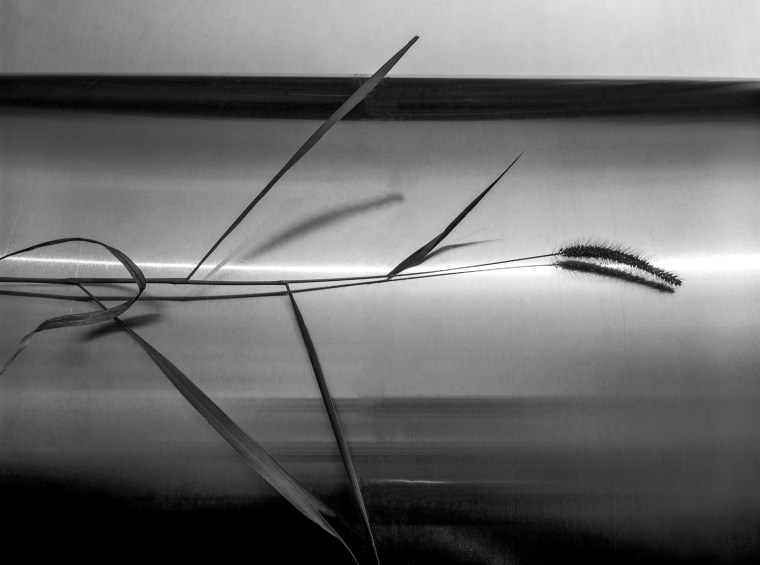
“Going with the flow” is an expression that suggests it’s a better life strategy is to align with rather than resist what’s happening. As guidance for individual behavior, paddling with the “current”—in the context of home, work and relationships—is certainly easier than paddling against it. In this image of waving grass, sometimes called “Whisp” or “Foxtail,” there’s more to be observed than just the blowing wind. From a whole systems perspective, I note that the stalks that support the tassels are rooted in the ground. They stand together as a community of sorts, and they lean in the same direction in response to the wind. Systemically, as a group, they can be seen as evidence of harmony.

Flow is in evidence at many levels.  Atoms, for instance, flow together or unite to form molecules, molecules combine to form cells, cells join to form organisms, organisms integrate to form bodies and so on. In nature, flow is represented in schools of fish, crop fields, herds of wild mustangs and flocks of birds, all moving together in harmony with each other and with their environments. Human communities that evidence flow include high functioning families, teams and synergistic work groups where people are all moving in the same direction. On a grander scale, Sweden, Japan and Canada are often cited as societies that are harmonious and less militant, places where there’s less social discord and more people living happier lives. Why is that?

The question is too big and complex to even approximate a reasonable answer, but it elicits a smaller question that piques my interest—What are the energies that result in or give rise to flow in human systems? An answer to that would also suggest the qualities that contribute to harmony. One thing for certain, they are notas evidenced by religious and political polarization—the energies of intolerance, inflexibility and interfering.

Because analysis of living systems begins with an assessment of individual members, specifically their behaviors and relationships, I pulled up a list of some of the higher human character traits that were part of my “Vision for Television.” Here, I think they go a long way toward suggesting the energies that contribute to flow in individuals and society.

Acceptance • Altruism • Appreciation • Awareness • Caring • Compassion • Confidence • Cooperation • Courage • Creativity • Curiosity • Empathy • Faith • Flexibility • Forgiveness • Goodwill • Gratitude • Helpfulness • Honesty • Humility • Humor • Imagination • Integrity • Intelligence • Intuition • Kindness • Love • Patience • Respect •   Responsibility • Reverence • Tolerance • Trust • Wisdom • Wonder • Zest for Life

I believe these characteristics, or qualities, are contagious. As we experience them in others, they are awakened in us. And given even a small group, they can shape the direction of social change. On balance are the energies that retard flow and harmony, evidenced by the destructive “winds” blowing in the Middle East and other parts of the world where separatist factions and fundamentalist ideologies are bent on destruction rather than construction. Like grasses on the prairie, it makes a huge difference where individuals are planted or located. Those who paddle against the flow of life may expend a great deal of energy, but relatively little is accomplished that is enhancing and sustainable; the nature of conflict is merely to escalate.

Feeding my long-term optimism are the seeds of reason, respectful communication, intelligent creativity, wisdom, planetary stewardship and the rule of law, energies that are on the ascendency because evolution favors increased freedom, order, complexity and consciousness. How grateful we are to have been planted in such rich soil.

The evolution of consciousness always moves in the direction of greater love, inclusiveness, tolerance, synthesis, freedom, and empowerment, however slowly and painfully.

Corinne McLaughlin, Author, educator

____________________________________

smithdl@fuse.net

DavidLSmithPhotography.com

Photography Monographs (Select a book. Click on in it to turn pages)


Love

Metaphysical gravity Something we are?


Jesuit paleontologist and philosopher, Pierre Teilhard de Chardin S.J., wrote that love is “The affinity of being for being.” Affinity recognizes love as an energy that’s not only a human experience, it’s also intrinsic to the universe. In support of this, engineer and futurist, R. Buckminster Fuller, often said that “Love is metaphysical gravity.” That is, it holds all things together, in relationship, at all times, everywhere. And with regard to the action that love gives rise to, Mother Teresa said, “It is not the magnitude of our actions but the amount of love that is put into them that matters.” Love can be many things but putting these ideas together we can say that love is an energy, a force the favors relationship and affects bonding throughout the universe.   

Country singer, Clint Black, sings a beautiful song that says, love isn’t something that we find or have, “It isn’t something that we’re in, it’s something that we do.” The song references the frequencies of love that are the subject of literature, theater, film and mass media—romance, intimacy, amorous relationship and marriage. As biological creatures it’s natural and evolutionarily necessary for these to be paramount in our consciousness, rites, rituals and celebrations. Within these frequencies we marvel at the process of “falling” and “being” in love and lament the falling out of love. Indeed, love at these frequencies is something that we do.

The ancient Greek philosophers understood that there’s more to love than finding it and making it. Their term, eros, referred to this kind of elemental love—eroticism and intimate love, the kind of love where there’s an expectation of return. “If you make me happy and I’ll make you happy.” Another kind was storge, the natural affection between parents and children. It says, “I cannot help but love you.” Philia was affectionate regard for friends—“If you show me virtue, equality and familiarity, I will care for you.” And agape was the term applied to brotherly love, charity, the love of God and God’s love for man. Significantly, the latter was regarded as unconditional—“No matter what happens or what you do, I will love you.” Thomas Aquinas wrote that agape was “To will the good of another.” 

All these distinctions, different frequencies of vibration, regard love as a quality of relationship between human beings or humans and God, given our five senses and common interpersonal experience. But there is a higher and more potent frequency. “Transcendent” love steps away from material, space/time relationships and moves into the realm of Ultimate Reality, the present moment and union at a cosmic level where there is no object at which to direct love. It simply is, often occurring as an unexpected, fleeting and uncontrollable upwelling, a completeness that encompasses all that is. And it urges no action, no reciprocation. Indian guru, Sri Nisargadatta, said “When I look inside and see that I am nothing, that’s wisdom. When I look outside and see that I am everything, that is love. Between these two my life turns.” It’s the difference between doing—”I love you,” and transcendent love—”I am love.” 

If love is metaphysical gravity, the energy that holds all things together, might it be that the experience of transcendent love occurs when this is fully realized? I’m reminded that we only know these energies by their effects. For instance, we know how atoms interact and unite to form matter, that sub-atomic “particles” are actually energies of attraction and repulsion and that between them by far is space. But we don’t know why these energies are as they are. The same is true of love. If Buckminster Fuller is right about the energy of love holding everything together at every level, might love be—or give rise to what scientists are calling “Dark Energy?” Indeed, something we are? 

Benjamin Disraeli wrote, “We are born for love. It is the principle of existence, and its only end.” If all the above is true, what would be the consequence of living in such a universe? My view combines what Mother Teresa and Thomas Aquinas recommended, that as conscious beings, evolution encourages us to maximize the amount of love in all that we do and, as much as possible, widen our circle of love until it becomes inclusive, universal and unconditional, willing the good of the universe and all it contains.

On the everyday practical side, awareness of these vibrational distinctions in love can ease suffering. From the Buddhist perspective, the more we move from eros to agape—from thoughts and words of judging to non-judging, from controlling to allowing, from disapproving to supporting, from criticizing to empowering, from denying to accepting and doing to being—the less we suffer in the face of breakdown and disappointment. Irrespective of the frequency of love energy, it promotes union, the refinement of personality and the expansion of consciousness.    

Someday after mastering the winds, waves, tides and gravity, we shall harness for God the energies of love and then, for the second time in the history of the world, man will have discovered fire.

Pierre Teilhard de Chardin, S.J., Priest, paleontologist

__________________________________________________

smithdl@fuse.net

DavidLSmithPhotography.com

Photography Monographs (Select a book. Click on in it to turn pages)


Faith

Grasping lightly can lift us up; grasping too tightly holds us down

255-B3


Dictionaries generally provide two definitions for the word “faith,” one being the trust or confidence we have in someone or something, the other a strong belief in God or a doctrine of religion irrespective of evidence. This image of a mother holding a child’s hand clearly speaks to the former, but in it I see where both aspects have their origin.

As infants and through childhood we are completely dependent upon others. Trust is given and “a given” if we are to survive. We take on faith that someone, usually parents or guardians, will be there—and able—to provide for our physical, emotional, psychological and spiritual needs. It seems like this should be an inalienable right as a prerogative of birth, because care given by responsible adults is what it takes minimally for children to become whole, healthy and contributing persons. That too often these essentials are not provided, deepens my appreciation for what I took for granted as a child. Even as adults, we have faith in family members and friends. They are the ones we can usually turn to in difficult times.

We also have faith in the systems that provide the contexts for our lives—schools, churches, small businesses, corporations, non-profit organizations, local governing bodies and the Federal government. My careers in education and business were all grounded in faith—that my teachers knew what they were talking about, that higher education would lead to desirable and creative work opportunities, that the economy would grow, that salaries in my field would be enough to support a family and so on. 

Along the way we learn that some of our faith in people and institutions was misplaced. Neither individuals nor institutions can always be trusted. Not everyone is responsible, not everyone behaves ethically. People and circumstances change. And so, through disappointments we develop some discernment as a hedge against misplaced faith.

Faith has higher and lower vibrations. The “higher” is acceptance of what is. Bo Lozoff, an American writer and interfaith humanitarian wrote that “Faith is a profound acceptance of life’s ultimate goodness no matter what happens.” At the opposite end of the faith spectrum is fanaticism—excessive, irrational, uncritical zeal characterized by an unwillingness to recognize and respect differences in opinion or belief. Robert Pirsig, author of Zen And the Art of Motorcycle Maintenance wrote that “No one is fanatically shouting that the sun is going to rise tomorrow. They know it’s going to rise tomorrow. When people are fanatically dedicated to political or religious faiths or any other kind of dogmas or goals, it’s always because they are in doubt.”

In this regard I think of President Biden’s campaign perspective, that “We’re engaged in a struggle for the soul of America.” Former California State Senator John Vasconcellos said the same thing in 2014, adding, “We are struggling between two visions of human nature: faithful and cynical.” Indeed, held lightly and with an open mind, faith can unite and lift us up. Grasped too tightly it divides and holds us down.

In the long run the fate of a civilization depends not only on its political system, its economic structure, or its military might. Perhaps, indeed, all of these ultimately depend in turn upon the faith of the people, upon what we believe and feel about man; about the possibilities of human nature; about our relation or lack of it to such intangibles as the meaning of morality or the true nature of value.

Ashley Montagu, Anthropologist

__________________________________________

smithdl@fuse.net

DavidLSmithPhotography.com

Photography Monographs (Select a book. Click on in it to turn pages)

Belief

We move in the direction of our beliefs

Life isn’t ever a straight line on a single track. Rather, it’s a progression along many tracks with lots of switching going on. Although I have switched “tracks” purposefully, there were many instances, probably more, where a switch occurred and I didn’t see it coming. The analogy raises questions about control and self-determination. How much control do I really have over my life?

Certainly, I can choose a destination and get on board with ideas and plans to get me there. That’s “entrainment.” But what about those switches, the plans that don’t—or do—work out, the emergency phone call, lottery ticket, birth, diagnosis, failed plans, new interest or the person we meet who changes the course of our life?

Some things happen beyond our control that changes us, at times even altering our destination. In large part, I think it’s our encounter with life’s unexpected turns that urges the search for meaning. Is life just a random sequence of events over which I have some but not much control? And why all the unexpected switching along the way? What are we to think? How do we respond to change and uncertainty? When switches altered my dad’s life journey he would shrug his shoulders and say “What can you do?” Indeed, when life (the soul) is leading, the wise course is resignation, go with the flow, align and allow. Resistance just creates frustration and pain.

Somewhere along the line, likely paralleling philosophical tracks, I found comfort in the notion that the inner animating force—I call it the “soul”—of each individual is like the engineer on a train, making decisions about which tracks to take and which switches to activate, when and where.

Looking back I can see how my life as been punctuated by unanticipated events, people and experiences that altered my course. Some were outright challenges that were either met or not—opportunities for growth. Others were tangible opportunities, like when a full scholarship to graduate school was presented to me without my even applying. Others were gifts, one of the most memorable being a friend’s sale to me of about $8,000 worth of high-end darkroom equipment for one dollar. And then there’s the lost opportunity as when Ansel Adams offered to sell a group of us students at RIT, original photographs for fifty dollars—prints that now sell for hundreds of thousands of dollars. In retrospect I can barely imagine that I was all those people who did what I did and didn’t do what I now wish I had. That every switch and each new track presented an opportunity of one kind or another adds credence to the soul being in the driver’s seat.

One thing is certain—each track provided a unique set of life lessons, chapters in the story of me and my becoming. Hard lessons learned leave little to regret. Rather, ideally, they lead to constructive intentions and choices when a familiar lesson comes again. My belief for now, and it could change tomorrow, is that life stories are written before we appear—already complete, perfect and happening in the Eternal now. That we don’t remember them allows us to freely choose both tracks and switches. Whatever the outcome, lessons were learned. Or not.

The tracks we’re on lead us toward destinations appropriate to the soul’s plan. The engine of belief provides the momentum. And so, whether or not we’re aware of it, we move in the direction of our beliefs.

And I’m a strong believer in belief. I think it’s creative, we get what we believe. Gandhi described the mechanism succinctly—

Your beliefs become your thoughts

Your thoughts become your words

Your words become your actions

Your actions become your habits

Your habits become your values

Your values become your destiny.

Mahatma Gandhi

Through years of study, personal experiences, readings and conversations with people like Dr. Beatrice Bruteau, a friend and mentor, I’ve come to believe that the soul, which is already one with the universe, has constructed a plan for each individuation. However, once embodied, the egoic personality can choose to ignore or alter it. Further, I believe that we will ultimately need to confront the lessons of the plan that we ourselves have made—lessons that balance, correct and lead us toward the realization of our true identity. The question is, “With regard to the more difficult choices, when life throws a switch that’s uncomfortable or undesirable, will we face it now or in a later life?”

There are instances when a particular track or switch is obviously part of the plan—as when I discovered photography, met my wife and saw my daughter for the first time. More often it’s by hindsight that I learned an event was part of my soul’s plan. In either case, knowing that my universal Self is driving my experiences toward the fulfillment of my purpose, that it’s setting me on the right tracks at the right time and will continuously throw the switches that favor realization, I feel like the story is unfolding properly and beautifully. I’m grateful for that, including the privilege of feeling that way. Of course, there is no way to know if my beliefs are in alignment with Absolute reality. At least they’re comforting and the effects appear to be constructive.

NOTE: If this topic interests you, I highly recommend a book by cellular biologist Bruce Lipton entitled, The Biology Of Belief. He presents recent studies on the biochemical effects of the brain, showing that all the cells of our bodies are affected by thought. Further, he talks about the profound effects this has on our personal lives and the collective life of our species. It’s a great read!

This is a make-believe world. We make it according to our beliefs.

Jerome Perlinski, Teacher, History of Ideas

The most powerful thing you can do to change the world is to change your own beliefs about the nature of life, people and reality to something more positive… and begin to act accordingly.

Shakte Gawain, Teacher, Personal Development


The Soul’s Journey Through Mistakes and Failures

Considering Reincarnation, Karma and Compassion

“I think I was ten different people in this lifetime.” I hear words to that effect quite often and share that sentiment. Looking back on some of my beliefs, things I’d said and done, it’s hard to believe it was me. Who was that guy? How was that possible? I’m so far away from being those people I can’t imagine they were ever me. The really confounding part is how easily long-time, seemingly solid, core beliefs and values could have been ignored, set aside to accomplish a goal, bend the truth, rationalize a behavior. It just goes to show, not only can we change, we do. Sometimes dramatically. When we acknowledge that “life is a work in progress,” the emphasis is always on looking ahead, but some of the more important and lasting lessons are encountered by how we respond to past mistakes and failures, including those of others. Do we ignore them, blame them or suffer the guilt ourselves? Is peace of mind even possible?

It’s been said that both the “saint” and “sinner” reside within us. I’m not a theologian or spiritual teacher, but after eighty some years of sampling spiritual perspectives, I’ve done a lot of connecting the dots. Like a mountain climber who stops to rest and observe the view, I offer a metaphorical sketch of what I see.

Prior to incarnation the soul makes a plan, specifying lessons carried over from previous incarnations, and those yet to be addressed on the ascent toward realization. It also makes a contract with other souls who agree to provide a mutually beneficial circumstance or experience to create the best opportunity for their plans to be fulfilled. Of course, at any point, free will can intervene and halt the soul’s advance.

Now consider an unimaginably enormous and steep mountain. I’ll call it “Love Mountain,” because that’s its substance, and as we go up it expands to become all-inclusive—divine—at the summit. In the valleys below the climbers are absorbed with its features, which are both beautiful and treacherous. When they become discontent feeling separate from Source—God, The Ground of All Being, Infinite Intelligence, Nothingness or whatever you want to call it—they begin to climb. All around the mountain, the flanks are rough and rugged with slippery rock surfaces, mud, boulders, gravel and dense vegetation that provide the full range of earthly experiences. Considered as a whole, the journey for each climber is an evolution in consciousness leading to the realization of their True Self at the summit. The irony, according to Eastern mystics, is that Divine Love is already fully present within all the climbers, but the terrain is so engaging their attention is on the ground in front of them.

 Along the way, climbers become so exhausted they stop and shed their bodies. Those on the Eastern side of the mountain largely believe that their climb, which includes both progress and backsliding, has correspondingly positive and negative consequences, which will carry over when they inhabit a new body and return to the mountain where they left off. They consider it a law of nature. Those on the Western side of the mountain also believe their actions have consequences, referring to an ancient precept that says, “Whatever you sow, you shall reap.” These climbers believe that when they reach the summit, the supreme being will judge them according to what they consider to be right and wrong, good and bad.

 Being one who climbs on both sides of the mountain, with respect to this idea, I prefer the former because judging is inconsistent with this climber’s understanding of unconditional love, which is ascribed to the Creator. Aside from these beliefs, there’s near universal consensus that actions have consequences. Had I as a climber really understood that, or thought about it early in this lifetime, I would have saved himself a lot of backsliding. Then again, mistakes and failures are part of the process of the growth while climbing the mountain.

 That being so, what would be the better response to past mistakes and failures, including those we observe in others? Is there a way forward? Judgments are natural and necessary. We make them every day. But thoughts and speech that amount to “judging”—a negative perception or opinion about us or someone else, perhaps to blame or condemn—get us mired in the “mud.” It can hold us back spiritually. This contemplation was prompted by my fascination with the feeling that, looking back, I have been many different people.

 For me, one way to unstuck is through thoughts of “compassion.” The Mirriam-Webster Dictionary defines it as “sympathetic consciousness of others’ distress, together with a desire to alleviate it.” In the mountain analogy I believe a compassionate response to  mistakes or failures would create a solid step up on the otherwise rugged and slippery slope, because compassion is a demonstration of love. On Love Mountain it provides sure footing. So also with the other virtues, particularly those that formed the core of Jesus’ teaching and example, including humility, gratitude, generosity, truthfulness and forgiveness. Each in its own way reveals and externalizes more of our True Self (divinity) to ourselves and others, which in itself is a certain level of realization.

Nationalism

It can manifest as an open hand or a clenched fist

Nationalism is a point of view that puts the identity, interests and values of a nation ahead of other nations, regarding itself as independent and self-sufficient, the ultimate authority on what’s best for its citizens. Grounded in national pride, it has brought people together to assert their freedom, independence and economic growth in the face of domineering kings and tyrants. The French and American versions of democracy resulted from their respective sense of identity and values, driven by a passionate desire to unite and formalize them. So within a nation, collective fervor can contribute to unity and resilience.

However, it can also create division and vulnerability, poverty, war and genocide through exclusive and aggressive policies. History and the sciences, biology and anthropology in particular, have shown that all living systems are interdependent. If your liver cells collectively decide to stop regulating the nervous system, preferring instead to only process hormones that make it bigger and stronger, the organ will become cancerous and create a host of painful symptoms throughout your body. Unchecked, you could die of end-stage liver disease. Whatever the reason, when a living system—family, company, corporation, church or nation— builds a virtual or actual wall around itself, it not only limits variety, innovation and expansion which are evolutionary drivers, it becomes increasingly vulnerable to change with limited ability to adapt.

How does national pride turn into self-centered obsession nationwide? Systemically, the short answer is fear, which begins in a climate of breakdown. When members in a complex living system such as a nation, observe a number of breakdowns that escalate, they feel vulnerable and helpless. They look outside themselves for someone at the top—a king or government— to fix them. As tensions rise and problems escalate, those at the bottom of the social pyramid lose faith in their leader or government. Kings can be deposed. In governing bodies, a charismatic person, often a celebrity who’s had a taste of power acquired by being rewarded and admired, stands up, expresses national pride and criticizes the way the system is being managed, confidently proclaiming easy solutions to complex systemic issues. Not understanding the complexities and relationships involved, everyday citizens are easily seduced by passionate expressions of self-confidence and conviction. They want the quick fixes. And the prospect of something radically new encourages people to participate in the promise of a future where their payoff is both intrinsic (respect, acknowledgement, engagement) and extrinsic (“more money in our pockets”).

How do we know when national pride turns toxic? What are the telltale signs? When those seeking power reveal the mentality of what psychologists refer to as “narcissistic personality disorder,” a red flag should go up. Below, I characterize expressions characteristic of a toxic nationalistic mindset. While the power-seeker speaks of “we the people,” his or her inner compulsion is always “I.”

We’re the best. We come first. (I am the best. I come first)

Words to this effect are a clear expression of collective superiority and self-centeredness. The mindset creates division, erodes trust, limits global cooperation, creates economic and political tension and risks, promotes discrimination or conflicts with marginalized groups and foreign nations, neglects the moral obligation to assist less-developed nations and because environmental issues transcend borders, short-term gains lead to unsustainable practices that harm the planet.

Immigration poses a threat to our culture, livelihoods and security.

A nation’s greatest asset is its people. The greater the diversity of a population, the stronger its resilience, the ability to respond to crises. And greater diversity increases the capacity to innovate, particularly in the areas of health, economics and security. For example, America became strong because it welcomed immigrants. Rather than seeing them as intruders, they were regarded as potential contributors, and we found ways to incorporate, educate and encourage them to become responsible and productive citizens.

We don’t need to depend on outside producers. We’ll produce everything we need.

This is a failure to understand or accept a reality that has the potential to uplift every facet of a nation’s existence. Like it or not, every living system maintains its existence in the context of a larger system. Nothing that’s alive can exist alone, not human beings and not their collectives. When each member (nation) in a whole system (planet) contributes its unique gifts and exchanges them, the whole and its members flourish. A nation that draws a membrane around itself, limits or excludes those benefits. Its unnatural.

We don’t need to belong to regulating organizations. They don’t respect our freedom.

This is like saying we won’t subscribe to traffic laws, water treatment authorities and police departments in our neighborhood. At every level, regulations in human systems are designed to ensure their health, protection and smooth operation. Detaching from these increases a system’s vulnerability to breakdown.

I’m not like your current leaders who are making things worse. You deserve better.

This statement creates division, pitting “Us against Them.” It’s an emotional appeal to those at the bottom of the social pyramid. We learn from debate strategies, that to gain position or power within an existing system, the challenger must assert the negative (whether he or she believes it or not). And reasoned arguments, evidence and supports are given to prove that the status quo is not working. One of the telltale signs of an individual promoting self over social well-being is the lack of these essential components of formal debate—argumentation, instead making emotional proclamations couched in generalities. Rarely if ever do these leaders display reason or intelligence regarding the solutions they propose. It’s a diversionary tactic: You don’t need the details. Trust me. 

Those who resist or stand against us must be eliminated. God wills it! He is on our side!

This proclamation, followed by widespread demonstrations of violence and murder, quickly raise the status of the charismatic individual. Historical examples include Napoleon (France), Hitler (Germany), Mussolini (Italy), Atatürk (Turkey) and Sun Yat-sen (China).

There is no end to our greatness. Under my rule, we can conquer the world.

The first indication of this particular narcissistic and power-hungry attitude is gaining control of an existing army, pouring more resources into it and building it up through larger and larger successes in gaining ground. The leaders mentioned above fall into this category.

In the current era, two more indicators of toxic nationalism have emerged—

You can’t trust science or facts. (Inference: But you can trust me).

You can’t trust the news media. (Inference: But you can trust me).

By definition, a nation that places its trust in one individual is a dictatorship. A fundamental principle of whole systems states, “The whole organizes the parts.” In a democracy, citizens collectively experience the positive and negative consequences of the consciousness (beliefs, values, moral character) they elect to office. This means that voters at the bottom of a nation’s pyramid are far more responsible for its failures than those in office. When citizens feel neglected, disrespected, undervalued or disenfranchised they will eagerly vote for change. Any change. Thomas Jefferson understood the importance of trust in a democracy. He often stated, “An informed citizenry is at the heart of a dynamic democracy… Whenever the people are well informed, they may be trusted with their own government.”

In an evolutionary, even historical time frame, democracy has not yet proven to be sustainable. In The Jungle Book by Rudyard Kipling, a pack if wolves recite, “The strength of the pack is the wolf; the strength of the wolf is the pack.” Indeed, the strength of a nation is the citizen, and the strength of the citizen is the nation. All systems are characterized by feedback loops. In living systems they enable the members to adjust based on the state of the whole. For instance, when a democratic nation breaks down, the departments modify their behavior based on goals and performance parameters established in its constitution, not the desire or order of its president or dictator.

Schism in the soul, schism in the body social, will not be resolved by any scheme to return to the good old days (archaism), or by programs guaranteed to render an ideal projected future (futurism), or even by the most realistic, hardheaded work to weld together again the deteriorating elements of civilization. Only birth can conquer death―the birth, not of the old thing again, but of something new… The West will terminally decline unless a new spiritually motivated minority emerges offering new creative leadership, bringing the society to a new level of consciousness and development.

Arnold Toynbee, English historian and philosopher of History

In keeping with my intention that every posting be an appreciation; we can be grateful for the negative consequences of toxic nationalism because pain and dysfunction clearly demonstrate what is not working. The souls caught in the web of narcissism are not “bad.” I believe they’re following a pre-birth plan, intending to learn other-directed, balanced and productive responses to fame, fortune and power. In a word: love.

Merry Christmas and Happy New Year!


Merry Christmas and Happy New Year!

Whose woods these are I think I know.

His house is in the village though;

He will not see me stopping here

To watch his woods fill up with snow.

My little horse must think it queer

To stop without a farmhouse near

Between the woods and frozen lake

The darkest evening of the year.

He gives his harness bells a shake

To ask if there is some mistake.

The only other sound’s the sweep

Of easy wind and downy flake.

The woods are lovely, dark and deep,

But I have promises to keep,

And miles to go before I sleep,

And miles to go before I sleep.

Robert Frost, Woods on a Snowy Evening


Thank you for following Contemplative Photography!

David L. Smith


Job — Work — Vocation

Human activity: Toward what end?

Welding

This image reminds me to appreciate and not take for granted the opportunities I had along the way to choose work that I enjoyed doing. My parents didn’t have that luxury. I think of the difficulties people had in finding jobs during the Great Depression and Dust Bowl era, including the immigrants who came—and are still coming—to this country without two nickels to rub together. And I think of the billions of souls worldwide who, under the thumb of kings and dictators had no choice but to spend their days toiling in the fields, building temples and fighting on battlefields. Subsistence and staying alive throughout most of human history was “job one.” 

Every year, when I asked my students what was more important to them in considering a career, money or the opportunity to be creative, the vast majority chose the latter. That was not surprising because they were majoring in a creative field—filmmaking, visual communication and television production. Had I put that question to accounting or business majors, the answer would likely have been different. One of the benefits of education beyond high school is that students have both the freedom and opportunity to choose a field of interest that can lead to either work or a job.

A “job” is a contract, usually an exchange of a person’s time and energy for money. The reward is primarily extrinsic. Young people use them as stepping-stones to learning and becoming self-sufficient. And many adults, like my father who couldn’t afford to pursue advanced education, find security and fulfillment it their jobs. “Work” is an activity that provides intrinsic rewards as well as financial compensation. This includes anything that satisfies us as a person. 

I further distinguish between work and “vocation,” the motivation of which has less to do with personal gain or fulfillment, and more to do with feeling “called” to a particular endeavor. It’s work that’s compelling, regardless of compensation. It feeds the soul. Poet-philosopher Kahlil Gibran wrote that “Work is love made manifest.” In this category I include religious orders, great artists, innovators and emergents, people whose lives and work is motivated by love.

Among them was Fr. Thomas Berry, a writer and promoter of deep ecology. He wrote, “The great work before us is reverence and restoration”—reverence for all living things and restoration of the planet, viewed as a living system. Another is theologian Matthew Fox who asked, “Are we making products that are useful and necessary or are we exploiting the earth and degrading our planet for future generations? How does our work relieve the suffering of other beings on the planet?”

The above image, combined with these perspectives, prompts several considerations for further contemplation. How am I investing my time and energy? What is my reason for doing what I do? What are the intrinsic rewards? Is my work commensurate with what I’ve come here to do? To what am I contributing? (See my posting on “Contribution and Legacy”).

Once we recognize that we are interdependent, it only makes sense to work together. It does not make sense to try to beat out the other guy, because there is no such thing, in the ultimate calculus, as “I win, you lose.” I can only win when we all win.

Willis Harman, Engineer, futurist


Light And Shadow

An aesthetic and so much more

There’s an intrinsic satisfaction, an aesthetic pleasure, that comes from the experience of light when it plays a prominent, sometimes dominant, role in a photograph or painting. The works of masters such as Rembrandt, Turner, and Hooper are largely characterized and revered for the qualities of light they depict. Light and shadow are so pervasive in everyday living, we tend not to regard them, but they can be key to an appreciation of the day in addition to artistic contexts.

I have sort of a meditative hypothesis about those moments when we become aware of light and shadow, when we allow ourselves to enjoy and appreciate the forms, contrasts, and gradations they delineate in objects such as this cocktail glass. Just as sports provide an abundance of metaphors for life and living, I think images where light is prominent do this as well—particularly in still images where there’s time to explore the elements and relationships within the frame.

In life, we experience “bright” ideas, “illumination” and “flares of insight.” There’s “light” at the end of the tunnel, the “light” and “dark” or “shadow” side of being human. We have “contrasts” in personality, lifestyle preferences and beliefs. We speak of “color” and “values,” which are properties of light. “Transitions” are equivalent to gradation. “Tone” relates to music and variations in emotional intensity. And “patterns,” both in life and imagery, display the qualities of order and repetition.

Of course, we don’t consciously make these associations when we use these words, not even when we look at a photograph or painting. But I think the subconscious makes these kinds of associations as part of our quest for meaning and significance. Conversely, the role of the conscious mind when confronted with an image is to seek recognition on the way toward analysis and assessment. What is this? Do I like/not like it? Does it move me? Is it curious or provocative? Evocative? Repulsive? Or am I indifferent to it? The objective mind wants to know if something has value or meaning that’s positive or negative. And the subjective mind wants to know how it feels.

Lighting for motion pictures requires the Director of Photography (DP) to begin a lighting design by identifying the scene’s real or studio-replicated environment, including the source of both primary and secondary light sources. Having practiced and taught this procedure, images where light plays an important role call me to “consider the source” of light, what and where it would naturally be.  It’s a phrase my students came to use when analyzing and designing images, because it results in more potent and true representations.

For instance, from what direction is the “key” (predominant) light coming from? The answer is found by looking at or imagining the shadows. From their placement, one should be able to point to the light source—or where it should be given the situation. What kind of light was used? Shadows with sharp edges are produced by specular, point-sources like the sun on a clear day or bare bulbs. Images with no shadows or soft edges indicate a source that was diffused in some way. Paying attention to these and other qualities of light in an image—and in life throughout the day—is more than a technical exercise. It’s an attunement that heightens perception, deepens appreciation for the great mystery of light, and teaches us how to manage it more effectively at home and in the workplace. Whether we’re aware of it or not, every image is about what the light is doing.

Regarding the mystery that light is, physicist Arthur M. Young wrote in The Reflexive Universe: Evolution Of Consciousness, “Light, itself without mass, can create protons and electrons which have mass. Light has no charge, yet the particles it creates do. Since light is without mass, it is nonphysical, of a different nature than physical particles. In fact, for the photon, a pulse of light, time does not exist: clocks stop at the speed of light. Thus mass and hence energy, as well as time, are born from the photon, from light, which is, therefore, the first kingdom, the first stage of the process that engenders the universe.”

What’s more, increased awareness of the source, qualities, and functions of light—in our lived spaces as well as in photographic or painted images—deepens our appreciation for the capacity of sight. Had evolution not provided the combination of eyes to collect certain photon frequencies and brains to interpret them, we would only be feeling the radiation coming from the sun—and every other source.

Light created the eye as an organ with which to appreciate itself.

Johann Wolfgang Goethe, Poet, statesman

Light is energy and it’s also information, content, form, and structure. It’s the potential of everything.

David Bohm, Theoretical physicist