God by the Side of the Road

 Everything alive has a unique purpose

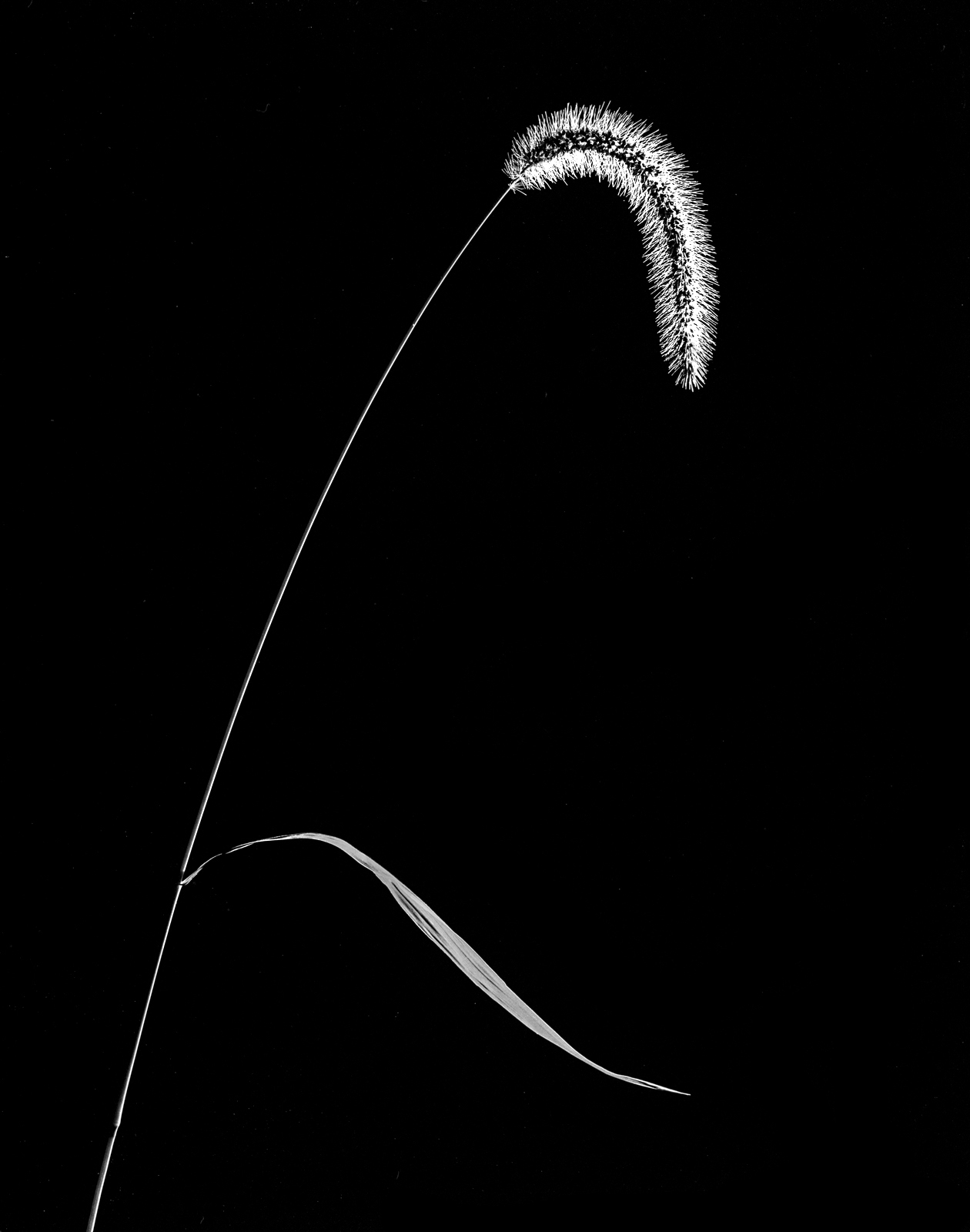
Bristle Grass (Setaria species)

I used to walk or drive by thousands of these and similar weeds every week. I barely noticed them, much less knew their names—until I singled this one out to photograph. A review of my catalog revealed that I had long been pointing a camera at patches of weeds. Around that time, I came across Ralph Waldo Emerson’s popular quote about a weed being “…a plant whose virtues have not yet been discovered.” That made sense, and I had some images to support it.

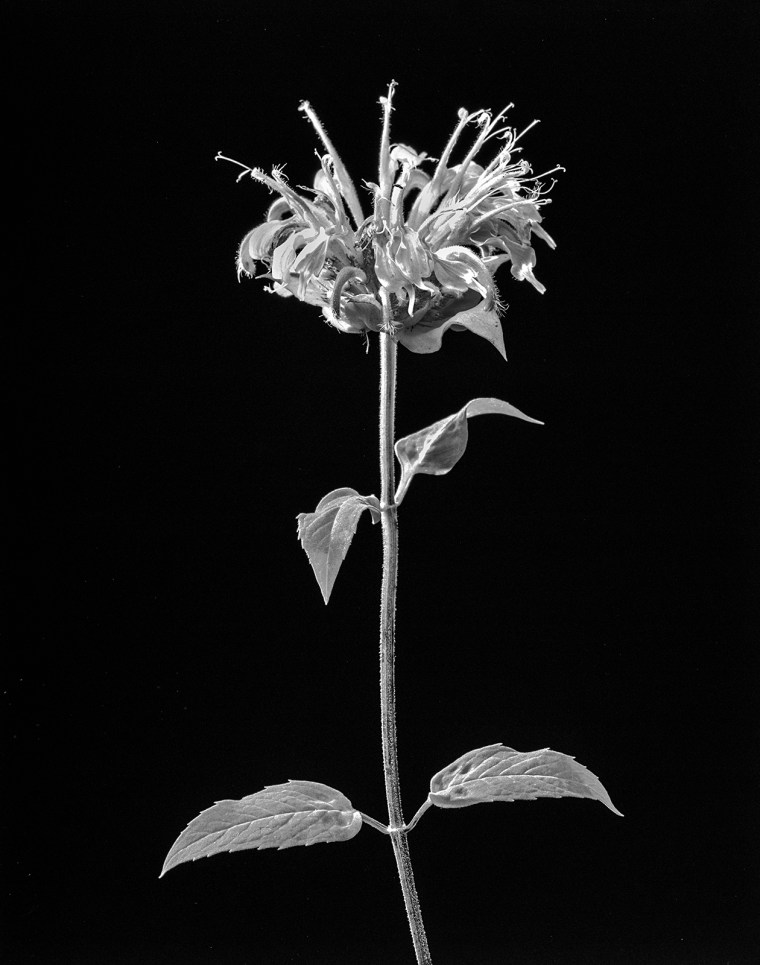
Going back to my roots in large format black and white film, I initiated a project to photograph individual weeds in my basement studio. Black and white film and controlled lighting helped to illuminate the virtues of these commonplace plants. By paying attention to them as individuals, I learned their names and gained an appreciation for their beauty, complexity and contribution to human well-being. Going forward in this post, I blend a description of each plant’s contribution to humanity along with some contemplations and quotes.

Beginning with bristle grass, its domesticated form—foxtail millet (Setaria italica)—was one of the world’s earliest grains, sustaining ancient civilizations in Asia, and serving as a resilient food source in dry, marginal lands. Today, both wild and cultivated varieties provide valuable forage for livestock and seed for birds. Their hardy growth helps prevent soil erosion and restore degraded ground. Beyond these features, bristle grass (Setaria) is a model plant in scientific research on photosynthesis, drought tolerance and crop improvement.

Milkweed

Indigenous peoples considered milkweed a source of medicine, food and fiber. It’s silky floss was used as insulation and later stuffed into life jackets during World War II. Ecologically, it’s indispensable as the sole host plant for monarch butterfly larvae and a rich nectar source for countless pollinators. Its deep roots help restore soils and prevent erosion, and its fibers and natural compounds are being studied for sustainable textiles, biofuels and medical uses. Far from being a nuisance, milkweed is a plant of nourishment, protection and renewal.

The process of photographing dozens of individual plants reminded me that we best discover the virtues of other people by getting to know them as individuals. Observing them in “clumps,” it’s easy to ignore, categorize, devalue or otherwise see them as a threat in some way, particularly when they’re different from us. Rather than considering plants or people as commonplace, peripheral to our interests or a nuisance, I remember that life has taken a particular form for good reason. And that makes all living beings unique, precious and beautiful.

Pokeweed

Often feared as a poisonous nuisance, pokeweed has nevertheless played a notable role in human history. Native to North America, it was traditionally used by indigenous peoples and rural communities for medicine, dye and even food—its young shoots, carefully prepared, were eaten as “poke sallet,” a spring green of both nourishment and ritual. Its deep purple berries have long been used as a natural dye and ink, including in early American writing, and serve as food for birds and wildlife. Today, pokeweed is also studied for its antiviral and cancer-fighting compounds, showing promise in modern medicine. Though unruly and toxic if misused, pokeweed carries a legacy of resilience, healing and unexpected beauty.

I wonder, might the great American experiment in Democracy, be in fact the mechanism by which “we the people” shift our perception from separation and fear to unity and love? Are we Americans walking the path toward accepting others, respecting all human beings as they are and putting into practice—for ourselves and as a workable model for the rest of the world—the deep truth that “All men are created equal.”? If so, the challenge is not to revert to separation, censorship and consolidation but to put aside our smartphones and engage others individually, face-to-face, to build harmonious and collaborative relationships. After all, those we don’t know are also members of the global family, members whose virtues and diverse contributions we have yet to discover.

Burdock

Burdock, with its prickly burrs that cling stubbornly to clothing and fur, is often seen as a bothersome weed, yet it has given much to humans. Long used in traditional medicine across Europe and Asia, its roots and seeds were valued for purifying the blood, supporting digestion and treating skin ailments. In Japan, burdock root (gobo) remains a nutritious and popular food, rich in fiber and antioxidants. Its burrs inspired the invention of Velcro when a Swiss engineer studied its natural hook-and-loop design. The plant also provides nectar for pollinators and food for wildlife, reminding us that even the most tenacious weed can nourish, heal and spark human innovation.

If we are to direct evolution… we have to find an appropriate moral code to guide our choices. It should be a code that… specifies right as being the unfolding of the maximum individual potential joined with the achievement of the greatest social and environmental harmony.

Mihaly Csikszentmihalyi, Psychologist

Johnsongrass

Often cursed as one of the world’s worst invasive weeds, johnsongrass nonetheless carried unexpected gifts. Originally from the Mediterranean and introduced to the U.S. in the 1800s as a forage crop, it grows vigorously, offering abundant fodder for cattle when properly managed. Its deep roots help hold and enrich soils, and its fast growth can provide quick ground cover on eroded or disturbed land. Researchers have studied johnsongrass as a potential biofuel source, since it produces high biomass under poor conditions. Though it spreads aggressively and demands respect, this hardy grass embodies resilience and productivity, showing how even a troublesome plant can serve human and ecological needs.

Power rests in the conjunction of what the individual perceives of his own internal being, what he perceives in the world about him, and how he relates these perceptions to establish his relations with other human beings.

Richard Adams, English novelist, author of Watership Down.

Teasel

With its spiny flower heads and tall, prickly stalks, teasel is often dismissed as a nuisance along roadsides and fields, yet it has served humans for centuries. In Europe, the dried seed heads were once indispensable in the textile industry, used to raise the nap on woolen cloth, giving fabrics their softness and sheen before metal tools were invented. Medicinally, teasel root has been valued in folk remedies, particularly in Chinese and European traditions, for supporting joints and circulation. Its striking flower heads are also beloved by pollinators, and in winter they feed finches and other birds with their seeds. Though bristly and unyielding in form, teasel has clothed, healed, and sustained both people and wildlife, proving its worth beyond its weedy reputation.

We must be whole to see whole. We must in a sense be beautiful to see beautiful.  Art, at its most elevated is not so dependent upon skill as upon virtue. And virtue is preeminent dedication to a life of truth. 

Richard Guggenheim, artist

Nettle

This plant stings the skin, so it’s often cursed as a plant to avoid—yet few weeds have served humans more generously. For millennia, nettle has been harvested as a highly nutritious spring green, rich in iron, protein and vitamins, often sustaining communities after long winters. Its fibers were spun into cordage and cloth in Europe long before flax and cotton, and its roots and leaves have been used in herbal medicine for inflammation, allergies and blood health. Nettle enriches soils with minerals drawn from its deep roots and provides food for butterflies and other insects. What seems at first a plant of pain is, in truth, a plant of nourishment, healing and strength—a reminder that life’s stings can conceal deep blessings.

While we and others occasionally experience barbs and stings, behind them are unique gifts and potentials which, if we choose, can be explored. Every living being, plant, animal and human expresses an outer form for reasons that are not always evident. What is known, however, is that each individual, as a member of a greater whole (species), is endowed with “life,” inner animated being. However simple or complex the form or consciousness, it emanates from the same Source. We may see it differently and call it by different names, but because we’re aware of our own inner experience we know it’s real and fundamental. Whenever and wherever we experience “clumps” of people, there’s much to be gained by engaging their members directly as individuals. The next time you observe a clump of weeds by the side of the road, remember—everything alive has a purpose.

____________________________________

For more such images check out my monograph: Weeds: God By The Side Of The Road. (Click on the book and expand the screen)

My other sites:

David L. Smith Photography Portfolio.com

Ancient Maya Cultural Traits.com: Weekly blog featuring the traits that made this civilization unique

Spiritual Visionaries.com: Access to 81 free videos on YouTube featuring thought leaders and events of the 1980s.

Clouds and Beyond

Science, Ecology, Art; Spiritual Insight

I’ve always appreciated clouds. Often, they evoke an out loud “Wow!” If Linda’s nearby I can’t help commenting on them. In the early years of elementary school, the nuns always seated me in the back of the room, probably because I was paying more attention to what was going on out the windows, rather than what they were saying. Besides their fluffy and graded beauty, I think my attraction to clouds had a lot to do with the expansiveness of the sky interrupted only by the sun and those soft white, untextured and floating forms that, unlike the earth’s surface, had no natural or artificial boundaries. Whenever I see a cloud-filled sky, it evokes in me a sense of both freedom and awe.

Science

Simply put, clouds form when warm, moist air rises into the sky and cools down. As that happens, the water vapor turns into tiny droplets or ice crystals that gather together. As the droplets bump into each other and stick together, they grow bigger and heavier. And when they become too heavy to stay in place, gravity pulls them down as raindrops or snowflakes.

Cumulus

In the early 19th century, meteorologist Luke Howard classified clouds as cumulus, stratus and cirrus, laying a foundation for their study. He also personified them, suggesting they were atmospheric indications of nature’s up and down moods. In 1887, Scottish Ralph Abercromby saw clouds as dynamic storytellers, “the message of which is opaque and threatening, but always true…and difficult to read.” American meteorologist John A. Day, known affectionately as “The Cloud Man,” combined scientific rigor with metaphysics and photography to show how clouds bridge empirical study and human wonder. And a team headed by Lubna Dada, a CERN atmospheric scientist, has shown that trees emit organic compounds—sesquiterpenes—that significantly influence cloud formation, sometimes doubling it. The study shows how biological systems and atmospheric science are interrelated.

Ecology

Ecologist-philosopher David Abram urges us to see ourselves as part of a living, breathing Earth—not above it—which includes air, sky, and clouds as vital, sentient threads in the whole tapestry of life. His perspective on clouds in particular, is that they reflect the dynamism, flow and interconnectedness of the living world. “They shape themselves and go.” Environmental writer Gavin Pretor-Pinney writes extensively about clouds in The Cloudspotter’s Guide. “Having your head in the clouds, even for just a few minutes each day, is good for your mind, good for your body, and good for your soul.” And “Life would be dull if we had to look up at cloudless monotony day after day.” In The Cloud Book: How to Understand the Skies, historian Richard Hamblyn offers insight into how clouds are both natural phenomena and carriers of cultural meaning. And famed priest-ecologist Thomas Berry added a poetic voice to his call for conservation and right-relationship to the planet. “Without the soaring birds, the great forests, the sounds and coloration of the insects, the free-flowing streams, the flowering fields, the sight of clouds by day and the stars at night, we become impoverished in all that makes us human.”

Stratus

Art

One of Georgia O’Keeffe’s monumental paintings, titled “Sky Above Clouds IV,” depicts a field of clouds seen from above in an airplane. Many of her works featuring clouds as subjects reflect her appreciation of a common theme—grandeur and transcendence. Geoffrey Hendricks, known as a “cloudsmith,” depicted skies and clouds in a variety of media—painting them on objects, vehicles, textiles and more. He wanted to blur the line between earth-bound objects and the limitless sky. And musician-vocalist Joni Mitchell’s iconic song “Both Sides, Now” captures clouds as metaphors of life’s ambiguity, change and perspective. Her inspiration for the song came from seeing clouds from above and below, pondering how that dual perspective reflected broader complexities in life.

Clouds are the sky’s way of expressing laughter.  Pablo Picasso

Each day brings a new canvas, waiting for clouds.  Vincent van Gogh

Spiritual

Vietnamese Zen Buddhist Monk Thich Nhat Hanh wrote, “If you are a poet, you will see clearly that there is a cloud floating in this sheet of paper…” It was an invitation to see and appreciate a piece of paper’s source, beginning with sunlight, the clouds that provided rain, the tree it was made from and the people involved in its creation and distribution. He used this perspective to  illustrate the Buddhist concept of “interbeing” where all things are interconnected because they/we ultimately derived from a common and single source. awakin.org. “Every day,” he said, “we are engaged in a miracle which we don’t even recognize: a blue sky, white clouds… All is a miracle.” Transcendentalist Ralph Waldo Emerson expressed both constancy and impermanence when he wrote “Nature is a mutable cloud which is always and never the same.” Paul F. Davis, an inspirational author, wrote “The sun always rises above the clouds”—a metaphor suggesting that clarity, warmth and light prevail even when dark clouds obscure the sky.

In the novel The Book of Mirdad, author Mikhail Nuayman uses clouds as a symbol for the self, a distinct form that’s inseparable from the divine. “The Word is the ocean; you, the clouds…Except it lose itself, it cannot find itself. Except it die and vanish as a cloud, it cannot find the ocean in itself which is its only self.” For him,  “The Word” represents the divine or cosmic source—pure, boundless plenitude. And clouds, formed of the ocean yet distant from it, symbolize us: beings made of divine substance but still detached from full realization. Extending the metaphor, he asks the reader if a cloud is but the ocean it contains. It’s a reminder that clouds, though separate in form, are not distinct from the ocean—they originate from it and will eventually return to it. The moral of this passage in the book is clear: Why would a cloud “waste away its life striving to pin itself in space so as to keep its shape and its identity forever?” This amazing little novel, written in mystical-diction in 1948, is an invitation to see ourselves as both cloud and ocean—distinct in awareness, yet fundamentally one. It urges the letting go of false identities to rediscover our divine unity.

Cirrus

Analogies aid understanding, but there’s nothing like direct experience. For me, that occurs on days when clouds are prominent. I pause to absorb their light bedazzled beauty, then look between them to the clear blue sky, because there lies the spectacle of uncountable stars and galaxies—the universe. Although the eye can’t see it, the knowing of what’s there provides a perspective, a taste of what matters here below.

For reasons I’ve never quite understood, the act of just looking up, day or night, has since childhood evoked in me a sense of amazement and gratitude for the privilege of dwelling on the surface of a planet—rather than living underground. It’s like, in previous incarnations I’d never been exposed to sunlight or seen the stars. As noted, turning my attention back to the reality in front of me, the mental-emotional weight of what’s going on in the world seems almost trivial by comparison—passing clouds against the immeasurable evolution of the earth and human consciousness.

God is the light beyond all clouds, yet the clouds themselves are part of His garment.

Meister Eckhart, Christian mystic

The clouds are but a veil between us and the infinite.

Henry David Thoreau, American essayist, philosopher

(Can you see the jet trail in the first photograph, the cluster of clouds?)

___________________________

My other sites:

David L. Smith Photography Portfolio.com

Ancient Maya Cultural Traits.com: Weekly blog featuring the traits that made this civilization unique

Spiritual Visionaries.com: Access to 81 free videos on YouTube featuring thought leaders and events of the 1980s.

Attitude

The difference between mediocrity and excellence

Image

In addition to the quiet sensibility that this image evokes in me, it speaks to the human journey, our quest for meaning and purpose, even our individual place and function in the world as we paddle this way and that with attention focused mainly on the surface of things.

Quantum theorists observe that, at the level of quanta, consciousness—thought—directs and influences the outcome of that which is sought in research experiments. Until a researcher looks  for a particular sub-atomic particle, it can occupy two different places at the same time. And then it only shows up where the person looks. Might the same be true at the human level? Could our surface realities be reflections of underlying expectations in consciousness?

In this regard, I recently noticed a sharp contrast between the experience of two grocery stores. In one the employees were bored and unhappy, preferring to engage each other in gossip and playful banter while halfheartedly waiting on customers. Perhaps reflecting the scattered consciousness of the manager—or the other employees—the store was messy and cluttered. And the atmosphere was stressful.

In the other store, the employees were pleasant, doing their jobs, responding to customer’s questions and looking people in the eye. A new employee went and got immediate help to answer my wife’s question about a checking procedure and both she and the manager were courteous. The place was clean and orderly, the atmosphere inviting and friendly. I commented to Linda on the way out about the difference in attitude—consciousness. I think it was the calm sensibility of the above image that prompted my comparison. The water was calm because the men in the rowboat were calm. One reflected the other. Neither of them were rocking the boat.

Building greatness is achieved one human being at a time. The difference between whether an organization is mediocre or superb is determined by whether all its individual members are mediocre or superb. The difference between organizations that are mediocre and those that are great is the attitude within each of us—our values and our culture. An inspired organization is simply the sum of inspired souls.

Lance Secretan

Beyond the relationship between consciousness and the effects it ripples onto the surface of life, further consideration of this image reminded me of past experiences in a rowboat, the smoothness of oak, the sound of paddles turning in the oarlocks, the pull against the water, the water swishing and dripping off the oars as they were raised, the drops and ripples they make when the paddling stops, and the bumping of wood on wood. Deeper yet, I imagine the voices of the men in the boat, perhaps telling stories about the one that got away, how things used to be or ought to be, sharing memories of great games, players or plays and where to get the best pizza.

___________________________

My other sites:

David L. Smith Photography Portfolio.com

Ancient Maya Cultural Traits.com: Weekly blog featuring the traits that made this civilization unique

Spiritual Visionaries.com: Access to 81 free videos on YouTube featuring thought leaders and events of the 1980s.

The Wonder Of Being

What had to happen for these leaves to be photographed?

Leaves By Streetlamp

Trees have long thoughts, long-breathing and restful, just as they have longer lives than ours. They are wiser than we are, as long as we do not listen to them. But when we have learned how to listen to trees, then the brevity and the quickness and the childlike hastiness of our thoughts achieve an incomparable joy.

                                                                  Hermann Hesse

This is one of the first photographs I made as a student at RIT (Rochester Institute of Technology), not as an assignment, but attempting to explore how the light without could reveal the light within. I felt that the black and white photographs of masters such as Ansel Adams, Ed Weston and John Paul Caponigro pointed to or evoked sensibilities beyond and deeper than representation. They not only increased my appreciation of subject matter, they helped me see deeper into essences through the patterns in creation.

My photographic contemplations usually begin with an evoked feeling or question. With respect to Leaves By Lamplight, the question that comes to mind as I write is one of the most common because it can be asked of every photograph irrespective of subject matter — What had to happen for this subject matter and image to exist? And that includes the circumstances that gave rise to them. What had to happen for me to be wandering the streets of Rochester, New York in the dark, with a 4×5 camera and tripod, looking for something to photograph?

The answer, of course, is EVERYTHING! Everything since a speck, tinier by far than a grain of sand, dramatically burst forth and expanded to become the cosmos that we know—all of space-time with its invisible fields of energy and clumps of matter, the galaxies, stars and planets including their patterns of organization, 13.7 billion years of evolutionary unfolding, the position of planets with respect to the Sun, the cooling of the Earth and the shifting of the continents, the unbelievably precise conditions to produce the water and atmosphere that gave rise to living organisms, all of human evolution and technological development up until that cold September night in 1962 when I made this photograph. Had any one of these events, elements, object or process varied even slightly—including my birth and life experiences up until that moment—the tree, the lamppost and the above image would not exist.

According to cosmologist, Brian Swimme, if the rate of the expanding universe had been slower by even a millionth of one percent, it would have collapsed. Conversely, if the universe had expanded faster by even a millionth of a percent it would have expanded too quickly for structures to form. So if the unfolding of the universe had not occurred exactly as it has, this image, the photographer and you the reader would not exist.

It’s a humbling perspective that leads me to appreciate that those of us alive today stand as the pinnacle achievement of the evolutionary process, the result of countless lines of ancestors going back to just a few individuals in Africa more than 40,000 years ago. They survived to reproduce. And we are the result of their success down through the ages. Now, we are the leading edge of the future, determining what we will become.

So in this image I see evidence of the perfection and success of being itself—ALL being, as it happened and as it is. Though we humans may be imperfect in our becoming, we and everything around us is perfectly being what it is and doing what it needs to do. Here and now, in and through us, the universe with all it’s blessings and blemishes is, in us, reflecting upon itself, coming to self-knowledge—the Love that we are—through infinitely diverse and creative expression.

Just as Morning Glory blossoms attract hummingbirds to extend their line, the young leaves on this particular tree in Rochester, New York attracted a young college student many decades ago to stop and notice them. Due to the law of attraction they captured me and it turn I captured them. Part of the wonder is that, although those leaves are long gone, they are still present and operating in my life—and now, because of their presentation here, beyond it.

____________________________

My other sites:

David L. Smith Photography Portfolio.com

Ancient Maya Cultural Traits.com: Weekly blog featuring the traits that made this civilization unique

Spiritual Visionaries.com: Access to 81 free videos on YouTube featuring thought leaders and events of the 1980s.

The Aesthetic Dimensions in Art and Society

Chapter 14: Pattern (The final in this series)

Through repetition, patterns create visual harmony, rhythm and order, all of which can contribute to meaning and create a sense of stability and symmetry which is pleasing to the eye. Patterns are apparent in the energy fields within atoms, the immensity of the cosmos and the way we function, behave and spend our time. They can convey spiritual, mathematical and philosophical ideas. And as an aesthetic dimension in photography, they can create visual interest, lead the eye, frame subjects and add depth and texture. Artists in every field look for patterns and incorporate them in their works, in part because they evidence and reflect patterns in Nature and the evolutionary process of growth and expansion.

Patterns are pervasive. Look closely at your clothing, how different threads are interwoven to create a pattern. Think about the repetitive structuring of your day, the stores and restaurants you frequent, your thoughts and behaviors, how you brush your teeth and read a book. There’s security in repetition. Redundancy is an indication that something is working. When machines, objects and processes display a pattern, they become part of our psychological “comfort zone.”

Human-made patterns are evidence of our ability to repeat processes and create objects and images that are consistent, even identical, and organize them into coherence. They’re strongly associated with culture, for instance in the areas of building materials, shopping carts, clothing and fabric, wallpaper and architecture. Look at the black and white work of German photographer Peter Keetman (1916-2005) who specialized in patterns that he found in water, cars and machine tools.

Depiction of Chaak, the ancient Maya rain god

In Patterns of Culture, anthropologist Ruth Benedict observed that “A culture, like an individual, is a more or less consistent pattern of thought and action.” Each culture, she said, chooses from “the great arc of human potentialities” a set of characteristics that become its personality traits. They constitute an “interdependent constellation of aesthetics and values” that make up the culture’s unique worldview. A conception of an ancient Maya diety is reflected in this patterned frieze on “The Nunnery,” a large architectural complex at Uxmal in Yucatan, Mexico. The photographs of African artist Thandiwe Muriu combine her interest in the country’s people, textiles and ideologies to create striking, highly patterned tableaus that confront issues around identity and self-perception.

Nature-made patterns reveal the underlying order of universal forces including gravity, magnetism, planetary and geologic movement, seasons, climate, wind and wave motion and electric force to name a few. Among other things, Amanda Means created black and white photographs of leaves without using a camera, exposing them to white light in a darkroom after pressing them down with glass on photographic paper. These are sometimes called “photograms.”

In some patterns the order is regular, for instance in snowflakes, spider webs, snake skin and fish scales.

In others, such as a tiger’s stripes, tree bark and soil erosion the patterns are irregular.

Patterns can also flow, as in smoke, water ripples and a undulating sand dunes. Artist Paula Pink explores “the unforeseen or hidden details that are part of our everyday lives.” Her images demonstrate how an electronic flash light and color backgrounding can capture beautiful patterns in water.

APPLICATION

In a world where visual chaos appears to be the norm, ordered patterns stand out. And they can be stark. If the communication objective is to create an image that will grab the viewer’s attention, a highly ordered pattern would be appropriate. The downside is that once the subject is identified and the pattern appreciated, the regularity or sameness can become monotonous.

South Dakota Badlands

TECHNIQUE

Patterns are relatively easy to find, especially in nature and where natural subjects such as flora and fauna are found—for instance, in gardens and zoos. For years, one of my most productive locations for photographing flower patterns with a close up lens has been greenhouses. The diffuse lighting is excellent and there are varieties of plants. Without wind requiring a fast shutter speed to reduce blur, the aperture can be stopped way down to maximize depth of field, even up close. Unlike large conservatories, owners of greenhouses readily give permission to set up a tripod as long as it doesn’t block the aisles for their customers.

A pattern is enhanced by eliminating any visual element that’s not part of it. Again, this means getting in close. In nature I plan my expeditions by searching locations—especially “ecosystems” on the internet, favoring places where patterns and other strong geometries are likely to be found. In nature, these include tide pools, sand dunes, forests, meadows, snow drifts and water or wind-formed rock features.

Human-made objects displaying patterns are abundant in floor tiles, brick walls, furniture, architecture and clothing.

“PATTERN” IN PERSONAL AND SOCIAL CONTEXTS

Pattern recognition is critically important in making decisions and judgments, acquiring knowledge, advancing the sciences and expressing creativity. Writing in Psychology Today, psychologists Michele and Robert Root-Berstein found that “The drive to recognize and form patterns can be a spur to curiosity, discovery and experimentation throughout life.” They cite M.C. Escher and Leonardo da Vinci as artists who purposefully looked for patterns in wood grain, stone walls, stains and clouds to depict and stimulate the viewer’s thinking. Biologists and anthropologists observe that every living being repeats a form, behavior or process in order to survive and propagate.

Psychologist, Jamie Hale adds a caution, noting that “the tendency to see patterns in everything can lead to seeing things that don’t exist.” His examples of pattern recognition gone awry include “hearing messages when playing records backward, seeing faces on Mars, seeing the Virgin Mary on a piece of toast, superstitious beliefs of all types and conspiracy theories.” I’d add to this “the corporate turning of a blind eye” to the increasing patterns of destruction—shown in television newscasts—due to human influenced climate change.

Once in a while it’s good to look at our most repetitious behavioral patterns, the things we do almost every day, and ask if they’re producing positive results for ourselves, others, society and the planet. As with every facet of our lives, to get a different result the challenge is to adopt a different pattern of thinking or behavior. A recent little example of my own has been to reduce my use of plastics in certain restaurants by asking for cold beverages in a paper cup and not using straws.

On the social side, there are both positive and negative patterns in public policy. I summarize some examples (from AI 2025) as representative of an information based pattern.

Positive

Environmental Justice and Climate Resilience Initiatives

The Environmental Justice Executive Order (2021) directed federal agencies to address pollution and climate risks disproportionately affecting low-income and minority communities. The Justice40 Initiative ensures 40% of climate and clean energy investments benefit disadvantaged communities.

Strengthening Worker Protections and Living Wages

The Occupational Safety and Health Act (OSHA, 1970) significantly reduced workplace injuries and deaths. Several states and cities have raised the minimum wage to $15/hour or higher, improving living conditions for low-income workers.

Expanding Public Transit and Sustainable Urban Development

Federal investments in transit systems like New York City’s subway and California’s high-speed rail aim to reduce car dependency. The Bipartisan Infrastructure Law (2021) allocates billions for public transit, rail and pedestrian infrastructure to reduce emissions.

Water Infrastructure and Clean Drinking Water Initiatives

The Safe Drinking Water Act (1974) set standards for clean water, protecting public health. The Infrastructure Investment and Jobs Act (2021) includes $50 billion to replace lead pipes and improve water infrastructure.

Negative


Deregulation of Environmental Protections

The current administration rolled back over 100 environmental regulations, including limits on methane emissions, protections for endangered species and clean air and water regulations. These rollbacks favored industrial profits despite increased pollution and environmental degradation.

Fossil Fuel Subsidies and Drilling Expansion

The U.S. government provides billions of dollars in subsidies to fossil fuel companies.

Agricultural Policies Favoring Industrial Farming

The U.S. Farm Bill heavily subsidizes large-scale monoculture farming of corn and soybeans, which depletes soil health, encourages excessive pesticide use and harms biodiversity. Factory farming also leads to water contamination and high greenhouse gas emissions.

Policies Encouraging Deforestation and Land Exploitation

The U.S. government has allowed logging and mining in national forests and public lands, often overriding indigenous rights. In 2020, the Tongass National Forest in Alaska lost protections, allowing more commercial logging, threatening biodiversity and carbon storage.

Given the current socio-political climate, I offer a personal perspective—

According to philosopher and social scientist Beatrice Bruteau, our best hope lies in the emerging paradigm, what she refers to in Eucharistic Ecology and Ecological Spirituality as the “communion paradigm,” the perception that the earth does not belong to us, that we belong to it, and that all things and people are interconnected in the web of life.

In The Universe Story: From the Primordial Flaring Forth to the Ecozoic Era–A Celebration of the Unfolding of the Cosmos, eco-theologian Thomas Berry and cosmologist Brian Swimme show how the old sectarian story about how the world came to be and where we fit in, is not only dysfunctional but toxic to living systems. Importantly, Dr. Berry distinguishes the “environmental” movement from the “ecological” movement, the former attempting to be a respectful adjustment of the earth to the needs of human beings, whereas the latter is an adjustment of human beings to the needs of the planet. It’s why I’m always looking for leaders whose concern is “ecosystems” rather than “the environment.” According to Berry and Swimme, the basic tenants of ecosystems are differentiation, which is the foundation of resilience (creating and celebrating variety in all things including people), subjectivity (preserving the inner aspects of life, the “vast mythic, visionary, symbolic world with all its numinous qualities”), and communion (the co-creative, mutually beneficial interrelatedness “that enables life to emerge into being.”) These three elements  have been identified as fundamental patterns in the evolution of living systems.

A change in perception is not enough. It must be matched with commensurate action by individuals and governments, religions, educational institutions and corporations. For me, shifting to clean and renewable power sources is Priority Two. Thomas Berry expressed my Number One, which is love and respect for the planet and all living beings. As he put it, “All human institutions, professions, programs and activities must now be judged by the extent to which they inhibit, ignore or foster a human and Earth relationship.”

So what can we do? We can develop a pattern, habits of recycling, minimizing our carbon and consumption footprints, supporting local, state and national initiatives in safeguarding or restoring ecosystems, educating ourselves and talking about ecology with family and friends—in person and through social media, and affect even broader influence by consistently supporting and voting for leaders who are knowledgeable about ecology and make positive responses to climate change a top priority. It’s important because the survival and vitality of everything else, without exception, depends on humanity getting into patterns of right relationship with the planet, the biosphere and each other.

For further reading on what we can do, I recommend Active Hope: How to Face the Mess We’re in without Going Crazy by Joanna Macy and Chris Johnstone.

The human might better think of itself as a mode of being of the Earth rather than simply as a separate being on the Earth.

Thomas Berry, Catholic priest and geologian

_____________________________________________________

My other sites:

David L. Smith Photography Portfolio.com

Ancient Maya Cultural Traits.com: Weekly blog featuring the traits that made this civilization unique

Spiritual Visionaries.com: A library of 81 free videos on YouTube featuring visionaries and events of the 1980s.

 

The Aesthetic Dimensions in Art and Society

Chapter 13: Line

Harrold, South Dakota

Lines serve to define length, distance and shape, indicating boundaries and separate forms, textures and colors that move the eye and create the illusion of depth—like railroad tracks to the horizon. Physically, they can be many or few, take many shapes, have thickness and depth, length and texture with varying degrees of brightness.

And lines can consist of light and shadow, both specular and diffuse.

In geometry, a “point” is a location. A “line” is an extension of a point, an elongated mark, a connection between two points or the edge of an object or situation. Artist Paul Klee said, “A line is a dot out for a walk.” It can define a space by outlining and creating boundaries between visual elements, be used as a signal, suggest movement and flow within a frame and evoke emotional responses. In photographs that create patterns and geometric shapes, circles and zigzags create a sense of motion; static lines suggest calm or stillness.

Downtown, Columbus, Ohio

Leonardo da Vinci (1452-1519 CE) initiated a revolution in art by using architectural lines to direct the eye to a vanishing point as in The Last Supper. Artists in the East drew and painted calligraphic lines as part of their spiritual practice. For Chinese artist Wang Xizhi (303-361 CE), brushstrokes were a way to emphasize the harmony of the cosmos. And Andreas Gursky, a contemporary German photographer, became known for his large format architecture and landscape color photographs, made from a high point of view. Apparently, “line” topped the list of his aesthetic preferences.

This line of highlighted water serves to separate textures and tones. Lines of light like this can make an image pleasing to the eye, because we’re attracted to highlights, especially when they separate darker tones.

APPLICATION

Horizontal lines have a meditative quality, conveying a sense of calmness, tranquility and expansiveness. They divide an image harmoniously, structuring elements in a way that feels natural and ordered, leading the eye across an image to create a sense of flow. Italian photographer Franco Fontana is best known for his abstract color landscapes, strong in vertical and horizontal lines with discordant color.

Vertical lines suggest growth, solidity and permanence. They tend to be rigid, stable and strong, often seen in architecture, trees, telephone poles and electric towers, windmills, waterfalls and mountain peaks. Lines guiding the eye upward evoke ideas of growth, ambition and transcendence. Slim vertical lines evoke a sense of grace, whereas thick lines convey a more grounded and weighted sensibility.

The eye tends to follow lines, so artists use them as vectors, directing the viewer’s attention to elements of interest. Here, besides the railroad tracks which are lines of light, other lines include the diminishing telephone poles and wires, railroad ties and the horizon itself which leads to the sun.

Research has shown that our perception of elements within a frame happens at 13 milliseconds. This, combined with eons of artistic pictorial expression, has shown that an expressive composition results from the intentional placement of linear elements. Lines are especially emphasized by combining an unusual camera angle with deep depth of field.

Artists have characterized shadows as “organic lines.” When broken or varying in thickness, texture, shape or color they help to describe edges and create depth. Their position in the composition helps to define the primary subject and its location. And the sharpness or blurriness of  shadow edges indicate the specularity or diffuseness of the light source, including its relative brightness. Here, they contribute to the sensibility of a warm, bright summer day.

Lines can also be ephemeral, for instance, a ray of light, an airplane vapor trail or a line of fog in a valley. In this instance, sunlight streaking through windows on the dome at St. Paul’s Cathedral in London, conveys a sense of divine presence. The dome itself displays a series of concentric circles in the architecture, directing the eye heavenward to a point of light.

TECHNIQUE

Amish hey shocks

Vertical Lines are powerful, leading the eye upward. The closer to the subject, the more likely they are to be bent. A view camera with swings and tilts is often used to get the lines exactly parallel. Images made with a Single Lens Reflex (SLR) camera can also correct for “barrel” and other distortions with editing software. Contemporary French photographer Hélèn Binet often works with vertical lines in architecture. Strong lines, exquisite light and shadow constitute her aesthetic preferences.

As a reminder, the point of this series which demonstrates the variety of aesthetic dimensions is to encourage you to become aware of them in your photographing (or other visual art form), toward identifying the top 3-5 preferences that constitute your unique “style.” Once known, they will guide your choices of location, subject matter and composition making your creative expression truly authentic.

Horizontal lines are restful, calm and serene. They suggest gravity, depth and breadth—converging railroad tracks, rolling hills and meadows, a line of fences, a sprawling farm, a thin stream meandering through tall grass and weeds. Thes lines are enhanced by removing distractions so there’s a clean division between elements and compositions that are clearly about one thing. Look for flowing horizontal patterns in nature—rolling hills, sand dunes or winding roads. Consider long exposures where clouds and water are moving, so they can be blurred. To extend the exposure, us a tripod and neutral density (ND) filters in front of the lens. Michael Kenna’s images will surely inspire you along these “lines.”

New York, close to Lincoln Center

Lines that intersect suggest strength, tension and durability. Their crossing can convey a sense of convergence or conflict. As directional vectors, the eye is drawn to the point of intersection before it explores the other elements in the frame. Because the above lines consist of light, they create depth and express a dynamic flow that’s balanced, equally strong left to right. Intersecting lines can also tell a story, represent collaboration or resolution, even mark moments of change or transition. They can also create a visual metaphor for journeys, relationships or conflict resolution.

Diagonal lines are dynamic. They express the energies of activity, restlessness, drama and opposition—wind-blown trees, a severely tilted barn, an uplifted rock face, contemporary architectural features, an ascending airplane. Lines of light are particularly distinctive, especially against a dark or black background.

Straight, sharp and bold lines are assertive. Curved, thin, and continuous lines soften. It’s one reason why, aesthetically speaking, straight lines are considered “masculine,” and curving lines “feminine,” particularly in architecture. And finally, lines can be imaginary. Photographers and filmmakers make use of  “sight lines,” the direction people in the frame are looking. Generally, we don’t want these lines to lead the viewer out of the frame, preferring to have a person direct their gaze either toward the camera, to another person or an important object or situation.

CONTEMPLATING “LINES” IN PERSONAL AND SOCIAL CONTEXTS

We all draw lines in life. How and where we draw them is an expression of our beliefs and values. Often, these can trigger an emotional response—people standing in line, waiting for hours in the rain or cold, segments of society being excluded, walls to keep immigrants out.

We resolve conflicts by “drawing a line in the sand.” Sitting in a line of traffic for a long period tests the patience of drivers, at times to the brink of road rage. We’re “sold a line of goods” by Robo callers who are directed to follow a “line of thinking.” In the military and certain companies, people are required to “fall in line” behind a leader. In these and other such situations, the choice is social alignment, deciding whether or not to follow someone else’s lead or thinking, conform to a request or behavior. We want to know if it’s “in line” with our beliefs and values.

How and where society draws its lines reveals its collective consciousness. In anthropology and sociology, the phenomenon of drawing lines around groups of human beings is referred to as “stratification.” It’s how we position ourselves relative to the groups we identify with in relationship to outsiders, making distinctions according to kin, tribe, caste, race, geography, economic status and intelligence to name just some of the common groupings.

Landscape photographers in the United States are severely restricted due to every bit of land being owned or enclosed by lines such as buildings, walls and fences. Our environments are filled with fences, telephone poles, electric towers and wires, wind turbines and cell phone towers. It’s why photographers favor state and national parks and travel to other countries and wilderness destinations. In rural England it’s very different. While farmland is owned, its fences have gates for the express purpose of allowing people to walk the property without needing to ask permission. And there’s strict governmental regulation about where poles and towers can be placed. The lines we draw communicate. And what they say has everything to do with how we perceive our neighbors.

Maya women separating and binding stacks of onions.

On a research trip to Guatemala, I followed a Maya guide on walking paths through hills and valleys where vegetables were being grown. One of the notable features was the lack of fences—anywhere. Individual plots were marked by rows of low stone or trees that only grow five feet tall (seen in this photograph). Walking paths through the fields were open to anyone and were often used as shortcuts to various destinations. Where there’s trust, there’s no need to build fences.

The opposite of trust is control; control is an announcement that we do not trust.

Benjamin Shield, craniosacral therapist

____________________________________________________________________

My other sites:

David L. Smith Photography Portfolio.com

Ancient Maya Cultural Traits.com: Weekly blog featuring the traits that made this civilization unique

Spiritual Visionaries.com: A library of 81 free videos on YouTube featuring visionaries and events of the 1980s.


The Aesthetic Dimensions in Art and Society

Chapter 12: Light

“Photography” literally means writing with light. Awareness of light’s properties and behavior is a critical requirement for all artists, especially photographers. Paying attention to what light is doing contributes to an awareness of how profoundly it qualifies everything we arrange within a frame. Lit in a certain way, a cracked eggshell pulled out of a garbage pail can be rendered special and beautiful, perhaps even evoke a sense of impermanence.

What does light do? Technically, it “illuminates” through transmission and reflection. Your electronic display is transmitting light directly to your eyes right now. Your hand, however, is reflecting “ambient” light from a lamp or the sun. On the aesthetic side, light generates shadows, directs focus through vectors and contributes to the qualification of form, shape, size and texture all of which influence mood and meaning. The quality (color) of light and its relative degree of brightness can communicate a wide spectrum of emotions and create atmosphere. Its modification through reflecting devices and diffusion materials can create a sense of a subject’s hardness or softness. And there’s a quality of light that symbolically represents divine presence, truth and revelation.

George Eastman House, Rochester, New York

In 1888, when George Eastman introduced the first commercially available camera—a “Kodak” box pre-loaded with enough film for 100 exposures—the instructions simply read “keep the sun at your back.” That avoided dark shadows under people’s eyes and noses. It worked great, except when intense sunlight made everyone squint. Today, we take that into consideration. Given improvements in image-capturing technologies, subjects are more often placed in softened shadow area to avoid that discomfort. If the intent is to create photographs that will have some aesthetic appeal and captivate viewers, consideration needs to be given to the light source and its management. I made this image with a minutes-long exposure, walking around with the shutter open, “painting” the structure with bursts from an electronic flash.

APPLICATION

Photographically, light can reveal subject matter as it appears to the eye normally or enhance it by managing the four primary aspects of the source: 1) quality, 2) intensity, 3) direction, 4) modification (how it’s made more or less diffuse).

QUALITY

When photographers talk about the “quality” of light, the reference is generally to its color. Normally, in daily living, the human perceptual system tends to interpret all light, indoors and out, as “natural.” When LED “daylight” bulbs became more commonly offered online and in hardware stores, people realized that the incandescent bulbs they used in home fixtures were decidedly yellow compared to daylight bulbs, which are blue by comparison. Every light source emits  specific wavelengths or color of light, so films and digital cameras have to be “balanced” according to the shooting conditions.

Sunlight varies dramatically depending on geography, atmospheric conditions and the time of day.

The quality of light that a camera will record can be altered by changing the “white balance” feature on digital cameras, or by putting a filter over the lens. In both cases the color of the image is affected overall. Everything takes on that color. To apply only a portion of color to an image, an acetate “colored gel” can be placed in front of a light fixture, so the subject will take on its color. Yellow gel produces yellow light. Three lights with different colored gels will result in three different colors of light on the subject.

INTENSITY

Shooting in bright sunlight yields sharp, very distinct, hard-edged shadows and high contrast—excellent for deepening color saturation and creating depth.

As brightness diminishes, these qualities gray-down, softening the shadows and emphasizing highlights.

DIRECTION

Whatever the source, inside or out, light coming from the side enhances texture. The more to the side the greater the texture.

Light falling on the front of a subject illuminates its features but is considered “flat,” lacking in depth. It’s fine, just ordinary.

The opposite is true of light coming from behind the subject. Backlighting is dramatic because it creates a halo or rim around the subject, enhancing its form and creating depth. Generally, the brighter the backlight the more dramatic the image, but there’s a decision to be made: Is there enough light on the front of the subject to resolve some detail in the shadows? To ensure this, expose for the darkest shadow. Compensations can then be made in the software.

MODIFICATION

A light “modifier” is any medium that diffuses light coming from its source. Clouds soften bright sunlight and various types of diffusion devices or translucent material in front of an artificial source will accomplish the same thing.

At one extreme is “specular” light. It comes from a source that’s tiny and bright, like the sun on a clear day, or a tiny 500-watt clear quartz bulb. The more specular the source, the sharper the edges of the shadows. Jewelry stores have several of these kinds of lights mounted in the ceiling and even rotate them in cases to make the facets in precious gems sparkle.

As a source becomes more diffuse, the shadows spread out until they nearly diminish altogether.

When photographing people, specular light tends to increase contrast, sharpen shadows and emphasize skin features and textures. It can be harsh.

Diffuse light softens those same features. Sheets of foam core are often used to fill in shadows created with a specular light. And large areas can be lit with diffuse light by bouncing one or more lights off white walls or ceilings. If a wall is colored, the subject will display that tint.

PERSONAL AND SOCIAL REFLECTION

“Light” is a metaphor for awareness. That’s why a light bulb was often used in comic strips and animated movies to symbolizes a bright idea. We “shed light” on a problem, and when spiritual seekers attain realization, they speak of it as “illumination.”

Awareness clarifies our experiences so we can respond appropriately rather than impulsively. It keeps us grounded in the present and cultivates greater empathy, patience and kindness toward others. Because we make more of whatever we attend to, it’s good to be aware of how and where we’re spending our “attention capital.” What am I thinking about most often? Do those thoughts serve me, brighten or darken my day? Above all, what is the illuminating source in my life, the “voice” I can completely trust?

Socially, our collective awareness—consciousness—has profound implications for the shaping, functioning and evolution of social systems from communities to nations; ultimately, the world. Viewed through an extremely wide angle “lens,” human evolution is fundamentally the story of  its evolving consciousness, a process of increasing understanding and appreciation of who we are, where we are and why we’re here. With the first glimmer of light from a family campfire somewhere in East Africa around 160,000 years ago—the time when homo sapiens became self-aware—we began to construct and experiment with  systems of organization that would meet the needs and desires of individuals in a context that would be sustainable.

Today, through eons of experience we’re learning what does not work for a population that’s  exceeded the world’s sustainable limit. That’s important and apparently necessary, because the experience is a greatest teacher. Newscasts are showing us the breakdowns, the social consequences of citizens and leaders activating the dark side of human nature. The breakdowns and tragedies being reported can be viewed as opportunities to change direction, to move away from dysfunction and toward the light. Components of the shift are obvious, but an AI chart makes them specific.

Darkness Light
Discrimination Inclusion
Injustice Justice or Fairness
Lies Truth
Greed Generosity or Selflessness
Self-centeredness Altruism or Empathy

Hate / Fear

Love
Prejudice Acceptance or Open-mindedness
Lawlessness Lawfulness or Order
Disorder Harmony
Disease Health or Well-being
War Peace
Nationalism Globalism
Separation Unity

Futurist Barbara Marx Hubbard often observed that “Our story is a birth.” She said humanity is currently experiencing the pangs of being born. “We’re only beginning to open our eyes, just catching a glimpse of how intelligent technology combined with our urge to join together can co-create a positive future for all. It’s a real possibility.” Her vision is fully articulated in a series of videos online at SpiritualVisionaries.com. I recommend Videos>Barbara Marx Hubbard>Navigating Evolutionary Change (52:00). Chapter 2 in that title is shorter. (14:56)

My mission is to tell the story of the birth of ourselves as a universal humanity, awakening all of us to our unique opportunity to participate through our own conscious evolution.

            Barbara Marx Hubbard

____________________________________________

My other sites:

David L. Smith Photography Portfolio.com

Ancient Maya Cultural Traits.com: Weekly blog featuring the traits that made this civilization unique

Spiritual Visionaries.com: A library of 81 free videos on YouTube featuring visionaries and events of the 1980s.

The Aesthetic Dimensions in Art and Society

Chapter 11: Key

The terms “low key” and “high key” are often used in photography. They refer to photographs that are overall bright or dark. “High Key” images are predominately light or  white, like a white cat sitting on a white sofa. “Low Key” is dark and somber, a black dog in a dark tunnel.  These images stand out because the effect is rarely seen in nature or everyday living. For that reason they’re usually simple rather than complex, consisting of few elements.

Low key images tend to create eye-catching experiences because they tend to be moody and mysterious. Photographers have long understood that “there’s mystery in the shadows.” With fewer distracting elements we tend to delve deeper into the dark areas, searching for more information. The result is that low key images tend to hold our attention a little longer than those those characterized as “normal” in tonality. The style in appropriate when the communication objective or expressive intent is to create a sense of solitude, heaviness or mystery. However, low key is not good at providing information.

Australian photographer Bill Henson underexposes his color negatives with carefully positioned lights, then prints them even darker. And Yousuf Karsh, an Armenian-Canadian considered one of the greatest portrait photographers of the 20the century, was known for his black and white portraits of notable individuals. His aesthetic preference was low key lighting of people on dark backgrounds. It emphasized character in their faces, men and women alike.

High key images consist of mostly light, often pure white tones. They tend to be bright with a minimum of shadows. The look is crisp, clean and uplifting. In the extreme, the style can be abrupt, even shocking to the eye. On the positive side, the brightness can create a sense of purity, softness (depending on the subject) and optimism. However, the immediate surprise can wear off quickly and three-dimensionality suffers. So high key images work well when the expressive intent is to shock or create a sense of optimism. As with low key, it’s not a good choice if the communication objective is to provide information.

 Richard Avedon, master of black and white portrait and fashion photography often used all white backgrounds for his subjects so there would be no distracting elements. His intent was to capture an individual’s personality, so in his shooting sessions he would ask his subjects probing, sometimes uncomfortable psychological questions.

British photographer Michael Kenna often photographs landscapes in black and white. He accomplishes high key effects by photographing in snow and creating light gradations of blurred seascapes with time exposures. In “Recent Work,” click on “Biwa Lake Look Out” and “Hillside Fence, Study 9″—exquisite examples of high key.

 TECHNIQUE

Lighting For Low Key

Low key images require a dark or black subject, similar toned backgrounds or a dark space with minimal lighting—generally a single diffused source. Keep the camera’s ISO around 100-400, with the aperture wide for narrow depth-of-field and underexpose the background by about 2-3 stops darker than the subject. Sometimes “feathering” the light off the subject (using just the edge of a light) keeps the tones low, especially on faces. In the editing software, you can always boost the black areas.


Lighting For High Key

To produce a high key effect in a photograph, it’s not enough to have a white or light toned subject. It also needs to be situated on or within a predominantly white background that is or can be rendered at least as bright, ideally more so, than the subject. This accounts for high key photography being mostly done in a studio. The final component needed for high key photography is control of the exposure. A light meter or camera sensor will render a white vase sitting on white paper as gray. So the exposure has to be adjusted away from “normal,” in the direction of overexposure. This lightens the black and shadow areas. The largest part of this shell was dark, but the exposure shifted those tones to gray.

PERSONAL AND SOCIAL REFLECTION

The high key technique in photography contains some important parallels with respect to everyday living. Perhaps the simplest perspective was expressed in the song that the movie, Monty Python and the Holy Grail advised: “Always look on the bright side of life!” We characterize some people that way, “She brightens my day,” or on the contrary, “He brings me down.” In everyday living we experience light and dark personality expressions within ourselves and others. Both are equally valid experiences.

While this image boarders on low key, the man’s smile and bright personality was decidedly upbeat, high key. Linda and I were in Nassau, passing by, when he stuck his head out the door like this and made a friendly comment. It touched me, so I asked if I could take his picture.

The key for advancement in the University of Planet Earth is to favor environments and people that bring out the light that we all are. How and where do we find them? Increased illumination or lightening occurs wherever we experience the energies of love, resonance, empowerment, connection and joy. After an encounter with a person or group, we wonder to ourselves, “Did I resonate? Was I uplifted, encouraged or inspired? Am I feeling better about myself and the world? Or the opposite?” Low-key experiences can lead to disappointment, a lack of trust, anger, confusion or depression. Of course, there’s a full spectrum of environments and expressions between these extremes, and many the gray areas.

Individually and socially, with some resolve and mental discipline, we can move more in the direction of selecting positive, empowering and uplifting perceptions, behaviors and experiences—the psychological equivalent of white subject matter in photography. High key imagery often affects a shift toward heightened aesthetic appreciation by displaying a brighter than normal representation of a subject. Just so, a more positive—brighter—perception of others and the world can lift the spirit.

In life, frequent or prolonged exposure to the light of higher consciousness (more complex, abstract and inclusive thinking), increased awareness and spirituality is achieved either through grace or the choices we make—spiritual reading, self-inquiry, prayer, meditation and being with people whose light shines brightly. Through these and other uplifting experiences, the dark and gray values in life gradually become lifted into a higher tonal range.


In the midst of darkness, light persists

Mahatma Gandhi, Indian lawyer and political ethicist

____________________________________________________-

My other sites:

David L. Smith Photography Portfolio.com

Ancient Maya Cultural Traits.com: Weekly blog featuring the traits that made this civilization unique

Spiritual Visionaries.com: A library of 81 free videos on YouTube featuring visionaries and events of the 1980s.

The Aesthetic Dimensions in Art and Society

Chapter 10: Gradation

Aesthetically speaking, “gradation” refers to a gradual or graded change of tone over a surface. Artists refer to it as a grading of “values.” In color photography, gradation can be a transition from one hue to another or to a different level of saturation or brightness. In black and white, it’s the transition from light to dark or vice versa, or from one texture to another. The width or “spread” of the transition can be wide, narrow or in between.

There can be multiple areas showing gradations within the same image. Here, there’s light to dark sand at the top of this image, black sand to lighter sand from the bottom up and the pure white of the sun reflecting in the pool of water where the grays of the sky waves ripple into full highlights.

APPLICATION

1939 Ford Coupe

Unlike “contrast” which consists of abrupt changes, stark difference between dark and light tones,  gradation conveys a smooth and slower, more pensive experience for the eye. It feels soft and flowing, diffuse and delicate. In some instances it can feel ethereal or luminescent. It’s especially pleasing when it enhances the roundness of a subject or object. Gradation is often created in the studio when the communication objective is to express soft sensibilities and curvature. It’s one of my top five aesthetic preferences.

TECHNIQUE

Outdoors in sunlight, gradation occurs naturally wherever there are curves, rounded or flat surfaces where the sun rakes across a subject from the side. The extent of grading varies according to the degree of the subject’s roundness, the camera’s angle relative to the brightest element in the frame and the position of the sun.

British photographer Michael Kenna often photographs in the mornings and evenings when the skies are just turning dark. To create further gradation, he makes very long exposures so clouds, water and reflections are blurred with graded edges. If the sky is too bright for a time exposure, he puts one or more “neutral density” (ND) filters in front of the lens. That way, exposures can be as long as several minutes.

Inside or in the studio, lighting for gradation is a matter of positioning the camera or the subject in relation to the light so the brightness falls off gradually. The light illuminating the white paper under the vase was “flagged off” to create another graded surface.

Minor White was teaching at RIT (Rochester Institute of Technology) when I was there. I didn’t take his course, but I watched him examine students’ work. He often wrote about “spirit” guiding his work. Many of his photographs demonstrate an attraction to gradation.

And Jonathan Knowles is an advertising photographer. Scroll through his meticulous images to see how he uses gradation in color.

To widen gradation, situate a light well above, below or to the side of a subject so the shadow side is left dark. To shorten it, add a bit of fill light in the shadow areas using a reflective surface, for instance a sheet of foam core or another light placed at a distance and “feathered” (using just the edge of a light) to control the amount of desirable detail in the shadows.

REFLECTIONS ON PERSONAL AND SOCIAL GRADATION

“Gradation” in art is easy, gradual and soft. In life, it equates with the personal quality of equanimity, responses to change that are gradual and graceful, calm and quiet as opposed to stark and abrupt. Graded experience doesn’t excite or shout. It relates to the way we approach things that take time and consideration—personal growth disciplines, new relationships, creative expressions, skill development, job searches and financial planning. Are we in a hurry? Not enough hours in a day? “Gotta get this done!” Peace of mind requires a relaxed mind, confidence that “It’ll work out when it’s supposed to.” A graded approach to life is more about allowing rather than controlling.

Allow the world to be as it is, and your mind will find peace.

Eckhart Tolle, German spiritual teacher, self-help author

Socially, gradation is more evolutionary than high contrast revolution. It’s more thoughtful and flowing. Less reactionary. We see it in dialogues rather than debates, questioning rather than pronouncing, inviting rather than excluding, listening rather than speaking and accepting rather than confronting.

Most important issues aren’t totally black and white; there are gray areas. Although we’re sometimes frustrated that positive change in the area of social development takes a long time, our faith in the future is grounded in the belief that eventually common sense, decency, intelligence, wisdom and truth will overcome ignorance, greed and anger. As in our personal lives, the challenge—and lesson—of social development is patience. Gradual change may take longer, but because it’s thought out and tested, it’s more likely to lead to a good result and sustain.

Every time we invest attention in an idea, a written word, a spectacle; every time we purchase a product; every time we act on a belief, the texture of the future is changed… The world in which our children and their children will live is built, minute by minute, through the choices we endorse with our psychic energy.

Mihaly Csikszentmihalyi, psychologist

_______________________________________________

My other sites:

David L. Smith Photography Portfolio.com

Ancient Maya Cultural Traits.com: Weekly blog featuring the traits that made this civilization unique

Spiritual Visionaries.com: A library of 81 free videos on YouTube featuring visionaries and events of the 1980s.


The Aesthetic Dimensions in Art and Society

Chapter 9: Geometry

Artistically, form and geometry are interconnected but distinct creative dimensions with unique expressive roles. The previous chapter on “form” was about creating a three-dimensional sensibility on a  two-dimensional substrate, usually an electronic screen or paper; the object was to create the sensibility of depth. “Geometry” in the context of creative expression, deals with precise shapes and structures including circles, ovals, squares, triangles and lines that convey a feeling of visual harmony and order. It’s one of my top five preferences because it “speaks” to the order inherent in Nature and the cosmos.


Geometry and numbers are sacred because they codify the hidden order behind creation.

Stephen Skinner, author, Sacred Geometry: Deciphering the Code

In the early two decades of the twentieth century, single-image “modernist” photographers moved away from the soft focus, painting-like quality of “pictorialism,” preferring sharp focus and clean lines with an emphasis on shape and form including viewpoints that better lenses made possible. This was the specialty of the 1930’s “Group f64” California photographers that included Ed Weston, Ruth Bernhard, and Paul Caponigro. Among others in that association, I selected these because they were particularly adept at lighting for gradation, another one of my preferences.  

APPLICATION

If the purpose of an image is to inform or to communicate quickly, an emphasis on geometric shape is ideal because it immediately suggests the subject’s size and importance relative to its environment and other visual elements. Take a look at the work of Julius Shulman, a highly esteemed American architectural photographer, framed his stunning black and white images with a view camera, at times using infrared film to create a dark sky against the strong lines and contours of famous buildings. Some of today’s SLRs provide an infrared option.

On the other hand, if the purpose is to express a mood or  feeling, an emphasis on geometry is again warranted, this time emphasizing simplicity to make the subject fascinating or unusual. That can be done using only one light, perhaps a bare bulb in a dark room; a mirror can be positioned to reflect sunlight coming through a window; penlights and flashlights are great for photographing small objects in the dark.  Fan Ho, a master Chinese photographer, often set up his camera in spaces with strong geometric lines and then waited for the “right” moment to click the shutter. Master of street photography, Henri Cartier-Bresson, famously referred to it as “the decisive moment.”


TECHNIQUE

Artists want to perceive beyond looking. And they want to see what others take for granted. To accomplish this, they engage in a practice of not naming subjects and disregarding their function. Instead, they choose to see elements consisting of shapes, surfaces, textures and lines that display highlights, shadows and graded areas. Beauty lies in the combination and treatment (point of view and lighting) of these qualities.

Shapes that contribute to geometric expression include—

  • Leading lines move the viewer’s eye within the frame
  • Triangles create a sense of stability
  • Diagonals contribute to motion
  • Patterns attract through repetition
  • Perspectives create a sense of depth
  • Silhouettes make people look dramatic through backlighting
  • Simplicity reduces the number of visual elements to geometric forms
  • High Contrast lighting emphasizes lines and shapes

REFLECTION

The Merriam-Webster dictionary defines “geometry” as “the study of shapes,” specifying that they make things fit for a particular use or purpose. This is curious when applied personally because it raises the question, “Am I fit, in good enough shape, to accomplish what I’m here to be and do—physically, mentally, emotionally and spiritually? It’s a good question for contemplation, not only to gain some perspective but also to consider our fitness relative to the future. Geometric shapes exhibit stability and balance. Can we say the same of ourselves? Geometry deals with angles. What of our point of view? How do we see the world right now? It’s a critically important question, because we create and sustain what we see.

Socially, we can ask similar questions. What is the shape of the nation? Is the social body physically, mentally, emotionally and spiritually fit, resilient, ready to face the changes that are coming? Are we collectively able to create forms and systems that can respond appropriately to change? Are we prioritizing properly? Is the way we talk and act reflecting our true values? Are we thinking and planning ahead or spending our time and creative capital metaphorically “putting out fires?” Are we keeping our “eye on the ball,” not letting ourselves become distracted by the voices of negativity, sensationalism, conformity and hate? While these questions may be unanswerable beyond opinion or speculation, I think they deserves some thought.

Real learning does not come solely through assimilating knowledge; it involves coming to hold one’s conceptual frameworks sufficiently lightly to allow in experiences that don’t fit well with the existing frameworks.

Willis Harman, engineer, futurist, author associated with the human potential movement