Nations And Nature

All flags wave in the winds of nature

American Flag

Aside from the symbolism represented by the stars and stripes, the American flag standing against the sky speaks to me of the contrast between nations and nature, and how the former are dependent upon the latter.

The flag, most flags, symbolize a people, a group characterized by the things they hold in common, typically their history, values and aspirations. So far, nations represent the largest social structure on the planet. As complex and dynamic as these entities are, their survival and development largely depends upon the establishment and nurturing of mutually beneficial and amicable relations with other such entities—and nature.

Current events indicate that the leaders of many nations, particularly those based on radical fundamentalist ideologies, have not yet come to terms with this, the result being warfare and acts of terrorism. I think we’re witnessing the death throes of the paradigms of both separation and male dominance. At this stage of global evolution I guess we shouldn’t be surprised that nations are still learning how to live and work together collaboratively, internally and externally, in order to create mutual growth and prosperity for all while maintaining the integrity and sustainability of the planet.

Amidst this transformation in consciousness, nature is providing another, perhaps even shorter-term and more vital lesson, this one having to do with the quality of life for everyone; eventually the survival of nations. Climate change.

No nation can stand without healthy citizens. And health requires clean air, appropriately filtered sunlight, an abundance of clean water, sustainable forests and non-polluted, fertile soils to produce food. To keep the flags of nations waving then, it’s not enough for individuals to seek their own health. They—we—must also do what we can to maintain the health of the nation.

In the United States of America, a principle way to do this is by electing representatives who understand that the conservation and preservation of the environment is a survival issue for our children, grandchildren and for the nation. In a very real sense, the flag in this photograph—and the flags of all nations—stand on the pedestal of nature.

Some argue that measures to respond to the changing climate is too costly. But that cost will pale in comparison to the cost of lives lost, property destroyed, species loss, towns and cities impacted by flood, fire and other natural disasters. History has shown, the size, wealth and power of civilizations and nations does not shield them from the awesome, unmanageable forces of nature.

The American flag is a symbol that reflects the ideals of the founding fathers. It will stand and endure only so long as we enact those ideals as a united community. As far back as Aesop and his fables we were cautioned: “United we stand, divided we fall.”

We are all here together, at once, at the service of and at the mercy of nature, each other, and our daily acts.

Paul Hawken, Environmentalist and entrepreneur

Educating The Whole Person

Addressing the soul as well as the mind

Lecture Hall

In this image I see the next generation of professionals being exposed to the knowledge of the past and unfolding present. I also see the learning process accelerating, facilitated by the rapid and global flow of information technology that empowers many more people to make many more and better connections between content and others than ever before.

Going forward from the industrial revolution, we acquired knowledge about how the human senses, particularly sight and sound can be expanded, improved upon and extended far into the cosmos through the use of microwave and radio telescopes. Intricate surgeries are being successfully performed by robots acting under the control of surgeons at a distance. Animals are being cloned. Innovations in technology are advancing exponentially every year.

Millions of people are communicating globally and simultaneously. I look at this image and wonder if considerations of more and faster are also producing better results. Does more knowledge, better tools and increased capacities result in higher quality—more competent, ethical, responsible and caring human beings? More secure, economically sound and vital societies? In some cases “yes,” in other instances “no.” When it comes to tools of any kind, what matters is how we use them.

Certainly it’s easier, faster and more financially profitable to direct the flow of information and knowledge toward external changes, more so than addressing internal changes, those relating to the qualities of consciousness and character, which are neither sexy nor profitable. Reflecting on these qualities in relation to learning, I wonder what we’re educating for—at every level. And toward what ends should we be applying what we’re learning?

Constructive jobs and the professions are part of it. Wisdom born of hard experience is another part, necessary for intelligence and creativity to be channeled into understanding, improvements, health and well-being. And then there’s knowledge that contributes to personal growth and social development. Might there be less crime and corruption, perhaps even less political polarization, if more people understood the many ways in which all of life is interconnected and interdependent? And that all choices have consequences—for the society, species and environment as well as the individual.

A long time ago, I was a students in this very lecture hall. Back then, we took notes with pad and pen. And the focus was more on the teacher than projected images. Beyond the name of the teacher and the course, I have only a vague memory of the lessons that were taught there. I do, however, vividly remember the teacher and his passion for the subject. He captured our attention, not only because he had expertise and experience in the field we aspired to; he lived it. We listened with rapt attention because he provided the model for what we could expect at the executive level in the broadcast industry. And in my experience it proved to be an accurate assessment.

Years later, as a university professor myself, I learned that education is only partly about the conveyance of knowledge and information. Students can get that on their own. And they will pursue certain subjects when they’re sufficiently motivated to do so. What’s more difficult for them to acquire are the qualities of character that contribute to a life well lived with meaningful contributions, qualities that are best demonstrated rather than talked about.

Technologies in the classroom are essential tools now, particularly for learning the externals—how the world works and what’s needed to enter into it. Equally, perhaps even more, I think attention to the internals, the qualities of thought and character, are essential. And for that we need positive role models—parents, teachers, professionals and leaders in every domain, people who consider their role a vocation, not just a job.

The process of creating intelligence is not merely a question of access to information. Would that learning were as easy as diving into a swimming pool of information or sitting down at a great banquet table for an info-feast. Rather, education, which comes from the Latin educaré, meaning to raise and nurture, is more a matter of imparting values and critical faculties than inputting raw data. Education is about enlightenment, not just access. 

David Shenk, American writer, lecturer and filmmaker

Email: smithdl@fuse.net

Portfolio: DavidLSmithPhotography.com

Photography Monographs (Click on the pages to turn them)

Individual Freedom

Independence to the exclusion of concern for others feeds  entropy

Guard Rail

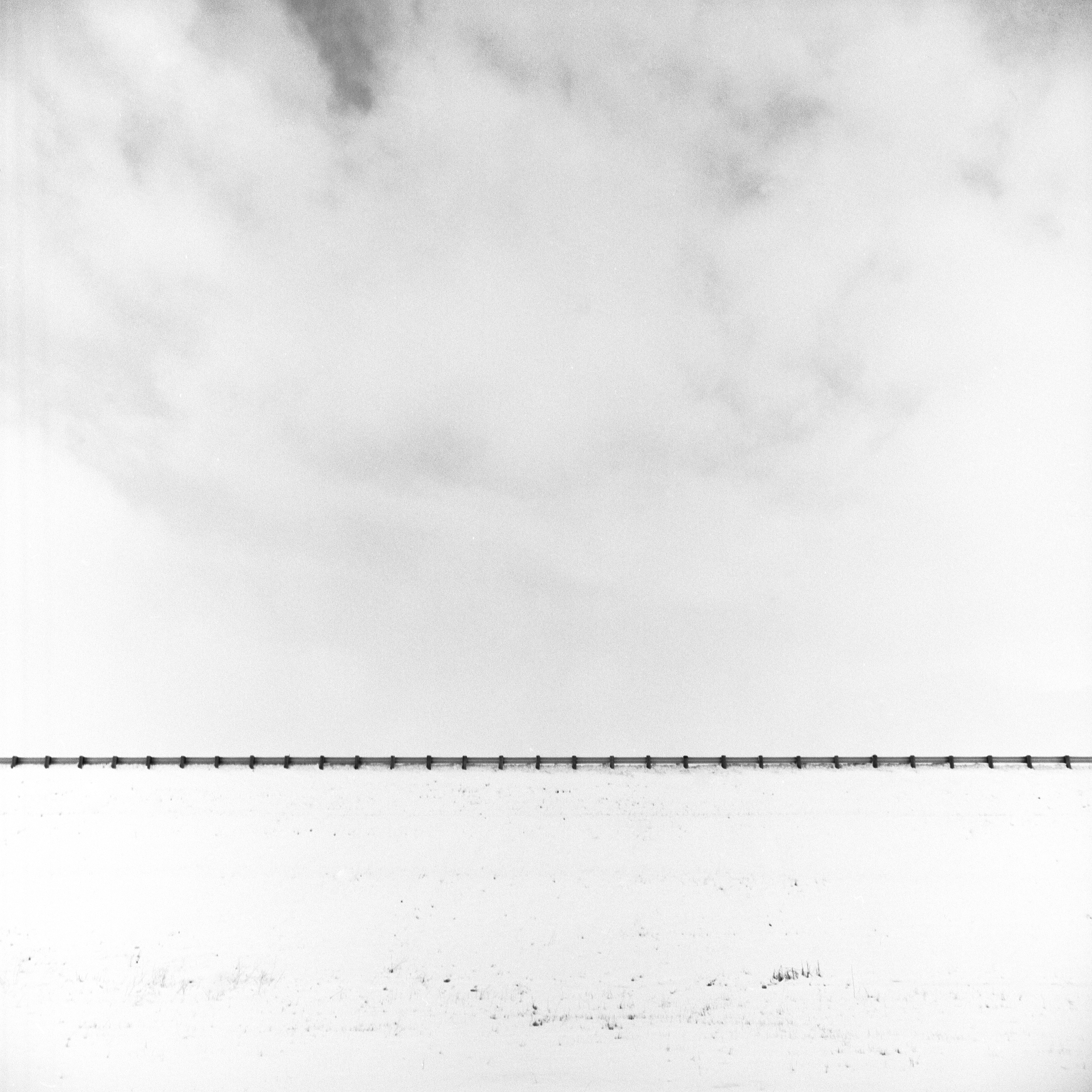
Obviously, guard rails are intended to keep cars from running off the road—and to reduce the severity of an accident when they do. Not so obvious is the observation that their presence indicates a lack of trust. Appropriately so. Bad accidents, even death, may have occurred had we trusted—ourselves and “the other guy.” This image reminds me that, because human beings generally cannot be trusted, safeguards are necessary, increasingly so in proportion to the level of distrust, which in highly mobile societies increases with population density and social complexity. Without safeguards the odds of breakdown increase as more people are on the road with more distractions.

At the same time, the presence of guard rails on roadsides generates trust. These metal barriers actually have served their purpose. Systemically speaking, they are “syntropic.” They reduce the effects of entropy, which is the tendency of systems to dissipate heat. In other words, breakdown. In the case of a highway system, entropy amounts to the dis-integration of roadway integrity. If entropy goes unchecked by safeguards such as improvements in the areas of car design, road maintenance, guards and signage, more and more severe accidents will occur. The many innovations, requirements and regulations surrounding car and passenger safety are prime examples of how syntropy reduces the frequency and severity of mayhem and catastrophe.

I reflect on the human body, mind and spirit which are equally susceptible to the forces of entropy—from tooth decay to depression. At base, advertisers are in the business of selling syntropy: products and services that help prevent, retard, manage or eliminate the effects of entropy. (In living systems, 100% entropy equates with death. Maximum equilibrium). So to gain more confidence in the components of our personal and social lives, ultimately to increase their  health and well-being, regulation is essential. A social example is the national economy. It’s heavily regulated, not so the few can disadvantage the many, but to insure stability and increase public confidence, which directly influences the nation’s health and well-being—and the economy.

The word “regulation” in some spheres—mine was the broadcast television industry—has been seen as a threat to individual freedom. “Don’t tell me how to run my business.” Whether the social unit is a family, church congregation, community, business, corporation, nation or the global family, without regulation entropy will inexorably result in more and more severe breakdowns. The Coronavirus is a good example.

Systemically speaking, zero regulation equates with no growth and maximum entropy. In nature, a species dis-integrate when it acts solely in self-interest. Similarly, in human social systems, entropic disintegration is enhanced when the members act primarily in their own interest, despite justifications and rationals. One’s health, well-being and success, however it’s measured, is never secured independently, because human beings are socially dependent—interconnected and interdependent— physically, emotionally, economically and spiritually. Independence is both an illusion and an entropic idea that’s not sustainable.

Personal, social and international conflicts and breakdowns such as wars, occur in a climate of self-centeredness. “Nationalism” has often been raised as a banner to profess “love of country,” which is a healthy posture. But taken to extremes it becomes entropic when it promotes exclusion, self-sufficiency and righteousness.

Futurist and author Barbara Marx Hubbard observed that “Crisis precedes transformation.” Like pain in the body, breakdowns are a sign that entropy is having its way and catastrophic change is coming, unless something is done to repair, replace or transform the system. The rapidly declining state of infrastructure in the United States is an example. Polarization in health and government is a direct result of self-centered close-mindedness, which to me are indications that systematic transformations are underway.

Sometimes we need to experience what doesn’t work in order to rethink and redesign the system so it does work—like a highway system with guardrails, cars with seat belts, police body-cameras, face masks and vaccines. Learning through breakdowns is difficult, but eventually they contribute to breakthroughs, even resilience as a consequence of learning.

Trouble is, getting to that point can take a lot of breakdowns over a long period of time. The ideal would be to own up to them and take syntropic action so the system can affect a shift to a more viable paradigm and behaviors. As we have seen, the misunderstanding of freedom as license, stubbornness and rigid clinging to ideas and ideologies only feeds the entropic dragon.


If ten people walk beyond civilization and build a new sort of life for themselves, then those ten people are already living in the next paradigm, from the first day.

             Daniel Quinn

About The Image

I was cruising the highway, looking for something to photograph when I came to a stoplight at an intersection. While waiting I noticed how the guardrail divided the bright sky and white snow with a nice clean line.

Since one of my constant visual quests is to find or create simplicity, the fewest number of visual elements within the frame, I backed up the car, put it in “park” with the emergency lights blinking, got the camera and ran about thirty yards hoping the police would not come.

They didn’t. I hand-held several shots, each with the guardrail at a different position in the frame. This is the one I like best because there’s just a hint of snow and the immensity of the sky diminishes the man-made object. With no other objects in the frame, the rail provides some evidence of where we are as a society. Metaphorically and physically.

____________________________________

Email: smithdl@fuse.net

Portfolio: DavidLSmithPhotography.com

Photography Monographs (Click on the pages to turn them)

Humanity On The March

Advancing toward the light of increased awareness

Tourists On Cliff

In this image I reflect on the notion of “reality,” that what we experience and know is both an individual and social construct. There’s the reality that I, as the photographer, experienced—the bright sun and the people on the hill.  Part of that reality includes cars in a parking lot and an observation platform to the right of the walkers, so the reality within the frame is a small fraction of what I experienced. The realities of the individuals walking down the path are entirely different from my experience, each having a unique perspective based on a complex of references, preferences, relationships and motivations.

Then there are the realities that people will read into this image: perhaps humanity’s exploration of the planet, it’s advance into the future or the scale of the Earth and human beings relative to the immensity of the sun. Yet another reality is the image itself, experienced differently on a screen or on paper. These and other realities are quite easily seen and understood because our senses provide our brains with input that constructs meaning based on both our personal and social experiences.

What we do not see is objective reality. While our sensory systems evolved to maximize the potential for survival and growth, they do not detect the realities that gave rise to life and form, the worlds of atoms and quanta. For instance, the photons stimulating our retinas as we look at this image. Objectively they have no color. What the brain interprets as color has everything to do with the reflection and absorption properties of surfaces. We say a fabric is “red,” for instance, because the combination of threads absorb most of the colors of the visible spectrum other than red. Put another way, “blue” is the experience of a lack of yellow wavelengths. So while eyes perform the critical task of gathering wavelengths and generating electrical stimuli, it’s actually the brain that “sees” color. The same is true of shape, texture and dimension, properties the brain uses to interpret and construct our visual reality.

Even the experience of a solid is a mental construction. In the realm of the atom, nothing is solid. In metals and even diamonds, the hardest of rocks, there’s mostly space within and between the nucleus and electrons. At the quantum level of reality, there is no matter.

For whatever reason, the above image reminded me that the realities of everyday experience are personal constructs, moment to moment brain-interpreted creations where all sensory inputs are filtered through a myriad of past experiences and influences including physiology, ethnicity, psychology, family, education, peer associations, socialization and work to name a few. Even the realities and the symbols that represent them, such as words and images are momentary constructions. Consider how your personal reality would be changed without the concepts and words for “television” or “time.” I’m reminded of the indigenous people who experienced Spanish galleons for the first time, regarding them as monster canoes and rifles as barking sticks or fire sticks. New realities rely upon established ones to make sense of them.

On the one hand, the awareness that what we call “reality” is a construct is humbling. It leads to the observation that we live somewhere in the middle between the ephemeral and immensity. It’s also empowering because, if my personal reality is a construct, I can alter it. Make it better. What’s more, the leading edge of consciousness and technology that’s expanding our understanding and capabilities in both directions suggests that something grand is in the process of being born. In the above image, I see humanity walking with hope and determination into the light of a more awakened awareness of and appreciation for the reality that gives rise to and sustains all forms.

If an almost limitless field of action lies open to us in the future, what shall our disposition be, as we contemplate this march ahead? A great hope held in common. 

Pierre Teilhard de Chardin S.J.

About This Image

I’d been photographing the magnificent landscapes in the Badlands of South Dakota when I saw a turnout where people were walking back and forth on a walkway that led to an overlook and a grand vista of mountainous forms. There were so many people going back and forth, so I had to see the attraction.  Also, a lifetime in photography has taught me that unusual and powerful images are much more likely to occur when walking rather than driving.

“Happy accidents” happen so often, it didn’t matter to me that the lookout was crowded with people taking pictures. I set up my tripod beside several others and got the same shots. And they were nice. But the one that I celebrate most is this one, taken from the parking lot.

__________________________________

Email: smithdl@fuse.net

Portfolio: DavidLSmithPhotography.com

Photography Monographs (Click on the pages to turn them)

A Journey Of Imagination

Opening to life’s deeper revelations

Wrench

Considering this wrench, what was its history? How did it come to be? My reflection begins with the observation that someone, likely a man with dirty hands, placed it on an oil drum inside the mushroom farm in Loveland, Ohio—where I photographed it.

Where was the wrench before that? Might it have been used in a factory, a gas station or railroad yard? Did it hang on a pegboard above someone’s basement workbench? Was it cherished? Was it even used? Had it sat in a metal or wooden drawer filled with other wrenches? Had it been dropped in the dirt and rained upon? Not this wrench. There was no of sign of rust. With each of these possibilities I imagine the environment, what the users would be wearing, the grease on their hands, dirt under their fingernails—the calendars on the walls, the smell of oil and gasoline, the sound of a baseball announcer in the background coming from an plastic radio and the voices of workmen talking, perhaps yelling, sounds absorbed and held in this object’s metallic memory cells. Yes, these are stereotypical images. But elements of imagination, like pieces of a puzzle, contribute to the picture of the human project, the strengths and vulnerabilities that spark appreciation and evoke compassion.

My imagination shifts to when the wrench was new, when it looked its best, gleaming bright steel with the manufacturer’s name engraved on it. Was it on display in a window? Or was it one of the many that were wrapped in brown paper and put in a box with a drawing or photo on top with specifications and serial numbers on the side? There are no right or wrong imaginings in contemplation. Each reflection contributes to the unfolding development of self and reality. Imagining is at the heart of contemplation. As well as enabling the exploration of times, places, events and abstractions that we could not otherwise experience physically, it sidesteps everyday thinking, inspires creativity and fuels our appreciation of what is, as it is.

Back to the wrench. I imagine the manufacturing process. I see the minerals being scooped from the ground by giant, loud and smoke-belching diggers. The boulders are crushed and then dumped into a molten crucible where rock transforms into liquid. Sparks fly. Gloved men with black goggles handle the controls in a dark factory with a dirt floor. The cars parked outside are vintage 1930’s. Men in the office wear double-breasted, three button suits, starched collars and ties with finger-length clips to hold them in place. Their office managers and secretaries wear shirt waist blouses and nylons with seams down the back.

Further back in time I conjure a gray haired man sitting at a drafting table wearing spectacles. He also wears a tie, but his sleeves are rolled up and he smokes unfiltered cigarettes. With fine-pointed pencil in hand he transposes a sketch of the wrench with notes on dimension and weight onto a blueprint that will be used to create the model and mold.

Farther back is the visionary (or visionaries) who met the challenge of a connection problem. How does a mechanic connect two pieces of metal in a way that they will almost never come apart but can easily be separated? Trial and error. After many attempts and failures someone (innovation more often begins with an individual rather than a group) imagines a threaded bolt with flat sides and a tool with a handle that would turn it. Tighten. Untighten. Brilliant!

Descending the historical ladder even further, where did the iron ore for this particular wrench come from? China most likely. Other possibilities include Australia, Brazil, India, Russia, South Africa, Minnesota and Michigan. And who was the first to have the idea of the making of a molten soup consisting of iron oxide, magnetite, hematite, goethite, limonite and siderite, particularly when these minerals are scattered around the world? I think about motivation as well, the need for a material harder than any rock, the desire to build things that would last—and win wars.

I can see this wrench new, old or ancient. I can see it whole or as a conglomerate of parts. I can think about it as a solid or liquid, even as fields within fields of quanta. Perception is a choice we make, and unusual ones, particularly in contemplation can evoke wonder and appreciation. For me then, the question becomes: What is gained by different perceptions? I think it has a lot to do with imagination and beauty being in the eye of the beholder.

There is nothing in all the world that is not God’s manifest glory and essence.

                                          Kabbalah 

About This Image

I was riding country backroads looking for something to photograph when I saw a sign that read Fred’s Mushroom Farm. The place intrigued me, so I went in and told the manager I was a photographer. Would he mind if I photographed his facility? Not only did he grant permission, he gave me a tour and described the process of growing mushrooms. He introduced me to his employees and displayed great patience while I photographed anything that caught my eye.

I shot about six rolls of 120 film in that facility, all by available light. In passing from one room to another, I saw this wrench sitting on an oil drum. I composed the shot and made one hand-held exposure. The light level was very low, so I was not surprised when the slow shutter-speed resulted in an image with shortened depth of field and slight blur. I didn’t print the negative right away, but years later I was paging through my contact sheets and decided that, because of the simplicity and graded light, the image might have possibilities. Now, it peaks my imagination ever time I see it.

Besides being exhibited and published, I used this among other images in my Visual Communication classes to illustrate a comment made to a reporter by the master of street photographer, Henri Cartier-Bresson.  “What’s the secret of your success?” the reporter asked. The response was: “Be there and f8.” Indeed, more important for a photographer than technology and technique is Being where life leads us and Seeing what it’s showing us.

__________________________________

Email: smithdl@fuse.net

Portfolio: DavidLSmithPhotography.com

Photography Monographs (Click on the pages to turn them)

The Noosphere

Outside and above the biosphere there is a field of mind.

Satellite Farm

”Because satellite dishes look skyward, I sometimes imagine lines of light, like coherent laser beams, streaming out of them toward their satellites. If those beams could somehow become visible at night, globally and simultaneously, the resulting web of crisscrossing lines and waves would be dazzling, testimony to humanity’s hunger to relate and learn.

The invisible energies that radiate from worldwide microwave, radio, cellphone and television towers, including satellite transmissions and cable and fiberoptic lines combine to form a global communications “structure.” Several decades before this structure explosed in scope and complexity, French Jesuit and paleontologist Pierre Teilhard de Chardin wrote about a “Noosphere,”  literally a “sphere of mind” that encompasses the Earth like the atmosphere. The term was actually coined much  earlier by Vladimir Vernadsky, a Russian biochemist, to describe an emerging state of the biosphere where “scientific reasoning” would eventually prevail. Teilhard took an entirely different approach, attributing the term to a naturally evolving consciousness that increases with increasing complexity.

In his view, as social systems such as law, government, education, religion and commerce become more complex and their members interact and become more linked and self-aware, their collective thought will tend toward ever greater organization, personalization and unification—patterns he recognized in biological evolution as adaptations for survival.

Centuries ago, the ancient Rishis, Vedic sages in Indian culture, spoke of “Akasha” in Sanskrit as a subtle, all-encompassing medium that underlies all things and becomes all things. In the New Testament, evangelists Luke (12:7) and Matthew (10:30) spoke about everything being recorded, “Even the very hairs of my head are numbered.” In modern times, Madam H.P. Blavastsky (1831-1891) a clairvoyant founder of the theosophical society, spoke of the Akashic records as a non-physical library of every human and non-human event, thought, word, emotion and intent ever to have occurred in the past, present, or future—throughout the universe.  Edgar Casey, “the sleeping prophet,” claimed the Akashic records was one of his sources. So also, the philosopher of science Rudolf Steiner, who wrote about the lost continents of Atlantis and Lemuria.

In modern science, Nikola Tesla observed that an “original medium” that fills space was like the Akasha, “a light-carrying ether.” He considered that medium to be a force field that becomes matter when Prana, cosmic energy, acts on it, and when the action ceases, matter vanishes and returns to Akasha.

Irvin Laszlo, author of Science and the Akashic Field, says “Scientists now realize that space is not empty, and what is call the “quantum vacuum” is in fact a cosmic plenum, a fundamental medium that recalls the concept of Akasha.” He goes on to say, “In the next development of science, the A-field (Akasha) will join the currently known universal fields: the G-field (gravity), the EM-field (electromagnetic), the Higgs (bozon) field, and the locally effective but universally present strong and weak nuclear fields.”

Consistent in these writings about the Akashic “record” is the notion that we not only contribute to the Akashic record by every thought, word and deed, through meditative processes we can access information and inspiration from it. A computer library  such as a “cloud” is an apt metaphor in this regard.

The image of the satellite farm prompted me, not only to consider the evolving noosphere as an Akashic field, but also to think about the content we’re feeding into it. What are we communicating? What are we saying—to and about each other? How are we talking about and depicting human nature itself? What is our contribution to life? Are our acts and conversations contributions to love or fear?

What’s on our minds? What do we value? What are we teaching the next generation? Is the increasing capacity to communicate easier, better, faster and farther making life more enriching for many more people? What should we be talking about? What kind of future are we shaping by our words and images? And what intentions, acts, words, information and thoughts am I contributing to the Akashic record? Rhetorical questions all, but important ones to consider.

Gregory Bateson defined information as “A difference that makes a difference.” Whatever the medium, are our connections—personally and socially—making a positive difference? Are they facilitating and empowering individuals to identify and realize more of their potentials? Relate better? Solve difficult challenges? Repair breakdowns? Are they positively affecting the health and well-being and reproductive success of the species? Responses to such questions point to the direction of communication’s evolution, the evolution of consciousness.

Standing back far enough to let the content of our communication blur for a moment, and fast forwarding, factoring in the rate of communication technology change, I observe a dynamic and unified global communication system already performing functions identical to those of the human nervous system—sensing, interpreting and activating the body (humanity) to respond to change appropriately, that is, toward the health and well-being of all its members. From the science of living systems we learned that when the individual members of a society are functioning well, the whole performs well. It’s also the lesson of the Coronavirus pandemic.

Although it has been many years since I worked in broadcast television, production technologies and media facilities such as television and radio stations, satellite trucks, and farms still get my heart pounding. In them I see the enormous, barely tapped opportunity they have to lift the spirit, empower, inspire and facilitate the realization of human potential.

I believe Teilhard’s grand vision of our collective consciousness moving in the direction of divine realization can be realized—if whatever the issue, we find its resolution in acts of love rather than fear. I offer THIS LINK as a demonstration of that.

A glow ripples outward from the first spark of conscious reflection. The point of ignition grows larger. The fire spreads in ever widening circles ’till finally the whole planet is covered with incandescence. Much more coherent and just as extensive as any preceding layer, the ‘thinking layer,’ which, since its germination at the end of the Tertiary period, has spread over and above the world of plants and animals. In other words, outside and above the biosphere there is a noosphere.

Pierre Teilhard de Chardin, S.J.

About The Image

Readings on the topics of dark matter, dark energy and zero point gravity prompted my desire to photographically represent or evoke an awareness of the many forces and energies that we can’t see with our eyes. When I read that “Space is not nothing,” that it’s a “Seething maelstrom of subatomic particles,” and that the composition of the universe is 73% dark energy, 23% dark matter and only 4% atoms, which combine to make hard matter, I wanted somehow to represent this with my camera.

The challenge was how to photograph the invisible. I was stalled, thinking about this for months. And then, typically, a conversation with Linda revealed a way to proceed. She proposed that, rather than showing the lines of force (which I was thinking I might physically need to draw on photographs), I could suggest them by their relationship to the land and other Earth objects. She noted that some of my images already did this. (For instance, Solitude, the image featured in my blog entitled “Attitude.”

The very next day I was out with my camera shooting tests. Since only 4% of the universe is constituted of matter, I decided to include approximately only that much subject matter in the frame. The rest would be either blank, a continuous field of color or texture or blank sky. It worked. For me at least.

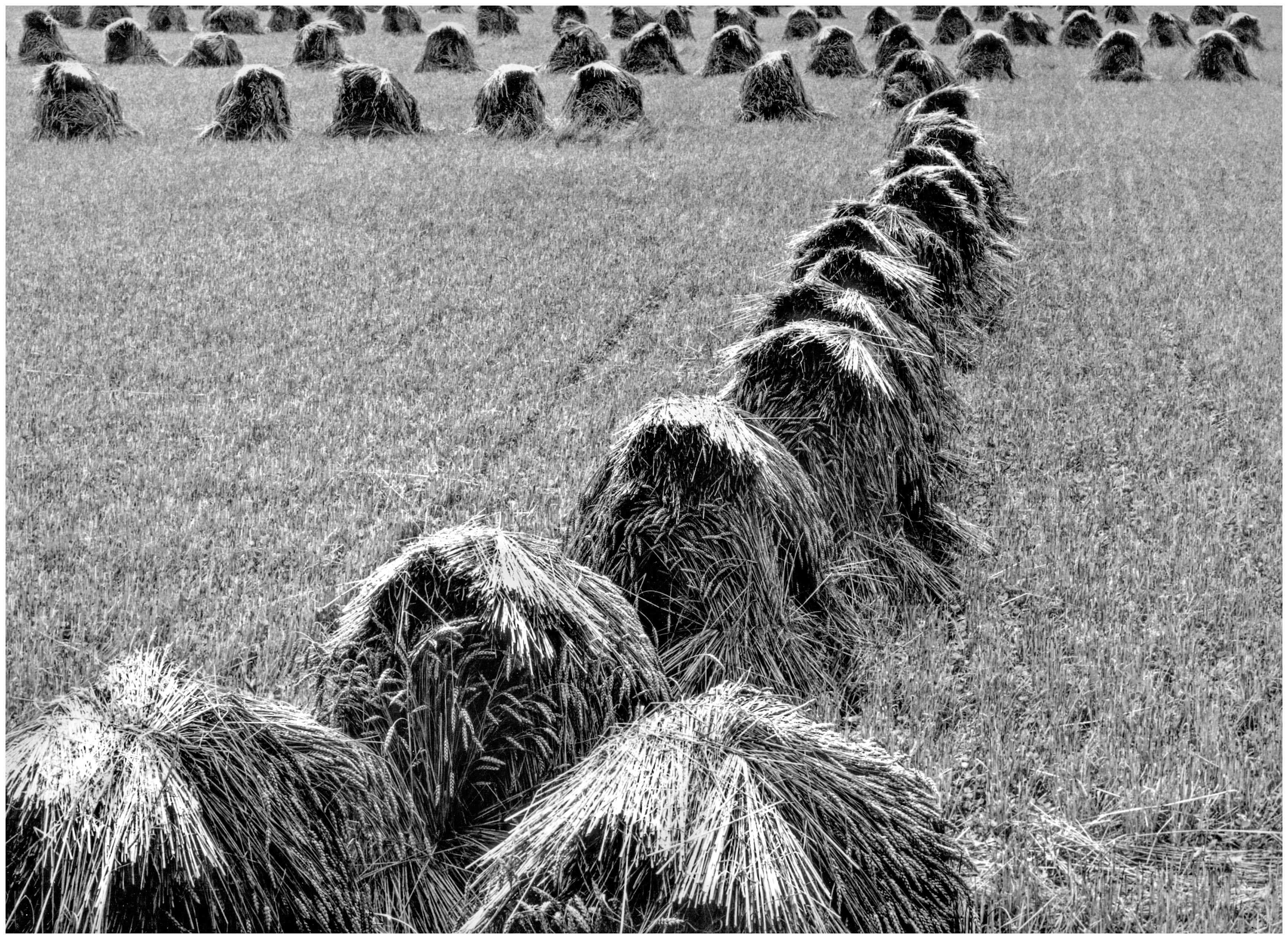
I went to the computer and searched for a destination where I could find immensities of land, sky or water. On Google Earth I found what I was looking for. (The little “man” icon that can be dragged to any street to see what’s there was particularly helpful). The Northern Plains of South Dakota and Nebraska had “oceans” of wheat fields, fascinating peaks in the Badlands and wide open skies. Using Map Quest I found lodging facilities that I could reach within a day and still be close to the areas where I wanted to photograph the next morning.

I chose to visit this area at a time when the wheat was knee-high and turning golden. I photographed for a week, early morning until and sometimes after dark. I was in the flow, ecstatic every day. I hadn’t realized that there would be so little traffic. Frequently, I set up my tripod in the middle of a highway and shot with a 4×5 view camera without a single vehicle passing by. I could drive thirty or forty miles down county roads and not see another car or human being. In many places there were neither fences nor phone poles. And I’d never seen so much wildlife.

This photograph was made at the end of a day, behind the motel where I was staying. It’s an example of an image that evokes a sense of invisible forces, in this case, television and microwaves. Many of these photographs are in my portfolio, and I published two Blurb monographs featuring photographs of “The Northern Plains.”

____________________________________

Email: smithdl@fuse.net

Portfolio: DavidLSmithPhotography.com

Photography Monographs (Click on the pages to turn them)

Greta Thunberg Speaks Urgency To Power

In a previous posting in this series, one of the reasons I expressed optimism regarding climate change was the concern and initiatives of young people. Because sixteen-year-old Greta Thunberg has stepped up to speak to power with intelligence, wisdom and passion, I dedicate this posting to her and those she is influencing worldwide. 

As the image above illustrates, a storm is brewing and it’s time to do something about it.

You may have seen sound-bites of Greta on television, but I highly recommend these presentations.  

Greta Thunberg’s 11 minute TED TALK

 (1, 734,269 views)

Greta Thunberg at the UN (4 minutes) “How dare you!”

(Over 2 million views)

Greta Thunberg speaks to EU leaders (4 minutes)

(664,719 views)


Email: smithdl@fuse.net

Portfolio: DavidLSmithPhotography.com

Photography Monographs. The pages can be turned in each book.

Which Would You Rather Have: More Or Better? Choose one.

The climate challenge and decision point for everyday citizens

Ecologists note that growth in commerce and the economy are primarily based on consumption, which is linear and limited because resources are finite. Growth in nature, however, is cyclical and unlimited because the decay of organisms produces materials that are recycled. Mulching is a prime example.

Less considered but equally contributing to the slowing and diminishing severity of the changing climate is a shift in thinking from quantity to quality. Ecologists promote “qualitative growth”  rather than quantative growth because it enhances the quality of life. According to systems theorist and ecologist Fritjof Capra “In living organisms, ecosystems, and societies, qualitative growth includes an increase of complexity, sophistication, and maturity. Unlimited quantitative growth on a finite planet is clearly unsustainable, but qualitative economic growth can be sustained if it involves a dynamic balance between growth, decline, and recycling, and if it also includes the inner growth of learning and maturity.”

Psychologists trace motivations and desires to a variety of physical, mental and emotional causes. Whatever they may be, everyday living is filled with choice-points. Growing up in a consumption-oriented culture, decisions relating to what we need and want come easily because so many products and services are on the shelf. Available. But as the above image attests, “everything has a price tag.” Our hesitation is often just affordability and priority.

Consumption proliferates in the bloodstream of American culture. The unwritten, unspoken but clearly understood and pervasive message is clear: Having things and having exciting experiences will make you happy. There’s even a well-trodden path to success in life, the American dream. Get your toys, books, desk, telephone, computer, car, college degree, apartment, job, spouse, house, children, stock portfolio, pension and retire in luxury. It brings to mind comedian George Carlin’s sketch A Place For My Stuff. 

… And when you leave your house, you gotta lock it up; wouldn’t want somebody to come by and take some of your stuff. They always take the good stuff. They never bother with that crap you’re saving. All they want is the shiny stuff. That’s what your house is, a place to keep your stuff while you go out and get more stuff! Sometimes you gotta move, gotta get a bigger house. Why? No room for your stuff anymore. 

George Carlin

When peoples’ homes, properties and material goods have been destroyed in a fire, flood or tornado they report, “At least we have each other.” Homes can be rebuilt. Goods can be replaced. Happiness is not  attained through acquiring, owning or consuming, not even collecting a variety of interesting or exciting experiences. That’s not to say there’s anything wrong with these. It’s just good to be aware of what we’re considering at decision-points, so consumption is based on real needs and prioritized wants, ideally taking social consequences and the environment into consideration. 

Historically, because the modus operandi in science is measurement, money became the best way to assign value. Then, when movies and television came along they showed us that having more was sexy, fun and glamorous. Images of people having less were shown to be miserable. It’s a fallacy, of course. The tragic lives of many attest to the fact that extravagant wealth and high status are no guarantee of happiness. And many people around the world are happy despite their lack of luxury items and meager living conditions.

Ecologists recommend a shift in thinking, making life-decisions less about quantity and more about quality across the board—in material goods, services, relationships. Such decisions enhance the quality of life and at the same time lessen the ecological footprint and optimize sustainability.


The perpetual growth myth promotes the impossible idea that indiscriminate economic growth is the cure for all the world’s problems, while it is actually the disease that is at the root of our unsustainable global practices.

Brundtland, G.H., Author, Environment and Development Challenges: The Imperative to Act


I found it curious and on the mark that Dr. Capra cited “inner growth of learning and maturity” as contributing to sustained qualitative economic growth. For instance, it took a lot of maturing for me to realize that, in many instances, buying cheap is a false economy. It’s more economical to pay more for a high quality product that will last, than an inexpensive one that will need to be replaced.

A popular consumer attitude is summed up in the bumpersticker slogan, “He who dies with the most toys wins.” Linda had a student who died unexpectedly in his freshman year of college while studying architecture. His dream was to design a great building. In high school, he’d built a replica of Shakespeare’s Globe Theater.  After hearing that he’d passed, she said to her class: “What you do today could be the most important thing you’ll ever do.” Relative to our topic, it matters less how much we get done or how much we have, far more important is how well we do what we do. And the joy it brings. In light of this, I’d revise the bumpersticker to say “He wins, who dies having fulfilled his purpose in life.”


Ecological healing requires our society to look beneath its consumptive symptoms and reorient toward qualitative development. To do so requires significant reprogramming, since our guiding narratives, from economic to scientific, embody quantitative thinking.

Charles Eisenstein, Author, Climate—A New Story


As the purpose of this blog is to express appreciation, I am grateful for the many companies that advises their customers to “consume responsibly.” I appreciate those in leadership positions who are finding ways to conserve and recycle their goods and packaging materials. And I acknowledge the many restaurants and employees who are giving customers the option of taking less or no plastic.


Email: smithdl@fuse.net

Portfolio: DavidLSmithPhotography.com

Photography Monographs. The pages can be turned in each book.

Reframing The Ecological Challenge

How we talk and what we see determines how we act

The Data

The climate has been changing since the Earth coalesced. It will continue to do so until it’s subsumed by the sun billions of years from now. The recent concern is that human beings have accelerated the rate of change—10 to 100 times faster than in the past 65 million years— to the point where the quality of life, perhaps even life itself, is being threatened.

In his 2001 book, The Weather Makers, Tim Flannery, Chief Commissioner of the Climate Commission of the Federal Government reported, “The Earth’s average temperature is around 60º F. A rise of a single degree will decide the fate of hundreds of thousands of species, and most probably billions of people.” A 2017 study in the journal Geophysical Research Letters estimates that Earth’s climate will be 1.5º F higher as early as 2026. By 2050, the physical world and lifestyles worldwide will be dramatically different. The ways in which it will be different is the challenge of this and the next three generations.”

A Statista report in September of 2020 noted that “The past years were the warmest years on record, where warming was driven largely by increased emissions of carbon dioxide and other greenhouse gasses into the atmosphere.


How We Talk

In Climate: A New Story, Charles Eisenstein advises against “reductionistic war thinking,” and talking about destroying problems, even if the problem is climate change. The language of war and destruction, he says, “is an extension of the culture of death, domination and control that has led us to the verge of collapse.”

Instead, he invites us to adopt a framework of love which gives us permission to trust what is innate to us, namely “our love of life and our desire to save it.” His observation brought to mind the many ways we talk about issues—the war on drugs, fighting wildfires, battling cancer, defeating ISIS and so on. The language we’ve been using, largely adopted from the media’s propensity toward sensational and confrontational news stories, ads and soundbites has contributed to polarization. Instead, the changing climate could be a challenge that unites us.

High thoughts must have high language.

Aristophanes (Greek philosopher)


Simon Sinek Says We Got Global Warming Wrong.  Michael Touchton explains Sinek’s criticism, that global warming has a marketing problem. “We’ve confused people with poor messaging and we’ve assumed that people’s better nature would lead them to act selflessly. Wrong.”

People need to be convinced, inspired, sold and left to feel like they’ve decided to act out of their own free will and self-interest.” Instead of talking about saving the planet 50 years out, he proposes that we talk about ourselves and loved ones being in danger. “We need to communicate exactly what the problem is in a way that people will immediately understand and emotionally feel. People get cancer… There is a cancer in our climate. And if we don’t act, there will be death.

Simon Sinek


What And How We See

Regarding significant issues like the rapidly changing climate, polarization is built-in by virtue of duality—opposing views. Rather than framing the matter in the language of competition, which encourages people to take sides and respond forcefully, sometimes violently, Eisenstein advises a shift in the frame to the language of love. “No matter the issue,” he says, “what’s required are shifts in perception and attitude toward—

  • I have a strong point of view, but I will keep an open mind, willing to be convinced of a greater good for all.
  • We are not in a war, battle or contest. We will work together to find the best decision, ideally not one that is right for me and wrong for you.
  • Both our views deserve to be heard with equal respect and serious consideration.
  • Both our views need to be supported by facts and debated with sound reasoning.
  • Because we are in this together, an enlightened change of mind is highly respected.
  • Lacking facts, our guideline for decision-making will be the optimization of benefit and minimization of harm to all—people, environment, society, world.
  • Before deciding, we will investigate and openly share the positive and negative consequences of our perspectives in consideration of people, environment, flora, fauna, society and planet.
  • Once a vote is taken or an impartial judge decides, we will accept the outcome gracefully and move on.
  • Maintaining a friendly and respectful working relationship is more important than having things go my way.”


Researching online for my screenplay, Love—Period!—about a musician who rises to prominence on concert stages worldwide because of his love of Earth and commitment to conservation—I appreciated the many celebrities who are articulating their concerns and personal lifestyle changes relative to climate change. Also, it’s encouraging that ordinary people, all over the world, are doing what they can to be part of the solution. There’s is not the language of war or the perception of a distant catastrophe, its the language of caring, personal responsibility and collaboration. Doing what can be done right now.   

All living systems heal in true relationship. We need a deep revolution in how we relate to the rest of life—not as dominators of nature, but as partners in an evolutionary process that is much greater than ourselves. Only love can give us the kind of courage and willingness to offer ourselves to the more beautiful world we know in our hearts is possible.

Charles Eisenstein, Author, Climate: A New Story

Our language and nervous system combine to constantly construct our environment.

Francisco Varela, Chilean biologist, philosopher, neuroscientist


Email: smithdl@fuse.net

Portfolio: DavidLSmithPhotography.com

Photography Monographs. The pages can be turned in each book.

Radiance

Light expanding from source / Source

Radiance

Early in my photographic life I formulated a guideline that has served me well to this day. Since light is the essence that reveals subject matter, and because my urge was to pursue essences, I adopted the practice of looking more for “qualities of light” than interesting subject matter. Because color tends to arrest the attention, my preferred medium for creative photography was and remains black and white, which emphasizes the qualities of form, texture and geometry.

Whether on location or in my basement studio, my first consideration was always the light—its angle, brightness, color, contrast and it’s modulation between soft diffusion and crisp specularity. Working in this manner and reflecting on the results over time, I noticed that certain qualities of light contributed to an evocative spiritual quality I refer to as numinance. For instance, the above image calls me to consider both the nature of light and its use as a metaphor for intelligence, ideas and “illumination” in the spiritual sense.

In science, the essence of light is still an open question. At the atomic level a unit of light is referred to as a photon, but that’s just a label to describe an energy that has a fixed speed but no mass and can behave as either a particle or a wave depending on how it’s observed. Photons are entirely different from matter, yet they give rise to and sustain matter. We know they’re produced when energy is either added or subtracted within an atom, specifically when an electron—best conceived as an energy field—“jumps” from one orbit to another, incredibly, without crossing the distance. Gazillions of these events happening together result in the streams of light entering my eye. Physicist David Bohm saw these emissions as information, content, form and structure itself, regarding light as “the potential of everything.”

The above image also evokes in me considerations of the first light of the universe, a result of the great expansion or Big Bang. A key property of light, like the universe, is that it expands in all directions at once, piercing the darkness. It’s this expansive feature that gives rise to light as a metaphor for birth, awakening, increased awareness and spiritual evolution. Deepak Chopra observed that, “In the dark we will always seek the light.” We are creatures who seek meaning, clarity and understanding. Literally, light throughout the cosmos is itself the source of our increasing understanding of the universe and our beginning. A photographer friend, Walt Weidenbacher, referenced light as a guideline for living when he said, “The world is as big as the candle we carry.”

Are we not all, potentially, radiant? Sources of light? Through transmission and reflection we reveal ourselves to each other and the world, and awaken within. Having been fortunate to cross paths with many individuals who radiate light through qualities of character, refined personalities and expanded consciousness it gives me joy to think of them and know that they’re illuminating the darkness, making a positive difference in the world.

Can you name three individuals that you know who are sources of light in your life? Now, besides acknowledging them, consider the nature of their light. What are they radiating? What are they reflecting?

Beauty is the radiance of spirit. —  Alex Gray, artist

About This Image

I’d been working with an image that had flare, faint lines of light streaming from the sun, and I wondered if I could reproduce them in the studio with the lines enhanced. “Flare” in a camera amounts to the scattering of light within the lens system, modified by the shape of the aperture, the blades that admit more or less light onto the film or digital chip. The brighter the light; the brighter the flare.

I set up a 4×5 camera on a tripod in the studio and pointed it toward a round and clear 250 watt quartz bulb about ten feet away. To insure sharp, high contrast and radiating lines, the source had to be as tiny and bright as possible without any kind of reflector or housing behind it. I positioned the camera and bulb so its filament was in the center in the frame. Then I turned out the lights to insure total darkness.

The alignment turned out to be critical. Slight changes in the camera position made dramatic differences in the image, so I adjusted the alignment until the streaming lines of light were at a maximum—which turned out not to be dead-center. Since the amount of flare was different at different aperture settings there was no way to evaluate the exposure, so I exposed several sheets of film at different f-stops.

This image, photographed at f16, had the most prominent lines. The negative was very dense, so to bring out more of the gray areas in the halo’s I overexposed the paper. Even more exposure would have revealed the coiled filament in the bulb, so I left it white in order to generalize rather than particularize the source to give the image a numinous quality.


Email: smithdl@fuse.net

Portfolio: DavidLSmithPhotography.com

Photography Monographs. The pages can be turned in each book.