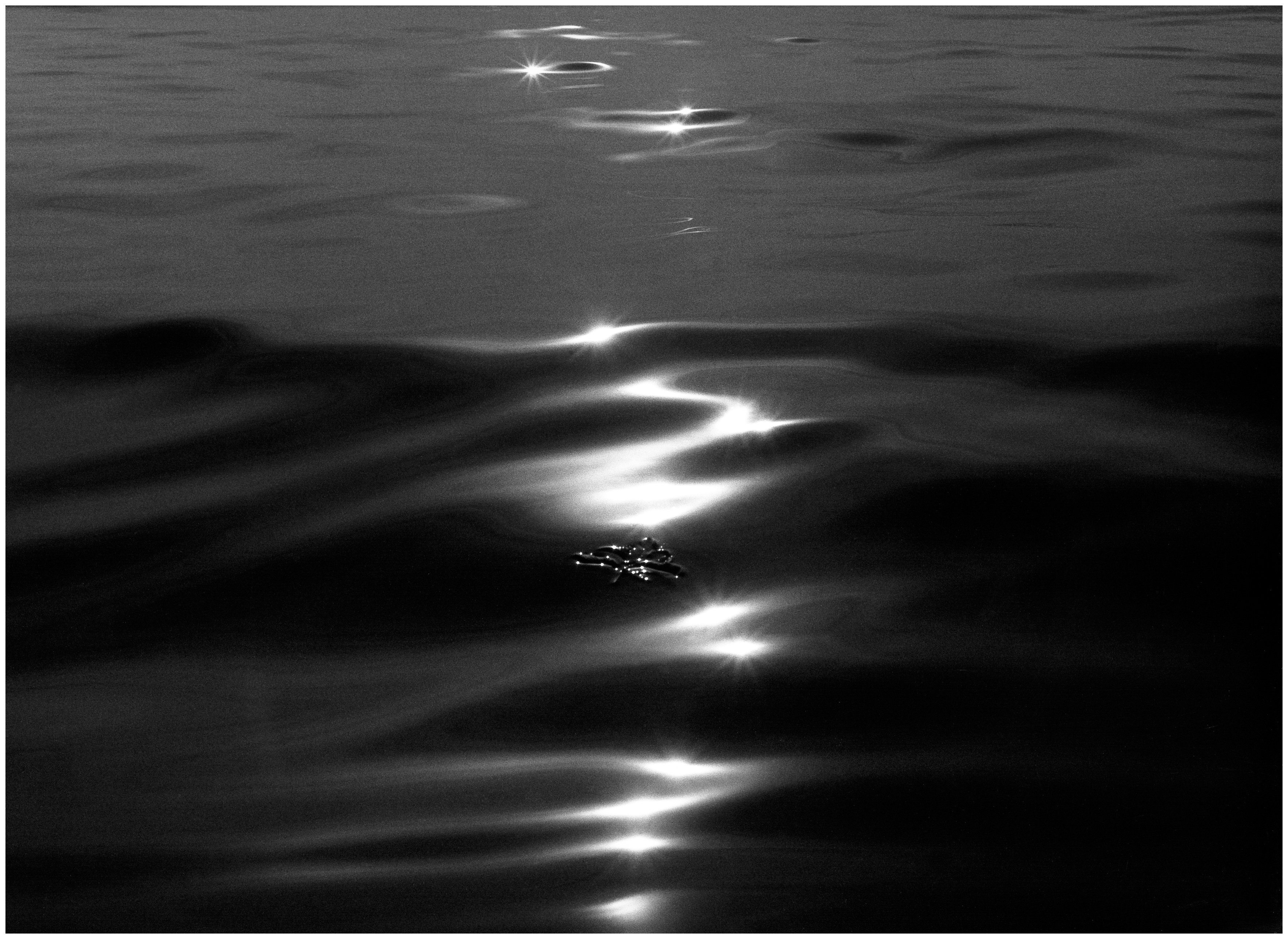
Tranquility

Reflecting as a floating leaf

Leaf In The Surf

One among many leaves that float on the surface of life, I ride the waves.

The calm—

meaningful conversations,

helping where help is needed,

Linda’s cooking; Graeter’s ice cream; Skyline chili,

Scott Hamilton’s tenor saxophone; Chuck Mangione jazz; Andrea Bocelli; Beebe Adair piano

backroads to photograph; photographing in the studio; producing books

orange tabby cats, jaguars; 

The West Wing; Northern Exposure; Morgan Freeman’s Through The Wormhole, Downton Abby

The Life of Pi; Avatar; Singin’ In The Rain; Contact; Close Encounters Of The Third Kind; Ghost

The turbulent—

war; man’s inhumanity to man; intolerance; cruelty to animals

not being able to help when help is needed,

loud music in malls and bookstores; discordant jazz, 

loud talkers in restaurants; busers clearing gravy-stained plates near the table,

littering; line jumping; horn honking; cursing and swearing; robo calls,

television ID’s in the corner of the screen; hype and destructive commercials

apocalyptic movies,

On the surface I come to know who I am and where I fit.

Beneath the surface, I relish the depths; expanse; it draws me.

Further down, stillness; peace of mind.

Deeper yet, ironically, in darkness comes greater illumination.

Descending through the abyssal plane, the adopted surface-self diminishes.

No place to look, no distractions, authentic self emerges.

At Tranquility Base, the place where not knowing is embraced, being takes precedence over doing.

There, aware of how much more there is—and how much more there is to all of us,

I rise to the surface with fresh insight: Though I am still a leaf, I am more. And One.

You can’ t do anything about the length of your life, but you can do something about its width and depth.

Henry Louis Mencken

________________________________________

Email: smithdl@fuse.net

Portfolio: DavidLSmithPhotography.com

Photography Monographs (Click on the pages to turn them)

Collaboration

It’s how we build a better world for everyone

Urinal Handle

If this object happened to be found by future archaeologists, isolated and with nothing to compare it to, it would signify the existence of a complex and highly advanced civilization—even if its function was not known. The evidence: chromed metal, parts that function together as a whole, intricate design, meticulous manufacturing, a “system” to convey the flow of water complete with fittings, seals and regulators to control that flow—all without leaking. Although such an item could well be exhibited as an object of ancient art, the clear indication is that it was functional and probably mass produced.

Civilization. It’s what can happen when people, oriented toward a common vision, come together to collaborate, not to serve or support a powerful individual or committee, but to build a social structure that works for everyone—bottom to top. For me, at this stage of human evolution, one of the indicators of an advanced society is the extent to which people work together to create and maintain an infrastructure, particularly, but not solely, systems that satisfy basic human needs including abundant and healthy food, clean water, sanitary and safe living conditions, efficient and effective means for managing waste, safe and efficient transportation modalities and widely distributed electric power.

Social collaboration is difficult and slow to evolve, in part because of the prerequisites. People have to have a common objective, come together, agree and contribute labor. They have to be willing and able to pay taxes. There has to be a trustworthy management team that has both know-how and access to resources. And all of this needs to be coordinated within a structure where, again, the intention is to build a workable and sustainable society for everyone.

What prompted my selection of this image for contemplation is that it stands as a symbol of collaboration, in contrast to symbols of dysfunction, such as conflict, poverty and crime. Other signs include the felt need to own guns and other weapons for protection, buildings that lack plumbing, contaminated water, open sewer trenches, shanties and so on.

Without becoming maudlin or political, I observe that in many places age-old rivalries, greed and power-grabs are preventing the possibility of collaboration, thereby sustaining conflict and violence in a vicious cycle of pain and retribution. I don’t have a solution. But I do have faith. In the final analysis, human beings want to have the freedom to be more, do more, have more, know more, contribute and experience life more fully. History has shown that those who interfere with that, don’t long endure.

It’s going to take collaboration of the whole planet to save the planet.

Joseph Firmage, Scientist, futurist, author

 ___________________________________

Email: smithdl@fuse.net

Portfolio: DavidLSmithPhotography.com

Photography Monographs (Click on the pages to turn them)

Bounty And Beauty

An appreciation

Amish Hay Shocks

Two words come to mind when I look at this image: bounty and beauty. Even more than the wheat shocks, the cultivated ground on which they stand evokes in me a sense of the skin of the earth—how thin it is and how marvelous that, year after year, seeds dropped into it rise in such a short period of time to provide the nutrients we need to survive. It seems like a miracle—until I remember that it’s part of the chain of interconnections that evolved to make life sustainable and more abundant.

Images like this also remind me to appreciate that we in the technologically developed nations of the world enjoy regular and bountiful harvests. It’s not something to take for granted when, according to the United Nations Food and Agriculture Organization, in 2021 10.7% of the world’s population (7.6 billion people) suffer from hunger. That’s 815 million people.  

I made this photograph in Central Ohio’s Amish country with a 4×5 view camera. As I was standing close to a busy road with my head under a dark cloth to adjust the composition on the ground glass, I heard a horse and buggy approaching. Not wanting to get my tripod bumped or frighten the horse, I stepped aside and waved for the driver to pass. Surprisingly, he stopped and let traffic go around him. “You like that field do you?” said the long-bearded farmer wearing a wide-rimmed black hat.

“I do,” I replied. “These fields are amazing. May I ask what those stacks are called?”

“Shocks,” he said. “Wheat shocks. Do you know why we arrange them like that?” I shook my head. “It’s a lot more work to do it that way, and it takes longer than rolling. Either way, the bulk of the wheat stays dry. But we do it because it’s beautiful.”

That little but precious comment took root in my soul that day as both an inspiration and an injunction to, as much as possible, make beauty an essential component of all my creations. I don’t always succeed, but the intention is firmly planted.

Beauty is finally our surest indication of whether what we do is in the most creative direction for nature as a whole. 

Fredrick Turner

_____________________________________________________

Email: smithdl@fuse.net

Portfolio: DavidLSmithPhotography.com

Photography Monographs (Click on the pages to turn them)

Acknowledgement

Appreciating those who support the great pyramid of society

Bearers Of Light

Late evening, New York city. Men hauling pipe on a busy sidewalk. I see shadows, light, pedestrians and aging cement. I also laborers playing their part to deliver materials to those who will used them to fix a problem, maintain a system or realize a dream. Although I can’t tell much about these individuals beyond their forms and a hint of clothing, they speak to me of the mass of people who provide the goods and services that keep the wheels of society churning, the everyday people whose hauling, building, cleaning, repairing, collecting, moving and monitoring activities are essential yet not glamorous.

I’m reminded of a luncheon I attended at the headquarters of a multinational corporation. Waiting in the lobby for my host, I read the company’s impressive mission and values statements. I was introduced to the CEO and other officers. People dressed professionally throughout. Luxurious facilities. The details of the meeting are lost to me now—except for one that I will never forget.

After lunch my host, a relatively new department manager, led me to a place where we dropped off our food trays. Behind the open window, an older woman wearing a hairnet and apron busily took the trays as we slid them to her so she could move them onto a conveyor belt headed for people who separated the items on their way to the dishwasher.

My host and I were talking but she stopped. “Excuse me David,” she said. She turned and set her tray down, but held onto it so the woman couldn’t take it. “Hello!” she said, looking her in the eye. “I just want you to know how much I appreciate what you do here.” She said something else, but I didn’t hear it. A line was forming in back of me. Moving on, I asked my friend if she knew this woman. She didn’t. “I think it’s really important to acknowledge people for what they do,” she said. I asked if everyone there did that and she answered, “Probably not. But I have to.”

Indeed. Acknowledgement. She probably made that woman’s day. Certainly, she made my day. And the best part, it left such an impression that I have ever since wanted to emulate her simple words of kindness. And so this image calls me to acknowledge and appreciate the hard working and largely unnoticed individuals who keep everything running. They constitute the foundation of the social pyramid. Without them, it could not stand.

We’re a country that acknowledges only those who stand on the victory podium, but some of my heros come in last.

Bud Greenspan


Knowledge And Imagination

Going deep to gain insight and expand awareness

748 (e) Wide


Connoisseurs of fine wine and vintage cars relish detail. They follow the lines of interest and attraction as far as they can because observation, knowledge and reflection improve both the breadth and depth of experience. In addition to “contemplating” a finished photograph, which has been the emphasis of my offerings so far, I thought I’d provide some descriptions of going deep into aspects of my creative process itself.

When processing film I turned off the stereo, telephone and dehumidifier. Although I could have used “daylight” tanks, which allows the lights to be turned on when changing chemicals, I much preferred to work in total darkness and process the film in trays. I allowed me to go deeply into imaginative—contemplative—space.

Einstein famously said, “Imagination is more important than knowledge.” Indeed. It is also true that knowledge of a subject—a sport, cooking or an art form—feeds the imagination. For instance, the more I learned about photographic “materials and processes”—we had a class by that name at R.I.T.—the more adept I became at using them. Over time, as I shifted from thinking about what I did was “Fine Art Photography” to “Contemplative Photography” the knowledge and experience I gained triggered what I call acts of “immersive” contemplation.

I offer the following an examples. Because most photographers work in the digital domain, I include descriptions relating to both digital and chemical processes.


Chemical Process

In total darkness I slid sheets of 4×5 film into clear water, a “pre-wash” that swells the gelatin emulsion so the film will more quickly and evenly absorb the developing solution. In total darkness, like looking through a high-powered microscope, I imagined the emulsion absorbing water like a sponge. The anti-halation backing—a layer of red dye between the emulsion and the acetate substrate that prevents light from reflecting back through it, otherwise creating flare—dissolves and through agitation floats away in billowing red clouds.

As the sheets of film are immersed in the developing solution, I begin to soar as if on an underwater scooter, moving through the emulsion. Like flying through the rings of Saturn, I pass by a myriad of silver halide crystals, “T-grains,” looking like thin geometric icebergs that clump together to form islands. Their flat surfaces were ideal for absorbing radiant energy—light. I observe the crystals oxidizing, some more quickly than others, turning gray and black according to how they were exposed to light.  Magnified image of Kodak T-Grain emulsion crystals

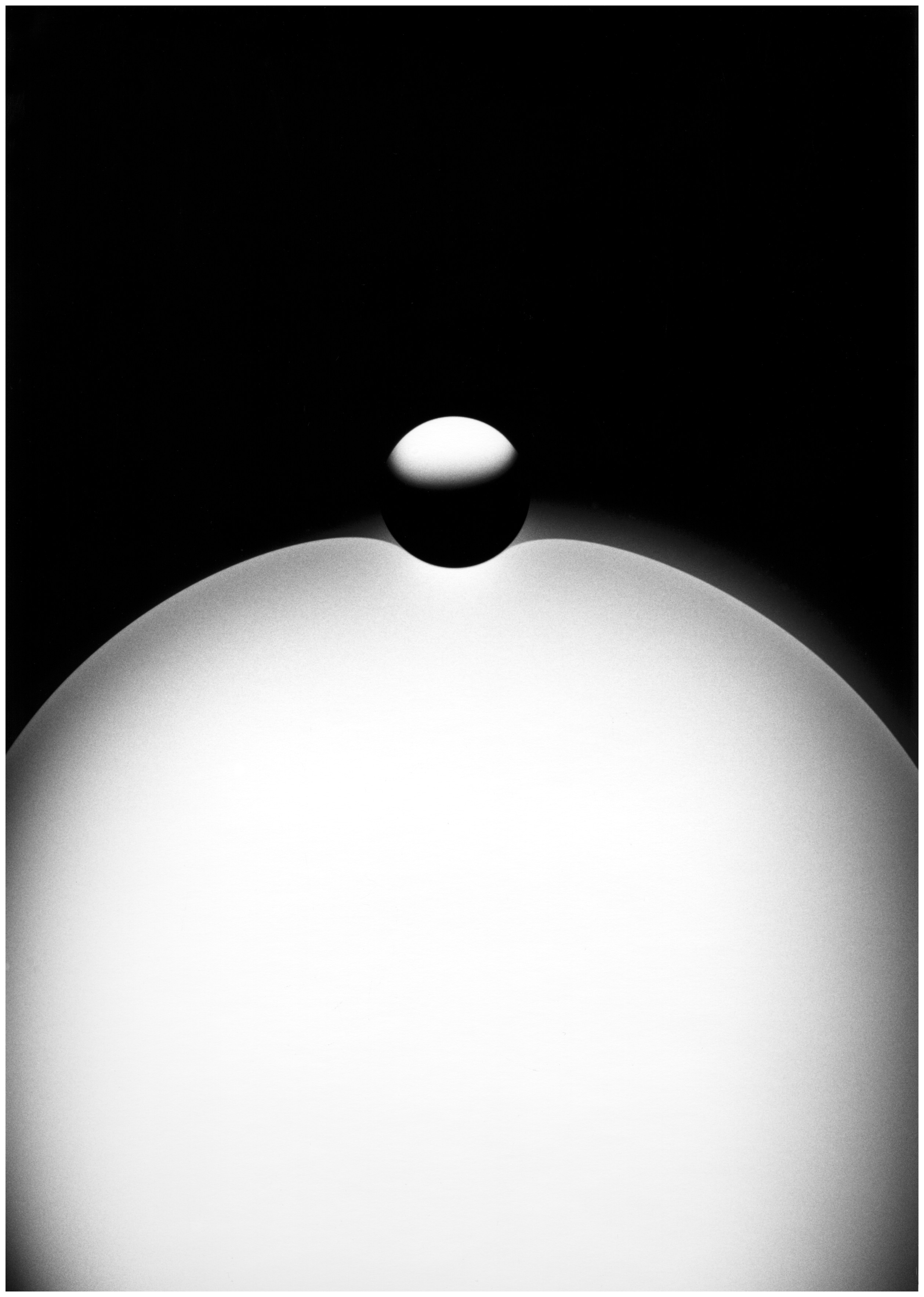
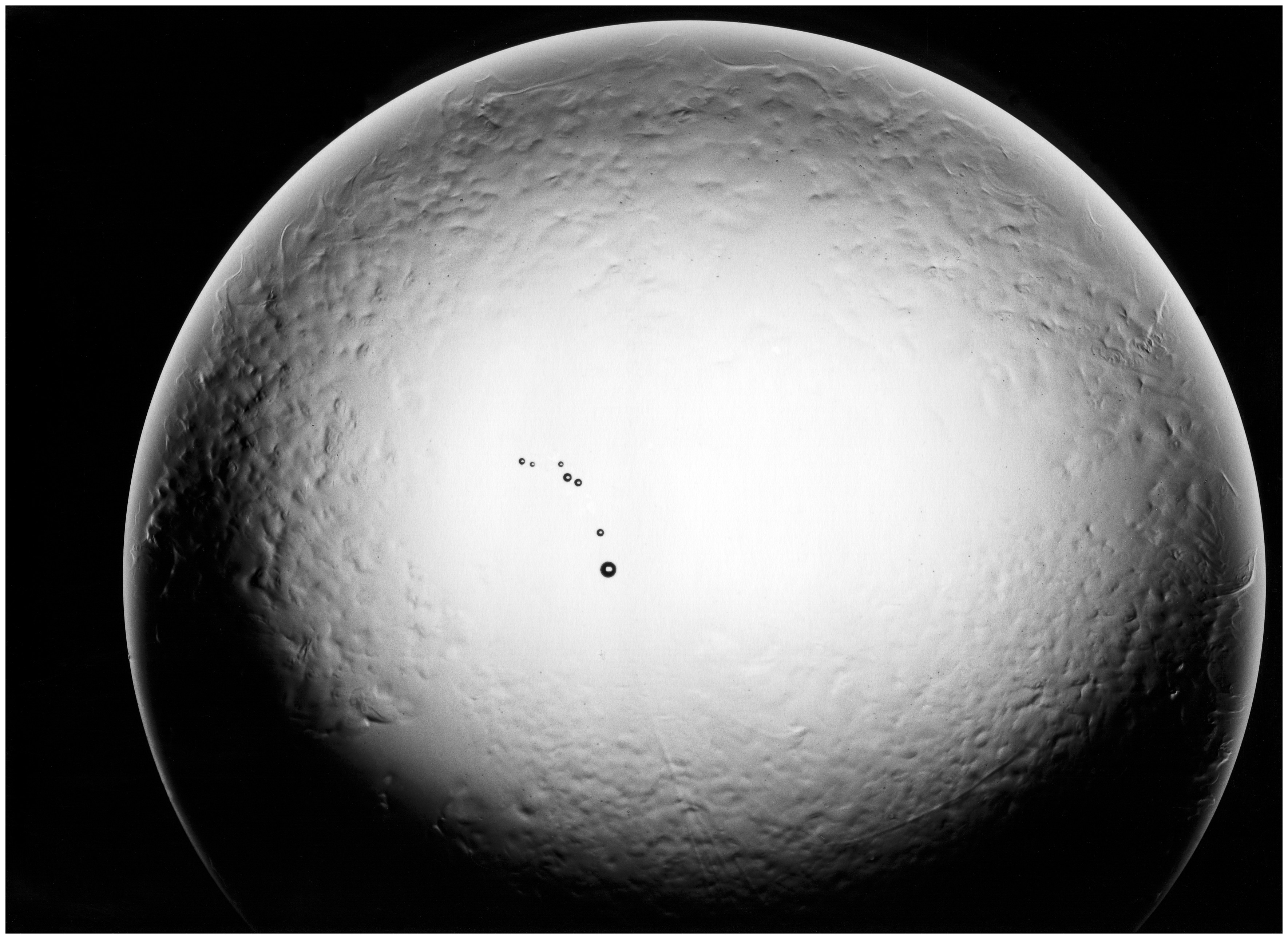
All around, as individual grains become more dense, the islands they’re attached to grow darker and darker. After six minutes or so the environment has become very dark. I turn the scooter around and head in the direction of brighter islands. Like swimming from the depths of the ocean toward the surface, the gelatin field begins to brighten. The transition appears to be gradual, but when I zoom out, as it to the sky, it’s a sharp edge. Contrast! (See the dotted rectangle in the photograph of the sphere photograph).

Zooming in again, a single grain of silver halide catches my eye. The surface looks smooth, so I descend slowly, somewhat like a soft approach to the moon. Closer yet, grooves and channels become apparent, then there’s a landscape of mountains and valleys, and some of the grooves turn out to be deep crevasses. 

From the bottom of a crevasse, the walls on both sides look like Superman’s crystal palace, but with spires arranged more orderly. I detect movement, like pulsing within the walls. The dance of molecules? Like the aurora borealis, there’s a brightness that modulates, and I notice dark spots on the walls, looking like blemishes. Curiously, the imperfections are attracting neighboring crystals—like the way water vapor forms around a dust particle in the atmosphere to form a raindrop or snowflake. And suddenly they turn black.

On the surface of the emulsion, I’m startled as the slippery and caustic environment I’d grown accustomed to becomes acidic. The “stop bath,” a weak solution of acetic acid solution halted the development. Outside as an observer now, I watch as a flood of sodium thiosulfate washes away the silver crystals that had not been exposed to light, and the density of the others becomes “fixed,” rendered no longer sensitive to light. At this point I turn on the room lights and wince because of the sudden brightness, the shift between worlds. 

Digital Process

Here’s another example of taking a deep dive into the details of a medium. In this case, rather than a journey, it evokes a contemplation. Sitting comfortably in front of my computer with an image on the screen that I particularly like, I use the image processing software—Adobe Lightroom in tandem with Photoshop—to magnify it 11:1 so I can discern the individual pixels.

748 (e) CU

Moving this image to a place where there’s a distinct transition from light to dark tones or from one color to another, I focus my attention on a single pixel, and make it my avatar. (The medium gray pixel, top right).

748 (e) ECU

I imagine being surrounded by family avatars—the nearby pixels—and a vast community of others. Some are darker than me, others are lighter. Because I’m familiar with the photograph, I see how well we fit together to form the whole. Although different, none is better and each is necessary.

748 (e) Medium

In the image we began with at the top, here again is the section enclosed in the box. Zooming out a bit from the family of pixels, I reflect on the part-whole “relationship.”  If my avatar or any of the others were excluded or even changed, the whole picture would be changed. There would be a hole or a dark spot that would be out of place. And so my contemplation moves to considerations of “community.” Is it simply a matter of proximity? Or individuals who share an interest? If the whole is to have integrity, diversity becomes a necessity—as does respect for one’s uniqueness and place in the scheme of things.

Zooming in again to consider my avatar, I imagine its physical components, the interacting and vibrating atoms, within them the subatomic particles and within them the quanta that are blinking in and out of existence.  Suddenly, I’m reflecting on matters of constitution and identity. Am I merely a composite of these vibrating energies? What is it that distinguishes me from everyone else? Or is there no distinction at this level? The deeper I go, I see less of what sets me apart from everyone else, and then reach a point where there is no difference. Yet all are present. We still know each other. And at any moment we can zoom out—shift our awareness—and see the whole picture again. Having descended into the depth of my being, I can now realize what we are together, where we are, how each of us fits perfectly in the whole and how together we are creating the picture.

The contemplation reminds me about one of the observations of quantum physics, that we find what we’re looking for. For what should we be looking? What do I want to see in me? Where do I fit in the big picture? What picture am I creating?

_______________________________________________________________

Email: smithdl@fuse.net

Portfolio: DavidLSmithPhotography.com

Photography Monographs (Click on the pages to turn them)

Nations And Nature

All flags wave in the winds of nature

American Flag

Aside from the symbolism represented by the stars and stripes, the American flag standing against the sky speaks to me of the contrast between nations and nature, and how the former are dependent upon the latter.

The flag, most flags, symbolize a people, a group characterized by the things they hold in common, typically their history, values and aspirations. So far, nations represent the largest social structure on the planet. As complex and dynamic as these entities are, their survival and development largely depends upon the establishment and nurturing of mutually beneficial and amicable relations with other such entities—and nature.

Current events indicate that the leaders of many nations, particularly those based on radical fundamentalist ideologies, have not yet come to terms with this, the result being warfare and acts of terrorism. I think we’re witnessing the death throes of the paradigms of both separation and male dominance. At this stage of global evolution I guess we shouldn’t be surprised that nations are still learning how to live and work together collaboratively, internally and externally, in order to create mutual growth and prosperity for all while maintaining the integrity and sustainability of the planet.

Amidst this transformation in consciousness, nature is providing another, perhaps even shorter-term and more vital lesson, this one having to do with the quality of life for everyone; eventually the survival of nations. Climate change.

No nation can stand without healthy citizens. And health requires clean air, appropriately filtered sunlight, an abundance of clean water, sustainable forests and non-polluted, fertile soils to produce food. To keep the flags of nations waving then, it’s not enough for individuals to seek their own health. They—we—must also do what we can to maintain the health of the nation.

In the United States of America, a principle way to do this is by electing representatives who understand that the conservation and preservation of the environment is a survival issue for our children, grandchildren and for the nation. In a very real sense, the flag in this photograph—and the flags of all nations—stand on the pedestal of nature.

Some argue that measures to respond to the changing climate is too costly. But that cost will pale in comparison to the cost of lives lost, property destroyed, species loss, towns and cities impacted by flood, fire and other natural disasters. History has shown, the size, wealth and power of civilizations and nations does not shield them from the awesome, unmanageable forces of nature.

The American flag is a symbol that reflects the ideals of the founding fathers. It will stand and endure only so long as we enact those ideals as a united community. As far back as Aesop and his fables we were cautioned: “United we stand, divided we fall.”

We are all here together, at once, at the service of and at the mercy of nature, each other, and our daily acts.

Paul Hawken, Environmentalist and entrepreneur

Educating The Whole Person

Addressing the soul as well as the mind

Lecture Hall

In this image I see the next generation of professionals being exposed to the knowledge of the past and unfolding present. I also see the learning process accelerating, facilitated by the rapid and global flow of information technology that empowers many more people to make many more and better connections between content and others than ever before.

Going forward from the industrial revolution, we acquired knowledge about how the human senses, particularly sight and sound can be expanded, improved upon and extended far into the cosmos through the use of microwave and radio telescopes. Intricate surgeries are being successfully performed by robots acting under the control of surgeons at a distance. Animals are being cloned. Innovations in technology are advancing exponentially every year.

Millions of people are communicating globally and simultaneously. I look at this image and wonder if considerations of more and faster are also producing better results. Does more knowledge, better tools and increased capacities result in higher quality—more competent, ethical, responsible and caring human beings? More secure, economically sound and vital societies? In some cases “yes,” in other instances “no.” When it comes to tools of any kind, what matters is how we use them.

Certainly it’s easier, faster and more financially profitable to direct the flow of information and knowledge toward external changes, more so than addressing internal changes, those relating to the qualities of consciousness and character, which are neither sexy nor profitable. Reflecting on these qualities in relation to learning, I wonder what we’re educating for—at every level. And toward what ends should we be applying what we’re learning?

Constructive jobs and the professions are part of it. Wisdom born of hard experience is another part, necessary for intelligence and creativity to be channeled into understanding, improvements, health and well-being. And then there’s knowledge that contributes to personal growth and social development. Might there be less crime and corruption, perhaps even less political polarization, if more people understood the many ways in which all of life is interconnected and interdependent? And that all choices have consequences—for the society, species and environment as well as the individual.

A long time ago, I was a students in this very lecture hall. Back then, we took notes with pad and pen. And the focus was more on the teacher than projected images. Beyond the name of the teacher and the course, I have only a vague memory of the lessons that were taught there. I do, however, vividly remember the teacher and his passion for the subject. He captured our attention, not only because he had expertise and experience in the field we aspired to; he lived it. We listened with rapt attention because he provided the model for what we could expect at the executive level in the broadcast industry. And in my experience it proved to be an accurate assessment.

Years later, as a university professor myself, I learned that education is only partly about the conveyance of knowledge and information. Students can get that on their own. And they will pursue certain subjects when they’re sufficiently motivated to do so. What’s more difficult for them to acquire are the qualities of character that contribute to a life well lived with meaningful contributions, qualities that are best demonstrated rather than talked about.

Technologies in the classroom are essential tools now, particularly for learning the externals—how the world works and what’s needed to enter into it. Equally, perhaps even more, I think attention to the internals, the qualities of thought and character, are essential. And for that we need positive role models—parents, teachers, professionals and leaders in every domain, people who consider their role a vocation, not just a job.

The process of creating intelligence is not merely a question of access to information. Would that learning were as easy as diving into a swimming pool of information or sitting down at a great banquet table for an info-feast. Rather, education, which comes from the Latin educaré, meaning to raise and nurture, is more a matter of imparting values and critical faculties than inputting raw data. Education is about enlightenment, not just access. 

David Shenk, American writer, lecturer and filmmaker

Email: smithdl@fuse.net

Portfolio: DavidLSmithPhotography.com

Photography Monographs (Click on the pages to turn them)

Individual Freedom

Independence to the exclusion of concern for others feeds  entropy

Guard Rail

Obviously, guard rails are intended to keep cars from running off the road—and to reduce the severity of an accident when they do. Not so obvious is the observation that their presence indicates a lack of trust. Appropriately so. Bad accidents, even death, may have occurred had we trusted—ourselves and “the other guy.” This image reminds me that, because human beings generally cannot be trusted, safeguards are necessary, increasingly so in proportion to the level of distrust, which in highly mobile societies increases with population density and social complexity. Without safeguards the odds of breakdown increase as more people are on the road with more distractions.

At the same time, the presence of guard rails on roadsides generates trust. These metal barriers actually have served their purpose. Systemically speaking, they are “syntropic.” They reduce the effects of entropy, which is the tendency of systems to dissipate heat. In other words, breakdown. In the case of a highway system, entropy amounts to the dis-integration of roadway integrity. If entropy goes unchecked by safeguards such as improvements in the areas of car design, road maintenance, guards and signage, more and more severe accidents will occur. The many innovations, requirements and regulations surrounding car and passenger safety are prime examples of how syntropy reduces the frequency and severity of mayhem and catastrophe.

I reflect on the human body, mind and spirit which are equally susceptible to the forces of entropy—from tooth decay to depression. At base, advertisers are in the business of selling syntropy: products and services that help prevent, retard, manage or eliminate the effects of entropy. (In living systems, 100% entropy equates with death. Maximum equilibrium). So to gain more confidence in the components of our personal and social lives, ultimately to increase their  health and well-being, regulation is essential. A social example is the national economy. It’s heavily regulated, not so the few can disadvantage the many, but to insure stability and increase public confidence, which directly influences the nation’s health and well-being—and the economy.

The word “regulation” in some spheres—mine was the broadcast television industry—has been seen as a threat to individual freedom. “Don’t tell me how to run my business.” Whether the social unit is a family, church congregation, community, business, corporation, nation or the global family, without regulation entropy will inexorably result in more and more severe breakdowns. The Coronavirus is a good example.

Systemically speaking, zero regulation equates with no growth and maximum entropy. In nature, a species dis-integrate when it acts solely in self-interest. Similarly, in human social systems, entropic disintegration is enhanced when the members act primarily in their own interest, despite justifications and rationals. One’s health, well-being and success, however it’s measured, is never secured independently, because human beings are socially dependent—interconnected and interdependent— physically, emotionally, economically and spiritually. Independence is both an illusion and an entropic idea that’s not sustainable.

Personal, social and international conflicts and breakdowns such as wars, occur in a climate of self-centeredness. “Nationalism” has often been raised as a banner to profess “love of country,” which is a healthy posture. But taken to extremes it becomes entropic when it promotes exclusion, self-sufficiency and righteousness.

Futurist and author Barbara Marx Hubbard observed that “Crisis precedes transformation.” Like pain in the body, breakdowns are a sign that entropy is having its way and catastrophic change is coming, unless something is done to repair, replace or transform the system. The rapidly declining state of infrastructure in the United States is an example. Polarization in health and government is a direct result of self-centered close-mindedness, which to me are indications that systematic transformations are underway.

Sometimes we need to experience what doesn’t work in order to rethink and redesign the system so it does work—like a highway system with guardrails, cars with seat belts, police body-cameras, face masks and vaccines. Learning through breakdowns is difficult, but eventually they contribute to breakthroughs, even resilience as a consequence of learning.

Trouble is, getting to that point can take a lot of breakdowns over a long period of time. The ideal would be to own up to them and take syntropic action so the system can affect a shift to a more viable paradigm and behaviors. As we have seen, the misunderstanding of freedom as license, stubbornness and rigid clinging to ideas and ideologies only feeds the entropic dragon.


If ten people walk beyond civilization and build a new sort of life for themselves, then those ten people are already living in the next paradigm, from the first day.

             Daniel Quinn

About The Image

I was cruising the highway, looking for something to photograph when I came to a stoplight at an intersection. While waiting I noticed how the guardrail divided the bright sky and white snow with a nice clean line.

Since one of my constant visual quests is to find or create simplicity, the fewest number of visual elements within the frame, I backed up the car, put it in “park” with the emergency lights blinking, got the camera and ran about thirty yards hoping the police would not come.

They didn’t. I hand-held several shots, each with the guardrail at a different position in the frame. This is the one I like best because there’s just a hint of snow and the immensity of the sky diminishes the man-made object. With no other objects in the frame, the rail provides some evidence of where we are as a society. Metaphorically and physically.

____________________________________

Email: smithdl@fuse.net

Portfolio: DavidLSmithPhotography.com

Photography Monographs (Click on the pages to turn them)

Humanity On The March

Advancing toward the light of increased awareness

Tourists On Cliff

In this image I reflect on the notion of “reality,” that what we experience and know is both an individual and social construct. There’s the reality that I, as the photographer, experienced—the bright sun and the people on the hill.  Part of that reality includes cars in a parking lot and an observation platform to the right of the walkers, so the reality within the frame is a small fraction of what I experienced. The realities of the individuals walking down the path are entirely different from my experience, each having a unique perspective based on a complex of references, preferences, relationships and motivations.

Then there are the realities that people will read into this image: perhaps humanity’s exploration of the planet, it’s advance into the future or the scale of the Earth and human beings relative to the immensity of the sun. Yet another reality is the image itself, experienced differently on a screen or on paper. These and other realities are quite easily seen and understood because our senses provide our brains with input that constructs meaning based on both our personal and social experiences.

What we do not see is objective reality. While our sensory systems evolved to maximize the potential for survival and growth, they do not detect the realities that gave rise to life and form, the worlds of atoms and quanta. For instance, the photons stimulating our retinas as we look at this image. Objectively they have no color. What the brain interprets as color has everything to do with the reflection and absorption properties of surfaces. We say a fabric is “red,” for instance, because the combination of threads absorb most of the colors of the visible spectrum other than red. Put another way, “blue” is the experience of a lack of yellow wavelengths. So while eyes perform the critical task of gathering wavelengths and generating electrical stimuli, it’s actually the brain that “sees” color. The same is true of shape, texture and dimension, properties the brain uses to interpret and construct our visual reality.

Even the experience of a solid is a mental construction. In the realm of the atom, nothing is solid. In metals and even diamonds, the hardest of rocks, there’s mostly space within and between the nucleus and electrons. At the quantum level of reality, there is no matter.

For whatever reason, the above image reminded me that the realities of everyday experience are personal constructs, moment to moment brain-interpreted creations where all sensory inputs are filtered through a myriad of past experiences and influences including physiology, ethnicity, psychology, family, education, peer associations, socialization and work to name a few. Even the realities and the symbols that represent them, such as words and images are momentary constructions. Consider how your personal reality would be changed without the concepts and words for “television” or “time.” I’m reminded of the indigenous people who experienced Spanish galleons for the first time, regarding them as monster canoes and rifles as barking sticks or fire sticks. New realities rely upon established ones to make sense of them.

On the one hand, the awareness that what we call “reality” is a construct is humbling. It leads to the observation that we live somewhere in the middle between the ephemeral and immensity. It’s also empowering because, if my personal reality is a construct, I can alter it. Make it better. What’s more, the leading edge of consciousness and technology that’s expanding our understanding and capabilities in both directions suggests that something grand is in the process of being born. In the above image, I see humanity walking with hope and determination into the light of a more awakened awareness of and appreciation for the reality that gives rise to and sustains all forms.

If an almost limitless field of action lies open to us in the future, what shall our disposition be, as we contemplate this march ahead? A great hope held in common. 

Pierre Teilhard de Chardin S.J.

About This Image

I’d been photographing the magnificent landscapes in the Badlands of South Dakota when I saw a turnout where people were walking back and forth on a walkway that led to an overlook and a grand vista of mountainous forms. There were so many people going back and forth, so I had to see the attraction.  Also, a lifetime in photography has taught me that unusual and powerful images are much more likely to occur when walking rather than driving.

“Happy accidents” happen so often, it didn’t matter to me that the lookout was crowded with people taking pictures. I set up my tripod beside several others and got the same shots. And they were nice. But the one that I celebrate most is this one, taken from the parking lot.

__________________________________

Email: smithdl@fuse.net

Portfolio: DavidLSmithPhotography.com

Photography Monographs (Click on the pages to turn them)

A Journey Of Imagination

Opening to life’s deeper revelations

Wrench

Considering this wrench, what was its history? How did it come to be? My reflection begins with the observation that someone, likely a man with dirty hands, placed it on an oil drum inside the mushroom farm in Loveland, Ohio—where I photographed it.

Where was the wrench before that? Might it have been used in a factory, a gas station or railroad yard? Did it hang on a pegboard above someone’s basement workbench? Was it cherished? Was it even used? Had it sat in a metal or wooden drawer filled with other wrenches? Had it been dropped in the dirt and rained upon? Not this wrench. There was no of sign of rust. With each of these possibilities I imagine the environment, what the users would be wearing, the grease on their hands, dirt under their fingernails—the calendars on the walls, the smell of oil and gasoline, the sound of a baseball announcer in the background coming from an plastic radio and the voices of workmen talking, perhaps yelling, sounds absorbed and held in this object’s metallic memory cells. Yes, these are stereotypical images. But elements of imagination, like pieces of a puzzle, contribute to the picture of the human project, the strengths and vulnerabilities that spark appreciation and evoke compassion.

My imagination shifts to when the wrench was new, when it looked its best, gleaming bright steel with the manufacturer’s name engraved on it. Was it on display in a window? Or was it one of the many that were wrapped in brown paper and put in a box with a drawing or photo on top with specifications and serial numbers on the side? There are no right or wrong imaginings in contemplation. Each reflection contributes to the unfolding development of self and reality. Imagining is at the heart of contemplation. As well as enabling the exploration of times, places, events and abstractions that we could not otherwise experience physically, it sidesteps everyday thinking, inspires creativity and fuels our appreciation of what is, as it is.

Back to the wrench. I imagine the manufacturing process. I see the minerals being scooped from the ground by giant, loud and smoke-belching diggers. The boulders are crushed and then dumped into a molten crucible where rock transforms into liquid. Sparks fly. Gloved men with black goggles handle the controls in a dark factory with a dirt floor. The cars parked outside are vintage 1930’s. Men in the office wear double-breasted, three button suits, starched collars and ties with finger-length clips to hold them in place. Their office managers and secretaries wear shirt waist blouses and nylons with seams down the back.

Further back in time I conjure a gray haired man sitting at a drafting table wearing spectacles. He also wears a tie, but his sleeves are rolled up and he smokes unfiltered cigarettes. With fine-pointed pencil in hand he transposes a sketch of the wrench with notes on dimension and weight onto a blueprint that will be used to create the model and mold.

Farther back is the visionary (or visionaries) who met the challenge of a connection problem. How does a mechanic connect two pieces of metal in a way that they will almost never come apart but can easily be separated? Trial and error. After many attempts and failures someone (innovation more often begins with an individual rather than a group) imagines a threaded bolt with flat sides and a tool with a handle that would turn it. Tighten. Untighten. Brilliant!

Descending the historical ladder even further, where did the iron ore for this particular wrench come from? China most likely. Other possibilities include Australia, Brazil, India, Russia, South Africa, Minnesota and Michigan. And who was the first to have the idea of the making of a molten soup consisting of iron oxide, magnetite, hematite, goethite, limonite and siderite, particularly when these minerals are scattered around the world? I think about motivation as well, the need for a material harder than any rock, the desire to build things that would last—and win wars.

I can see this wrench new, old or ancient. I can see it whole or as a conglomerate of parts. I can think about it as a solid or liquid, even as fields within fields of quanta. Perception is a choice we make, and unusual ones, particularly in contemplation can evoke wonder and appreciation. For me then, the question becomes: What is gained by different perceptions? I think it has a lot to do with imagination and beauty being in the eye of the beholder.

There is nothing in all the world that is not God’s manifest glory and essence.

                                          Kabbalah 

About This Image

I was riding country backroads looking for something to photograph when I saw a sign that read Fred’s Mushroom Farm. The place intrigued me, so I went in and told the manager I was a photographer. Would he mind if I photographed his facility? Not only did he grant permission, he gave me a tour and described the process of growing mushrooms. He introduced me to his employees and displayed great patience while I photographed anything that caught my eye.

I shot about six rolls of 120 film in that facility, all by available light. In passing from one room to another, I saw this wrench sitting on an oil drum. I composed the shot and made one hand-held exposure. The light level was very low, so I was not surprised when the slow shutter-speed resulted in an image with shortened depth of field and slight blur. I didn’t print the negative right away, but years later I was paging through my contact sheets and decided that, because of the simplicity and graded light, the image might have possibilities. Now, it peaks my imagination ever time I see it.

Besides being exhibited and published, I used this among other images in my Visual Communication classes to illustrate a comment made to a reporter by the master of street photographer, Henri Cartier-Bresson.  “What’s the secret of your success?” the reporter asked. The response was: “Be there and f8.” Indeed, more important for a photographer than technology and technique is Being where life leads us and Seeing what it’s showing us.

__________________________________

Email: smithdl@fuse.net

Portfolio: DavidLSmithPhotography.com

Photography Monographs (Click on the pages to turn them)