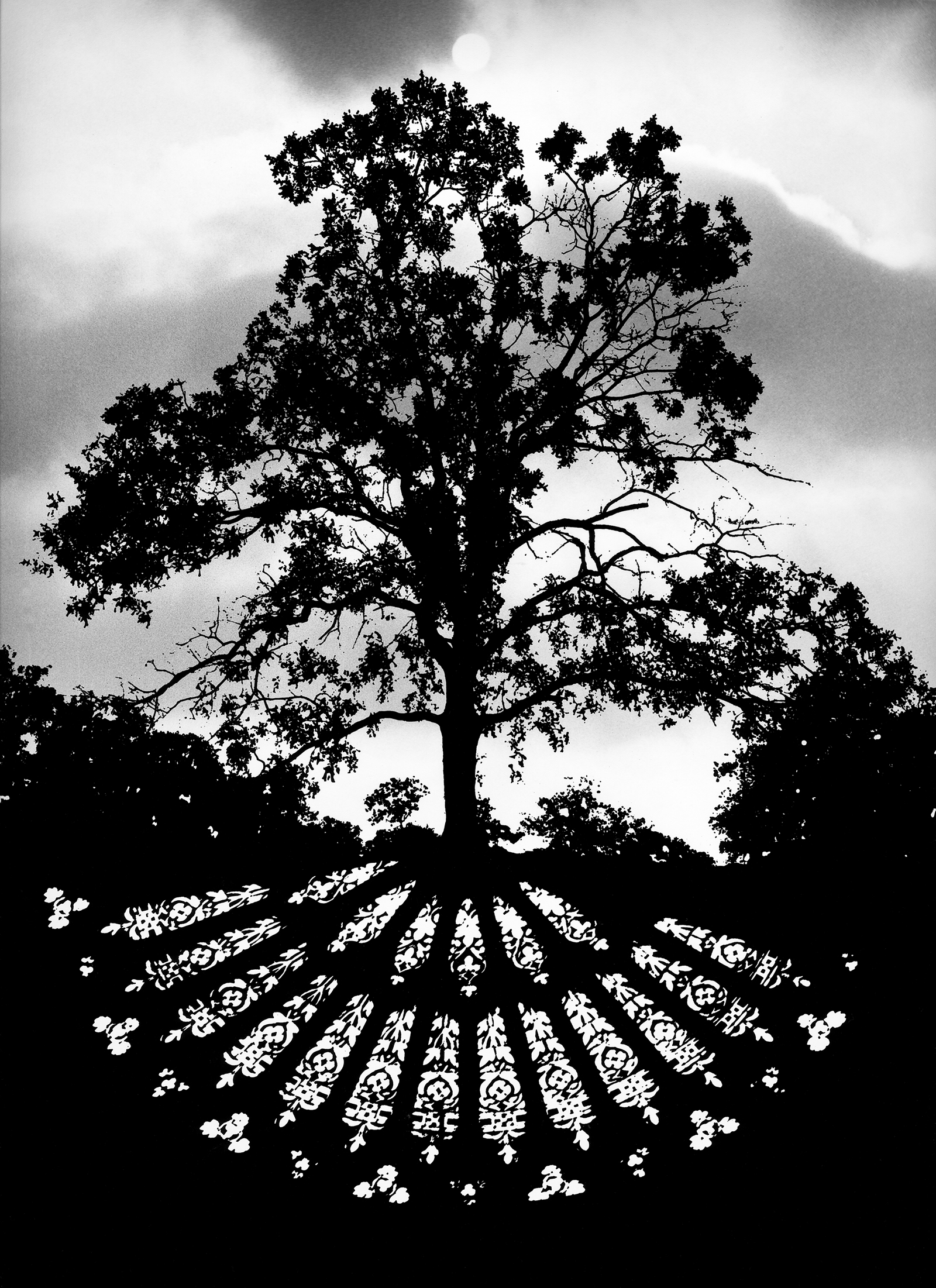
Inspiration

This image resulted from inspiration I received many years ago after seeing the work of Jerry Uelsmann, a master of the multiple printing technique. His work caught my attention because he was a graduate of R.I.T.. Although the word inspiration derives from inspiratio, which is Latin for “divine guidance,” a modern dictionary renders it a “process of being mentally stimulated to do or feel something, especially to do something creative.”

While I understand the secular orientation of this definition, I believe that Spirit or universal consciousness is fundamental to the process, with the brain serving as a “tuner,” able to access vibrations (stimulations) emanating from that Source according to interest or desire. In this instance I wanted to see if I could make a print from multiple negatives that would produce an interesting photograph. Starting out I had no idea what might work. Although it has been many years since I made this photograph, I remember the urge and the process as if it occurred yesterday.

A recent interview on Buddha At The Gas Pump between the host, Rick Archer and Marianne Williamson, prompted me to consider this theme because their conversation was inspirational. She not only put the current political crisis into global perspective, she called those of us with a spiritual orientation to task, pointing the way through and strongly urging us to get involved in the political process.

A friend once told me that he only gives money to the people and organizations that inspired him. That appeals to me because it directly supports the expression of our values. Mental health professionals recommend that we distance ourselves from people who, as a pattern, diminish our spirit, and maintain or seek relationships that lift us up. Linda and I keep this in mind in our media selections. We want the media to feed the spirit, not diminish it. On the subject of “guidance,” one our teachers at RIT famously said—

No matter how slow the film, Spirit always stands still long enough for the photographer it has chosen.

                        Minor White, Photographer, educator

After a lifetime of making photographs, I understand what he was saying. Indeed, I often have the feeling of being guided, that the spirit of a subject or object in front of the camera is “calling” to me. Looking back over my body of work and seeing that it does what I’d hoped it would—express my love of God and the world—it’s easy to see how my choices of technology, locations, subject matter, materials, printing and processing techniques were guided. This is especially the case in the images I consider numinous, the experience of a spiritual force. Guided by what or whom? I don’t know for sure, but I think we’re all guided by spirit, especially in matters we deem important for our life’s journey.

For instance, consider one of the major gifts you were born with, one that led to the development of your most passionate interest or occupation. You can probably pinpoint the moment or event that created a “spark,” the urge to learn more about what you experienced. Immediately, doors started to open.  As your interest grew, the “right” people showed up at just the right time to give you a boost. Problems got solved. Books, ideas and resources became available. And synchronicities happened. An example of the road rising up to meet my feet, was when I was 29. An elderly gentleman, Jack J. Smith Jr., to whom I had sold top-of-the-line darkroom equipment four years prior, sold it back to me for one dollar.

“Expressive” photography operates under the principle of attraction or affinity. Because like attracts like, when looking for subject matter, there’s something within the photographer that recognizes a connection when he sees it. Be it subtle or pronounced, there’s an “attraction,” a recognition, a pull of sorts, that urges exploration. In those instances, there’s the potential for an expressive photograph. Whenever I feel the attraction to something, I know guidance is urging me to pay attention. The message is: There’s something here, so work with it.

It is by long obedience and hard work that the artist comes to unforced spontaneity and consummate mastery. Knowing that he can never create anything on his own account, out of the top layers, so to speak, of his personal consciousness, he submits obediently to the workings of ‘inspiration’; and knowing that the medium in which he works has its own self-nature, which must not be ignored or violently overridden, he makes himself its patient servant and, in this way, achieves perfect freedom of expression.

Aldous Huxley, English writer and philosopher

ABOUT THIS IMAGE

Title: Celestial Roots

I randomly pulled out negatives that had clear or nearly clear backgrounds, and set them on a light table. By laying them on top of one another, I was able to see some possibilities. The negative of the stained glass window was especially conducive to multiple printing because of its high contrast. Using it as sort of a “master,” I kept superimposing the window over other negatives until I found one that worked—the tree. The sky behind the tree was overcast, so to remove it I made a copy by sandwiching it with a sheet of high contrast Kodalith film and exposing it under glass to keep it flat. From that positive, I made another copy onto Kodalith film, and that resulted in a negative that I could put in the enlarger.

With an ordinary piece of paper in the easel under the enlarger, I drew a rough outline, first of the tree and then the window. Using that to align the easel that would hold the photo paper under two different enlargers, I made several trial exposures, and along the way added the moon from another negative. Metaphorically the composite evokes the tree of life or World Tree with its roots in the divine.

Celestial Roots has been exhibited in a variety of venues,. It was made into a gold plaque as a prestigous award for a nonprofit organization. And I’m especially honored that my daughter and her husband chose it as the visual theme for their wedding.

Wabi-Sabi: The Art of Impermanence

The Japanese way of seeing beauty in entropy

We tend to think of entropy as something “bad,” the inevitable tendency for matter to dissipate, for all living things to die. As embodied creatures, we naturally would prefer to avoid this downward spiral—for ourselves, loved ones, pets, creations, cherished objects and the systems we use in order to function. And because death is so mysterious and ultimate, it’s not surprising that it has been and continues to be primary subject matter for storytellers across all cultures and media.

Japanese artists have another way of looking at entropy. For them, wabi-sabi is both a worldview and an aesthetic perspective based on the acceptance and appreciation of impermanence and imperfection. I so much respect the shift in consciousness it requires. When entropy is viewed as impermanence, a natural and cosmic principle, the aging process can be seen as beautiful. It’s all about perception—how we see.

In Wabi-Sabi For Artists, Designers, Poets And Philosophers, American artist Leonard Koren points out that the Japanese hesitate to explain wabi-sabi, but most will claim to understand how it feels. According to Wikipedia, “wabi connotes rustic simplicity, freshness or quietness and can be applied to both natural and human-made objects, or understated elegance… It refers to the creation of beauty through the inclusion of imperfection, focusing on subject matter that is asymmetrical, austere, simple, quiet and modest. Also, it appreciates the randomness of nature and natural processes… And “sabi is beauty or serenity that comes with age, when the life of the object and its impermanence are evidenced in its patina and wear, or in any visible repairs.”

It regards the signs of dissipation or decay as beautiful—peeling paint, a wilting flower, rusting or pitted metal. According to Mr. Koren, wabi-sabi is “the most conspicuous and characteristic feature of traditional Japanese beauty.”

Andrew Juniper, owner of the Wabi-Sabi Design Company in the UK, observes that “If an object of expression can bring about, within us, a sense of serene melancholy and a spiritual longing, then that object could be said to be wabi-sabi. It’s for this reason that the bowls used in Japanese tea ceremonies are rustic, simple, sometimes pitted and not quite symmetrical.”

It’s also why fine art and contemplative photographer’s are drawn to areas where entropy is well underway, including junk yards, abandoned structures, neglected neighborhoods and back alleys. When composed and lit well, textures born of age and weathering can be pleasing and interesting, at times dramatic.

Always, they present an opportunity to practice composition and explore one’s aesthetic. Images made in such places can evoke the sensibilities of aging, abuse and neglect. And for some, they can encourage contemplation.

By putting on a wabi-sabi “hat” or mindset, the artist can become more attuned to the subject’s characteristic energies—asymmetry, simplicity, quietness and imperfection, how the elements in a composition feel rather than look.

Wabi-sabi is neither smooth nor complex. It’s the bark of a tree and broken branches, cracks in a vase or brick wall, creases in a tablecloth, peeling paint or the random spill of oil on a blacktop surface. It’s not the smooth skin or perky expression of the young. Rather, it’s the character lines and calm demeanor that come with age.

Young and aspiring photographers tend to think they have to travel in order to find appealing subject matter. If the intent is to produce “calendar art” that may be so. But for those more interested in exploring through the exercise of their unique personal aesthetic, I recommend the practice of wabi-sabi. I also recommend working close to home because it presents more of a challenge to seeing with fresh eyes and activating the inner eye of understanding a subject’s essence and history beyond surface appearances. For instance, what does this or any expressive image evoke or reveal? What does it say about this object’s owner or user? Or human nature?

As perception expands and deepens, we better appreciate that entropy is a natural and cosmic process. Images of impermanence present the artist with a world of opportunities to explore his or her perceptual capabilities and connect to this awesome and beautiful force.

Our souls are all made of the same paper; our uniqueness, though, comes from the creases in that paper from the folding and unfolding of our experiences.

Jiddu Krishnamurti, Indian philosopher, speaker and writer

ABOUT THESE IMAGES (Images are not “photographs” until they are printed)

Rendering subjects in black and white is particularly conducive to wabi-sabi because the emotional appeal of color doesn’t overpower the characteristics of form, texture and simplicity in the aging process. One of the challenges for the visual artist then, is to see all things and all people as beautiful.


My other sites—

Love And Light greetings.com: A twice-weekly blog featuring wisdom quotes and perspectives in science and spirituality intended to inspire and empower

David L. Smith Photography Portfolio.com: Black and white and color photography

Ancient Maya Cultural Traits.com: Weekly blog featuring the traits that made this civilization unique 

smithdl@fuse.net

 

A Woods, Lovely Dark and Deep

Whose woods these are I think I know.

His house is in the village though;

He will not see me stopping here

To watch his woods fill up with snow.

My little horse must think it queer

To stop without a farmhouse near

Between the woods and frozen lake

The darkest evening of the year.

He gives his harness bells a shake

To ask if there is some mistake.

The only other sound’s the sweep

Of easy wind and downy flake.

The woods are lovely, dark and deep,

But I have promises to keep,

And miles to go before I sleep,

And miles to go before I sleep.

Robert Frost, Woods on a Snowy Evening

Our Story Is A Birth

Awakening to the truth of who we are and what we can become together

About two-thousand years ago a radical idea was born, presaged by a star that guided some wise men to a cave in Bethlehem. That idea, “Love they neighbor,” is a simple admonition admired by many but so challenging that, after all these years, humanity is still having trouble putting it into practice.

The evolution of human consciousness (values, beliefs, perspectives) is a slow process, punctuated by crises that lead to relatively sudden leaps forward, largely due to shifts in perception introduced by great thinkers, visionaries, mystics and prophets. In the current era, the rapid development of communication technologies, ideological differences and the widening gap between the wealthy “haves” and “have nots” has precipitated a compounding of crises worldwide in nearly every sphere of activity. The commonplace impression is that humanity appears to be taking a step backward rather than forward.

Systemically, because crisis precedes and gives rise to transformation, breakdowns can be regarded as “evolutionary drivers,” nudging us to grow in consciousness individually and collectively. By this I mean we must actualize the injunction to love our neighbors and expand our circle of caring to include everyone, including the planet.

It’s been said that humanity’s greatest challenge has always been and continues to be ignorance—we don’t know who we are. Overall, we haven’t yet connected to the animating spark within that is our essence. We don’t realize that all matter, including bodies and spirits, originated in and are extensions of the One, the Source or Infinite Intelligence, whatever name we prefer. We are one human family, interconnected and interdependent, struggling to coordinate, to learn the purpose and right use of our personal and collective power.

“Me first!” “Let somebody else clean it up.” “If it’s legal it’s alright, even if it’s immoral.” “If it can be done, we’ll do it regardless of consequences.” “We’re better than…” “We know better than…” “Our way is the right way.” “I’m not my brother’s keeper.” “Wealth at the top trickles down.” “Grab & run!” These are among the attitudes currently choking civilization.

Ultimately, the healing of ignorance at every level requires the activation of wisdom, balance, whole system understanding and respectful engagement, qualities that are largely developed in the context of a humanizing education. Beyond “subjects” and “skills,” education of the whole person informs, encourages and empowers a life of meaning and grace, ethics and integrity, right-relationship, lifelong learning, contribution and fulfillment. While training for jobs is important and necessary, without whole person development jobs get done but the virtues that contribute to our being more fully human get little or no attention. What’s under construction in human evolution are the qualities of love, compassion, kindness, appreciation and gratitude.

Arguably the most significant consequence of ignorance is intolerance. It’s human nature to notice and respond negatively to differences because they present a potential threat. But taken to extremes in acts of violence, whether personal, social or political, the bulk of humanity is learning that in order to not live in a world where violence is commonplace, each and every child has to be loved, respected and valued for who they are, as they are—and empowered to become the best version of themselves.

As I’ve often noted, the way to maintain the viability and vitality of a social system (business, community, nation, world) is to ensure that the needs of each member are being met and their unique gifts are developed and expressed. Only then can a person be in right-relationship with the other members of the system. Ultimately then, the healing of intolerance is love they neighbor.

Another consequence of ignorance is the illusion of separation. Because living systems at all levels are constituted of lower-level beings and unite to form higher levels systems, they are both social and interdependent, unable to survive for very long on their own as individuals. To the extent that any member is isolated, his work and worth to the systems above him is diminished. Seeing ourselves separate fosters fear and promotes greed. And the compounding of acts that advantage self without regard to others can carry devastating consequences for the whole—as when legislators turn a blind eye or vote favorably for companies that are abusing the environment. The stresses brought on by the perception of separation are teaching us that life, throughout the universe, is one whole, interconnected and interdependent system. Ultimately then, the healing of separation is the perception that all is one and we all have skin in the game. No matter one’s status or wealth, we rise and fall together.

Fear is the force that sustains separation and promotes division. Human beings can’t or won’t come together to collaborate, create or celebrate in a climate of fear. Of the drivers mentioned above, fear is perhaps the most widespread, difficult to overcome and trending, particularly when the mass media feed unhealthy and daily doses of breakdowns and possible threats into the social body. While I wouldn’t say that the commercial mass media systems are purposefully fostering ignorance and fear, they are the inadvertent consequences of a competitive system designed to maximize profits. As a consequence, what’s largely missing are programs and services that uplift, inspire, encourage and empower. On the consumer side, both in media and politics we cast a vote for more of the same when we spend our attention capital on the status quo.

Ultimately, the healing of fear is love. And that, at the very least, requires the perception that human beings, even those that appear and think differently, are good and intend to do good. This perception appears to be taking a long time to occur, but for those who understand that we are the architects of our lives, a change of heart and mind can be lived immediately.

While Christians celebrate the birth of Jesus for a variety of religious reasons, persons of all persuasions can rejoice in the birth of the paradigms he established—universal unconditional love and forgiveness. Indeed, at this time of year we celebrate His birth, teachings and example. And observe that our story is also a birth, an awakening to and realization of our higher potentials as individuals, nations and species.

May the leaders and wise ones of our time, perhaps by looking at images from space telescopes, gain a sense of the vastness and beauty of the universe beyond, and perhaps by encountering the right person at the right time and being guided by spirit, see the spark of goodness and higher potentials that reside within us all.

When human society practices agape, the promotion of the wellbeing of one another, the cosmos will be performing, on this very complexly organized level itself, a divine act. By its consciousness and its caring the cosmos will become ecstatic—transcend itself and its investment in individual or group ‘self-interest’—and its ecstasy will give birth to divine life.

Beatrice Bruteau, American contemplative, philosopher, author

_____________________________________

My other sites—

Love And Light greetings.com: A twice-weekly blog featuring wisdom quotes and perspectives in science and spirituality intended to inspire and empower

David L. Smith Photography Portfolio.com: Black and white and color photography

Ancient Maya Cultural Traits.com: Weekly blog featuring the traits that made this civilization unique 

smithdl@fuse.net

Giving And Receiving Gifts

A creative act that makes a powerful statement

Ethan Miller, my grandson, when he was four

Wouldn’t we all like to get this kind of response from those we deeply care about—at any age? Gifting is a critically significant form of communication, extending as far back as one Neanderthal offering a cherished stone or bone to another.

Marriage and political alliances were sealed and terminated over the exchange of gifts. Historian Dorothy Johansen describes the gift-giving dynamic among the indigenous people of the Pacific Northwest Coast of Canada: “In the potlatch, the host in effect challenged a guest chieftain to exceed him in his ‘power’ to give away or to destroy goods. If the guest did not return 100 percent on the gifts received and destroy even more wealth in a bigger and better bonfire, he and his people lost face and so his power was diminished. Hierarchical relations within and between clans, villages, and nations, were observed and reinforced through the distribution or sometimes destruction of wealth, dance performances, and other ceremonies. The status of any given family is raised not by who has the most resources, but by who distributes the most resources. The hosts demonstrate their wealth and prominence through giving away goods.”

Anthropologist Franz Boas reported that “Every present received at a potlatch has to be returned at another potlatch, and a man who would not give his feast in due time would be considered as not paying his debts.” My anthropology teacher, Dr. Beth Dillingham, said the Northwest Coast families would amass great wealth over a number of years and then give it all away to those who came to witness the rite of passage. Being tied to religion, these massive giving events were perceived as ceremonies and rites of passage rather than celebrations or negotiations. They would go on for days, and when everything was gone, the host was considered powerful—because he’d demonstrated his powerful spirit. All this to say that the giving of gifts is one of the most fundamental human activities across time and cultures.

As part of the research for one of my stories I read about subtext and it helped me to see that underlying meanings are a significant part of gift giving. When we say “It’s not the gift, it’s the thought that matters,” we’re essentially saying it’s the subtext, what the gift and its manner of presentation represent. What does it say, for instance, about a gift wrapped in a garbage or grocery bag? A gift that’s casually tossed onto someone’s lap? A gift that benefits the giver as much as the receiver? What does it say when everyone gets the same gift? Or no gift at all? Gifts speak loudly and clearly. In a matter of seconds the receiver understands the subtext. That’s why, if we really care about someone, we want the gift to say so.

The movie Dolly Parton’s Christmas of Many Colors: The Circle of Love moved me to contemplate this theme. The true story, beautifully produced, tells how Dolly’s father saw her mother admiring a ring in a store. He wanted to get it for her, particularly because they hadn’t had enough money to buy a ring when they got married. Still, he couldn’t afford it. When his eleven kids realized how badly he wanted the ring for his wife, they secretly met together and decided to give their father the cost of the one gift they each wanted. It wasn’t enough, so Dolly’s father, against his wife’s wishes, went off to work in a coal mine. Long story short, miracles happened and Dolly’s father surprised his wife with the ring on Christmas morning. Here was a demonstration of deep and precious love, the giving of self, of blood, sweat and tears in order to give joy—and communicate love. Indeed, when the message is love and caring, it’s not so much the object given as what it says. And the sacrifice of time or a cherished object for the sake of another is arguably the epitome of genuine caring.

The challenge for those of us who are privileged, is to make or find a gift, a “text” that conveys the subtext of love, caring or appreciation. Most everyone wants to be seen for who they authentically are. Gifts that acknowledge this require paying attention—well in advance of presentation—to the objects and experiences that will please, excite or feed an interest or concern of the receiver. Although we browse for gifts in stores and online because we’ve been indoctrinated to do so in our culture, the more direct way to objectify feelings and sentiments is to give the gift of time, energy or creativity, for instance by making, writing, performing or providing something that touches the heart.

In our early marriage, Linda taught me that women in general hope for a gift from their significant other that’s personal rather than utilitarian—something the affirms or reflects their values, qualities and virtues. Books, appliances, tickets to an event, electronics, music, videos and so on are fine, but they speak to interests, whereas personal items speak, well, to the person—how they are seen, appreciated and loved. Men on the other hand—speaking for myself and observing other men—tend to hope for gifts that are generally less personal and more utilitarian, objects we can use to play with, grow, construct, learn or otherwise support our work and interests.

When the intended recipients have everything they need or can buy what they want, we sometimes exchange lists to insure the recipient’s satisfaction. The subtext not only says “I want you to have what you really want,” it also provides the gift of time saved—by not needing to return an unwanted item. It’s a win-win strategy. The downside is the lack of a surprise, and for some people that’s important. Besides offering the expected in this way, a handwritten message—perhaps a compliment, appreciation or intention along with it—can enhance the subtext.

When I think of all the gifts I’ve given my daughter at Christmas time, the one that’s most memorable for both of us is a poem I wrote for her when she was in her early twenties. It was called The Tapestry Of Your Life. I haven’t been able to top it since. She framed it and occasionally mentions that the metaphor it contains continues to inspire her, even provide application in her work. Direct expressions like this are gifts that go beyond hope and expectation. They are gifts from the heart.

A subtle but significant gift that the receiver can give the giver is that of genuine gratitude for what is received, even if it’s not the perfect gift. I think it’s as important to know how to receive a gift as it is to give one. And this is important for children to learn. Because gifting is culturally conditioned, they need to be taught the significance, purpose and the rituals of presentation and appreciation. Actually, an excited or positive response along with gratitude is an in-kind gift itself. I know our conversations about gift-giving and receiving when Jennifer was growing up, especially as Linda wrapped gifts, made a difference in this regard. And every time I wrap a present I thank my dad for taking me shopping and showing me how to wrap packages.

If you’re looking for unusual and exceptional gift ideas that deliver loving subtextual messages for children, I highly recommend Jennifer’s blog. Among other inspiring ideas there you’ll read—

In addition to these imaginative toys, you might consider how can you give something that offers your child a part of you? This does not refer to anything store bought. Could you write a letter about what you learn from your child or all the good you see in them? Could you draw him? Could you frame your favorite picture of her? Could you write your wishes for her future? Think about how you might treat your child to an heirloom—a gift of your love—that they might keep well beyond their childhood years.

Jennifer Smith Miller, Parenting coach, author Confident Parents Confident Kids

___________________________________

My other sites—

Love And Light greetings.com: A twice-weekly blog featuring wisdom quotes and perspectives in science and spirituality intended to inspire and empower

David L. Smith Photography Portfolio.com: Black and white and color photography

Ancient Maya Cultural Traits.com: Weekly blog featuring the traits that made this civilization unique 

smithdl@fuse.net

Altruism

How we lift another’s spirit and the human project as a whole

In the above sun-flare, I see a dove. As well as “peace,” the dove symbolizes altruism. And in this context, the trees represent the strength and growth that accompanies the privilege of giving and helping. The word “altruism” was coined by French philosopher Auguste Comte. In French, altruisme, is an antonym for egoism. He derived it from the Italian altrui, which in turn was derived from Latin alteri, meaning “other people” or “somebody else.” (Wikipedia)

Arguably, the greatest social debate that’s been raging worldwide since the discovery of fire has been the question, “Am I my brother’s keeper?” In Genesis 4:9, after Cain killed his brother, Abel, the Lord asked him where his brother was. He lied, saying he didn’t know and posed that infamous question. Ever since, people either affirm or deny that we, as human beings, have an obligation to support or provide for anyone who is lacking or suffering.

The Religions

Christians are taught to love one another. The apostle Paul wrote (1 Thessalonians 5:12-15) “See that no one renders evil for evil to anyone, but always pursue what is good both for yourselves and for all.” Similarly, Buddhists are encouraged to practice “loving-kindness” toward one another. Neither emotional nor selfish, it’s seen as the most effective way to maintain purity of mind and to purify the mentally polluted atmosphere. 

In the Metta Sutta, the Buddha expanded this perspective. “Just as a mother would protect her only child even at the risk of her own life, even so, let him cultivate a boundless heart towards all beings. Let his thoughts of boundless love pervade the whole world, above, below and across without any obstruction, without any hatred, without any enmity.” Love of neighbor has been one of the fundamental precepts of all the traditional religions. 

The Dissenters

Among the skeptics and outright dissenters to the principle and practice of altruism, novelist Robert A. Heinlein believed altruism was “based on self-deception, the root of all evil.” Industrialist H.L. Mencken said it was “grounded on the fact that it is uncomfortable to have unhappy people about one.” Business and political writer Andrew Tobias said “there’s no such thing as altruism.” Marcel Proust, novelist and critic, said “Human altruism which is not egoism, is sterile.” Science fiction writer Greg Bear wrote “Altruism is masked self-interest. Aggressive self-interest is a masked urge to self-destruction.” Ayn Rand proclaimed that “If any civilization is to survive, it is the morality of altruism that men have to reject.” And D.T., former President of the United States, once commented casually that “You’re a chump to care about others.” (New York Times, Nov. 2020)

The Science

Dr. Abigail Marsh, author of The Fear Factor, reported in Psychology Today that after six years of MRI research working with dozens of altruistic kidney donors, researchers Kristin Brethel-Haurwitz and Abigail Marsh of Georgetown University in Washington, D.C. found that altruists are “particularly attuned to signs that another person is in distress. They have a better-than-average ability to recognize when others are frightened, which seems to result from an area of their brain, the amygdala, being more reactive to fearful facial expressions. This fear sensitive part of the brain is also physically bigger in altruists. These patterns are especially interesting because they are the opposite of those seen in psychopaths—particularly uncaring and selfish individuals—who have smaller, less active amygdalas. Together, these results suggest that humans may naturally vary along a sort of a “caring continuum,” a spectrum ranging from highly altruistic people who care a lot about others’ welfare to psychopathic people who don’t care much at all.”

The Wisdom Teachers

The root of happiness is altruism – the wish to be of service to others.

His Holiness the Dalai Lama

The best way to find yourself is to lose yourself in the service of others.

 Mahatma Gandhi, Indian lawyer, anti-colonial nationalist and political ethicist

When you are able to shift your inner awareness to how you can serve others, and when you make this the central focus of your life, you will then be in a position to know true miracles in your progress toward prosperity.

 Wayne W. Dyer, Motivational speaker

Practice kindness all day to everybody and you will realize you’re already in heaven now.

Jack Kerouac, author of The Portable Jack Kerouac

Every man must decide whether he will walk in the light of creative altruism or in the darkness of destructive selfishness.

Martin Luther King, Jr., American Baptist minister, activist, and political philosopher

What we have done for ourselves alone dies with us; what we have done for others and the world remains and is immortal.

Albert Pike, Arkansas poet and lawyer

Only a life lived for others is a life worthwhile.

Albert Einstein, Physicist

We make a living by what we get, but we make a life by what we give.

Winston Churchill, British statesman, soldier, writer who served as Prime Minister

True compassionate action comes out of the awareness that we are inseparable. We are all part of the same thing, and therefore your suffering is my suffering.

Ram Dass, American spiritual teacher, guru of modern yoga, psychologist, and writer.

COVID-19, wars and climate change continue to teach us that our health and wellbeing is inexorably interwoven. Nature is telling us in no uncertain terms, that if we’re to survive as a species, we must care for each other and the planet. Whatever the means or contribution—time, money, helping, volunteering, compliment or smile—it says people are good and caring. And it renews hope and faith in the future. 

_____________________________

My other sites—

Love And Light greetings.com: A twice-weekly blog featuring wisdom quotes and perspectives in science and spirituality intended to inspire and empower

David L. Smith Photography Portfolio.com: Black and white and color photography

Ancient Maya Cultural Traits.com: Weekly blog featuring the traits that made this civilization unique 

smithdl@fuse.net
Art

A deeper perspective

Philosopher Ken Wilber’s perspective on art in The Eye of Spirit: An Integral Vision For a World Gone Slightly Mad beautifully expresses what I believe is its highest potential—that everything is art. My philosopher friend, Beatrice Bruteau, made it explicit. “Since the divine Artist has chosen to create, we cannot love the Artist without giving our best attention to the artwork.” The challenge for us, of course, is to see our everyday reality that way. Here, I offer Ken Wilber’s statement in its entirety.

Great art suspends the reverted eye, the lamented past, the anticipated future: we enter with it into the timeless present; we are with God today, perfect in our manner and mode, open to the riches and the glories of a realm that time forgot, but that great art reminds us of: not by its content, but by what it does in us: suspends the desire to be elsewhere. And thus it undoes the agitated grasping in the heart of the suffering self, and releases us—maybe for a second, maybe for a minute, maybe for all eternity—releases us from the coil of ourselves.

That is exactly the state that great art pulls us into, no matter what the actual content of the art itself—bugs or Buddhas, landscapes or abstractions, it doesn’t matter in the least. In this particular regard—from this particular context—great art is judged by its capacity to take your breath away, take your self away, take time away, all at once. And whatever we mean by the word “spirit”—let us just say, with Tillich, that it involves for each of us our ultimate concern—it is in that simple awestruck moment, when great art enters you and changes you, that spirit shines in this world just a little more brightly than it did the moment before.

Take it one step further: What if we could somehow manage to see everything in the entire universe as being exquisitely beautiful, like the finest piece of great art? What if we right now saw every single thing and event, without exception, as an object of extraordinary beauty? Why, we would be momentarily frozen in the face of that vision; all of our grasping and avoiding would come quickly to rest; we would be released from the self-contraction and ushered into the choiceless contemplation of all that is. Just as a beautiful object or artwork momentarily suspends our will, so the contemplation of the universe as an object of beauty would open us to the choiceless awareness of that universe, not as it should be or might be or could be, but simply as it is.

Could it then be possible, just possible, that when the beauty of all things without exception is perceived, we are actually standing directly in the eye of Spirit, for which the entire Kosmos is an object of Beauty, just as it is, precisely because the entire Kosmos is in fact the radiant Art of Spirit itself?  In this extraordinary vision, the entire Kosmos is the Artwork of your own highest Self in all its shining creativity, which is exactly why every object in the universe is in truth an object of radiant Beauty when perceived with the eye of Spirit.

And conversely: if you could right here, right now, actually see every single thing and event in the entire universe as an object of sheer Beauty, then you would of necessity be undone as ego and stand instead as Spirit. You would want nothing from the Kosmos at that moment except to contemplate its unending Beauty and Perfection. You would not want to run from the universe, or grasp it, or alter it at all: in that contemplative moment you will neither fear nor hope, nor move at all. You will want nothing whatsoever, except to Witness it all, contemplate it unendingly, you want it never to end. You are radically free of will, free from grasping, free from all mean motion and commotion. You are a center of pure and dear awareness, saturated in its Being by the utter Beauty of everything it contemplates.

Not a single particle of dust is excluded from this Beauty; no object whatsoever, no matter how “ugly” or “frightening” or “painful”—not a single thing is excluded from this contemplative embrace, for each and every thing is radically, equally, unendingly the brilliant radiance of Spirit. When you behold the primordial Beauty of every single thing in the universe, then you behold the glory of the Kosmos in the eye of Spirit, the I of Spirit, the radical I-I of the entire universe. You are full to infinity, radiant with the light of a thousand suns, and all is perfect just as it is, always and eternally, as you contemplate this, your greatest Artwork, the entire Kosmos, this thing of Beauty, this object of unending joy and bliss radiant in the Heart of all that arises.

Think of the most beautiful person you have ever seen. Think of the exact moment you looked into his or her eyes, and for a fleeting second you were paralyzed: you couldn’t take your eyes off that vision. You stared, frozen in time, caught in that beauty. Now imagine that identical beauty radiating from every single thing in the entire universe: every rock, every plant, every animal, every cloud, every person, every object, every mountain, every stream–even the garbage dumps and broken dreams—every single one of them, radiating that beauty. You are quietly frozen by the gentle beauty of everything that arises around you. You are released from grasping, released from time, released from avoidance, released altogether into the eye of Spirit, where you contemplate the unending beauty of the Art that is the entire World.

That all-pervading Beauty is not an exercise in creative imagination. It is the actual structure of the universe. That all-pervading Beauty is in truth the very nature of the Kosmos right now. It is not something you have to imagine, because it is the actual structure of perception in all domains. If you remain in the eye of Spirit, every object is an object of radiant Beauty. If the doors of perception are cleansed, the entire Kosmos is your lost and found Beloved, the Original Face of primordial Beauty, forever, and forever, and endlessly forever. And in the face of that stunning Beauty, you will completely swoon into your own death, never to be seen or heard from again, except on those tender nights when the wind gently blows through the hills and the mountains, quietly calling your name.

Ken Wilber, American philosopher

___________________________________

My other sites—

Love And Light greetings.com: A twice-weekly blog featuring wisdom quotes and perspectives in science and spirituality intended to inspire and empower

David L. Smith Photography Portfolio.com: Black and white and color photography

Ancient Maya Cultural Traits.com: Weekly blog featuring the traits that made this civilization unique 

smithdl@fuse.net
 

Autumn Leaves: The Story of Change

They don’t really “fall” of their own accord, they’re evicted

Function

Leaves serve as solar collectors for a tree, gathering carbon dioxide and water from the atmosphere to create energy—sugar—through photosynthesis. In the process, they release oxygen into the air. 

For a tree to stand tall and survive the ravages of wind, rain, snow and ice in winter, it has to jettison its leaves. It knows to do this when daylight gets shorter due to the direction of the Earth’s tilt relative to the sun. At that time, a chemical change takes place in the cells between the leaf and the stem. Acting like scissors, a hormone makes a cut that allows the wind and gravity to have their way with the leaf.

From the tree’s perspective, letting go of leaves is a survival mechanism. Through the summer months, it collected an enormous amount of water for the trunk and branches. If it were it to freeze and expand, that would severely damage the tree. Also, the weight of snow and ice on a leaf-covered tree could bring it down or break branches that are necessary to produce leaves in the Spring. Without leaves, a deciduous tree would die. So like bears, trees go dormant through the winter months. 

From the perspective of the leaves, their purpose has been served. And their contribution continues as they decompose and renew the soil—from which a new plant or tree will grow. It’s the cycle of life. 

Color

Leaves are green because their primary pigment, chlorophyll, absorbs red and blue light from the sun, letting the green light to be reflected. Chlorophyll is what converts sunlight into energy for the tree, so through the summer months, it’s constantly renewed in the leaves. 

As the temperature drops, trees pull nitrogen from the chlorophyll and the green in leaves begins to fade. But it’s the change in the amount of sunlight that affects the change in color. With these changes, carbohydrates are transferred from the leaf to the branch and no more nutrients are brought in. With the leaves cut off from contact with the tree, the remaining sugar in the leaves’ veins promotes the formation of anthocyanin, a pigment that creates reddish colors.

According to ZME Science, different trees have different proportions of pigments. The amount of chlorophyll left in a leaf and the proportion of other pigments in it determine its color. A combination of anthocyanin and chlorophyll makes a brown color, while anthocyanins plus carotenoids create orange leaves.

Low temperatures above the freezing point help to produce anthocyanin, which produces a bright red color.

An early frost weakens the color by destroying the creation of anthocyanins, however… Where just a few tree species dominate, like in New England and Northeast Asia, color displays are intense but short. Diverse forests mean a longer display. Cloudy and warm Falls like those in Europe cause dull colors. When the leaves die and the chloroplasts are completely broken down, leaves turn a boring brown.

A Human Parallel

Change in the natural world is constant and cyclical. Everything, living and nonliving alike experiences cycles of change.  As with trees, in each season there’s a time to grow and express, and a time to rest and reflect. 

To everything, there is a season, and a time to every purpose under heaven; a time to be born, and a time to die; a time to plant, and a time to uproot…

Ecclesiastes 3:1-8  

In The Adult Years: Mastering the Art of Self-Renewal, philosopher and educator, Fredrick M. Hudson advised that a world in apparent chaos “requires a perspective that can find meaning in disturbing times as well as blissful times.” Indeed. The perspective he advises is a cyclical view of adult life, which he portrays as “A complex, pluralistic, multivariate flow, with ongoing cycles in nature, societies, and people.” Basically, it assumes that life ‘develops’ through cycles of change and continuity rather than in progressive, linear, straight lines, concentrates on what lasts and what changes, honors both ups and downs and acknowledges human systems as flexible and resilient requiring continuous learning and adaptation. Relating this to our topic, a cyclic view of life requires us to, like leaves on a tree, shed “unworkable habits and learn new ways to live effectively.”

For us to stand tall and survive the ravages of personal, social, political and environmental change, there comes a time when we need to jettison old paradigm thinking and behaviors, those that no longer serve us or society. This includes such things as humans being born into sin and being put here to subdue the Earth; exacting an eye for an eye; segregation; nationalism; competing to create winners and losers and believing that boundaries, borders and divisions produce security.

I appreciate the seasons—Dr. Hudson speaks of them as “chapters” in each life’s story—where nature warns us ahead of time about changes on the horizon. For one thing, they provide us the opportunity to reflect and recreate our lives in the coming new context, in part by casting off beliefs and perspectives that no longer work. And I appreciate that the process of crisis and transformation happens for the whole of humanity, as well as for individuals and nations. It’s how all life evolves. 

The temptation may be to hold onto our “leaves” longer, as many of our neighbors do. But ultimately, in the big picture—the cosmic forest—there’s at least one rule that never changes: “To thine own self be true. “


_____________________________

My other sites—

Love And Light greetings.com: A twice-weekly blog featuring wisdom quotes and perspectives in science and spirituality intended to inspire and empower

David L. Smith Photography Portfolio.com: Black and white and color photography

Ancient Maya Cultural Traits.com: Weekly blog featuring the traits that made this civilization unique 

smithdl@fuse.net
Autumn and What it Signifies

“Fall,” yes. Also a demonstration of Nature’s color palette—and more.

The coming of Fall triggers my appreciation of the things that make the season delectable—sweater weather, yellow, orange and red trees, cider, pumpkin pie, apple farms and Thanksgiving.

When the leaves begin to fall and the temperature dips, my thoughts turn to the possibility of day trips to photograph the colors and textures. Because images “speak” louder than words, I’ll show you what I mean.

When everything looks like a magical oil painting, you know you are in Autumn!

Mehmet Murat Ildan (Turkish playwright and novelist)


An autumn forest is such a place that once entered you never look for the exit!

Mehmet Murat Ildan

Autumn is also a time for reflection. Beyond reminding us that all things material are subject to entropy, encouraging us to embrace the present, it also demonstrates that change is an evolutionary process. To live is to grow physically, mentally and spiritually. Because what’s to come is a mystery, it affords us the opportunity to let go of erroneous thoughts and excess baggage and allow life to live us into the next step, rather that resisting or trying to figure things out.

Animals are preparing for winter, storing food and creating cozy places to settle in and hibernate. Just so, we gather in the harvest crops, expand pantries and prepare the house for comfort, perhaps with wood for the fireplace, cozy wrappings and decorations. Linda always puts pumpkins and decorative corn beside the hearth, squirrel sculptures, ceramic pumpkins and couch pillows sewn with images of the season.

Observing that day and night are the same length during the autumnal equinox, the ancients associated that day (September 23rd) with balance, a time to harmonize with the Earth and restore inner balance.

The ancient Maya of Central America (varying by time and place) destroyed and discarded tools and ceramic wares on the equinox to emphasize their plea for the gods to renew the world rather than destroy it.

_____________________

My other sites—

Love And Light greetings.com: A twice-weekly blog featuring wisdom quotes and perspectives in science and spirituality intended to inspire and empower

David L. Smith Photography Portfolio.com: Black and white and color photography

Ancient Maya Cultural Traits.com: Weekly blog featuring the traits that made this civilization unique 

smithdl@fuse.net

Transcend And Include

Qualities and behaviors that inhibit entropy

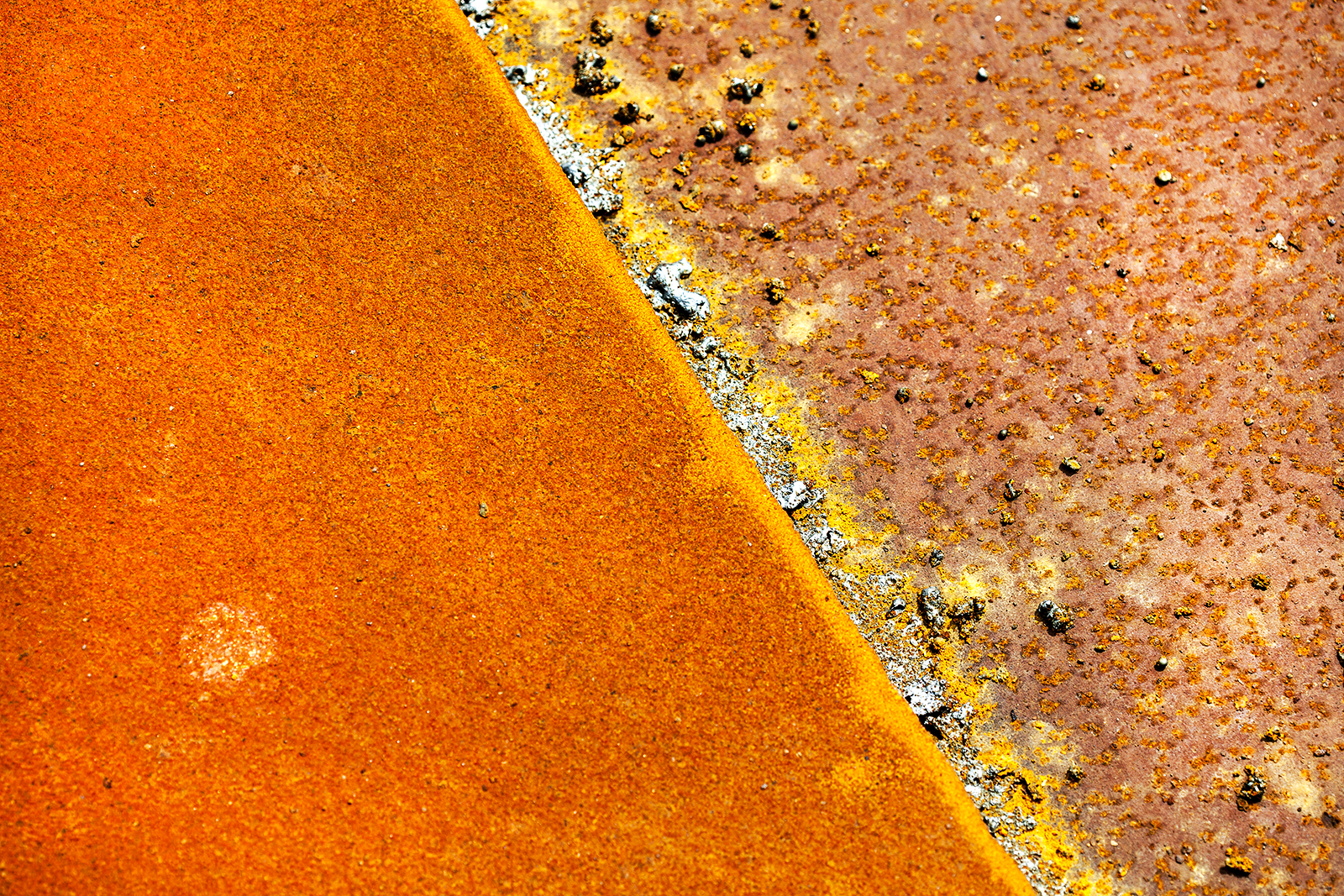
These retired coin-operated newspaper boxes call to mind two fundamental principals in the science of whole systems. The first is “entropy,” a term borrowed from the second law of thermodynamics in physics. It describes the process whereby matter gradually dissipates or declines into a state of disorder. Throughout the universe, entropy always and inevitably increases with time.

The compounds that constitute mechanical and biological systems revert to their elemental state. Social systems either die or transform to live another day. No exceptions.  The rust on these boxes is evidence of entropy. Had they been treated properly, maintained with oil or fresh paint, entropy would have been inhibited. Being nonphysical, spirit and soul are not subject to entropy. They are immortal.

The way the newspaper boxes stand, lined up like soldiers facing a Drill Sargent, calls to mind the system’s principal of “holism.” To manage mechanical and human systems in the face of entropy, scientists investigated their part-whole relationships and made a key distinction between mechanical systems, which have “parts” that can be repaired or replaced, and living systems that have “members” who make individual choices. Replace a part in a mechanism and it will resume its function. But replace a member of a team and the whole system changes. It will function differently as a result.

To underline the significance of members in living systems, author and journalist Arthur Koestler observed they have higher and lower relationships. Like nested Russian dolls, individual members “stand” in relation to higher order systems above them and lower order systems below. He characterized individual whole systems, wherever they stood, as “holons.”

An example is the human body. Below, it consists of member organs, and below that cells and even lower order holons down to atoms and quarks. Physicists haven’t gone below that because quarks blink in and out of existence from apparent nothingness. Current thinking points to “consciousness,” but that’s a contemplation for another time. Higher order human systems, those above the person, include family, church, special interest groups and social systems on up to governments, nations, humanity and the universe—each themselves, wholes within wholes.

And this relates to entropy because, fortunately, degradation of both mechanical and living systems can be interrupted by caring, increased attention and increased information. By meeting challenges and overcoming the limits of the past, humanity has evolved. And with each advance comes new and sometimes even more complex challenges, setbacks that are at times so severe there isn’t a clear path forward. Despite our perceptions of rising and fallings, the long-term evolutionary trajectory, physically and socially, is toward increased complexity and consciousness.

In The Eye of Spirit: An Integral Vision For a World Gone Slightly Mad  philosopher Ken Wilber asks how we account for the ups and downs of human evolution.

Because evolution proceeds by differentiation and integration, some things can go wrong at each and every stage. And one of the most prevalent forms of evolutionary pathology occurs when differentiation goes too far into dissociation. It is one thing to differentiate the mind and body, quite another to dissociate them. Differentiation is the prelude to integration; dissociation is the prelude to disaster. 

An evolving holon transcends and includes its predecessors. Atoms unite to form molecules, which form cells, which constitute complex organisms, and so on, all the way to the universe. Each stage of development includes its constituent sub-systems and adds its own unique and emergent qualities.

With pathologies, the senior dimension doesn’t transcend and include, it transcends and represses, denies, distorts, disrupts. Each new and higher stage has exactly this choice: transcend and include, befriend, integrate, honor; or transcend and repress, deny, alienate, oppress… The brighter the light, the darker the shadow. The acorn has to differentiate in order to grow into an oak. But if you see every differentiation as a dissociation—if you thoroughly confuse the two—then you are forced to see the oak as a terrible violation of the acorn. And thus, the solution to any problem faced by the oak is: we must get back to our wonderful acornness. The solution, of course, is just the opposite: find those factors that prevent acorns from self-actualizing as oaks, and remove those obstacles, so that differentiation and integration can occur naturally instead of drifting into dissociation and fragmentation.

Arrogant, ego-centric holons (cancer cells, self-centered individuals, dictators) don’t want to see themselves as parts within a whole. They want to be a whole unto themselves. They don’t want to integrate, collaborate, cooperate or be part of something larger than oneself. For them, progress is perceived as a threat. No sharing. No empathy. No compromise or communion with fellow holons.  They want so badly to dominate, to be the whole alone, they will lie, cheat, deny science and facts, promulgate falsehoods and rationalize an illogical position to achieve the status of chief decision-maker, king of the hill, top of the rubble if necessary. I, mine, me, rather than we.

In the above paragraphs Wilber is referring to larger holons such as dictators and tyrants in the context of human evolution, but pathologies can occur at any level. I, mine and me is a mindset that generally seeks inordinate gratification through acquisition, displays of power, manipulation, and celebrity in individuals as well as the larger holons. These can be overt or subtle and creep into one’s lifestyle or culture virtually unnoticed, particularly when they are glamorized or come packaged in the context of entertainment.

Because the focus of this blog is gratitude and appreciation, rather than providing some examples of dissociative values and their consequent behaviors, I will offer instead what I consider to be the antidotes to these values and behaviors—syntropic (entropy inhibitors) qualities that are commonly found in families, friends, colleagues, teachers and students. There are many, but those at the top of my list include moral and ethical decision making, authentic and creative expression, compassion, respect, inclusiveness, consideration for others, empowerment and anything that contributes to the health and well-being of fellow holons, including the greater holons within which we participate—schools, communities, churches, businesses, organizations and so on.

The take-away for me is three-fold. Through the exercise and acknowledgement of these syntropic qualities in daily life, we can overcome the entropic forces of I, mine and me. When we align with and support those who express or demonstrate these qualities, we’re encouraged to transcend our limitations and promote the energies that uplift the individual and the holons above us. And we can avoid falling into the trap of dissociation by respecting differences, honoring uniqueness, and looking for opportunities to acknowledge and celebrate our commonalities, qualities that overcome entropy.

We are all fellow travelers on Spaceship Earth… (In our era) It is the integrity of each individual human that is in final examination. On personal integrity hangs humanity’s fate. 

Buckminster Fuller, Engineer and philosopher