Chapter 3: Fine Art, Expression, Contemplation

In the early 1950s, when I was introduced to photography, the debate was raging as to whether or not photography could be considered an art form. In January 1955 Edward Steichen launched an exhibition at The Museum of Modern Art in New York City entitled, The Family of Man. While it was touring the United States, he published Family of Man: The Photographic Exhibition. Together, they demonstrated that not “anyone with a camera” could produce “art.”
Highly skilled painters re-present what they are observing. Whether on a wall or canvas, the work occurs within a fixed frame. Those skilled in the chemistry and optics of photography move the camera’s frame around to focus on a subject within it, excluding the distracting elements. Both mediums involve focused attention, an informed aesthetic and craftsmanship. Cameras today, even smartphones, can produce high quality photographs. But is it art? Certainly, it can be. That’s for each of us to decide, but a contributing factor is “value.” I don’t mean price. The value I’m talking about has to do with the significance a photograph has for the photographer.

Frames speak. They say, “Pay attention to what’s enclosed here. It matters to me. It interested or attracted me.” They do this by enclosing or “formalizing” the space within the frame and excluding everything else. From the viewer’s perspective, it commands our attention. Due to the rapid increase in the number and varieties of electronic devices, the opportunities to frame images, words, events, ads and entertainments of all sorts have grown exponentially in just a few decades, creating what some have called an “attention economy.” It’s nearly impossible to count the number of “frames” we encounter in just one hour.
A photograph can be considered to be “art”—an artifact of creative experience—when its creator thinks of it that way. Whether or not others recognize it as such is up to them. At the very least, putting something in a frame gives it value. A quality photo of my family in a 5×7 frame sits on my bookshelf. It’s a keepsake, not art. If I were to mount that print on a 16×20 museum board with a cover mat showing lots of white space, enclosed in a wood frame and hang it on a gallery wall, its value to me would instantly be recognized by others; it would likely attract their attention and they’d ask about it, curious about its significance. But they wouldn’t consider it an object of art. The intent of the person taking the picture was to capture a moment, not to make art. And there was little if any evidence of that person’s skill with a camera or concern about aesthetics.
Serious photographers consider an electronic file an image, a potential photograph. It’s not a photograph until it’s printed. It’s also why they only show their best works, mat and frame them, whether or not they will be exhibited publicly or offered for sale. It’s the photographer’s intention to create something new, the application of certain aesthetic preferences and skill in execution that constitute a “fine art” photograph. Another term used to characterize an artistic approach to photography is “expressive.” It’s where the maker invests more thought or feeling in the process, with the intent to convey one or the other.
An approach to photography that includes expression, is “contemplation.” Here, throughout the process, the intention is to use make and use photographs as vehicles for reflection and self-discovery. When considering a print, questions are asked about the subject and its representation. And they’re ideally written in a journal. What was the attraction? Why did I photograph this? If an object, what was its history? What does it say about humanity, society, the culture, our times and me? Which of the aesthetic dimensions were operating in me when I shot this? What can I learn from this? Does the photograph capture the spirit, the essence of this object or person?

The motivation for capturing the “spirit,” the essence of a subject, is personal growth and spiritual development, beyond recognition of monetary gain. Whether on location or in the studio, key to this approach is being open to guidance—intuition—and paying attention to the energies of attraction. Once a setting or subject has been identified, the “pull” of the mind’s eye—ideally the heart—triggers thoughts about how to frame the elements involved and decide the physical and aesthetic preferences that would best reveal its essence. Black and white works far better for this because it emphasizes form, composition and texture. Color too often dominates, making itself the principal feature of a photograph.

Philosophers find a basis for the law of attraction in the idea that “like attracts like.” To my knowledge this hasn’t been scientifically tested, but because I’ve become sensitive to the feeling of “resonance” and the reality of interconnectedness when I’m out with a camera, I pay close attention to what attracts me.
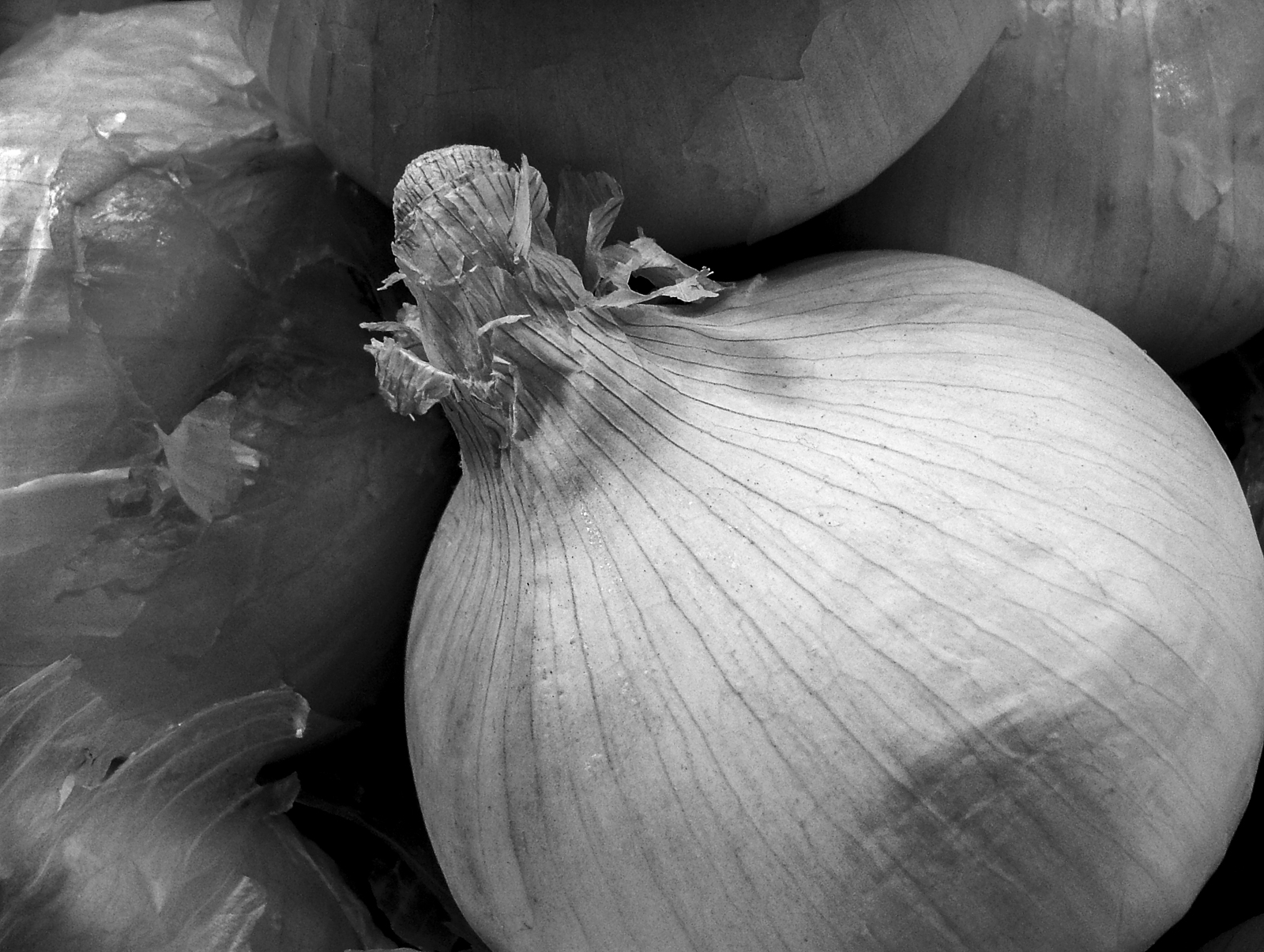
Early on, I went looking for subjects that would make a good photograph. But after years of analyzing my collection to understand what worked, what made a print “numinous”—expressive of spirit—I realized that I’d been guided to certain locations and subject matter, and that my aesthetic preferences were a significant contributing factor. For instance, after an outing where I’d been shooting landscapes, I got in my wife’s car to go grocery shopping. I hadn’t intended to shoot anything in the store (many don’t allow cameras inside), but I didn’t want to leave the camera in the car. Browsing the produce section, I was drawn to this particular onion among hundreds of others because of its geometry, gradation and simplicity—three of my aesthetic preferences.
The act of photographing with creative intention is mindful. However briefly, framing and focusing a camera requires us to be present and attend to a momentary attraction. From a spiritual point of view, the value of any creative pursuit isn’t only the final product. It’s the insight, appreciation and the expansion of consciousness that occurs throughout the creative process. Those are the qualities of what lasts, because ultimately what’s under construction on this planet is love and the expansion of consciousness, not the acquisition of more stuff or more thrilling experiences. The energy of attraction—love actually—is one of the ways the soul directs our attention to what matters in the trajectory of our personal growth and spiritual development. Considering this, the proper response to all creative expression, whatever the medium, is gratitude.
We are not alone here. Something is watching. Something is listening. I would say that the ‘something’ that is listening is everything: earth, sky, water, air, rocks, trees, animals, plants… along with beings we do not see and that have no name (in English anyway). Matter is sentient, watching, listening; God, you might say, is in all things, and nothing is not God.
Charles Eisenstein, American public speaker, teacher, author
Recommended Practice
STEP 1: Take your camera to a park with the intention of creating a “fine art” photograph. Take many shots. Make a large print of the one that you think worthy of being displayed.
STEP 2: Take your camera to a busy street intersection with the intention of creating a photograph that says something about people, the culture, our times or the world. It can be an idea or feeling, perhaps both.
STEP 3: Considering the images you gathered, make a large print of the one you like “best.” Alone, where you won’t be distracted, write your responses to these questions as you observe the print. Ask the questions:
- What attracted me to this?
- What was the history here? How did this come to be or happen?
- What does this say about humanity, society, the culture or our times?
- What does this say about me?
- Which of the aesthetic dimensions are operating here?
- Does this capture the spirit, the essence of (whatever it is)?
 Contemplative Photography