
Introduction
This begins a series of posts on the subject of whole systems thinking. After the topic is introduced, I’ll offer a contemplation that relates to the headline photograph and text.

Historically, patterns observed in nature were discussed and documented in China five thousand years ago, before they were articulated by Lao Tzu (Gia-fu Feng, 1968) in the 6th Century B.C.E. In 1968, Ludwig von Bertalanffy, regarded as the father of systems science, published General Systems Science, which quickly came to the attention of engineers and physical scientists.
A decade later, James Grier Miller (1978) elaborated Bertalanffy’s principles and applied them to living systems in his seminal book entitled Living Systems. Since then, scholars, scientists, engineers, information theorists, artists and philosophers have drawn on these sources and created a gestalt, a way of thinking about complex whole systems from the wristwatch to the universe, in order to better understand, appreciate and especially manage part-whole relationships. The story is told that, after President Kennedy committed the nation to the moon mission, NASA scientists drew heavily upon general systems science as a guiding principle to ensure a successful outcome.
Simply put, whole systems theory involves the consideration and management of part-whole relationships as a way to better understand and manage complexity. It’s about getting relationships right and sustaining them. As a thought process, this way of thinking is not a panacea, but it has tremendous practical value when it comes to keeping things going, particularly in the areas of human-machine interfaces, team building, organizational development, business protocols, political and social cohesion and creative endeavors.
The benefits are many, not the least of which is understanding the interrelations of mechanical and living systems, including the observation that living systems are constituted of smaller sub-systems and at the same time nested within larger whole systems, all of which are interconnected and interdependent. It’s this observation that is detailed in the books “Web Of Life” and “The Systems View of Life.” I highly recommend both publications. In scientific and technical circles, this framework is referred to as “General Systems Science.” In other settings, it’s simply spoken of as “Systems Thinking.” Because it has nearly universal application, and because I have been a long term student, practitioner and frequent beneficiary of systems thinking, I wanted to share it with you. I hope you’ll find this series both interesting and useful.
What Is A System?
According to Bertalanffy: “A system can be defined as a set of elements standing in interrelation among themselves and with the environment.”
Closed and Open
In “closed” systems, no material enters or leaves. All mechanical systems—watches, vehicles, electronic devices and appliances—are closed systems.
“Open” systems exchange matter with their environment, inputting and outputting, building-up and breaking-down its material components. All living systems are open. They evolve. Bertalanffy says: “Life is not comfortable setting down in pre-ordained grooves of being; at its best, it is élan vital, inexorably driven towards higher forms of existence.” Mechanical systems perform a function according to their design, and that’s all they can do—the movie “Transformers” to the contrary. The function of living systems, on the other hand, is to stay alive and continually make itself more, thereby contribute to the development of higher orders of complexity in an evolutionary process.
Simple And Complex
Within open and closed systems, we can discriminate between simple-systems that have few parts and complex-systems that have many. The more parts an assemblage has, the more complex the relations between them. And the more complex the relations, the greater the need for management in order to overcome a systems worst nightmare—entropy.

A relatively simple system.
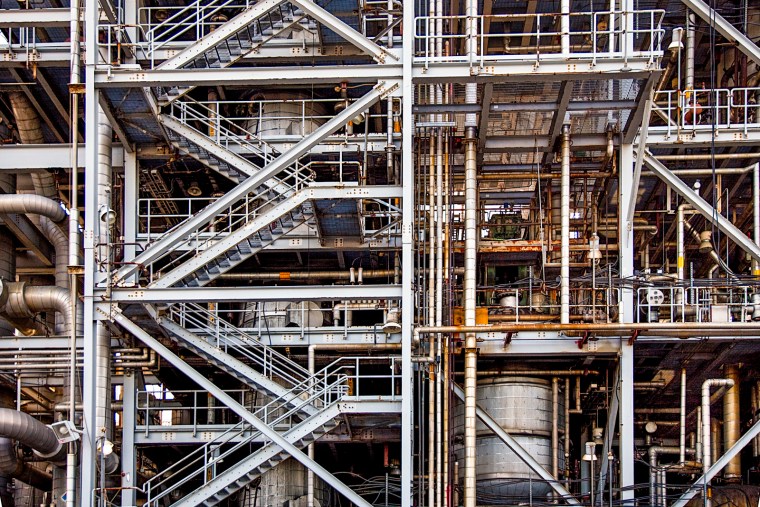
A much more complex system, requiring significant management, constant maintenance and upgrading.
Entropy
According to the Second Law of Thermodynamics, matter dissipates. Given time, it diffuses and eventually reverts back to heat energy. It’s in a constant state of disintegration. Dust to dust. Iron rusts; bones break; computers fail; noise disrupts communication; relationships and businesses fail; nations and civilizations come to an end. Nothing material, at any scale, endures forever. But there is a counterbalance to the forces of entropy.

Syntropy
Any energy, work, force or action that retards deterioration or disintegration is considered “syntropic.” Oiling a metallic surface prevents it from rusting. Putting fresh batteries in an electronic device keeps it running. Good dental hygiene prevents gum disease and promotes overall health. Feeding, complementing and rewarding a work crew encourages continued performance. Frequent communication improves relationships. Higher values and shared vision enhance social coherence and growth.

Contributors to Syntropy
- Information: The more and the higher the quality of information input, the more entropy is overcome.
- Order: Acts of ordering within living systems contribute to their survival and growth because they maintain the parts (members) in right relationship. We may need an electron microscope to see the infinitesimal order in atoms and space-based telescopes to it in the cosmos, but what we find at both extremes is exquisite order. Biologists understand that it’s the arrangement of atoms, molecules and cells that determine morphology, what a living expresses—is.
- Communication: More and better communication promotes knowledge, understanding and the desire to do what’s necessary to keep a living system alive and functioning. “Desire” to move, interrelate and express is innate in lower order systems, such as atoms and cells. In humans, it dominates consciousness.
- Positive or Constructive Fields. Calm, life-enhancing environments promotes cooperation, collaboration and intelligent creativity, realizing potentials that will contribute rather than retard growth.
- Affinity. When there is a connection between individuals or entities that is beneficial, respectful and harmonious they are in “right relationship.” In living systems it promotes sustainability and growth.
Contemplating Our Political System
Our political systems are in crisis because we citizens have inherited and sustain dysfunctional thinking. “Polarization,” for example, is not the problem. It’s a consequence of the erroneous perception that human beings are separate from each other, nature and the planet. This assumption, combined with capitalism which says, in effect, that you are free to own property, start businesses and make economic decisions without excessive government control has resulted in mass self-centeredness where many citizens feel free to disadvantage their neighbor, lie, cheat or steal to get what they want. It breaks down trust, which leads to increased separation and division into ethnic and ideological camps.
In a democracy, differing points of view are normal. As political systems grow and become more complex, the challenge for its members is to quantify and analyze growth within the system in the context of its changing environment. The “me, my, mine” perspectives of the past, when maintained, lead to increasingly severe breakdowns and dysfunction. The healing of a nation, which is a conscious living system, requires its citizens to adjust their thinking about how they relate to one another and the whole. Systems thinking helps them do this. I’ll elaborate on the “how-to’s” of managing personal, social and national complexity in postings to come.
Looking back, blaming and criticizing is a waste of time and energy. What’s needed is widespread education at all levels, directed to the realization that, although we see ourselves as separate individuals, we are interrelated and interdependent co-creators of the whole system, and that the nation is also an interdependent sub-system of a greater whole—humanity, which is a subsystem of the planet. And so on. Running parallel to this is the need to understand that the actions of each citizen, positive and negative, ripple a complex of influences into the environment and the whole within which they are a part.
Small changes in one part of the system can have profound implications for all else in the system… When we make choices about how we live our lives, we are having an impact far beyond our own immediate circumstances. Those impacts can extend not only to the rest of the planet but also to future generations.
John Donne, co-editor: Ecology, Ethics, and Interdependence)
It bears repeating: human beings are interconnected and interdependent. I am responsible for myself and the integrity of the wholes within which I participate as a member. The deep understanding of how living systems work should come from parents and educators at all levels. It can and should also come from television and advertisers, business mission statements and directives and churches.
A shift in thinking at the bottom of the social pyramid is the way to co-create positive change. A rapid shift, the kind that climate scientists are urging, requires it—and responsible action at the political level in every nation. Because citizens in a democracy suffer the consciousness of their elected leaders, it’s important to elect individuals who understand and appreciate the dynamic of whole systems thinking. Climate scientists from all nations have sent the message loud and clear: either we learn the hard way, through trial and error, or shift our thinking from “me first,” to “planet first.”
A human being is part of the Whole… He experiences himself, his thoughts and feelings, as something separated from the rest… a kind of optical delusion of his consciousness. This delusion is a kind of prison for us, restricting us to our personal desires and to affection for a few persons nearest us. Our task must be to free ourselves from this prison by widening our circle of compassion to embrace all living creatures and the whole of nature in its beauty. Nobody is able to achieve this completely, but the striving for such achievement is, in itself, a part of the liberation and a foundation for inner security.
Albert Einstein
I welcome your feedback at <smithdl@fuse.net>
My portfolio site: DavidLSmithPhotography.com
My photo books: <www.blurb.com/search/site_search> Enter “David L. Smith” and “Bookstore” in “Search.”
 Contemplative Photography
Thanks…but, no thanks. David you have made me think deeply about many things over the years but this makes my head hurt! Ok, the pain will eventually lead to a higher level of entropy. I struggle with the concept of global coexistence and it’s relationship to roles and responsibilities. My brain is just too small – maybe it will take AI to help us solve the many questions I have.
I look forward to how you develop the whole systems thinking in various contexts. Please include Deepak Lel and “unintended consequences” relation to WST.
Thanks, Paul
LikeLike