
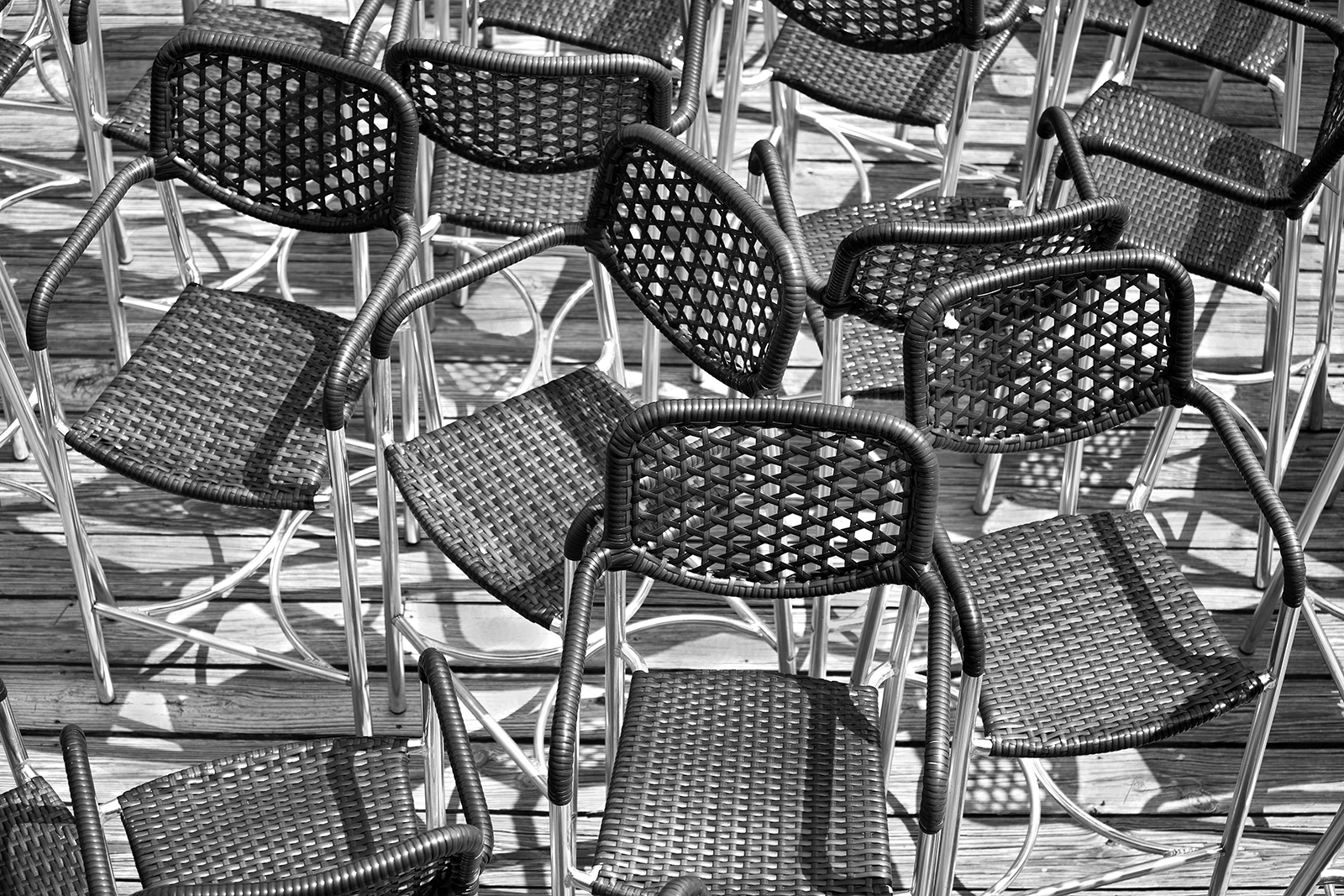
The random arrangement of visual elements juxtaposing lights and darks in this image comes near to creating abstraction because the subject matter is easily “read.” Another aesthetic feature here is the number of visual elements, each tonal change representing one of them. The more there are, the more complex the image, so there’s increased potential in the amount of information that can be derived such an image.
For instance, a photograph of just one chair would communicate “Look at this chair.” Consciously or unconsciously the viewer would wonder what’s so special about it? The image of multiple chairs generates many more questions: Where are these chairs? Who sat in them? Is this the random aftermath of a business meeting, party or ceremony? Or were these chairs just set to one side so someone could clean the other side of the deck? And is this really a deck? It could be a boardwalk. Might there be more than meets the eye here?
Abstracted images tend to challenge us, however briefly, to make sense of what we’re seeing. We want to grasp the meaning, part of which has to do with why the artist formalizing the subject matter within a frame. What did he or she see? And what’s so special about this subject that we should give it our attention? In this we’re attempting to understand the image-maker as well as the object represented.
In looking at an object we reach out for it. With an invisible finger we move through the space around us, go out to the distinct places where things are found, touch them, catch them, scan their surfaces, trace their borders, explore their texture.
Rudolf Arnheim (Art Theorist)
In many, if not most instances, the mind of the artist is as important as the subject being represented. We’re always trying to validate our world view or understand if there’s value in someone else’s perception that we might be missing, particularly when there’s a discrepancy. It’s why art historians, critics and others maintain that the function of art is to challenge, upset or overturn conventional ways of seeing and thinking.
According to social psychologist, Roy Baumeister, “What sets human beings apart from animals is not the pursuit of happiness, which occurs all across the natural world, but the pursuit of meaning, which is unique to humans.” This, in my view, is the highest function of fine art. However we engage, use or perceive creative works, and irrespective of medium and intent, those who produce it are holding up a mirror to show us who we are, how far we’ve come and what we’re capable of accomplishing. In the process, through the choices they make, is reflected in who they are, how they see and what they value.
So, art plays a significant roll in making sense of diverse personal and social realities. It attempts, and at times defines what it means to be fully human. Across all levels, media and applications, the making and observation of works of art engages us in acts of self-reflection and discovery. Just as instruments reach out to explore space and the depths of the oceans, works of art reveal the dimensions and beauty of the human spirit—wherever and however they are. Even when produced by artificial intelligence which, let us remember, lacking a heart and soul it can only produce through reference and imitation, never through inspiration.
A society that regards the function of “art” as entertainment and appreciation alone, fails to understand that its engagement is nutrition for the collective mind, heart and soul. Museums are not just warehouses for historic and contemporary treasures. They’re arenas rich with potential to stimulate the higher human faculties of observation, imagination, empathy, experimentation, discovery, critical thinking, symbology and aesthetic awakening all toward understanding and making sense of who we are, what we’ve come through and what we can accomplish.
Fundamentally, through expression, artistic works generate questions and stimulate the evolution of consciousness. Some may think this a soft or inconsequential enterprise compared to art produced for the art market, but I would argue that it’s essential for maintaining and advancing the quality of life across the spectrum of time and cultures.
Like the seers and oracles of old, Art sings and shouts from the axis of truth to wake us up to who we are and where we are going.
Alex Gray, Artist
__________________________________
My other sites—
Love And Light greetings.com: A twice-weekly blog featuring wisdom quotes and perspectives in science and spirituality intended to inspire and empower
David L. Smith Photography Portfolio.com: Black and white and color photography
Ancient Maya Cultural Traits.com: Weekly blog featuring the traits that made this civilization unique
 Contemplative Photography