They apply to everything, not just families
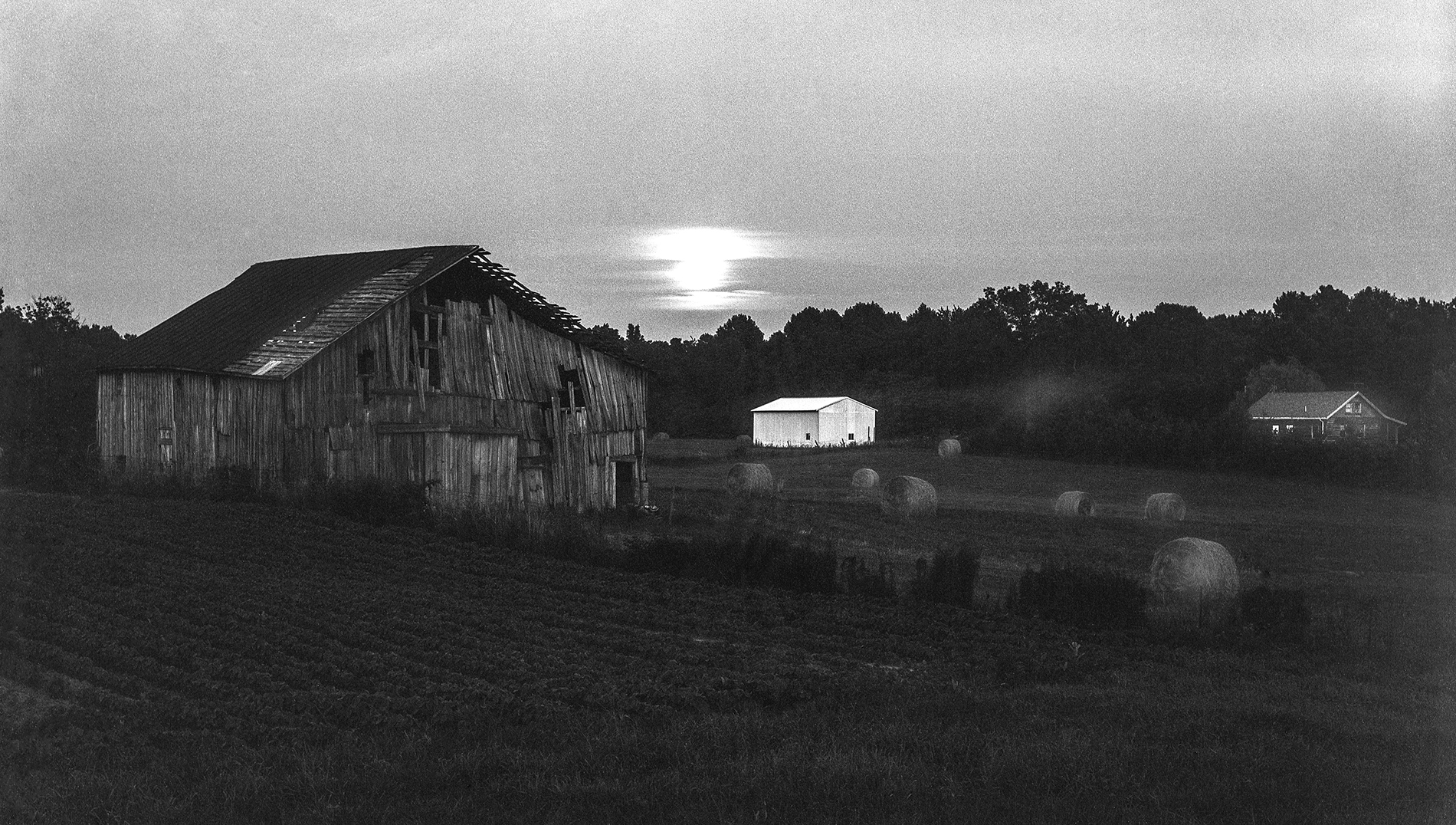
This image conjures for me an imagined family, perhaps two or three generations of farmers. The decaying barn speaks of a generation when the field was plowed with horses that, along with feed, seed, tools and machines required a shelter that didn’t require plumbing or heating. And wood was the building material of choice. I contrast this with the white modern structure in the background, which was more likely to be made of durable aluminum siding. Rather than a few horses, it can shelter horsepower by the hundreds in the form of combustion engines used to reshape and plow the land, plant seed, fertilize the soil and harvest crops. Mechanization changed everything for farmers.
Today, I imagine the farmer who lives in this house with his family, separately and at times together, using the tools of the electronic era where televisions provide information and entertainment while smart phones and computers connect them to relatives, friends and others a world away. All this for a year at about the cost the farmer’s grandfather would have paid for a bucket of nails to build the barn.
Rewinding the calendar, I observe that this little piece of land was inhabited and cultivated for probably less than three hundred years. Before that it was part of the great mid-eastern woodland where Native Americans reported to settlers that a squirrel could climb a tree on the east coast and not touch the ground until he reached the Pacific ocean.
An imaginary motion picture camera established on this spot after the extinction of the dinosaurs would record a lush jungle and then it would be submerged in a vast sea. When the water receded and the land became lush with forest again, there would come a period of increasingly cold winters with the eventual buildup of snow and ice forming glaciers two hundred feet above where that barn is now. I notice the time scale of these climate changes and compare them against the comparatively instantaneous changes that began to take place with the first people who settled on this property.
Through all these changes there have been two physical components that were common throughout—the sky above and the earth below. Whatever the extremes of climate, the watery atmosphere held back the harmful rays of the sun and let through those that promoted the emergence and growth of living systems.
Because the earth condensed from a ball of cosmic fire, it had the right combination of elements in just the right places to encourage the water and life that, as physicists theorize, was brought here by asteroids. A photograph such as the one above, helps me to reflect on what happened and extend the contemplation to the places where I live and visit. Another impetus in this regard is the memory of places that were significant in our lives but are no longer there.
For instance, the apartment building where I lived until I was ten is now a series of stores, and the factory that was next to us is now a restaurant. Passing by them, I remember much about the neighborhood and wonder if anything other than forest was on that land prior to the apartment building. Actual and imagined perspectives such as these remind me to appreciate what is. It also provides a touch of insight into the grand universal currents of change at a time when dramatic change is literally in the air and on the airwaves.
When we speak of “generations,” the reference is usually to human families. But the term can be expanded to include all cycles of change. Everything changes. Actually, the signature characteristic of living systems is change. Fearing change with respect to our bodies, families and properties is natural. However, the observation of larger cycles can also elicit our appreciation, particularly when they display order and resilience.
In Quantum Enigma: Physics Encounters Consciousness, Bruce Rosenblum and Fred Kuttner point out that “If the initial conditions of the universe were chosen randomly, there would only be one chance in 10 to the 120th power that the universe would allow life. Roger Penrose has it vastly more unlikely: 10 to 123rd power. The chance that a livable universe like ours would be created is less than the chance of randomly picking a particular single atom out of all the atoms in the universe.” And yet, here we are.
The probability of life evolving through random genetic variation is about the same as the probability of a hurricane blowing through a scrap yard assembling a working airplane.
Fred Hoyle, English astronomer
_________________________
 Contemplative Photography
David,
Fabulous post and incredible picture in this week’s Contemplative Photography!
To satisfy my instincts, however, I imagine an image where the modern white barn and farm house are Photoshopped out…leaving only nature and the dilapidated barn. I realize that you were going for contrast between the two, but for me the old barn says it all and captures the utter soul of the image…and eventual entropy of all things!!!
John
LikeLike