The Color “Green”

It’s not “out there.” It’s in us.

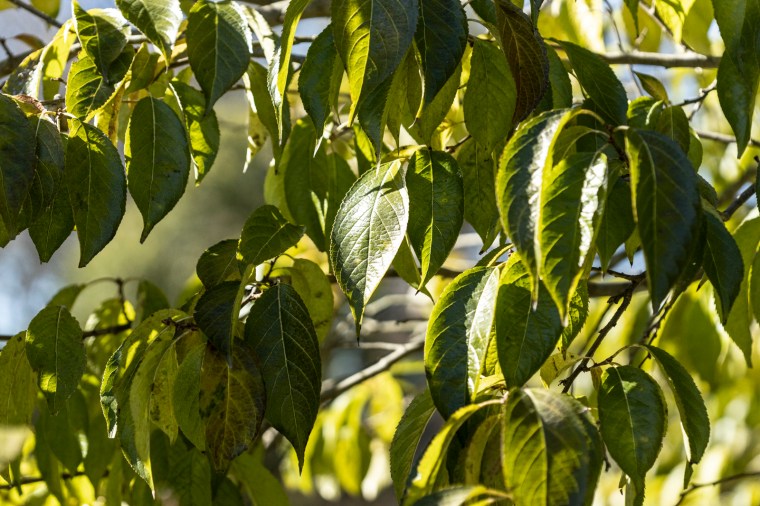
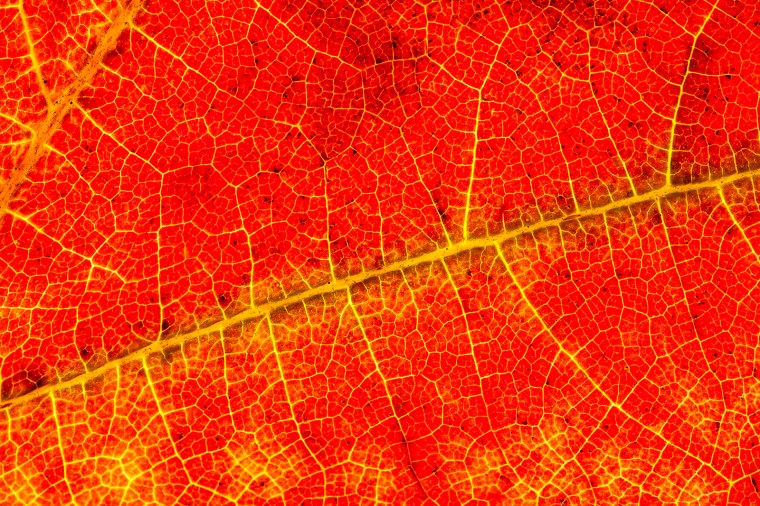
The above color and form evoke in me a sense of calm, and at the same time a feeling of strength and vibrancy, of life rising up—life both simple and complex. The cells are like pixels, individual packets of information, each unique with a life and mind of its own, contributing to the maintenance and growth of the organism.

All living systems consist of holons, whole systems composed of living sub-systems. In the human body there are an estimated 30 trillion non-human cells, each of which makes split-second decisions about its functional relationship with its neighboring cells and neurons. Red blood cells live for about four months; white blood cells live on average more than a year; skin cells live about two to three weeks; colon cells die after about four days.

In keeping with my propensity to trace subject matter back to its origins, I see in these leaves the genetic inheritance of structure and color—a system that maximizes surface area for the absorption of light coming from above (the sun) with vertical channels that, like rivers, deliver nutrients from the soil below—a perfectly integrated living system.

Plants are “green” because of photosynthesis, their ability to absorb sunlight and convert it into energy for growth. The key ingredient is mostly chlorophyll, a pigment molecule that absorbs “blue” and “red” frequencies, allowing green to be reflected. That’s the gist of the scientific explanation. Objectively however, there is no color in the world or in the brain. It’s the interpreting faculty of the mind—consciousness—that gives all light its apparent color. When signals sent from the eyes to the brain report the absence of blue and red spectral frequencies the brain says in effect, “Considering that red, green and blue are the primary colors of the spectrum, if it’s not blue and red, it must be green!” And of course, that happens continuously at the speed of thought.

Nonetheless, the experience of a particular color can generate meaning and trigger emotions that we share. For instance, “green” is associated with positive feelings. NIH’s National Library of Medicine cites the results of studies on the positive effects of green as it occurs in nature. “Green natural environments generated therapeutic and positive effects, such as fostering recovery from surgery (Ulrich, 1984) and subjective well-being (Kaplan, 2001van den Berg et al., 2003). Studies focused on exercise under controlled laboratory environments also revealed that perceiving green enhanced positive affective and cognitive outcomes (e.g., enjoyment, self-esteem, motivation) and diminished negative ones (e.g., mood disturbance, anxiety) (e.g., Akers et al., 2012Barton et al., 2012Briki et al., 2015Briki and Hue, 2016).”

We tend to relax when we’re experiencing or even observing nature, which is mostly green. As reported in a 2019 National Geographic article, the Japanese initiated a physiological and psychological exercise called shinrin-yoku  (“forest bathing” or “taking in the forest atmosphere”)  as an “eco-antidote to tech-boom burnout and to inspire residents to reconnect with and protect the country’s forests.” My appreciation of green is further enhanced considering that without plant life, animal and human life would never have evolved—at least not on a watery planet and in the forms we know today.

In one of my novels of the ancient MayaJaguar Sun: The Journey of an Ancient Maya Storyteller—the protagonist wonders why trees and plants are green. Since red is the color of blood and blood is the source of life according to his view of the world, shouldn’t the forests and plants be red rather than green? That makes sense. But fifteen hundred years later we understand that neither blue nor red has the capacity to photosynthesize, to absorb sunlight and reduce CO2 into sugars or other biological reactions necessary to sustain plant life.

I  want you to understand that there are no colors in the real world. There are no textures in the real world. There are no fragrances in the real world. There is no beauty. There is no ugliness. Nothing of the sort. Out there is a chaos of energy soup and energy fields. Literally. We take all that and somewhere inside ourselves we create a world. Somewhere inside ourselves it all happens. The journey of our life.

                        Sir John Eccles, Noble Prize-winning neurophysiologist

______________________________

My other sites—
Love And Light greetings.com: A twice-weekly blog featuring wisdom quotes and perspectives in science and spirituality intended to inspire and empower
David L. Smith Photography Portfolio.com: Black and white and color photography
Ancient Maya Cultural Traits.com: Weekly blog featuring the traits that made this civilization unique

Singular Purpose or Vision

Many Become One Through a Process of Coalescence

Systemically, an orchestra consists of a whole greater than the sum of its parts. Through loving collaboration—the characteristic feature of “synergy”—each musician contributes to a complex of sounds beyond the capability of his or her competence with an instrument, even beyond the full realization of their individual potential. In this image I observe the interplay of the many and the one. At a performance it appears that the musicians are playing the notes on the page, so much so the conductor may appear to be superfluous.

The conductor doesn’t just synchronize the players according to the score, he coalesces them into a whole that presents his or her interpretation of the composer’s intent. Having played third saxophone in my high school orchestra, I experienced the significance of the conductor firsthand. Our teacher, Mr. Bushley, provided the vision and shaped our diverse abilities and instruments into unique and hopefully stirring performances. As interpretations, no two performances are exactly alike.

Certainly, the score could be played without a conductor. Indeed, the musical composition would occur, but it would not “sing.” It would not express a singular vision, not even that of the composer. Although Mozart wrote the score for each instrument, it was the manner of his interpretation and conducting that gave the notes tonalities and rhythms, a vitality and richness that had been fixed on the page.

In system’s parlance, notes on a page are simply “data.” So strictly speaking, the performance is not the score. Like a recipe for stew, the sound attains quality through a process of combining the right ingredients at the right time and in a certain way. A conductor might say “Louder here, softer there; here with gusto, there not so much; let the woodwinds carry this phrase.” In that way, each performance is unique. That’s why an orchestra can have only one conductor, one interpreter. Otherwise, there would be breakdowns and chaos.

Whatever the collaborative field—movies, business, media, government or military—outstanding performances more often come from systems where individual members perform under the guidance of one person who has a vision of the outcome and is authorized to manifest it. Certain popular novels written by two authors fall flat compared to the those written by the “name” author. In the case of screenplays, those written by committee aren’t as compelling as those written by one person, especially when the writer is also the producer and director, a singular visionary. This also applies to sports where competition is institutionalized. From experience, coaches need to have the vision of a winning team and hopefully the motivational skills needed to coalesce the players into a functioning whole. It’s the task of ship captains, religious leaders, small business owners, publishers, museum directors, CEO’s and the President of the United States.

Collaboration under the direction of a single individual can be a daunting challenge, in part just to convince the participants to value and respect the vision in the first place, and then trust that the visionary can deliver it, enough that the members will surrender to it, ideally to wholeheartedly embrace it. And here’s a crucial point across the board. In the example of an orchestra, it can appear that the musicians organize themselves for the good of the whole—the performance. In system’s theory however, the principal is reversed— “the whole organizes the parts.”

It’s the love of music, that brings musicians together. Because thought always precedes action, the challenge of leaders is to communicate what they envision clearly and with passion so they will attract the best “players.” And the challenge of those aspiring to be leaders is to find leaders within their field and learn from them, noticing in particular how they are uniting the many into one.

In my Lifestyles and Workplaces in Television and Film classes, I observed that employers in creative fields hire the best players, the most competent and responsible people, they can find. They must do that to insure the realization of their goal or vision. Rather than look for jobs (a contract exchanging time and energy for money), I recommended that students understand their special gifts, what they have to offer, and consider instead looking for work (time and energy directed toward fulfillment as well as money). And while growing in knowledge, building skills and researching prospective employers, immediately demonstrate competence and responsibility by doing what they say they will do.

I also pointed out to students that most of their grandparents didn’t have the luxury of pursuing work that was fulfilling. Of necessity, their choices were limited to earning a living through jobs however they could, wherever there was an opportunity. It’s important for young people to appreciate and not take for granted the family, social and political circumstances that allow them the freedom and opportunity to fulfill their dreams as well as earn a paycheck.

Individual success depends on environments that trigger the fulfillment of our genetic potential. Environments that motivate through fear literally shut down the potential for growth. Those that motivate through vision, open us up to express unforeseen possibilities.

Bruce Lipton, Biologist

Author, The Biology of Belief: Unleashing the Power of Consciousness, Matter & Miracles

________________________

My other sites—
Love And Light greetings.com: A twice-weekly blog featuring wisdom quotes and perspectives in science and spirituality intended to inspire and empower
David L. Smith Photography Portfolio.com: Black and white and color photography
Ancient Maya Cultural Traits.com: Weekly blog featuring the traits that made this civilization unique

Silence / Stillness


Sometimes a photographer is gifted with an image that’s just too precious for words. The evocation is so pure, so gentle and quiet the only thought I want to give to this one is a silent “Ahhh!” Perhaps that’s the greater appreciation.

Silence is God’s language, everything else is a poor translation.

Deepak Chopra, Indian-American author, philosopher and alternative medicine advocate

____________________________

My other sites—
Love And Light greetings.com: A twice-weekly blog featuring wisdom quotes and perspectives in science and spirituality intended to inspire and empower
David L. Smith Photography Portfolio.com: Black and white and color photography
Ancient Maya Cultural Traits.com: Weekly blog featuring the traits that made this civilization unique 

Seeking Substance

From Above and Below

Whether planted by a human being or disbursed by an animal or bird, seeds gravitate downward toward life-giving substances—water and elemental nutrients. The root of this dried Queen Anne’s Lace plant shows how it reached into the soil in a variety of directions, and we can estimate by the size of the roots which of the “fingers” were more successful in finding those nutrients.

Rather than have one descending root, the evolutionary strategy of a plant or tree is to fan out many fingers, each of which develops a unique profile depending upon the “riches” that it finds. In this way each finger makes its own contribution to the growth and development of the whole, enabling it to rise where there’s even more life-enhancing substances—air and sunlight. So, nutrients from below combine with light and air above to promote growth, vitality and the ability to reproduce—actions that continue the species and provide higher species—birds and mammals—the nutrients they need to survive, grow and reproduce.

Of course, there’s much more science involved. But from the point of view of this general reflection on the seed-to-plant process evoked by this little root, some key dynamics stand out in relation to my own process of seeking life-giving substances. And they evoke some self-assessment questions.

For instance, to whom, what and where am I reaching out to find and secure the physical, mental, emotional and spiritual substances that contribute to my growth and development? Am I choosing real substance, or am I substituting artificial or imitation goods and experiences that, while satisfying or entertaining, don’t contribute to my growth? Some of these include drinking beverages loaded with sugar or caffeine, overeating fast foods, eating processed rather than organic foods, engaging in mundane absorptions like mindless television viewing or spending an inordinate amount of time with electronic devices rather than reading, studying, working, exploring nature or engaging with others. I know, “easier said than done.”

And then there’s the social questions. Am I associating with people who bring me down or lift me up? And what of the content of my conversations—on the phone or face-to-face? Do I spend much time with gossip or trivialities, as opposed to meaningful or uplifting exchanges of information, ideas and experiences? While it’s easy and can be enjoyable to indulge our base tendencies, we also have a built-in hunger for substance, nutritional input and engagement. (Here again, the caveat: “easier…”).

Our “fingers” yearn for the energies and elements that nourish body, mind and soul. But are we engaging them? What are they contributing to our lives? And what is taking shape—in me and in the world—as a result? While the soul reaches for enrichment, inspiration and fulfillment the many mental and physical stimuli in today’s world—some of them necessary—distract us so we only occasionally dip our roots beneath the surface or reach for the light of increased appreciation, understanding and awareness.

Aside from the satisfaction gained by going for substance rather than fluff, the best way I know to assess the growth of the whole person is to ask how much joy derives from our view of the universe and the choices we make. I’m not speaking of excitement or happiness, but the experience of feeling in the flow, attuned to and fulfilling our reason for being here.

And that provokes another assessment. Am I doing something every day, no matter how seemingly small or unproductive, that contributes to the realization of my purpose? And do I at least occasionally feel that I’m engaged in an activity where I lose track of time and well up with feelings of awe, gratitude or appreciation? Considering the analogy of a plant’s growth pattern, joy is the equivalent of basking in sunlight with occasional light rain. By seeking and taking in genuine substance, the stuff that feeds body, mind and soul, our reach expands and we become lighter.

Upon being asked who he was, Itzmat Ul responded, “I am the substance of heaven, the substance of the clouds.” 

Itzamat Ul was a deified Maya king of Izamal, Yucatan


Human beings are biological creatures who require meaning in their lives as much as the oxygen they breathe and the nutrients they put in their bodies.

James O’Dea, Former President of the Institute of Noetic Sciences, Washington office director of Amnesty International, and CEO of the Seva Foundation.

Author, The Conscious Activist: Where Activism Meets Mysticism

__________________________________

My other sites—

Love And Light greetings.com: A twice-weekly blog featuring wisdom quotes and perspectives in science and spirituality intended to inspire and empower

David L. Smith Photography Portfolio.com: Black and white and color photography

Ancient Maya Cultural Traits.com: Weekly blog featuring the traits that made this civilization unique

Two Difference Aspects of Reality


Inside and Outside; Hidden and Revealed

Strong backlighting reveals the intricacies of form, pattern and texture in this daylily. It’s a wonder to me that the plant has chosen, over eons of evolutionary time, to reveal its complexity and beauty in individual flowers for just one day depending upon multiples for pollination. Flowers— like every other lifeform, including human beings—have a particular strategy for maintaining survival and growth as a species. What’s going on there? Probing the peculiarities of the quantum world, physicist David Bohm published an explanation in his groundbreaking book called Wholeness and the Implicate Order. (A pdf copy can be downloaded here).

A flower’s appearance provides an excellent example of his perspective, that the reality we experience follows from an underlying reality that we don’t see. He refers to it as an “order.” The analogy he uses to represent reality is a rolled-up carpet—

Consider, for example, a carpet. The carpet may be regarded as consisting of two basic aspects: its explicit, measurable aspect (its length, width, color, texture, etc.), and its implicit, unmeasurable aspect (its overall design, the way the colors and textures are interrelated, etc.). Now suppose the carpet is rolled up and put away. In this state, the explicit aspect is hidden, but the implicit aspect remains, folded into the rolled-up carpet. This implicit order can be made explicit again by unrolling the carpet.

Similarly, in the implicate order, the universe is like a rolled-up carpet. The explicit aspect of the universe (the manifest world of separate objects and events) is like the unrolled carpet, while the implicit aspect (the enfolded, unmanifest order) is like the rolled-up carpet. The implicate order is not manifest, but it can be unfolded into the explicate order of manifest reality. (Pages 11-12 of his book)

What we’re experiencing moment-to-moment is a reality that’s not predetermined, but underlying it are universal rules, connections and principles. While the physical manifestation follows these rules without question, human beings possessed of free will could choose to align themselves with them. Or not. Dr. Bohm speaks of the implicate order as being universal. “Space,” he said, “is not empty. It is full, a plenum as opposed to a vacuum, and is the ground for the existence of everything, including ourselves.” A plenum is a “field” of energy, a deeper level of objective reality that emphasizes “the primacy of structure and process over individual objects.” So, what we take for reality, even time and space, are surface phenomena, forms that have unfolded out of this underlying (implicate) order, the ground from which reality emerges.

Here is an instance where science has codified a theory—that an inner dimension (field, order, spirit) gives rise to the outer (material, manifested) reality—long acknowledged by indigenous and formalized Eastern and Western religious traditions.

For decades, I’ve been photographing flowers and other plants, not only because they’re beautiful, but because this underlying order is evident in diverse forms, colors and geometries. Having witnessed the luminous qualities in the original photographs of Ansel Adams and several others, I realized that the light without could reveal the light within. And that became my modus operandi.

One of my photography books, a monograph entitled Patterns: Evidence of Cosmic Order, is essentially a celebration of it. Another is Weeds: God by the Side of the Road. (Click on the book to open it and click on the pages to turn them. The arrow at the top expands the book to full screen).

The opening and closing of daylilies have long been a metaphor for lifecycles—rising and falling, breathing in, breathing out, life and death. When I first took daylilies into the studio to photograph them, I thought they would die without a bright light on them to mimic sunlight. I was wrong. I left a cut plant in water overnight in total darkness, yet the blossom was open and brilliant in the morning. With some research, I discovered that the flower’s opening and closing mechanism is less a factor of sunlight, than a result of its biological clock. It just “knows” when a day begins and when it ends, irrespective of whether the sun is shining, rising or setting. Even in a coal mine the flowers would open and close as the day begins and ends. Remarkable!

Fractal Geometry

The strong backlight in this image reminds me of fractal geometry, one of the principals of the implicate order. The irregular appearance around the end of the daylily petal displays the same kind of irregularity as that seen around the coastline of islands and continents. Were we to continuously zoom in closer to the edge of the petal at any point, we would see ever smaller version of the same pattern on down to the cellular level. The same is true of the veins in the leaf. So, the underlying rules of the universe operate at every level of manifest reality. And running through them all is a common foundation—consciousness—from quarks to cosmos, the shaper of these rules and patterns.

The correspondence of broccoli florets, a firefly’s eye, courtship rituals, and dreamscapes with galactic nebula reveal a natural, folded up self-similarity. These examples point to the universality of the fractal as a central organizing principle of our universe; wherever we look, the complex systems of nature and time in nature seem to preserve the look of details at finer and finer scales. Fractals show a hidden holistic order behind things, a harmony in which everything affects everything else.

Jean Houston, American author involved in the human potential movement.

Everywhere we look, particularly in the patterns and geometries of living systems, we find pervasive and consistent—evolutionary—order. It gives us confidence that, even in the vagaries of the unfolding material world, Mother Nature knows what she’s doing. And that’s a reason to hope for the future.

At the heart of the most random or chaotic event lies order, pattern, and causality, if only we can learn to see it in large enough context.

 Corinne McLaughlin, American author and educator.

_______________________________

My other sites—

Love And Light greetings.com: A twice-weekly blog featuring wisdom quotes and perspectives in science and spirituality intended to inspire and empower

David L. Smith Photography Portfolio.com: Black and white and color photography

Ancient Maya Cultural Traits.com: Weekly blog featuring the traits that made this civilization unique 

The Fabric of Society

Social values are right only if the individual values are right

Notice the cloth is fraying in places, threads are broken, and holes are appearing. Is it beyond repair? Or is there something we can do to keep it from unraveling further?

One of the lessons I learned from Robert Pirsig’s Zen And The Art of Motorcycle Maintenance was that when a system is breaking down, whether a flag, motorcycle or social system, what’s needed is attention to the places where the breakages are occurring—attention and studied analysis rather than emotional reactions or expedient band aid solutions. I found so many gems of wisdom in his book, that I can imagine a conversation between Mr. Pirsig and myself. It would go something like this.

DS: So, Robert—this cloth, this whole system I’m concerned about, it’s enormous, beautiful and complex. In addition to a hole, there are many rips and tears, and I don’t want it to get worse.

RP: Remember the systems principle, David. “Attend to the parts and the whole will take care of itself. Think of yourself as a single thread in the system.” Attend to that and you will have made the first step, which is caring.

DS: But I’m just one “thread,” barely visible on the surface. Where should I begin?

RP: “The place to improve the world (system) is first in one’s own heart and head and hands, and then work outward from there. Wherever you are and with whatever gifts you have been given, act with love in your heart, positive thoughts and creative hands.” To maintain or improve the whole cloth, be the best thread that you can be. And do what you can to empower and aid the threads closest to you so they can be the best that they can be. Strong threads joined together and standing in place with integrity makes the cloth strong.

DS: But my little community of threads, my domain, is very modest. Neither I nor those close to me have the power or influence that the larger strands have.

RP: The strength and influence of the larger strands derives from the binding together of threads like yourself. They are wholes that depend upon the parts. Ultimately, the strength of a cloth depends upon the strength of the individual threads.

DS: When I look closely, I can see that this cloth was originally constituted by an interweaving of different colored threads, all aligned toward a common image. Now, to the detriment of the whole, the “strands” are competing for prominence. Abuses of all sorts seem to be pulling the cloth apart. The unity of vision and intention that went into its making is rapidly diminishing.

RP: All along the journey toward realizing the vision, “you look at where you’re going and where you are and it never makes sense, but then you look back at where you’ve been, and a pattern seems to emerge.” So, regain the vision of the whole again, one united whole.

DS: The original pattern, huh? Looking closer I see what you mean. Chaos seems to be normal for complex systems. Each thread has a “mind” of its own and unlimited potential. I can understand why some threads don’t want to fall in line with certain other threads. There’s competition and resistance; some don’t even feel like they belong. From my perspective the strident, coarser threads, the ones who shout the loudest, tend to overpower the refined, smoother ones in their attempt to make themselves stronger.

Others are bound tightly, maybe for rear of unraveling, but that boundedness itself is causing stresses that are resulting in more and bigger breaks. The coarse strands are so bent in their ways they’re not open to considering the potentials of the gentler, more congenial threads. With so much resistance within the system repair seems unlikely.

RP: “You are never dedicated to something you have complete confidence in. No one is fanatically shouting that the sun is going to rise tomorrow. They know it’s going to rise tomorrow. When people are fanatically dedicated to political or religious faiths or any other kinds of dogmas or goals, it’s always because these dogmas or goals are in doubt.”

DS: You’re saying the strands who resist the most do so because they’re insecure, that the vehemence and consistency of their resistance suggests a lack confidence in their position within the system? Maybe their vision is in doubt, or they don’t have one? Maybe they’re so focused on their position, they don’t concern themselves with the whole cloth? I can see how that would create stress and friction, even constriction, a holding on to the way things were when the cloth was new rather than adapting to the changes presented by entropy, the natural tendency for things to fall apart. And seeing things unravel, their future and that of the whole cloth is in jeopardy. It creates an existential fear. No wonder they’re shouting; they want to go back to a time when they felt secure.

RP: It is a difference in perspective, David. “To arrive in the Rocky Mountains by plane would be to see them in one kind of context, as pretty scenery. But to arrive after days of hard travel across the prairies would be to see them in another way, as a goal, a promised land… To live only for some future goal is shallow. It’s the sides of the mountain which sustain life, not the top. Here’s where things grow.”

DS: So basically, you’re saying the integrity and viability of a system depends upon the integrity and strength of its parts, and how they come together.

RP: That they come together! Also, “peace of mind produces right values, right values produce right thoughts, right thoughts produce right actions and right actions produce work which will be a material reflection for others to see the serenity at the center of it all.”

DS: Serenity. Nice word. Peace. It reminds me of a TED talk given by peace activist Jamila Raquib. She told how a group of twelve regular citizens in Guatemala brought down their corrupt president and his regime. They put out a call on Facebook, asking their friends to meet in the plaza carrying signs that read: Renuncia Ya, “Resign Already!” To their surprise, 30,000 people showed up. After protesting for a week and getting no results, they organized a strike. “In Guatemala City alone,” she said, “over 400 businesses shut their doors. Farmers throughout the country blocked the roads. Within five days the president and dozens of corrupt officials resigned and were indicted on charges of corruption. The former president and the others are currently in prison.” The story demonstrated her thesis, that “non-violent action works by destroying an opponent—not physically, but by identifying the institutions the opponent needs in order to survive and then denying them those sources of power.” Right action—as opposed to ranting, raving and violence.

It’s Mahatma Gandhi’s admonition to be the change we want to see in the world. So, speaking personally, to repair this fabric you’re saying I should, first and foremost, attend to the thread that I am by maintaining my strength of character and hold my place in the fabric—peacefully with flexibility and integrity to my vision of the whole. And at the same time withhold energies—the sources of power—from those whose actions are stressing the fabric. You’re talking about self-work basically, and that can be hard.

RP: “It’s having the right attitude that’s hard.”

DS: Right thinking and right acting, you said. How will I know when this self-referential and non-violent approach is working?

RP: “The test of the machine is the satisfaction it gives you. There isn’t any other test. If the machine produces tranquility, it’s right. If it disturbs you, it’s wrong until either the machine or your mind is changed… The real cycle you’re working on is a cycle called yourself. The machine that appears to be out there and the person that appears to be in here are not two separate things. They grow toward quality or fall away from quality together… The social values are right only if the individual values are right.”

DS: Obviously, you’re not talking motorcycles. I get it. The system is me. I am the system—the fabric of society and the government. You’re saying, one way or another, right where I am, how I am and what I say and do right now contributes to—or reduces—the quality of the larger systems’ functioning. Also, in maintaining the integrity of my function as a citizen I also provide a model for others of what works, what promotes tranquility and benefit for all. Is that right?

RP: Good David. You not only read my book, but you also understood what I was trying to say.


Care and Quality are internal and external aspects of the same thing. A person who sees quality and feels it as he works is a person who cares. A person who cares about what he sees and does is a person who’s bound to have some characteristic of quality.

Robert M. Pirsig, American writer and philosopher

Author, Zen and the Art of Motorcycle Maintenance

___________________________

My other sites—
Love And Light greetings.com: A twice-weekly blog featuring wisdom quotes and perspectives in science and spirituality intended to inspire and empower
David L. Smith Photography Portfolio.com: Black and white and color photography
Ancient Maya Cultural Traits.com: Weekly blog featuring the traits that made this civilization unique 

“Old School”


It can sometimes be a sign of good parenting

Our extended family had gathered in the afternoon to celebrate our grandson’s First Communion. We were sitting at the dining table talking when a woman noticed that I was wearing cuff links. She complimented me and another woman said she wished more men would dress up for special occasions. Yet another woman agreed and commented, “Old school—very nice!” Having more often heard that phrase used negatively, it was refreshing to hear it used positively.

Prior to this event, Linda and I had laughed with a great deal of understanding while watching the movie The Intern, in which Robert DeNiro’s character, Ben, a 70-year-old widower, enters the world of a startup company run by twenty-somethings. He wears a suit and tie, carries a handkerchief and an attaché case, writes with a pen and is observant. His demeanor is that of a seasoned professional. In contrast, the young people in this company are dressed for leisure and talk “tech.” Women ignore a messy desk and they don’t think to help each other. And the men are awkward in relating to women. As a whole the employees were disconnected, separated by technology. Their bicycling boss, Jules, played by Anne Hathaway, finds a kindred spirit in Ben because she, like him, pays attention to detail. Ultimately Ben empowers Jules to change her mind about hiring a CEO, deciding instead to assume the position herself.

In this movie we witnessed the contrast between the values of contemporary popular culture and those of an earlier generation. Generally, as I see it—and my bias is decidedly old school—the difference is between professional or formal and casual or informal.

Examples in the workplace include employees in restaurants and other public places preferring to engage with their fellow employees when they should be paying attention to customers, employees who have little or no knowledge of the products they sell or even the company they work for and when a customer comes to them with a problem they become defensive.

One of the principles of interpersonal communication is that attitudes and behaviors are communicable, that is, they are easily, if unconsciously, passed on and replicated. We not only pick up on the feelings of those around us, we formulate impressions, have prejudices reinforced and make assumptions about people and life in general based on them. At times, everyday displays of laziness, ignorance, carelessness, boredom or dissatisfaction, especially when compounded, can contribute to weltschmerz, a German word meaning “sadness for the world.”

In contrast, when we observe confidence, intelligence, friendliness, caring or enthusiasm—qualities frequently associated with more formal and professional attitudes, dress, manners and behaviors—we feel good about humanity. The phrase, “the dignity of man” is so old school there probably aren’t many young people who’ve even heard it spoken. Nonetheless, despite the differences in generations, the perception of self-respect, dignity, and caring in others never goes out of style.

I have very clear memories of my mother instructing my sister and me on manners, not just once, but as a pattern that persisted into high school. She showed us how to hold our forks and spoons gracefully, not like a shovel. She laid out place settings so we would know the functions of every utensil and where they belonged. I was to hold the door for a girl, stand when she entered the room, walk on the outside of a sidewalk from her, look a girl in the eye when talking, speak in terms of their interests and dance with as many girls as possible, especially those not being asked by other boys. She even did role playing with me so I would know how to approach a girl I didn’t know, how to ask if she wanted to dance, thank her afterward and return her to where she’d been sitting. I never went on a date without a coat and tie, never cursed no matter what the circumstances and after escorting my date to the door I complimented her in some way, said I had a good time and thanked her for going out with me. Initially, these lessons in manners and “proper” behavior were awkward. But it didn’t take long for me to realize what a god-send they were.

And my mother’s training carried into the workplace. Professionalism—being punctual, representing company values in dress and behavior and having a positive, can-do attitude, focusing on the task at hand, avoiding vulgar language, following through on commitments, considering other people’s points of view and collaborating. These were attitudes and values that my parents inherited from previous generations—sustained because they worked.

When I look around and see young people struggling to be accepted and suffering the consequences of substance abuse due to low self-esteem, insecurity and identity issues, I can’t help but appreciate that my parents instilled in my sister and me the values of respect, manners, dignity, order, responsibility and consideration for others. Also, a major influence for putting these behaviors into practice was my father, who modeled them perfectly. Now, whenever I hear someone refer to something as “old school,” I think to myself, “Right on! There’s an example of good parenting!”

Here’s an excellent example of old school thinking and practice in the modern world. As I was arranging this shot by the side of the road, a white-bearded Amish farmer pulled his buggy over and asked if I liked the look of the field. I said I did and he explained that they cut and arrange the wheat into “shocks” this way for it to dry. He said tall-stacking or rolling it would take less work, but they preferred to do it this way “because it’s beautiful.”

I’m old-school. I want to be there to drop off my daughter at school and pick her up.

Lisa Loeb, American singer-songwriter, musician, author and actress

I’m not trying to be new school and I’m not old school – I’m classic. There’s a lot of new cars and there’s a lot of old cars, but I’m just classic in doing what I do.

LL Cool J, American rapper, songwriter, record producer, and actor

______________________

My other sites—
Contemplative Photography
David L. Smith Photography Portfolio.com
Ancient Maya Cultural Traits.com

Vintage Photographs of Cincinnati, Ohio

A collection of my photographs have found a home

I am pleased to announce that 257 of my photographs featuring Cincinnati and the Tri-State region are now available online through the Cincinnati Public Library. The photos are identified by subject matter with relevant information, so visitors can search this permanent collection using keywords. Each image can be enlarged by clicking on it, and an arrow will expand it to full screen.

How The Collection Began

During 1961-1962 I worked as a lab technician for Brand Studio, a commercial photography business on Central Parkway in downtown Cincinnati, Ohio. Frequently, on lunch hours, I walked a few blocks north with a 35mm camera to take pictures in the Over-The-Rhine area, an early German settlement of brownstones and apartment buildings with attached stores.

It was a large, depressed neighborhood at the time, and being a novice photographer, I found it an interesting place to photograph textures and diverse people on the street. Especially appealing visually, was Findlay Market, the large and vibrant centerpiece of the community. Vendors and shoppers were so busy, they barely noticed me. Rather than walk, sometimes I slowly drove around with the car windows rolled down so I could shoot through them with a telephoto lens.

I stopped photographing there in 1962 to attend Rochester Institute of Technology and was afterward employed by Eastman Kodak Company in Rochester, New York. Returning to Cincinnati to work as a Sales Representative for Kodak Stores, I spent occasional weekends in the Over-The-Rhine district, but as time passed my aesthetic preferences shifted from people and street photography to a much wider range of subjects and locations.

In 2022 I published a monograph that contains 78 pages of photographs entitled, Over-The-Rhine: A Cincinnati Neighborhood 1961-1977. You can click on the book cover to open it. Click on a page to turn it—up to 15 pages. And click on the photos to enlarge them. The complete series of monographs can be viewed this way at the Blurb Bookstore.

The library collection is intended to provide a visual record of the Tri-State region throughout the period 1961-2020.

Vintage Photographs of Cincinnati, Ohio

A collection of my photographs have found a home

I am pleased to announce that 257 of my photographs featuring Cincinnati and the Tri-State region are now available online through the Cincinnati Public Library. The photos are identified by subject matter with relevant information, so visitors can search this permanent collection using keywords. Each image can be enlarged by clicking on it, and an arrow will expand it to full screen.

How The Collection Began

During 1961-1962 I worked as a lab technician for Brand Studio, a commercial photography business on Central Parkway in downtown Cincinnati, Ohio. Frequently, on lunch hours, I walked a few blocks north with a 35mm camera to take pictures in the Over-The-Rhine area, an early German settlement of brownstones and apartment buildings with attached stores.

It was a large, depressed neighborhood at the time, and being a novice photographer, I found it an interesting place to photograph textures and diverse people on the street. Especially appealing visually, was Findlay Market, the large and vibrant centerpiece of the community. Vendors and shoppers were so busy, they barely noticed me. Rather than walk, sometimes I slowly drove around with the car windows rolled down so I could shoot through them with a telephoto lens.

I stopped photographing there in 1962 to attend Rochester Institute of Technology and was afterward employed by Eastman Kodak Company in Rochester, New York. Returning to Cincinnati to work as a Sales Representative for Kodak Stores, I spent occasional weekends in the Over-The-Rhine district, but as time passed my aesthetic preferences shifted from people and street photography to a much wider range of subjects and locations.

In 2022 I published a monograph that contains 78 pages of photographs entitled, Over-The-Rhine: A Cincinnati Neighborhood 1961-1977. You can click on the book cover to open it. Click on a page to turn it—up to 15 pages. And click on the photos to enlarge them. The complete series of monographs can be viewed this way at the Blurb Bookstore.

The library collection is intended to provide a visual record of the Tri-State region throughout the period 1961-2020.

Data, Information, Knowledge, Wisdom

What matters is how we use them

What is the relationship between data, information, knowledge and wisdom? And what part does this play in human development and the expansion of consciousness? In his 1950 groundbreaking book, The Human Use Of Human Beings, mathematician Norbert Weiner defined “message” as “A sequence of events in time which… strives to hold back nature’s tendency toward disorder by adjusting its parts to various purposive ends.”

Simply put, information, exchanged as messages between human beings and between machines, retards entropy by adjusting their (and its) parts to accomplish purposeful objectives. His book was one of the first to study “message transmission among people and machines.” And it initiated the science of Cybernetics, a term that isn’t used much today. “Information Theory” is the current iteration of the idea that there’s more to information than meets the eye. And artificial intelligence is the latest example.

For better and worse, we’re awash in information and rightly concerned about the consequences of AI, which operates by gathering, processing, and manipulating information. On the positive side, information can and has saved lives. For instance, had it not been for the sharing of information between the Apollo 13 astronauts and ground control operations in Houston—aptly portrayed in the Apollo 13 movie starring Tom Hanks—the crew would surely have died. On the negative side, fake news, conspiracy theories, and hacking are posing a threat to democracy.

Data and Information

Information derives in part from “data,” which consists of numbers, characters, charts, or verbal expressions. Data is concrete and inert, whereas information is more abstract and active. Data exists on a page or screen or is talked about—until someone considers it, at which point it generates information, which is a product of mind. I’ve collected several definitions of “information,” but the one I like best was articulated by anthropologist, Gregory Bateson. He said, “Information is a difference that makes a difference.” Said another way, information is data that means something to someone.

For instance, hearing the distance between Mercury and Venus when they align with the Earth and sun would be data to me. To an astronomer or student of planetary motion however, that’s information.  What may be a curiosity to many—if they regard the data at all—may be a contribution to someone’s work, heighten their appreciation or contribute to understanding. This may seem obvious, but the insight that it raises is significant—the value of any bit of information is the extent to which it contributes to someone’s knowledge. It can be used. Further, just as data can generate information, it in turn contributes to knowledge and understanding—consciousness directed toward purposeful ends.

Knowledge

According to the dictionary, “knowledge is a familiarity, awareness or understanding of someone or something… It can refer to a theoretical or practical understanding of a subject.” And here, the value of knowledge is relative to the knower. In complex societies, particularly in the areas of government, business and education, people have been partly, sometimes largely, evaluated for employment based upon the extent of their knowledge. But IQ and other tests of intelligence have been shown to be narrow, often culturally biased. And given the advances in computer software, particularly artificial intelligence, knowledge is playing a diminishing role as a predictor of competency. This is understandable considering individual uniqueness. One “size” of education will never fit all people. Some place a higher value than others on gaining knowledge, particularly in the context of formal—and higher—education. But not everyone wants or needs to go to college.

When my wife was a child, her father drove her through the Bowery in Chicago, pointing out homeless people. He told her that many of them were intelligent, had high IQ’s, even academic degrees but for a variety of reasons they were not doing anything constructive. “It’s not what you know,” he said. “What matters is what you do with what you.”

I recently heard about someone not wanting to adopt a suggestion given by a knowledgeable, experienced, and highly ethical person, simply because he didn’t have a doctoral degree. Having spent over twenty-five years teaching in higher education, I have known students whose college education meant very little. Some were there to merely satisfy their parents, others to make friends, party, find a spouse, or create a network that could lead to a high-paying job. One student, in his fifth year as an undergraduate, confided to me that he purposefully flunked my course because he was having so much fun. He didn’t want to graduate. I suspected his parents were footing the bill.

At the other end of the spectrum, I had students who went well beyond the course requirements to feed their passion for learning and creative expression. Speaking personally, if I can gain some knowledge, develop an insight, or adopt a suggestion that would feed my interests or improve my life, I wouldn’t care if the information came from a child. Actually, it occasionally had.

Wisdom

So, what part do information and knowledge play relative to the expansion of consciousness and the development of wisdom? Over the archway of the administration building at the University of Cincinnati, carved in stone, is a quote from the King James Bible. It reads, “Wisdom is the principal thing; therefore, get wisdom.”

That’s remarkable considering that the perceived function of a university is to impart knowledge and encourage learning. Wisdom seems not so much to be valued in public education—at any level. The proliferation of state, career and community colleges signals a sea-change in the public’s interest in higher education—toward valuing “training” over personal development, service to others, and meaningful contribution, qualities that come from exposure to literature, history, the social sciences and humanities, all of which integrate mind and heart and foster critical thinking.

This is an observation, not a criticism. Knowledge and skill development are necessary values for earning a living, getting things done and realizing our potentials, but the foundation of knowledge is the intellect, the brain-mind system, which is finite and limited, subject to outside influences, rationalization, and bias, always subject to revision. Institutionalized or not, the ideal education is one that enriches the whole person (body, mind, and spirit), working with the student’s uniqueness and helping them realize their potential.

Wisdom can neither be taught nor acquired through directed effort, so it’s understandable that it’s not taught in schools. As a property of life experience and inner inquiry, it’s accessed. When we die, I believe the information and knowledge we’ve accumulated in life is gone. But, for those who like me, believe in an afterlife and reincarnation, the wisdom gained of experience is carried forward. The question is sometimes asked: “What do you know for sure?” In Eastern spiritual traditions the only thing we can say with complete certainty is “I exist. I am.” Because the mind is finite, every thought or belief, given time, will be altered. Change has proven to be a cosmic constant.

For me, the source of wisdom is the animating spirit within, the soul, an aspect of which I believe is eternal, all knowing and fully one with the cosmos, individuated here for the purpose of coming to realize and experience absolute reality. Because human beings are innately curious about this Great Mystery, we draw upon the knowledge and wisdom of others to construct a perspective that’s at least satisfying and workable for the moment. It’s our “worldview.” When it’s meaningful and constructive, we can adapt to change because it grounds and directs us. When it’s not, we can become lost, even violent when under pressure.

Information Access

In two places, the New Testament (Matthew 10:30 and Luke 12:7) authors say that “Even the very hairs of your head are all numbered.” Sanskrit and Indian cultures refer to “Akasha” as an all-encompassing medium, a cosmic information library where every thought, word, and deed of every person who ever lived is recorded and available to be downloaded. The ancient Rishis claimed to be able to connect to this “subtle energy field” through disciplined living and yoga.

According to Hindu Yogi Swami Vivekananda, “Everything that has form, everything that is the result of combination, is evolved out of this Akasha.” More recently, whole systems theorist Ervin Laszlo, writing in Science and the Akashic Field: An Integral Theory of Everything, put forward a perspective that draws on physics, systems science and quantum phenomena to describe “The presence of in-formation throughout the cosmos, carried and conveyed by the universal in-formation field we have named the Akashic field.”

In the experiences of intuition, insight, and inspiration we sense the existence of this fundamental field of consciousness. It feels like a download of some significant information, creative idea or truth, and it seems to have come from outside, above and beyond the thinking mind. Scientists, inventors, artists and performers speak of it often. What I’ve noticed, is that wisdom doesn’t seem to show up until it’s needed or called out in a meaningful conversation. That’s what I mean when I say wisdom is “accessed.” It’s there, ever present and available, but it requires catalyzing thoughts to trigger it.

Like a radio, when the mind “tunes” (turns) to a frequency that’s soul-enriching, it spontaneously triggers an inspirational download from this subtle energy field—Akashic Record (Hindu & Christian literature), noosphere (Teilhard de Chardin) or collective unconscious (Carl Jung)—whatever term we prefer. As Linda’s father observed, we are all endowed with the capacity to receive and process information, even wisdom. What matters is what we do with it.

The first law of the Akashic quantum universe is universal interconnection among all things, and the second law is the conservation of the information governing the interconnected things. Now we add the third law: the law that accounts for the fact that the systems that emerge and evolve in the universe are not random aggregates of their elements, but structured integrations of them. This is the Law of Coherence… Coherence means a form of organization in a complex system where every one of its parts is effectively linked with every other part. Internal coherence spells viability and health in the system; external coherence indicates adaptation between the system and the world around it. Both are needed if the system is to persist and flourish.

Ervin Laszlo, Systems scientist

Author, The Intelligence of the Cosmos: New Answers from the Frontiers of Science.

____________________

My other sites—

Contemplative Photography

David L. Smith Photography Portfolio.com

Ancient Maya Cultural Traits.com