
A Fundamental Phenomenon That Shapes Human Development and Consciousness
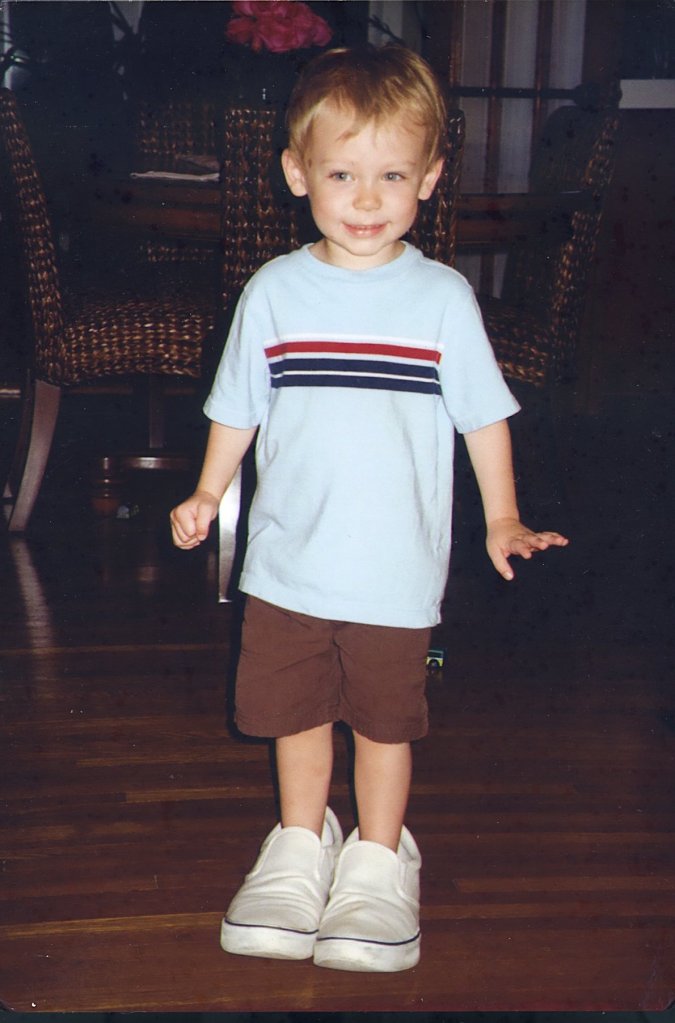
Ethan Miller, our grandson filling my shoes
My routine before going to sleep at night is to cite some of the happening of the day for which I am grateful. Often, snuggled under the covers with my head on the pillow, I become aware of the comfort that comes from the force of gravity pulling my body into the mattress—which is being pulled to the center of the earth. I read somewhere that we turn during the night so gravity can exert the right amount of pull for our organs to be reset, balanced or rejuvenated. Turns out it’s a myth. A little research into the physiology of positions during sleep indicates that the body instinctively changes position to preserve circulation, neural signaling, respiration and tissue health—while the brain performs its deep restorative processes.
In Practice
Repositioning during sleep allows the body to renegotiate its relationship with gravity, pressure and flow—so life can be sustained with minimal strain. Healthwise, positions matter, not gravity. In 2023 the NIH’s National Library of Medicine published a study showing that sleeping on the left side of our body significantly lowers acid reflux; it keeps the stomach and gastric juices lower than the esophagus, decreasing the likelihood of heartburn at night. A Sleep Foundation article agreed: sleeping on the left side promotes airway openness and reduces snoring and symptoms of sleep apnea, because the tongue and soft tissues are less likely to block the airway. And research in Healthline suggests that sleeping on the left side contributes to the brain’s waste-clearance (“glymphatic”) system. Also indicated in my search, the only benefit of sleeping on our back is alignment of the spinal column. What’s more, evidence suggests that sleeping on the stomach just strains the neck and back and compresses the abdomen. It’s not recommended.
The Science
So position more than gravity provides a health benefit. Nonetheless, I am grateful for this cosmic phenomenon, as such. So what is gravity? A review in the Stanford Encyclopedia of Philosophy says that Quantum Gravity is “a physical theory still under construction after 100 years.” It’s not a force like electromagnetism, but an effect of the curvature of spacetime caused by mass and energy. When physicists tried to apply quantum ideas to gravity, the math broke down. In summary, the review noted that “matter tells spacetime how to curve; spacetime tells matter how to move.” An article in Wikipedia elaborates, saying “gravitational waves” in particular are real, measured ripples in spacetime that are produced by accelerated massive bodies—like black holes. These waves propagate at the speed of light, but they are actually distortions of spacetime itself, not “waves of gravity force.”
Theories (Source: Wikipedia)
“String” theory” proposes that the universe is made of tiny vibrating strings rather than particles, and one such vibration corresponds to a hypothetical particle called a “graviton,” considered the quantum carrier of gravity. “Loop Quantum Gravity” (LQG) theory suggests that space and time are not continuous at the smallest scales but made of discrete “loops” that constitute “a quantized structure of spacetime itself.” While LQG is well-developed mathematically and theoretically, it has not been experimentally verified. Another theory, called “Hořava–Lifshitz” gravity, says that at very high energies (tiny scales), time and space behave differently—breaking the symmetry that Einstein assumed—in order to make gravity more mathematically manageable at quantum levels. This too, is speculative. Wikipedia concludes that gravity is the effect we see from massive objects changing the geometry of spacetime. At deeper levels, physicists believe this phenomenon must emerge from quantum principles, but they haven’t worked that out yet.
So gravity isn’t really a “pull.” It’s not like a magnet. It’s more like a bowling ball on a warped trampoline with a bunch of marbles around it: the deeper the dip created by the ball, the more the marbles roll toward it—not because there’s a force stretching across the surface of the trampoline, but because the surface is bent. Indeed, our solar system is bent.
Movement Perspective
What gravity would feel like on a planet depends on its mass and size, not just whether it’s big or small. If you were on the moon, you’d weight one-sixth of your weight on Earth. Jumping would send you six times higher, falling would be slow and graceful and walking would feel like moving through water up to your waist. (Mars has 38% less gravity than the Earth).
If the Earth were smaller but similar in density you could weigh 30-40% less than your current weight. If it were larger and denser, your body would be heavier all the time; standing would be tiring; running would be impossible; falls would result in injuries and you would labor to breathe; people would be shorter with thicker limbs, have stronger bones with compact bodies and evolution would favor strength over agility. Life would be extremely effortful.
Fortunately, the Earth sits in a narrow “Goldilocks” zone relative to the solar system. Gravity is strong enough to hold an atmosphere, support liquid water and maintain long-term geological and biological stability. Yet it’s weak enough to allow upright posture, permit endurance walking and running and enable fine motor control and large brains. Its gravity holds us, lets us move freely and shapes culture, architecture, language and imagination. By comparison, on a high-gravity planet, dancing and tall buildings would be impossible.
Human Development Perspective
The gravity we experience is a constraint. As such, it promotes physical growth: muscles strengthen, bones become strong and we develop balance. Resistance then, is necessary for physical development. Metaphorically, gravity inclines us toward what’s real in life, for instance, responsibilities, consequences, limitations and time constraints. Psychologically, it keeps us “grounded” from fantasies and ego enhancement, deepening humility and promoting critical thinking. Morally, it teaches us that actions have consequences, harm to others accumulates (i.e. wars escalate), caring and ethics matters and negative attitudes weigh things down. And gravity can teach us about true love—it commits, stays, bears weight and endures. Engineer-philosopher Buckminster Fuller famously said, “Love is evolutionary gravity.” (I was with him on two occasion when he said this).
Now, whenever I settle down and experience the force of gravity, my awareness leaps to the cosmos and a sense of the magnitude of our big “blue marble” rolling around the solar system and the Milky Way. It keeps my feet on the ground, my head on the pillow and my spirit filled with appreciation for how things are in this domain.
____________________________________-
My other sites:
David L. Smith Photography Portfolio.com
Ancient Maya Cultural Traits.com: Weekly blog featuring the traits that made this civilization unique
Spiritual Visionaries.com: Access to 81 free videos on YouTube featuring thought leaders and events of the 1980s.
 Contemplative Photography