
Are They “Individuals” or “Persons?”
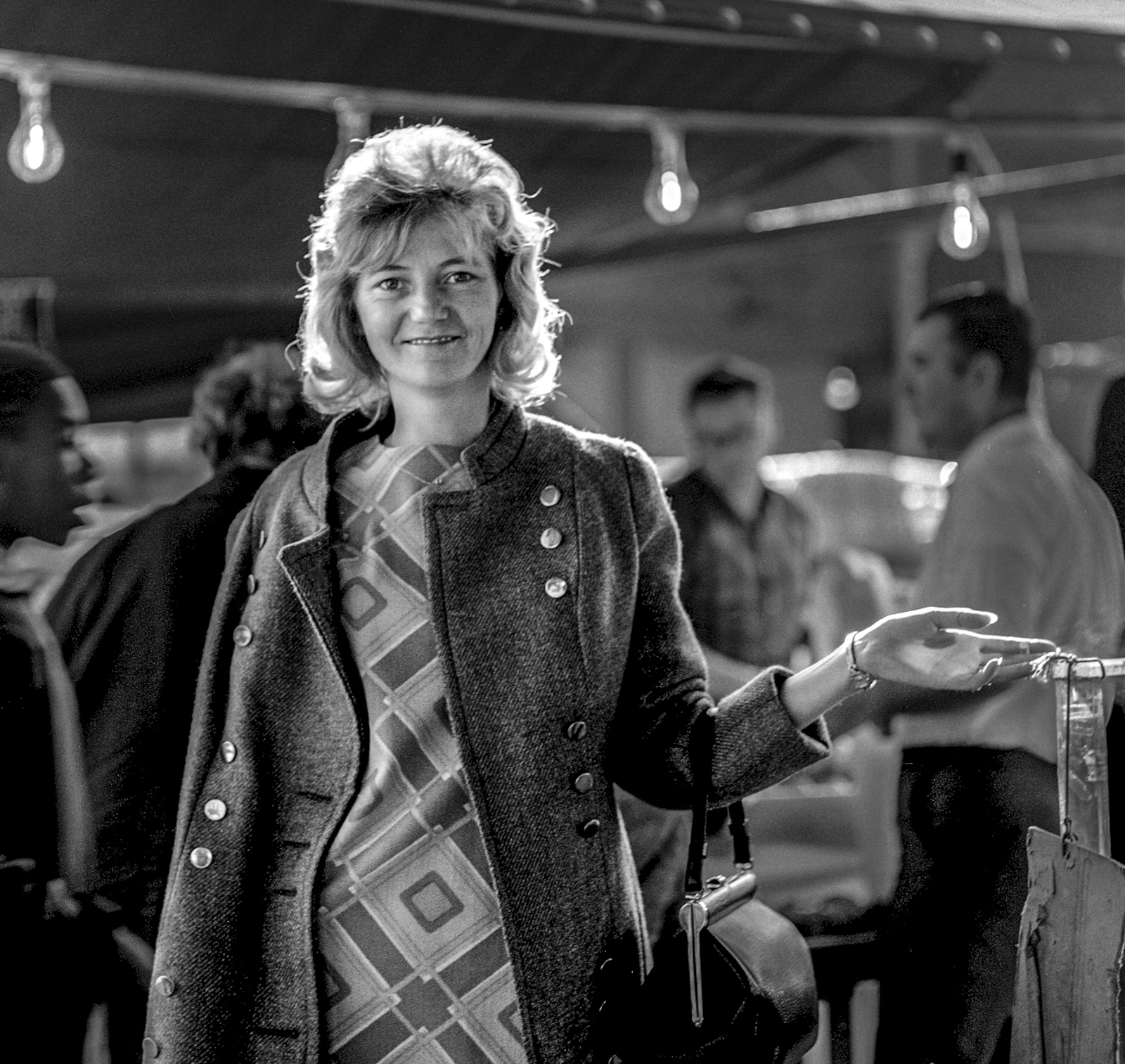
In the early 1960s I was photographing quite a lot in Cincinnati’s Findley Market downtown. This woman turned and saw that was pointing my camera at her, so she turned and posed. I took the shot, thanked her and we moved on.
After writing my post, “The Typewriter and Authenticity,” how words condition our perception of reality and how they can unite or divide us, I read Beatrice Bruteau’s sharp distinction between “Individual” and “Person” in The Grand Option: Personal Transformation and a New Creation. I think it’s significant in many ways, even having the potential to shift the current paradigm of “dominance” to “communion” at all levels.
Beatrice defines an “individual” as a self-contained unit, existing separately, competing for survival and recognition.” When asked,” Who are you?” the response would consist of one’s role, description or category having to do with their appearance or status, perhaps indicating what they are not in order to assert or protect the ego. Individuals are separate beings, identified by their descriptions, roles and unique attributes.
In contrast, a “person” is “inherently relational—a center of freedom, creativity and communion.” Beatrice says a “person is not the kind of being that can exist, or even be conceived, in singularity. We must always think persons, plural… (there’s a) transcendent, outpouring energy that indwells all other persons, so that the energy-exchange unites the many into one and forms a new being.” Gratefully, she specified several key features of this distinction.
Identity
Beatrice regards an individual as a singular instance of some description—gender, class, role, status, occupation and attributes, things like husband, black, tall, singer, smart or old. A person, on the other hand, is more than any description—properly considered a verb rather than a noun, something dynamic, relational and creative—and not reducible to roles or descriptions. She references Mahayana Buddhism, which recommends we see others as the seed of compassion and wisdom, specifying the Bodhisattva path that emphasizes the perception of others not as separate selves but as interdependent beings, each bearing the Buddha-nature.
The beginning of love is to let those we love be perfectly themselves… otherwise we do not love them, we only love the reflection of ourselves we find in them.
Thomas Merton, Trappist monk, theologian, mystic, poet
Relational status
Individuals are largely static with respect to other people. They’re external to them and separate. They’re known by comparison (“My hair’s longer than hers.”) and contrast (“He drinks wine, I’m a beer man.”). Persons relate in a deeper sense. Beatrice says they “reciprocally indwell” one another and are “capable of communion.” They enter into relationships in a way that transforms both self and other. Gabriel Marcel, a French philosopher who spoke of perceiving others as “mystery” rather than “problem,” said, “To encounter another is to participate in their being, not to analyze or reduce them.”
To love someone is not first of all to do things for them, but to reveal to them their own beauty, to say to them through our attitude: “You are beautiful. You matter.”
Jean Vanier, Canadian Catholic philosopher, theologian
Consciousness / Self-awareness
An individual may have awareness, roles, functions and attributes, but the term is more restricted, more tied to ego and separateness. A person has a more evolved consciousness, is self-reflexive, other-centered, capable of “transcendent freedom,” (original thinking) giving of self and projecting being to others. Persons are aware of being in relation to others at a deep unitive level, beyond their description and attributes. In the Hindu Vedanta tradition, seeing others as the Divine in different forms actually leads to liberation.
Activity / Becoming
An individual tends to be identified with what one already is, with what one has—roles, statuses, titles and descriptions. A person is an active center of becoming, not static but unfolding and creative, an entity that projects fuller being and growing to others. Martin Luther King Jr.
wrote of perceiving others through the lens of dignity and beloved community: “To perceive another as less is to undermine one’s own humanity.” And Pierre Teilhard de Chardin S.J. regarded others, not as static individuals, but as co-participants in the evolutionary process leading to the Omega Point (Realization in Christ consciousness).
Communion / Unity
Individuals relate to others but remain external to them. Here, the foundation of relationship is comparison, contrast and separateness. “Me and you are different.” Persons participate in communion, in a deeper sense of unity. They are plural, many together, and yet unified. “Me and you are one.” The way I think of it— a person is, together with others, a member in a divine community. A person is never alone. German theologian Dietrich Bonhoeffer stressed the seeing of Christ in the other person, not reducing them to what they do for us but perceiving them as bearers of divine presence. Picking up on this, John Chrysostom, former Archbishop of Constantinople, encouraged the perception of Christ in the poor and stranger, saying, “How you see the other is how you see Christ.”
How we see others is never neutral. It either objectifies, diminishes or dominates, or opens into reverence, responsibility, communion and compassion. Fittingly, Beatrice writes about the “contemplative eye (which) perceives others not as threats to our existence but as partners in life. Fear gives way to compassion when we realize that each person is an energy of freedom and creativity, not a rival… The fate of society depends on which lens we use. To see others as individuals alone is to live by the Domination Paradigm, where rivalry and fear rule. To see them as persons is to enter the Friendship or Communion Paradigm, where mutuality and co-creation become possible.” (Italics are mine)
Contemplation
All of this relates to a little mind game common to Vedantic practice. To the question “Who am I?” I realize that I am not anything that I “have,” “own” or “do.” These can be destroyed or taken away. For instance, I have a body, so I am not that. I have a mind and thoughts, so I am neither of those. When the possibilities are exhausted, the only thing left is simply being—the “soul” in Western traditions, the “Self” in the Eastern traditions. The statement, “I am.” is absolutely true now and forever for every soul that ever has or will incarnate. That human persons (plural) are one, has its roots in shared being. If that’s the case, the answer to the question, “Who are you to me?” at the level of personhood, becomes obvious—”You are another instance of I Am.”
In this, our endowments, possessions, appearances, differences and contrasts completely dissolve. These are acquisitions, spoken of throughout this incarnation to help us distinguish one from another as being unique. Indeed, individuals are differently endowed and we assume unique attributes—including our perception of others—to fulfill our pre-birth plan. This is the finite level of consciousness; it’s how embodied beings (individuals) experience personal and social realities. In another moment, we can affect a shift in consciousness to the infinite and see others as persons, “sons and daughters of God” (2 Corinthians 6:18). Interestingly, the word Jesus the Christ used to refer to “God” in Aramaic was Ahlaha, “Divine Unity” or “Divine Oneness.” This helps us understand the Trinity—”One God; many persons.” Not “individuals.”
Does it matter?
The way we perceive one another shapes everything from family to our global future. If we look at others through the lens of separation and competition (“rugged individualism”), we reinforce the domination paradigm that fuels division in politics, exclusion in religion, environmental degradation and competition in trade and economics. If, however, we can see with the “contemplative” eye—perceiving others as “persons” rather than “individuals”—we open the possibility of a communion paradigm: all of us together building trust, healing divisions, fostering genuine dialogue and reshaping how we use social media. The smallest shift in perception can ripple outward, influencing how we talk to one another in our homes and workplaces, how we engage across differences in public life and how we imagine our personal and common future.
In Practice
How does this work in day-to-day living? The shift from seeing ourselves as individuals, toward embracing our “relational” selves as persons—who we are because of friends, family and community—changes lives. For instance, in a conflict we’re more likely to ask, “How is this affecting our relationship?” And rather than thinking about what I want from someone, I shift into “How can we both benefit?” Whatever the context, parents who think of their children as “persons” acknowledges not only their individual achievement, but how they feel about their relationships and making them work. In the workplace, seeing colleagues as persons would create a culture that values connection, engagement and teamwork beyond individual output or accomplishment. “Winning” occurs when everyone succeeds. In social media and politics, the shift would move from “I,” “I,” “I,” and “you” to “we” conversations that emphasize belonging, community and collaboration rather than division. Strengthening the relational—”personhood”—side of ourselves can lead to more empathy, stronger social bonds, less loneliness and more cooperation. Seeing others as persons isn’t just nice. It’s mutually creative.
As far as I know—and could find—Beatrice Bruteau is the only philosopher or spiritual writer who makes the distinction between “individual” and “person.” I think it took a thinker whose central spiritual concern was the nature and importance of human relationships, because that’s where, in the current era, the “rubber meets the road.” If we’re to have a future that’s largely peaceful, one where the emphasis is on the “quality” of life beyond acquisition and survival, we have to move into “right relationship” with each other and the planet. While the spiritual path is largely a private endeavor, it is also a co-creative work of communion.
Disagreeing with each other is normal, even necessary for the evolution of human consciousness, but the narrow close minded holding tight to a belief or idea to the exclusion of other ways of thinking and seeing could destroy us. For so long, we’ve been blind to the common core of our being (the Self/soul), competing, blaming, acquiring, protecting our turf and defending our ideologies. There comes a time when the adolescent awakens to the realization that, according to Beatrice’s central message—to have life in abundance (as an adult) all we need do is give it to one another. In her words, as we encounter others we say to ourselves, “I am—may you be in abundance.” How we see one another might be the most practical step we can take toward healing each other and our world.
We are not separate, but deeply one, while remaining ourselves.
Beatrice Bruteau, contemplative, philosopher, author
Look again at the photo that heads this post. What do you see? An individual or a person?
______________________________________________________________
My other sites:
David L. Smith Photography Portfolio.com
Ancient Maya Cultural Traits.com: Weekly blog featuring the traits that made this civilization unique
Spiritual Visionaries.com: Access to 81 free videos on YouTube featuring thought leaders and events of the 1980s.
 Contemplative Photography