
Every Page a Lasting Fingerprint

Browsing at an antique fair, I was attracted to this typewriter with crooked letters, yellowed keys and options no longer used on computer keyboards (ribbon, margin release, fractions, cent-sign).
In 1575 an Italian printmaker named Francesco Rampazetto built a machine that impressed letters on paper. Centuries later, variations on his invention were huge and impractical. Then in 1868, Americans Christopher Latham Sholes, Carlos Gladden and Samuel W. Soule invented the first commercially successful, small device that everyday people could use to type words on paper. Machinist Matthias Schwalbach and E. Remington and Sons (sewing machine fame) sold the patent of his prototype machine to Densmore and Yost for $12,000. To promote and sell this machine, which typed all CAPS, they called it a “typewriter.”
In 1878 the Remington #2 a machine was marketed with commonly used letters arranged in pairs, allowing their salesmen to quickly type the word “TYPEWRITER” using just the top row. Advertisers promoted the machines as a way for women to enter the workforce as secretaries and typists. Ernest Hemingway used a typewriter for drafts, then retyped the pages more quickly. He said it helped him hear the “rhythm of the words.” And during WWII and the Cold War, intelligence agencies (FBI, CIA, NSA) identified documents by analyzing the “fingerprints” of specific typewriters—tiny quirks in alignment, ink dust and wear patterns unique to each machine.
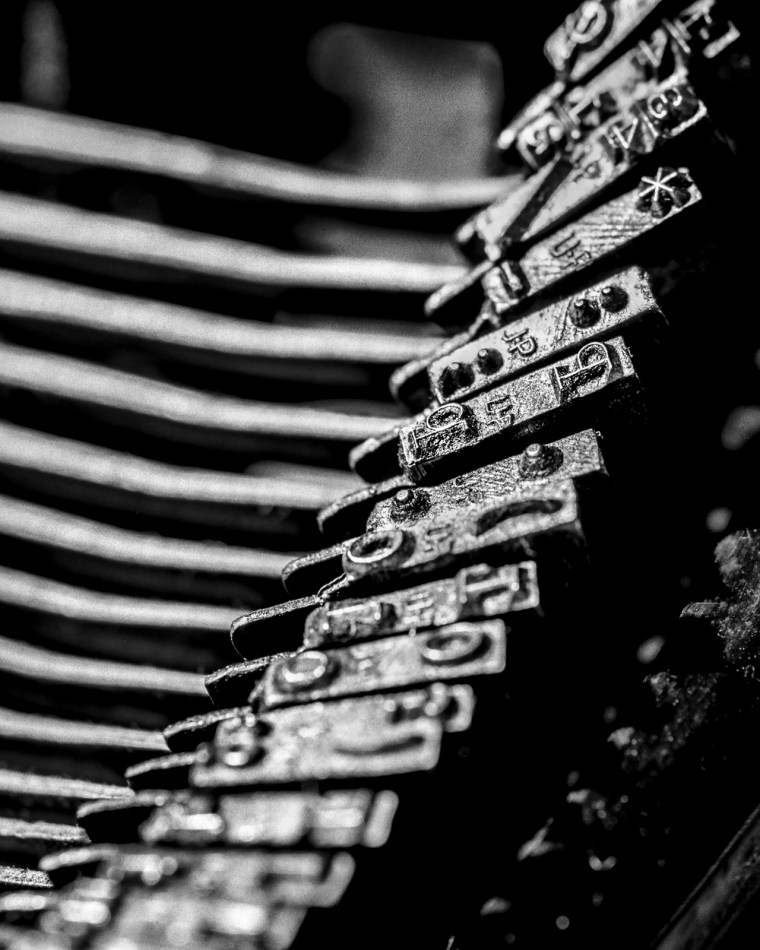
I used a mechanical typewriter until the early ’70s. Having taken a typing course in high school, I could type pretty fast. I liked punching the keys, the ding! at the end of each line and pushing the return handle. There was a sense of momentum, like a train of thoughts clicking on. What I didn’t like was ink on my fingers from changing ribbons, needing to punch the keys harder when using carbon paper between sheets to make copies and using “White Out” to make changes or correct errors. It was messy, dried crust fell into the keys and the pages looked bad on final drafts.
With a typewriter, you don’t erase, you live with your words. That permanence sharpens the thought.
Tom Hanks, actor
The Alphabet
According to Google, the English alphabet has its earliest roots in Egyptian hieroglyphs, where pictures were adapted by Semitic peoples into symbols that represented sounds. This system developed into the Phoenician alphabet, which spread widely through trade and has influenced many cultures. The Greeks adopted it and added vowels, and the Romans eventually shaped it carrying traces of its ancient origins.
Evolving Technology
Marshall McLuhan famously pronounced, “The medium is the message.” That is to say, the significance of all forms of “media” is that they extend human capacity—thought and expression in particular. The typewriter mechanized writing making it fast, uniform and widely accessible in academia, government, commerce, publishing and personal communication. In time, the keys showed up in the form of a computer keyboard, which transferred to the smartphone. And given the evolving forms of memory and processing media (silicon, quantum), direct speech could obsolete the keyboard. Futurist Barbara Marx Hubbard referred to this pattern of ephemeralization: “Our technology is helping us catch up with our consciousness… Technology is becoming less mechanistic and more bio-psycho neurological.”
Potential
The beauty of combining letters of the alphabet to give tangible form to thought, is that, unlike spontaneous speech, it requires me to slow down and consider, more accurately present what I want to say. Also, a keyboard presents a field of infinite potential. Because the letters can be combined to produce an infinite number of words and their arrangement, I’m required to “engage mind before fingers.” Typing encourages awareness: Is this accurate? Is that what I really want to say? And experimentation—writing a sentence or paragraph to see if it works. And I can easily make corrections to change the meaning, spelling or grammar.
Whatever the word-making medium, what matters is not only what we have to say and how we say it, but where it comes from—is it authentic, true to what we think deep down, believe or want to convey? Or does it originate outside us, perhaps an expectation, someone else’s opinion or belief or artificial intelligence? And tied to this, is motivation. I make these distinctions, because today the truth is under attack by politicians, foreign governments and Internet exploiters.
Words Matter
Words condition our perception of reality. They influence our emotions and guide our actions. They can heal or harm, inspire or discourage, unite or divide. It’s how we share ideas, transmit values, preserve memories and create meaning. They can clarify truth or distort it, affirm dignity or diminish it, contribute to understanding or confusion, inspire confidence or fear, empower or discourage action. Whatever the technology, the thoughts expressed enter the minds or readers, influence the culture and contribute to the “noosphere,” the subtle field of global and timeless consciousness in which all thoughts, energies and experiences are recorded. Both Western and Eastern spiritual traditions agree—from first to last breath, every thought, every word we think, speak or set down in some form is a contribution (positive and negative) to the whole, the human project. Accordingly, the species evolves in consciousness.

What lies behind us and what lies before us are tiny matters compared to what lies within us
Ralph Waldo Emerson, essayist, philosopher, poet
______________________________________________
My other sites:
David L. Smith Photography Portfolio.com
Ancient Maya Cultural Traits.com: Weekly blog featuring the traits that made this civilization unique
Spiritual Visionaries.com: Access to 81 free videos on YouTube featuring thought leaders and events of the 1980s.
 Contemplative Photography