
Chapter 1: “Abstract” and “Abstraction”

Introduction to the 13-part series
The Soul of Photography chapters provided insight and guidance about the function of the aesthetic dimensions relative to creative expression. This begins a series that elaborates those features (“atmosphere,” “contrast,” “gradation,” etc.) with an emphasis on application and technique. Also, I’ll show how the terms of these dimensions apply to the dynamics of social interaction.
The value of identifying one’s aesthetic preferences
As noted in the introduction to The Soul of Photography, by being aware of our aesthetic preferences we can more readily determine the locations, subject matter and situations where our favorites or a combination of them can be counted on to produce satisfying, often exciting, results. If these qualities are not found outside, they can be created at home or in the studio. Not knowing our preferences, we could be shooting haphazardly. That can work too, but if we want to succeed more often in creating images that work, those that feed the soul, knowing them saves time, energy and money.
The Aesthetic Dimensions in Art and Society
Chapter 1: “Abstract” and “Abstraction”

Abstract
Abstract thinking developed between 50,000 and 100,000 years ago. Anthropologists and sociologists consider it to be one of the key traits in modern human behavior, closely associated with the development of language.

It lets us plan for the future, use symbols, create and understand art, religion and science, solve complex problems and form social and moral frameworks. And importantly, it encourages us to imagine. For instance, it’s relatively easy for us to get a sense of “diverse community” in this image of diverse thumbtacks. Language itself is an abstraction, representing objects, ideas and emotions. For instance, the word “Happiness” is abstract, referencing a state of being. Even the word “community” is abstract, referencing a kind of social grouping. Fundamentally, abstract thinking expands human consciousness beyond the immediate and tangible, which is one of the benefits of making and sharing works of art.

The universe is constantly moving in the direction of higher evolutionary impulses, creativity, abstraction, and meaning.
Deepak Chopra, Indian American author
Artists and visual communicators use abstract imaging to capture and hold our attention. Subject matter that’s abstract may not be readily identified, so people linger with an image in order to understand what they are seeing—and try to understand something about the artist’s motivation. They’ll wonder: “What is this? Does it mean something, or is it just a pleasing image? What was the artist trying to convey?”

When an image is unconcerned about literal depiction, it’s regarded as “abstract.” Such images allow the artist to perceive beyond the real, create from imagination or feelings and often just to play. They hide the artist’s intent and in the process may create a bit of confusion for viewers, which is ideal for holding their attention. I’m reminded of the movie, L.A. Story where Steve Martin, confronting an abstract sculpture exclaimed, “What kinda deal is this?” 
Sometimes, the meaning of an abstract image is suggested by its title, an explanation or the artist’s statement. For example, knowing that this is a fender on a 1974 Javelin probably satisfies your curiosity.
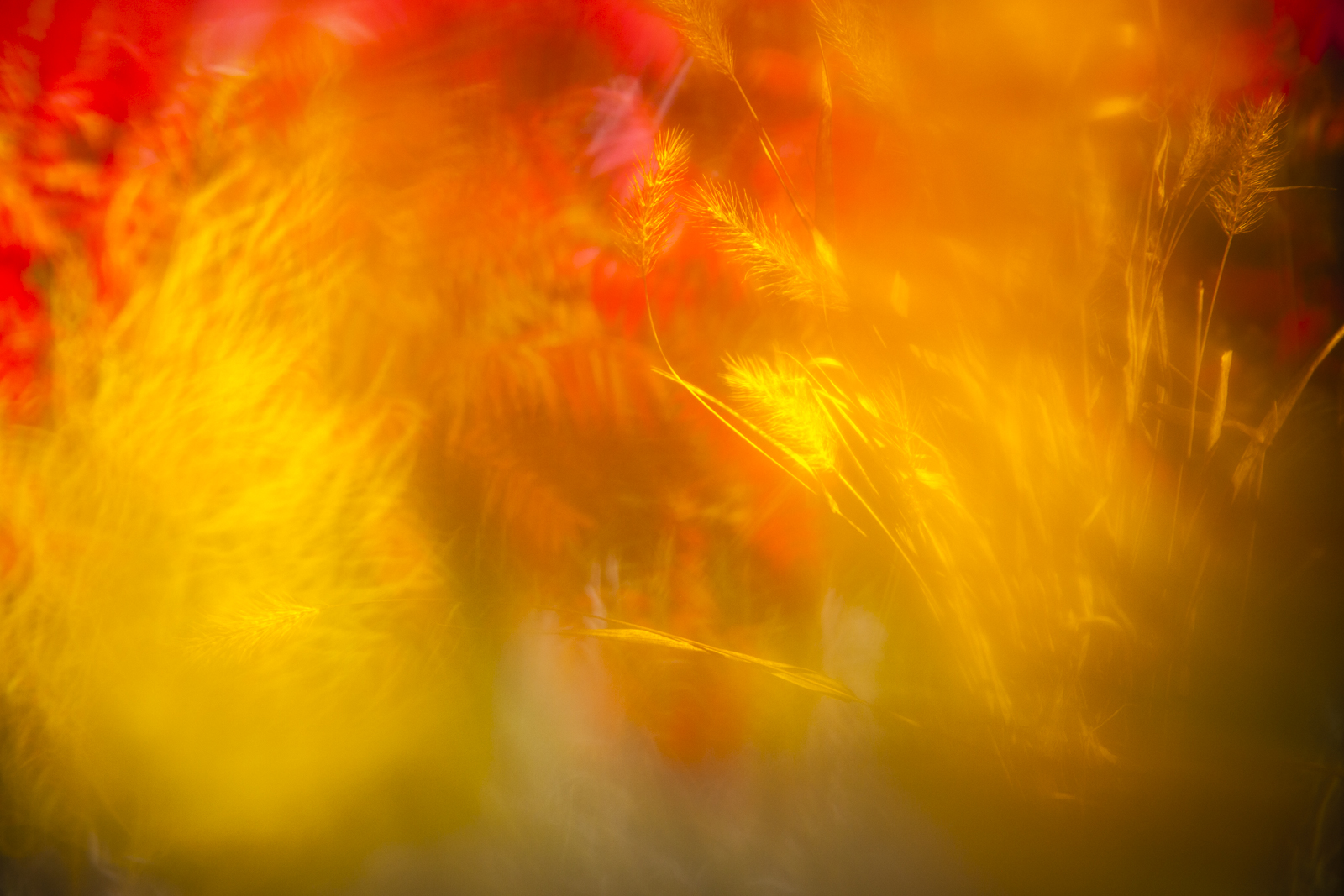
I found I could say things with colour and shapes that I couldn’t say any other way – things I had no words for.
Georgia O’Keeffe, artist
Abstraction

“Abstractions” bear some resemblance to the real world, so the subjects are more readily identified. Rather than represent reality, they incorporate elements of shape, color, line and composition to tangentially suggest the subject, allowing viewers to see with their minds as well as their eyes to determine what’s going on. Here too, typical of the inductive approach to image making, a particular image invites the viewer to make a general observation about the real world.
Like a good poem, a good abstraction attacks your feelings before your understanding. Abstraction within realism adds zest and excitement to otherwise dull subject matter.
Robert Genn, Canadian artist
Creative Application
In photography, abstraction is an excellent tool to use when the expressive intent or communication objective is to capture and hold the viewer’s attention beyond the subject’s identification. This is particularly the case when the photographer wants to challenge viewers to work a little harder to identify the subject and derive deeper meaning or significance. Because abstract and abstraction are largely a matter of minimizing easily recognizable features, they are best at expressing emotion and metaphors—and sparking philosophical discussions. They are not good at providing information.
Technique

Aside from going in close, shapes, forms and colors can readily be found in nature and in man-made objects using a closeup lens. Using image editing software, realistic photos can easily be manipulated to produce abstractions and non-referential abstract images.
Social Reflection
Psychologist Carl Jung wrote about abstract thinking, feeling, sensation and intuition. In each instance he said the process is inductive, requiring the rational-logical mind to assimilate and process particulars in order to reach a more comprehensive understanding or feeling. In whole-systems terms, it’s the relationship of parts to a whole, ordering them in ways that produce a concept, picture or sensation. Inductive process is higher order thinking, because it perceives or synthesizes a whole greater than the sum of its parts.
The same is true in social relations as an organizing principle. In Nation Formation: Towards a Theory of Abstract Community, Paul W. James argues that “A nation is an abstract community bringing together strangers who will never meet, resulting in real but abstracted and mediated relations—as opposed to personal relations.” At election time the American social climate becomes supersaturated with abstract labels such as “liberals,” “conservatives,” “nationalism,” “democracy,” “socialism.” If asked, twenty people in separate rooms would provide twenty different opinions on what these words mean.
Even the guiding principles of the United States Constitution are expressed in abstract terms—purposefully to allow for interpretation, which ensures vigorous debate in a two party system. Abstract terms such as “liberty,” “freedom,” “justice,” “welfare,” “prosperity,” are polarizing because there’s not a common understanding of their meanings. Politicians are adept at using abstract language to gain votes because they make for quick and emotional “sound bites.” Likewise, words like “civility,” “great,” “integrity” and value judgments such as “corrupt,” “out-of-control” and “fake” are never defined—and the lack of evidence suggests (erroneously) that the speaker mist have solid information.
Pay attention to minute particulars. Take care of the little ones. Generalization and abstraction are the pleas of the hypocrite, scoundrel, and knave.
William Blake, English poet and painter
Social Application
Photographers can document, critique and raise awareness about social and environmental issues by capturing images that expose hypocrisy, document protests and the effects of political decisions on their communities. Visual metaphors and symbolism can challenge or reveal hidden truths, and abstractions can increase awareness of political and environmental issues. Possible applications include the creation of themed and community-centered exhibitions, publication in issue oriented magazines, collaboration with investigative reporters across media platforms, posting images and commentary on social media and offering images to support activists, NGOs and grassroot movements.
One of the principal tenets of whole systems science says, “The whole organizes the parts.” The overall system dictates how its components behave, rather than the parts independently determining the system’s properties. For instance, the needs of the human body dictate how each organ and the cells within them function; a kidney cell in a heart couldn’t perform according to its design; companies organize their employees by assigning roles and defining objectives. On a broader scale, democracies manage their citizens, departments, corporations and other organizations through constitutions, laws, cultural norms, political structures and shared values.

The purpose of abstraction is not to be vague, but to create a new semantic level in which one can be absolutely precise.
Edsger Dijkstra, Dutch computer scientist, software engineer, scientist
__________________________________________________________________________________________
My other sites:
Substack: Poetry and insights relating to creation and Creator
David L. Smith Photography Portfolio.com
Ancient Maya Cultural Traits.com: Weekly blog featuring the traits that made this civilization unique
 Contemplative Photography