
The primacy of consciousness
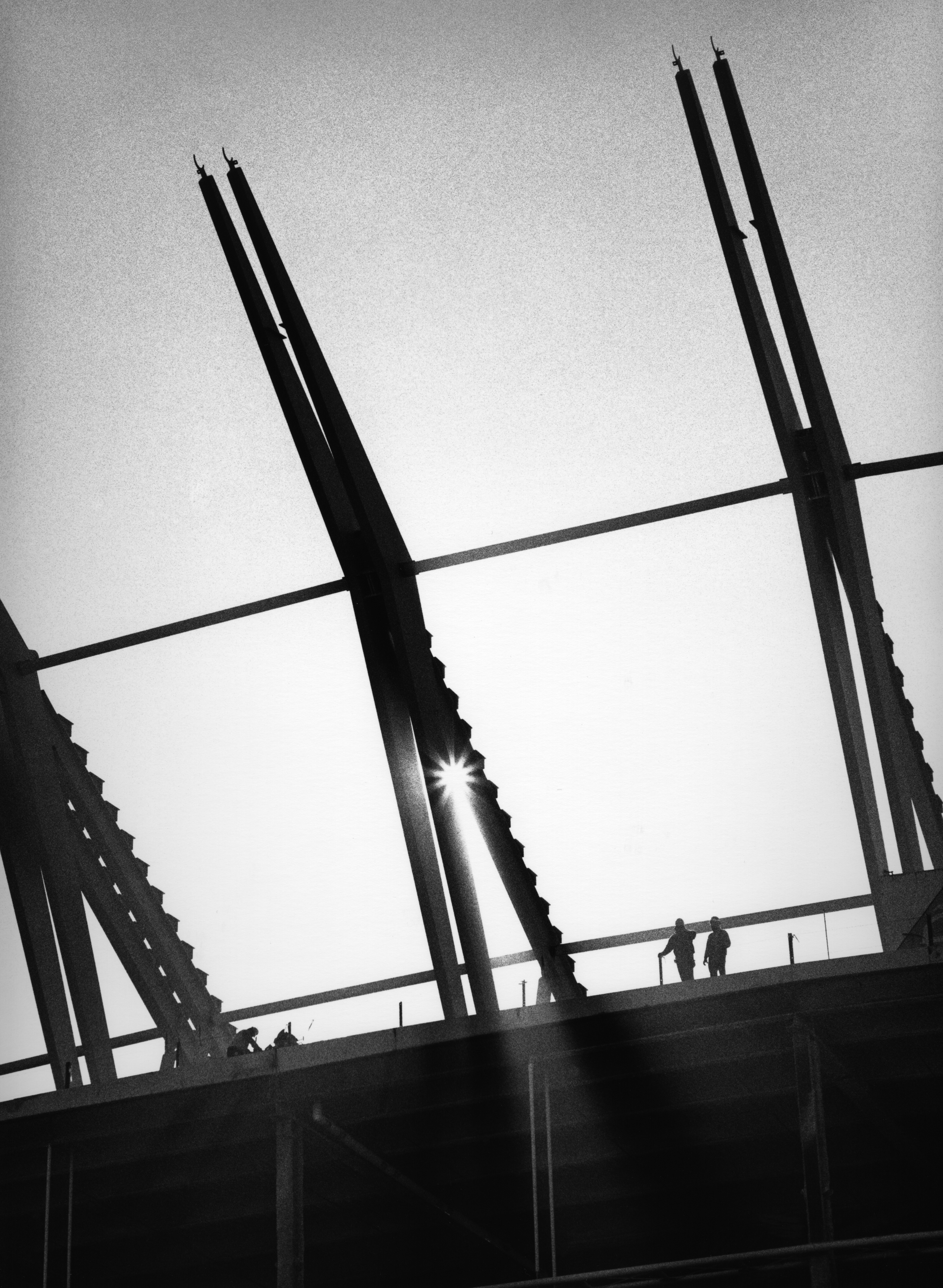
The relationship between the workers seen here and their towering creation took me to that place of amazement over what and how fast we can build. Prior to these steel structures being set in place, beams that would eventually support the bleacher seats in a football stadium, there were innumerable people involved—those with the vision and desire: geologists, engineers, architects, attorneys, politicians, bankers, investors and city planners. I think of the tonnage of paper documents, the multiple terabytes of information and images, the specification and sourcing of raw materials, contracts and the scheduling of contractors, all needing to be coordinated before the golden shovels could even break ground.
Consistently, I’m puzzled by how so few men can erect such enormous structures involving so many parts and heavy materials in such a short amount of time. How do they know where to move the dirt? I see conduits and all manner of PVC pipes sticking out of the mud without any indication where the walls will go—a testament to precise planning and measurement. How do builders determine structural stresses in advance? And how do they manage every aspect of the process so the structure will be plumb and sound? Another wonder is how supervisors manage to maintain teamwork, keeping multiple contractors on the same page, coordinating their activities in proper order? It seems to me that the building trades have arrived at, or are quickly moving toward, the realization that moviemakers enjoy, that whatever can be imagined can be built.
Pondering the notion of vision and realization, I think of the causal relationship between mind and matter, thought and form. I think about some of the great engineering feats: the Giza pyramids, the Great Wall of China, Teotihuacan in Mexico, the Panama Canal, the Manhattan Project, the Apollo missions, the Palm Islands in Dubai, the International Space Station. They all began with a vision to honor the gods, solve a problem, end a war, explore the cosmos, build a nation or fill a need like the U.S. Interstate Highway system.
It’s easy to look back and celebrate that the human mind has accomplished great things. Looking forward, however, is the vision of what’s possible reason enough to create it? Just because we can envision a weapon, drug or deadly virus, should we produce it? As technologies advance, the ethical questions compound exponentially. Excitement over discoveries can overshadow the consideration of ethical consequences.
We create what we can imagine, in part because it’s a challenge. Can it be done? If we build it, will they come? Looking around my room I can’t identify even one object that was not first a thought or influenced by thought. Look out your window. Is there anything there that was not first a thought or influenced by thought? The only thing that comes to mind for me are clouds. Not the garden. Not the trees that were planted, moved or modified in some way. Not even the rain drops that left acid stains on my car. Wait. Not the clouds either. In addition to water vapor, they’re composed of a myriad of man-made compounds, aerosols and particulate matter, all the residue of thought-produced products and processes.
Is there anything anywhere on the planet that was not first a thought or influenced by thought? What about insects, birds and animals? Consider how human beings have influenced their evolution, migrations and the foods they eat. The moon bears our imprint, as does the bottom of the ocean. Might the deep ice at the poles, magma and the worms growing around oceanic hydrothermal vents be exceptions? What about the planet itself? The solar system? The Milky Way galaxy? Everything emerges from thought, even thinking about thought. If not from the human mind, the mind of the Creator.
I personally believe that consciousness does indeed permeate the universe, that the universe proceeds intelligently in its evolution and must therefore be conscious… Consciousness is inherent in every level of the universal holarchy by logical argument.
Elisabet Sahtouris, Evolutionary biologist
___________________________________
My other sites—
Love And Light greetings.com: A twice-weekly blog featuring wisdom quotes and perspectives in science and spirituality intended to inspire and empower
David L. Smith Photography Portfolio.com: Black and white and color photography
Ancient Maya Cultural Traits.com: Weekly blog featuring the traits that made this civilization unique
 Contemplative Photography