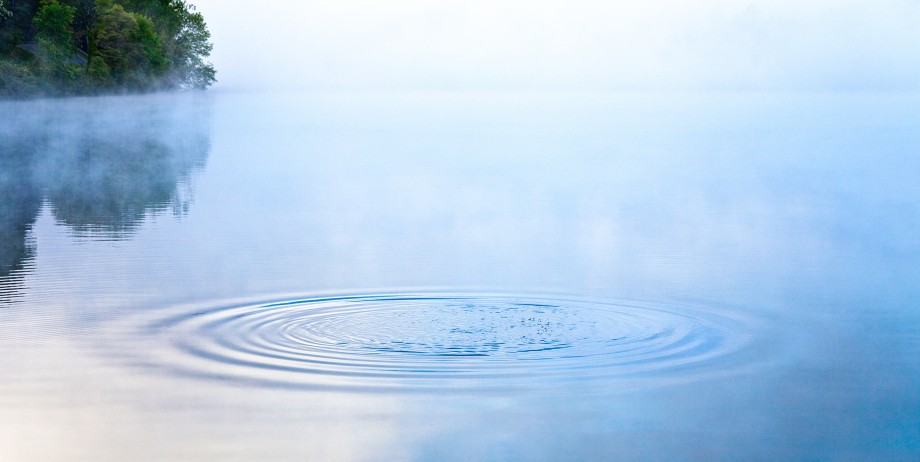
Making the slightest contact, separate masses tend to “pull” to one another

Reflecting upon these raindrops, I’m drawn more to their journey than to my usual inclination to trace subject matter back to its origins—perhaps because the first appearance of water on Earth has not yet been ascertained. Water known however, that gravity keeps it contained. None of it escapes into space. According to the United States Geological Survey: “If the total amount of water vapor fell as precipitation all at once, the Earth would be covered with only about one inch of water.” But “If all the world’s water was poured on the contiguous United States, it would cover the land to a depth of about 107 miles.”
Considering this image, each of these drops and droplets began to take shape as invisible molecules of water vapor high in the atmosphere by attaching themselves to a nearly invisible dust particle. As more and more water molecules attached—coalesced—and their weight increased, gravity pulled them down, through the atmosphere, causing even more coalescence. When a gazillions of these infant droplets grouped together, attracted by their electrical charges, their size increased to form a cloud where more attraction and more coalescence resulted in a drop that literally, well, dropped. Coalescence continues even when a drop splatters and runs.
The drops in this image didn’t land on the leaf and line up this way. Their sizes and alignments are a product of their travels, conditioned by the physical forces and electrical fields they encountered along the way. And the continue to change state, evaporating back into the atmosphere. In the liquid state, drops of water assume a rounded shape because a sphere requires the least amount of energy to form and has the least possible area for the volume it encloses. That makes it the most economical, energy-efficient way of enclosing and separating two volumes of space—water and surface. Aside from the physics, I love the aesthetics—how the drops are transparent and reflect the sky. Earth and sky integrated as one.
Another feature that comes to mind when contemplating this image is the water cycle, the change of state itself: liquid—vapor—solid (ice). It’s a perfect metaphor for transformation because water is constantly changing. Like the universe and all it contains, there’s a continuous rising and falling, birth and death, breathing in and breathing out. Lub dub, lub dub. Drip. Drip.
In preparing this post, I was delighted to find Ken Wilber’s quote in my database. It beautifully conveys the transcendent perspective of coalescence, connecting being with perception. Having enjoyed a career as a visual communicator, I appreciate the significance of perception and the opportunity to expand it. We become more by seeing—ourselves, humanity, environment, God—as more. Indeed, looking deeply into everyday objects and processes generates appreciation. And that can take us to the place where we are the sun, the rain and the earth.
You in the very immediateness of your present awareness, are in fact the entire world, in all its frost and fever, in all its glories and its grace, in all its triumphs and its tears. You do not see the sun, you are the sun; you do not hear the rain, you are the rain; you do not feel the earth, you are the earth.
Ken Wilber
____________________________________________
My other sites:
Love And Light greetings.com: A twice-weekly blog featuring wisdom quotes and perspectives in science and spirituality intended to inspire and empower
David L. Smith Photography Portfolio.com: Black and white and color photography
Ancient Maya Cultural Traits.com: Weekly blog featuring the traits that made this civilization unique
 Contemplative Photography