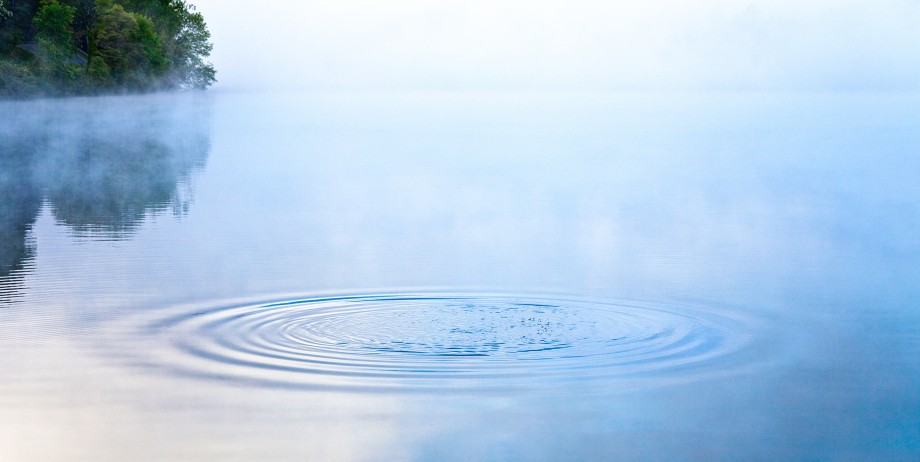
Through coherence, parts unite to form whole systems

For me, part of the appeal of this image is that it at once evokes the sensibility of living cells and astronomical bodies—the “innerverse” viewed under a microscope and the universe viewed through a telescope.
At both extremes we observe diverse parts that join together to make a whole, and we see the parts in relation to one another as well as the whole. My curiosity extends to both extremes, but lately my thoughts have been directed to the dynamics of biological systems, and these images prompted some observations that suggested a coincidence between the microscopic and the social.
In The Extended Phenotype published in 1982, British biologist Richard Dawkins introduced the idea that the effects of an animal’s genes or “phenotype” can stretch far into the environment. In 2016, science writer Ed Yong, writing in I Contain Multitudes: The Microbes Within Us and a Grander View of Life, gives examples of this noting that “…beaver genes build beaver bodies, but since those bodies go on to make dams, the genes are also redirecting the flow of rivers. A bird’s genes create a bird, but they also make a nest. My genes made my eyes, hands, and brain, and in doing so they also made this book.” This is an example of a whole being greater than the sum of its parts.
So while an animal’s genotype determines the physical characteristics of its offspring, it’s phenotype extends those traits into an “expression” or manifestation that has an affect on the environment. The good news I learned in my Physical Anthropology class is that, although specific genes are inherited, because human beings make considered choices, we can alter their expression, our phenotype—that which shows up.
One’s genetic endowment or genotype, therefore, is largely a predisposition rather than a sentence. And, because it’s the living organism as a whole that contributes (or not) to the next generation, what we do and how we live effects the genes we pass on. And considering that whole, what’s astounding is that each of us is composed of trillions and trillions of cells, each a living being making its own decisions, performing over 100,000 tasks per second! (Biologist Catherine Clinton in a HeartMath interview. And yet we consider our bodies a singularity.
We have to tread lightly in extrapolating from biology to sociology, but in reading about the relationships between microbes, their animal hosts and ecosystems, I can’t help but think there are some lessons to be learned about how we relate as groups. Aside from our cells, in order to be healthy and grow to reproduce, the diverse billions of individual microbes that live inside us are constantly considering: Is this new or unrecognizable incoming entity a suitable dance partner or not? What would be the consequences of our engagement? Is this good for me and the whole in which a play a role? Or not?”
There’s a lot of feeding, moving around and carrying on of conversations, mostly about the neighbors and the neighborhood. The net result of this relating, both in conflict and in harmony, results in the development of communities of like-minded entities, internal “ecosystems” that constitute a survival strategy that has worked since life first appeared on the planet. And rarely, if ever, do we give it a thought.
Socially, might it be that the pressure to engage with people different from us is nature’s way of bringing us together—through conflict as well as harmony within nested ecosystems—to form a new whole entity? Might our physical, mental and emotional urges and preferences constitute the phenotype of the global body? Our collective expression? Considering the consequences of our elections, that would be a resounding “Yes!” And by extension, might our species be developing a global brain? Since it’s founding and because, in part, of its diversity—which is an essential evolutionary ingredient—the United States of America has served as a crucible for the mingling of burning desires and differing beliefs, values and perspectives.
Microbiology informs us that the clash of values, ideas and preferences has been going on between microbes and cells for eons. It may not be comfortable and we might wish it to be otherwise, but just as the microbes inside us engage in energy and information sharing and decision-making that ultimately sustains our bodies, so also we struggle as groups to express our beliefs, values and perspectives so that one day we will open our eyes and realize that, through the union of commonly shared perceptions, values and objectives we have constructed a singularity of purpose and intention that works for everyone.
The dynamic goings-on between the microscopic creatures that populate our bodies suggests to me that, within the crucible the “refinements” that are happening now, though they may be painful, are part of an evolutionary process that requires us to live our best, most authentic lives and keep an open mind when interacting with others. Evolutionary survival value for whole systems is not in being right but in discovering truth and the best way forward for all. We Americans put the Constitution above powerful individuals and groups because, despite our differences, it’s the means by which we create coherence. It’s the operating system that allows us to function as a whole.
From atoms to galaxies, the evolutionary pattern is of diverse parts increasing in complexity and then uniting to form higher level systems. It’s a fundamental cosmic phenomenon that, at the human level, encourages patience and appreciation for the way things are.
Evolution by natural selection depends on just three things: individuals must vary; those variations must be heritable; and those variations must have the potential to affect their fitness—that is, their ability to survive and reproduce. Variation, inheritance, fitness: if all three boxes are ticked, the engine of evolution whirrs into action, pumping out generations that are successively better adapted to their environment.
Edmund Soon-Weng Yong, British-American science journalist
__________________________________
My other sites—
Love And Light greetings.com: A twice-weekly blog featuring wisdom quotes and perspectives in science and spirituality intended to inspire and empower
David L. Smith Photography Portfolio.com: Black and white and color photography
Ancient Maya Cultural Traits.com: Weekly blog featuring the traits that made this civilization unique
 Contemplative Photography