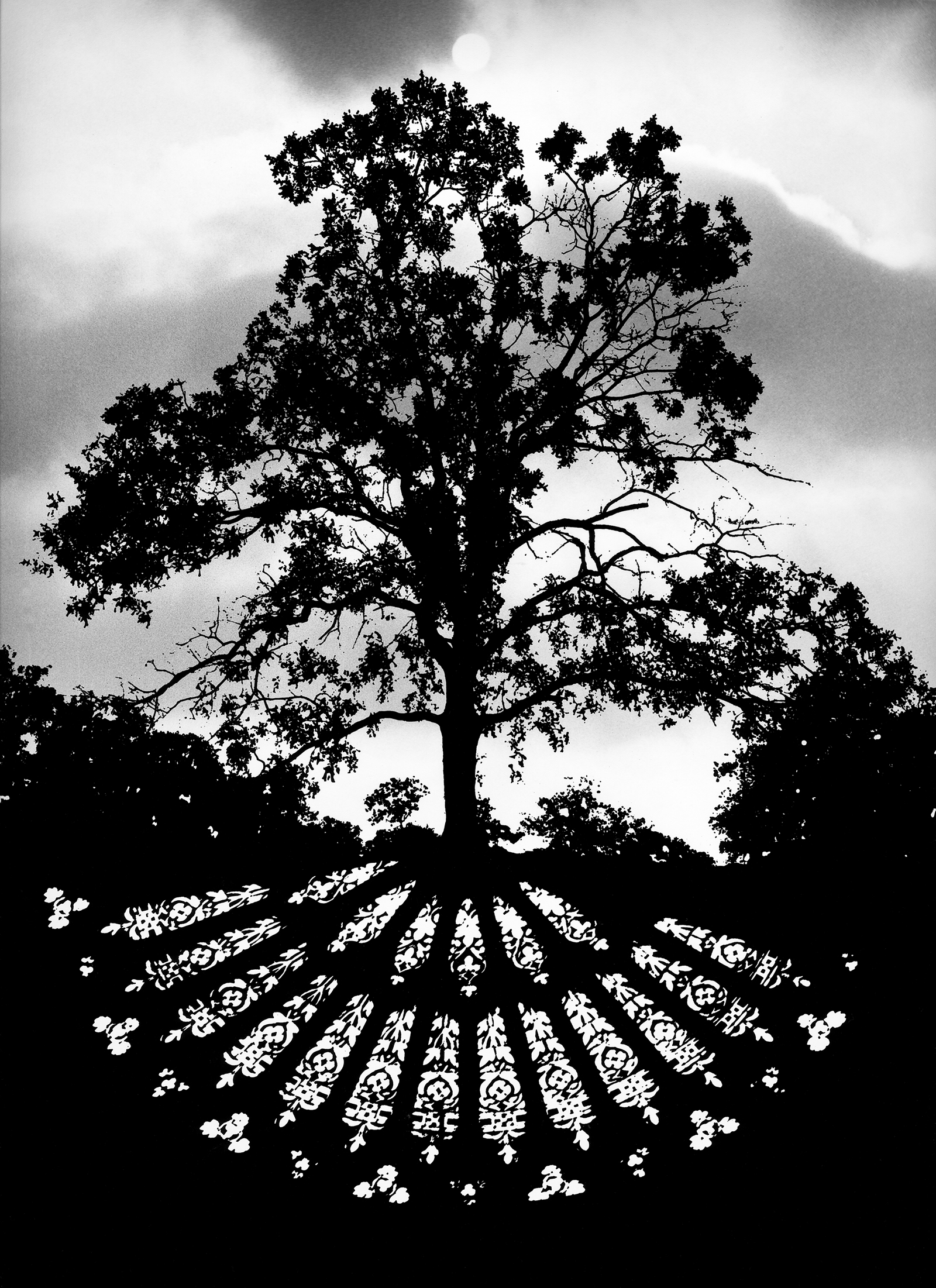
This image resulted from inspiration I received many years ago after seeing the work of Jerry Uelsmann, a master of the multiple printing technique. His work caught my attention because he was a graduate of R.I.T.. Although the word inspiration derives from inspiratio, which is Latin for “divine guidance,” a modern dictionary renders it a “process of being mentally stimulated to do or feel something, especially to do something creative.”
While I understand the secular orientation of this definition, I believe that Spirit or universal consciousness is fundamental to the process, with the brain serving as a “tuner,” able to access vibrations (stimulations) emanating from that Source according to interest or desire. In this instance I wanted to see if I could make a print from multiple negatives that would produce an interesting photograph. Starting out I had no idea what might work. Although it has been many years since I made this photograph, I remember the urge and the process as if it occurred yesterday.
A recent interview on Buddha At The Gas Pump between the host, Rick Archer and Marianne Williamson, prompted me to consider this theme because their conversation was inspirational. She not only put the current political crisis into global perspective, she called those of us with a spiritual orientation to task, pointing the way through and strongly urging us to get involved in the political process.
A friend once told me that he only gives money to the people and organizations that inspired him. That appeals to me because it directly supports the expression of our values. Mental health professionals recommend that we distance ourselves from people who, as a pattern, diminish our spirit, and maintain or seek relationships that lift us up. Linda and I keep this in mind in our media selections. We want the media to feed the spirit, not diminish it. On the subject of “guidance,” one our teachers at RIT famously said—
No matter how slow the film, Spirit always stands still long enough for the photographer it has chosen.
Minor White, Photographer, educator
After a lifetime of making photographs, I understand what he was saying. Indeed, I often have the feeling of being guided, that the spirit of a subject or object in front of the camera is “calling” to me. Looking back over my body of work and seeing that it does what I’d hoped it would—express my love of God and the world—it’s easy to see how my choices of technology, locations, subject matter, materials, printing and processing techniques were guided. This is especially the case in the images I consider numinous, the experience of a spiritual force. Guided by what or whom? I don’t know for sure, but I think we’re all guided by spirit, especially in matters we deem important for our life’s journey.
For instance, consider one of the major gifts you were born with, one that led to the development of your most passionate interest or occupation. You can probably pinpoint the moment or event that created a “spark,” the urge to learn more about what you experienced. Immediately, doors started to open. As your interest grew, the “right” people showed up at just the right time to give you a boost. Problems got solved. Books, ideas and resources became available. And synchronicities happened. An example of the road rising up to meet my feet, was when I was 29. An elderly gentleman, Jack J. Smith Jr., to whom I had sold top-of-the-line darkroom equipment four years prior, sold it back to me for one dollar.
“Expressive” photography operates under the principle of attraction or affinity. Because like attracts like, when looking for subject matter, there’s something within the photographer that recognizes a connection when he sees it. Be it subtle or pronounced, there’s an “attraction,” a recognition, a pull of sorts, that urges exploration. In those instances, there’s the potential for an expressive photograph. Whenever I feel the attraction to something, I know guidance is urging me to pay attention. The message is: There’s something here, so work with it.
It is by long obedience and hard work that the artist comes to unforced spontaneity and consummate mastery. Knowing that he can never create anything on his own account, out of the top layers, so to speak, of his personal consciousness, he submits obediently to the workings of ‘inspiration’; and knowing that the medium in which he works has its own self-nature, which must not be ignored or violently overridden, he makes himself its patient servant and, in this way, achieves perfect freedom of expression.
Aldous Huxley, English writer and philosopher
ABOUT THIS IMAGE
Title: Celestial Roots
I randomly pulled out negatives that had clear or nearly clear backgrounds, and set them on a light table. By laying them on top of one another, I was able to see some possibilities. The negative of the stained glass window was especially conducive to multiple printing because of its high contrast. Using it as sort of a “master,” I kept superimposing the window over other negatives until I found one that worked—the tree. The sky behind the tree was overcast, so to remove it I made a copy by sandwiching it with a sheet of high contrast Kodalith film and exposing it under glass to keep it flat. From that positive, I made another copy onto Kodalith film, and that resulted in a negative that I could put in the enlarger.
With an ordinary piece of paper in the easel under the enlarger, I drew a rough outline, first of the tree and then the window. Using that to align the easel that would hold the photo paper under two different enlargers, I made several trial exposures, and along the way added the moon from another negative. Metaphorically the composite evokes the tree of life or World Tree with its roots in the divine.
Celestial Roots has been exhibited in a variety of venues,. It was made into a gold plaque as a prestigous award for a nonprofit organization. And I’m especially honored that my daughter and her husband chose it as the visual theme for their wedding.
 Contemplative Photography