
An art style that sheds light on the value of choice
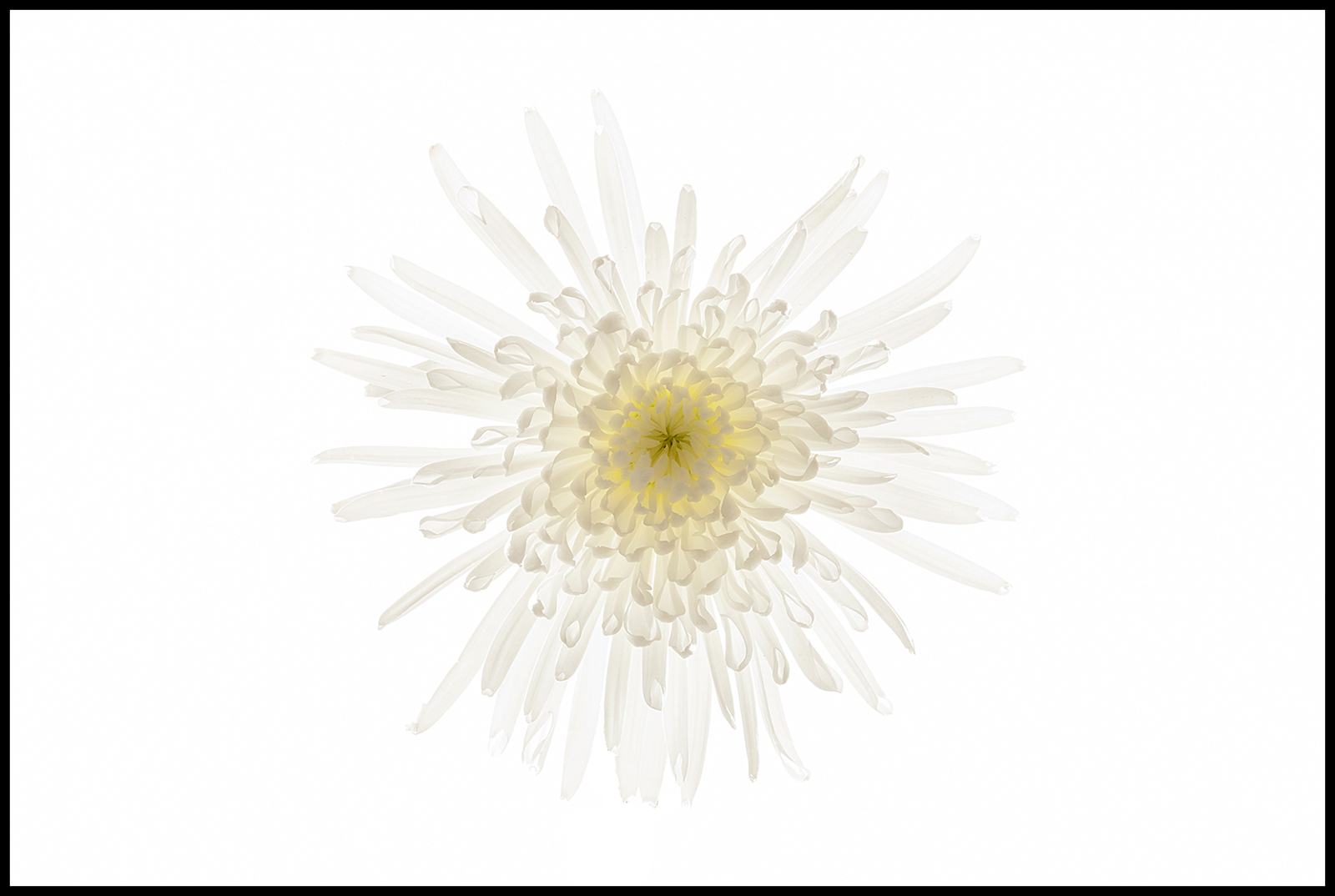
In a dream, I walked around an art gallery where all the large black and white photographs were made in “high key”—white subjects on white backgrounds with some grey values but no blacks. Attempting to achieve this with film was challenging because it required special lighting, exposure, processing and printing techniques. Also, it was not easy to find white subject matter, and evenly light a white background. Upon awakening from the dream—and loving the images I’d seen—I realized that I would have greater control by using digital technology. The above image is one of the results.
Fueled by the memory of the photographs I saw in the dream; I made some attempts at producing some high key images and the results were quite nice. Working with the above image to prepare it for printing, I realized that the high key technique contains some important parallels with respect to everyday living—most notably, as the song in Monty Python and the Holy Grail advises, “Always look on the bright side of life!”
To achieve a high key result—in an image and in everyday living—the subject matter needs to be white or bright. In everyday living we confront sights and sounds that alternate between the dualities of light and shadow personality expressions, aspects of our human nature. Our exposure to positive and negative perceptions and judgments is so commonplace and persistent it doesn’t seem like we have a choice. But we do.
With some resolve and mental discipline, we can choose to move more in the direction of selecting positive, empowering and uplifting perceptions, behaviors and experiences—the psychological equivalent of white subject matter in photography. High key imagery often affects a shift toward heightened aesthetic appreciation, even a Wow! —by displaying a brighter than normal representation of the subject. Just so, a more positive perception of others and the world can list the spirit. One way or another, our developing view of the world will guide us further into the light. Or not.
To produce a high key effect in a photograph, it’s not enough to have a white subject. It also needs to be situated on or within a predominantly white background that is or can be rendered at least as bright, ideally more so, than the subject. This accounts for high key photography being mostly done in a studio. Socially, we find these backgrounds—environments—in the company of other people. We even speak of people in the terms of their “key”—she “brightens my day,” or on the contrary, “he brings me down.”
Of course, within all of us there’s the potential for light and darkness. Embodiment presents the soul with dual realities—up/down, pain/pleasure, hot/cold, attraction/repulsion—ensuring that we learn, and karma gets fulfilled. The trick while attending the University of Planet Earth is to favor environments and people that celebrate and bring out the light that we are, usually in the form of speech and behavior.
How and where do we find these? Increased illumination or lightening occurs wherever we experience the energies of love, resonance, empowerment, connection and joy. After an encounter with a person or group, do I feel uplifted, encouraged or inspired, feeling better about myself and the world? Or the opposite? Low-key experiences feed the darkness. And of course, there’s a full spectrum of environments and expressions between the extremes.
The final component needed for a high key photograph is control of the exposure. A white vase sitting on white paper will be rendered gray, unless the exposure is adjusted as well—away from “normal,” in the direction of overexposure. Photographically, this lightens the black and shadow areas. In life, frequent or prolonged exposure to the light of higher consciousness, increased awareness and spirituality is achieved either through grace (discussed in a previous posting), or choice—spiritual reading, self-inquiry, prayer, meditation and being with people whose light shines brightly. Through these and other uplifting experiences, the dark and gray values in life gradually become lifted into the higher tonal range.
As noted at the outset, the production of a high key effect is challenging. But the simple act of taking note of the darks and grays can be illuminating. The more light we shed on the dark side through introspection or intuition, the more we move toward the light of truth, freedom and contribution.
High key photographs stand out because the effect is rarely seen in nature or everyday living. It’s a clean look, the word “simplicity” comes to mind. The words “high key” can easily evoke a sense of high octane excitement, but the creation and maintenance of a high key lifestyle—lightness in mind, associations and being—requires movement in the other direction, toward simplicity.
There are two ways of spreading light: to be the candle or the mirror that reflects it.
Edith Wharton, American writer and designer, first woman to win the Pulitzer Prize in Fiction, for her novel The Age of Innocence.
__________________________
 Contemplative Photography