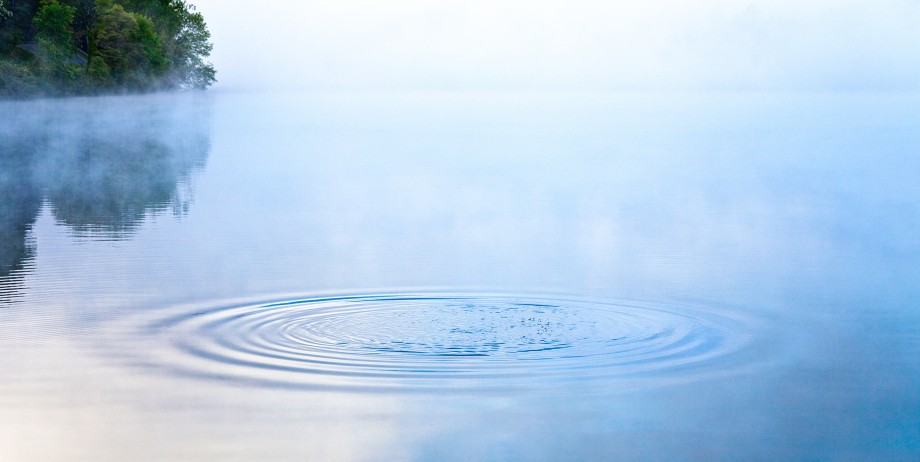
It’s not “out there.” It’s in us.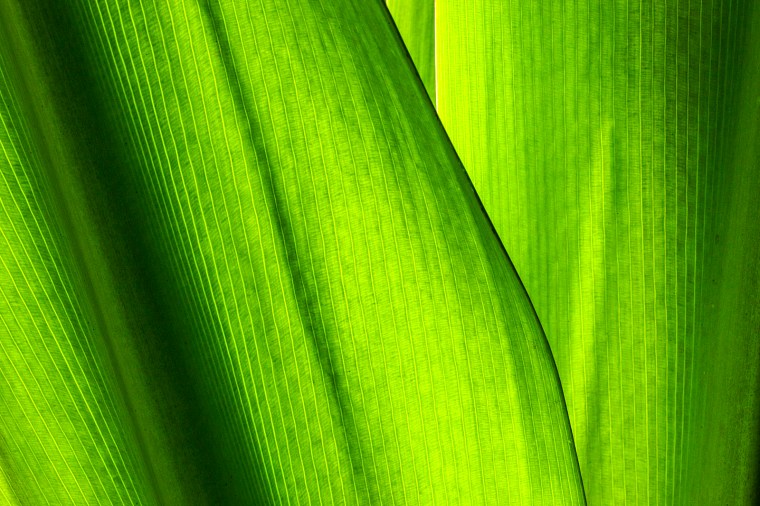
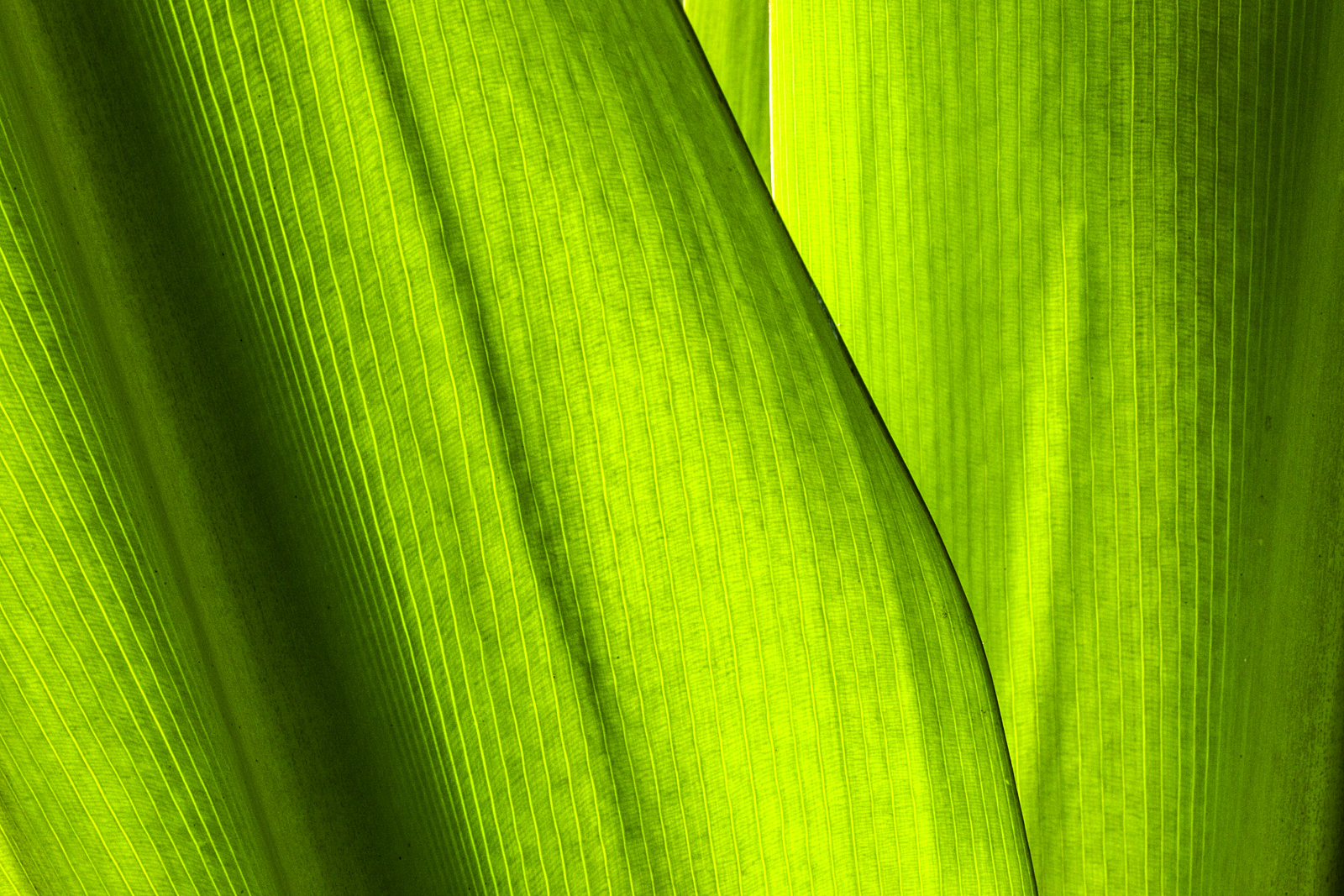
The above color and form evoke in me a sense of calm, and at the same time a feeling of strength and vibrancy, of life rising up—life both simple and complex. The cells are like pixels, individual packets of information, each unique with a life and mind of its own, contributing to the maintenance and growth of the organism.
All living systems consist of holons, whole systems composed of living sub-systems. In the human body there are an estimated 30 trillion non-human cells, each of which makes split-second decisions about its functional relationship with its neighboring cells and neurons. Red blood cells live for about four months; white blood cells live on average more than a year; skin cells live about two to three weeks; colon cells die after about four days.
In keeping with my propensity to trace subject matter back to its origins, I see in these leaves the genetic inheritance of structure and color—a system that maximizes surface area for the absorption of light coming from above (the sun) with vertical channels that, like rivers, deliver nutrients from the soil below—a perfectly integrated living system.
Plants are “green” because of photosynthesis, their ability to absorb sunlight and convert it into energy for growth. The key ingredient is mostly chlorophyll, a pigment molecule that absorbs “blue” and “red” frequencies, allowing green to be reflected. That’s the gist of the scientific explanation. Objectively however, there is no color in the world or in the brain. It’s the interpreting faculty of the mind—consciousness—that gives all light its apparent color. When signals sent from the eyes to the brain report the absence of blue and red spectral frequencies the brain says in effect, “Considering that red, green and blue are the primary colors of the spectrum, if it’s not blue and red, it must be green!” And of course, that happens continuously at the speed of thought.
Nonetheless, the experience of a particular color can generate meaning and trigger emotions that we share. For instance, “green” is associated with positive feelings. NIH’s National Library of Medicine cites the results of studies on the positive effects of green as it occurs in nature. “Green natural environments generated therapeutic and positive effects, such as fostering recovery from surgery (Ulrich, 1984) and subjective well-being (Kaplan, 2001; van den Berg et al., 2003). Studies focused on exercise under controlled laboratory environments also revealed that perceiving green enhanced positive affective and cognitive outcomes (e.g., enjoyment, self-esteem, motivation) and diminished negative ones (e.g., mood disturbance, anxiety) (e.g., Akers et al., 2012; Barton et al., 2012; Briki et al., 2015; Briki and Hue, 2016).”
We tend to relax when we’re experiencing or even observing nature, which is mostly green. As reported in a 2019 National Geographic article, the Japanese initiated a physiological and psychological exercise called shinrin-yoku (“forest bathing” or “taking in the forest atmosphere”) as an “eco-antidote to tech-boom burnout and to inspire residents to reconnect with and protect the country’s forests.” My appreciation of green is further enhanced considering that without plant life, animal and human life would never have evolved—at least not on a watery planet and in the forms we know today.
In one of my novels of the ancient Maya— Jaguar Sun: The Journey of an Ancient Maya Storyteller—the protagonist wonders why trees and plants are green. Since red is the color of blood and blood is the source of life according to his view of the world, shouldn’t the forests and plants be red rather than green? That makes sense. But fifteen hundred years later we understand that neither blue nor red has the capacity to photosynthesize, to absorb sunlight and reduce CO2 into sugars or other biological reactions necessary to sustain plant life.
I want you to understand that there are no colors in the real world. There are no textures in the real world. There are no fragrances in the real world. There is no beauty. There is no ugliness. Nothing of the sort. Out there is a chaos of energy soup and energy fields. Literally. We take all that and somewhere inside ourselves we create a world. Somewhere inside ourselves it all happens. The journey of our life.
Sir John Eccles, Noble Prize-winning neurophysiologist
______________________________
 Contemplative Photography